

The Wife and The Mistress, or, The Italian Spy. A Domestic Tale from the Milanese: Containing Matrimonial Infelicity, Intriguing Countess, Fascinating Marchioness, and Her Green and Silver Ridicule, with Many Other Particulars of A Noble and Well Known Family in the Last Century
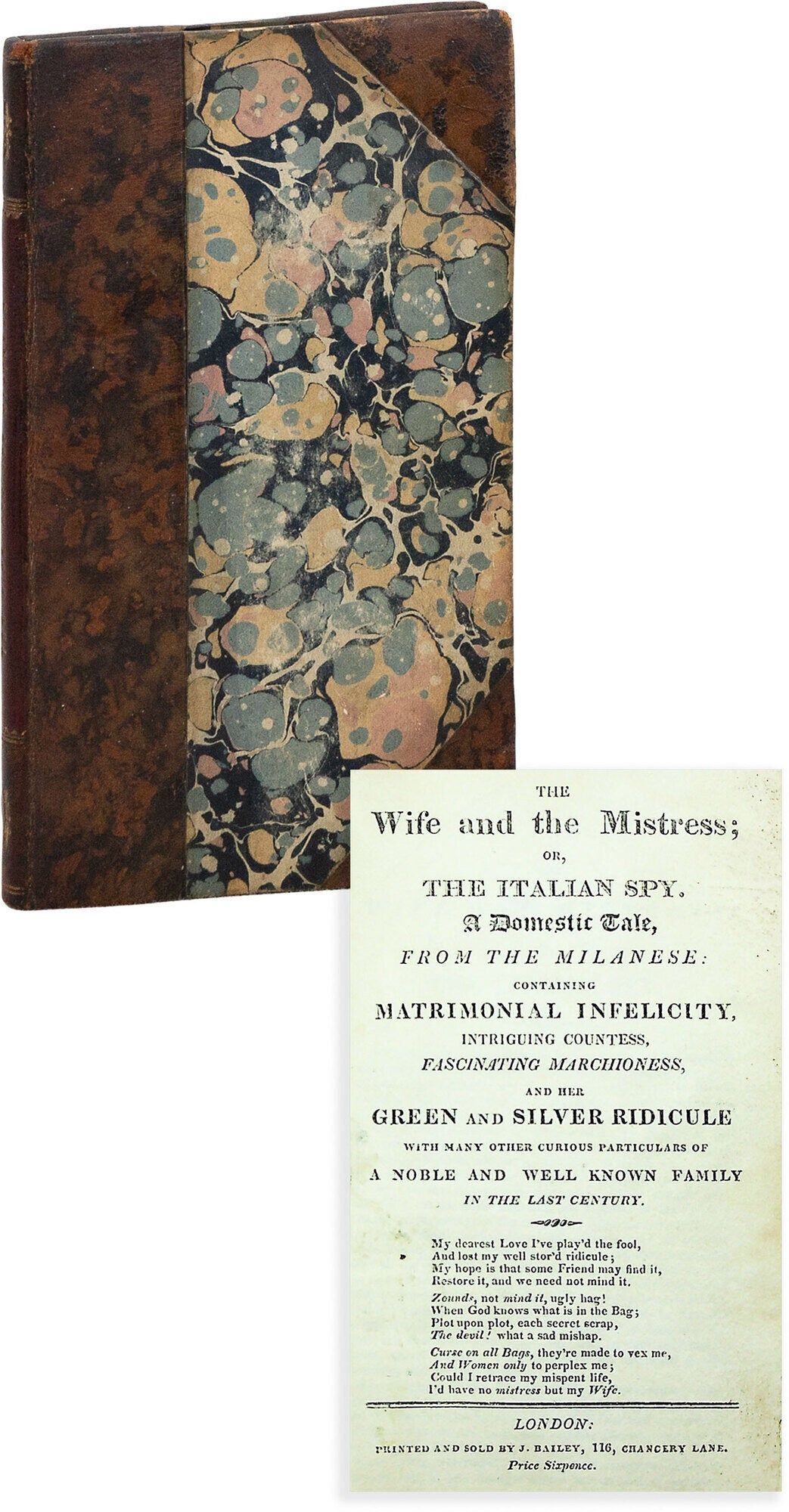
- London: J. Bailey, 116 Chancery Lane, [1820]
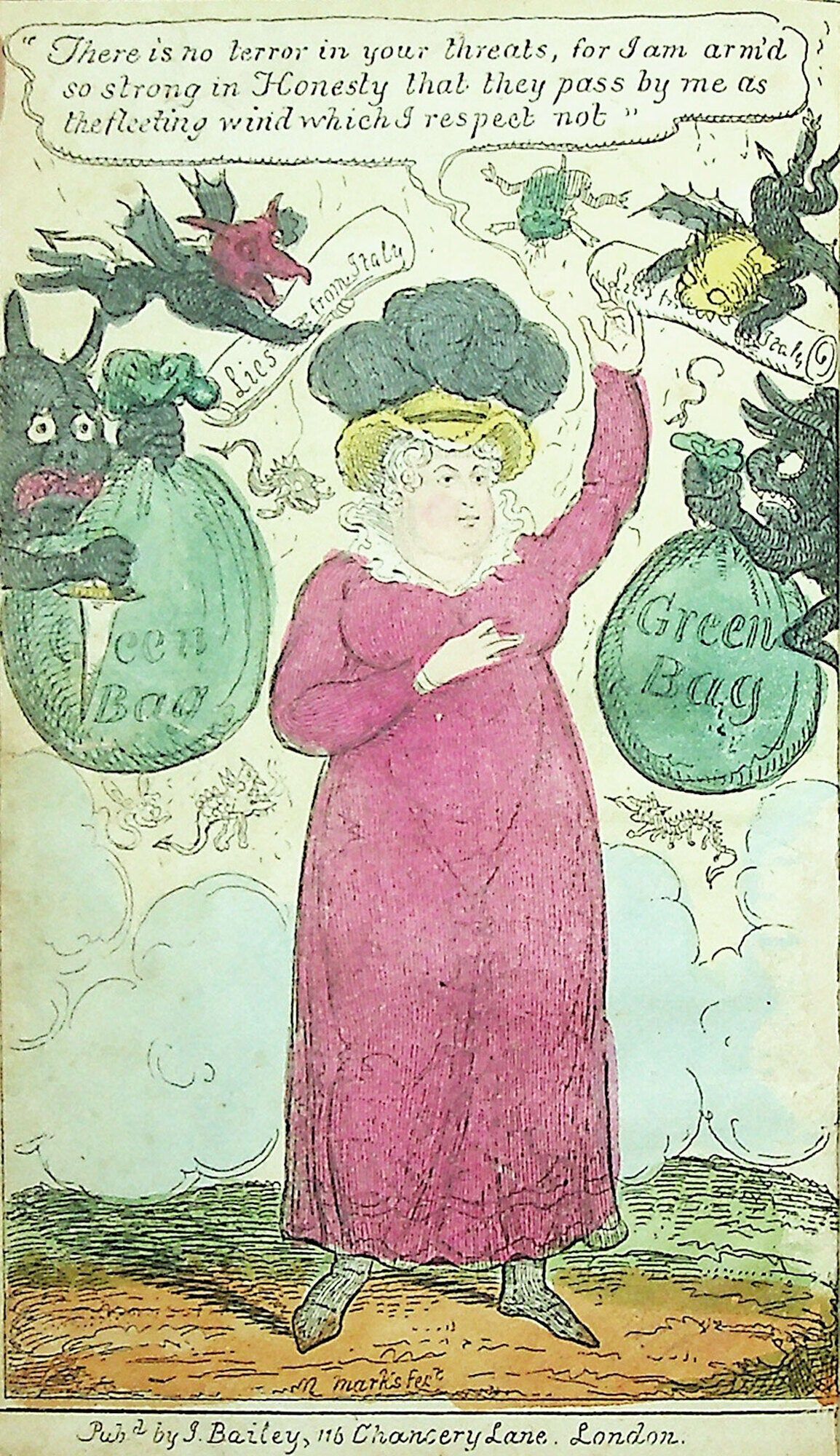
London: J. Bailey, 116 Chancery Lane, [1820]. First Edition. Slim Twelvemo. 18cm. Late 19th century half mottled calf over marbled paper covered boards by Bayntun of Bath, with a red title label to the spine titled in gilt, very much in the style of an older binding. 24pp. [with 24pp binder's blanks to rear, to stabilize the binding]. Light scuffing to corners and spine ends, darkening to spine label and a little dulling of the gilt, strong, tight, and handsome; internally clean, all edges gilt, marbled endpapers, later ex libris to front pastedown with traces showing removal of an older one visible beneath, hand colored frontispiece illustration with later tissue guard and a small archival tissue repair to a small tear on the fore-edge, offsetting of the color, and some light soiling to title page (the work would originally have been issued as a chapbook in paper wraps). A very good, attractive copy of an obscure piece of early 19th century pop culture.
John Bailey was one of those highly-energetic, and slightly scurrilous printer-publishers of the early 1800's, running alongside Stockdale, Dugdale, Duncombe and the like in a frenetic race to recognise the current zeitgeist and mine it for pamphlets, chapbooks and on occasional multi-volume exposés until the vein ran out and they moved on to the next thing. It could be the sporting Fancy, the murky doings of the Ton, memoirs of ladies of negotiable virtue, the scandalous habits of the French, or the diabolical behavior of home grown rakes; if it could be illustrated with a lurid cut and sold to popular acclaim, but no legal outcry, then it was prime for publication.
This is an indicative offering; a tale of a lady maligned, a wandering-handed husband, and some untrustworthy foreign types (Italians in this case, portrayed as being of a nation of bandits), promoting the popular and rather thrilling idea that nobody really knows what the aristocracy gets up to, but slim little volumes like this can give you a fair idea. Unusually studded with relatively competent verse commentary, and enough arch detail for the suggestive reader to wonder whether it is entirely fictional.
It isn't, in case you were wondering; it forms part of the Caroline Scandal blizzard of pamphlets and cartoons directed at the indiscretions and marital strife of Caroline of Brunswick, the oft estranged wife of King George IV. George despised his wife, even after the birth of their daughter, and Queen Caroline retired to Italy where her chief advisor and confidante was a gentleman named Bartolomeo Pergami - in short order Caroline and Pergami were rumored to be lovers, accusations of adultery and possible treason flew in all directions, and a legal deadlock began with both parties, George and Caroline (whose middle name was of course, Amelia) denying infidelity whilst pointing the finger at each other. The "Green Ridicule" is a reference to the bags presented at the reading of the bill intended to grant the King a divorce; large green sacks of "evidence" collected by the Milanese authorities, much of which was rather hilarious and involved a lot of innkeepers and coachmen testifying to having seen Pergami in flagrante whilst within 20 feet of the noble lady. The resulting legal wrangling and backstabbing had the opposite effect from the one desired by George, and rendered Caroline something of a public and political heroine, misused by her abusive husband and adopted by reformist political figures seeking to gain ground on an increasingly eccentric and damaging monarchy.
The tone of the tale is therefore rather sympathetic to Lady Amelia, in keeping with public sentiment. It is also stated to hopefully be the first part of a series of exposures of the travails of "Lady Amelia", and her somewhat ungallant spouse which suggests it was rushed out mid-trial and may have had subsequent installments as the proceedings continued through 1820. The title itself is possibly a riff on Mary Charlton's work; she published a substantial and popular work with a similar title a few years earlier. Scarce, and a little obscure, with three holdings in US institutions.
John Bailey was one of those highly-energetic, and slightly scurrilous printer-publishers of the early 1800's, running alongside Stockdale, Dugdale, Duncombe and the like in a frenetic race to recognise the current zeitgeist and mine it for pamphlets, chapbooks and on occasional multi-volume exposés until the vein ran out and they moved on to the next thing. It could be the sporting Fancy, the murky doings of the Ton, memoirs of ladies of negotiable virtue, the scandalous habits of the French, or the diabolical behavior of home grown rakes; if it could be illustrated with a lurid cut and sold to popular acclaim, but no legal outcry, then it was prime for publication.
This is an indicative offering; a tale of a lady maligned, a wandering-handed husband, and some untrustworthy foreign types (Italians in this case, portrayed as being of a nation of bandits), promoting the popular and rather thrilling idea that nobody really knows what the aristocracy gets up to, but slim little volumes like this can give you a fair idea. Unusually studded with relatively competent verse commentary, and enough arch detail for the suggestive reader to wonder whether it is entirely fictional.
It isn't, in case you were wondering; it forms part of the Caroline Scandal blizzard of pamphlets and cartoons directed at the indiscretions and marital strife of Caroline of Brunswick, the oft estranged wife of King George IV. George despised his wife, even after the birth of their daughter, and Queen Caroline retired to Italy where her chief advisor and confidante was a gentleman named Bartolomeo Pergami - in short order Caroline and Pergami were rumored to be lovers, accusations of adultery and possible treason flew in all directions, and a legal deadlock began with both parties, George and Caroline (whose middle name was of course, Amelia) denying infidelity whilst pointing the finger at each other. The "Green Ridicule" is a reference to the bags presented at the reading of the bill intended to grant the King a divorce; large green sacks of "evidence" collected by the Milanese authorities, much of which was rather hilarious and involved a lot of innkeepers and coachmen testifying to having seen Pergami in flagrante whilst within 20 feet of the noble lady. The resulting legal wrangling and backstabbing had the opposite effect from the one desired by George, and rendered Caroline something of a public and political heroine, misused by her abusive husband and adopted by reformist political figures seeking to gain ground on an increasingly eccentric and damaging monarchy.
The tone of the tale is therefore rather sympathetic to Lady Amelia, in keeping with public sentiment. It is also stated to hopefully be the first part of a series of exposures of the travails of "Lady Amelia", and her somewhat ungallant spouse which suggests it was rushed out mid-trial and may have had subsequent installments as the proceedings continued through 1820. The title itself is possibly a riff on Mary Charlton's work; she published a substantial and popular work with a similar title a few years earlier. Scarce, and a little obscure, with three holdings in US institutions.
Details
Title
The Wife and The Mistress, or, The Italian Spy. A Domestic Tale from the Milanese: Containing Matrimonial Infelicity, Intriguing Countess, Fascinating Marchioness, and Her Green and Silver Ridicule, with Many Other Particulars of A Noble and Well Known Family in the Last Century
Author
[ANON]
Condition
Unknown
Publisher
J. Bailey, 116 Chancery Lane: London
Date
[1820]
Edition
First Edition