

Declaration of the Causes Which Impel the State of Texas to Secede from the Federal Union -- Also the Ordinance of Secession [caption title]
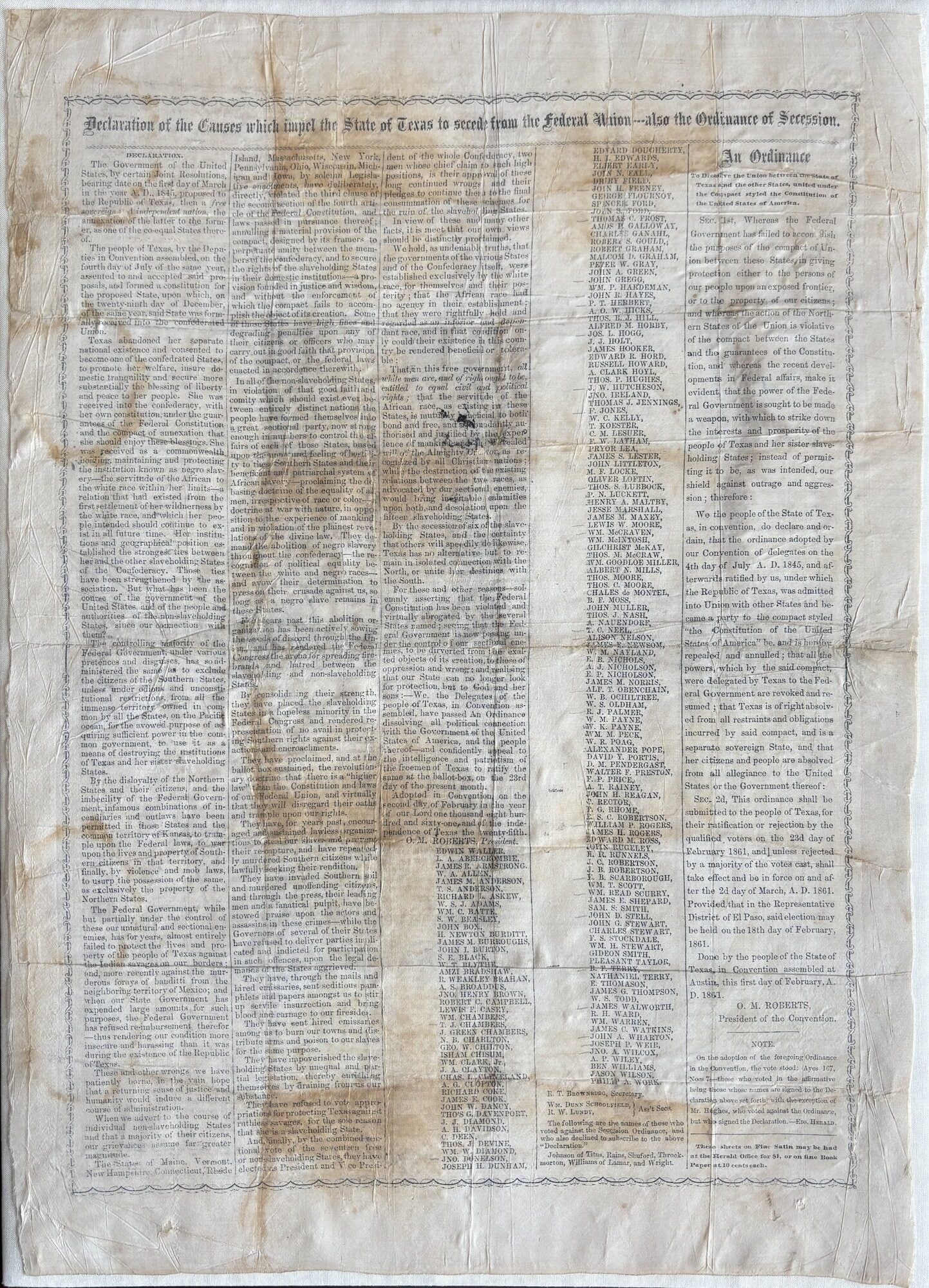
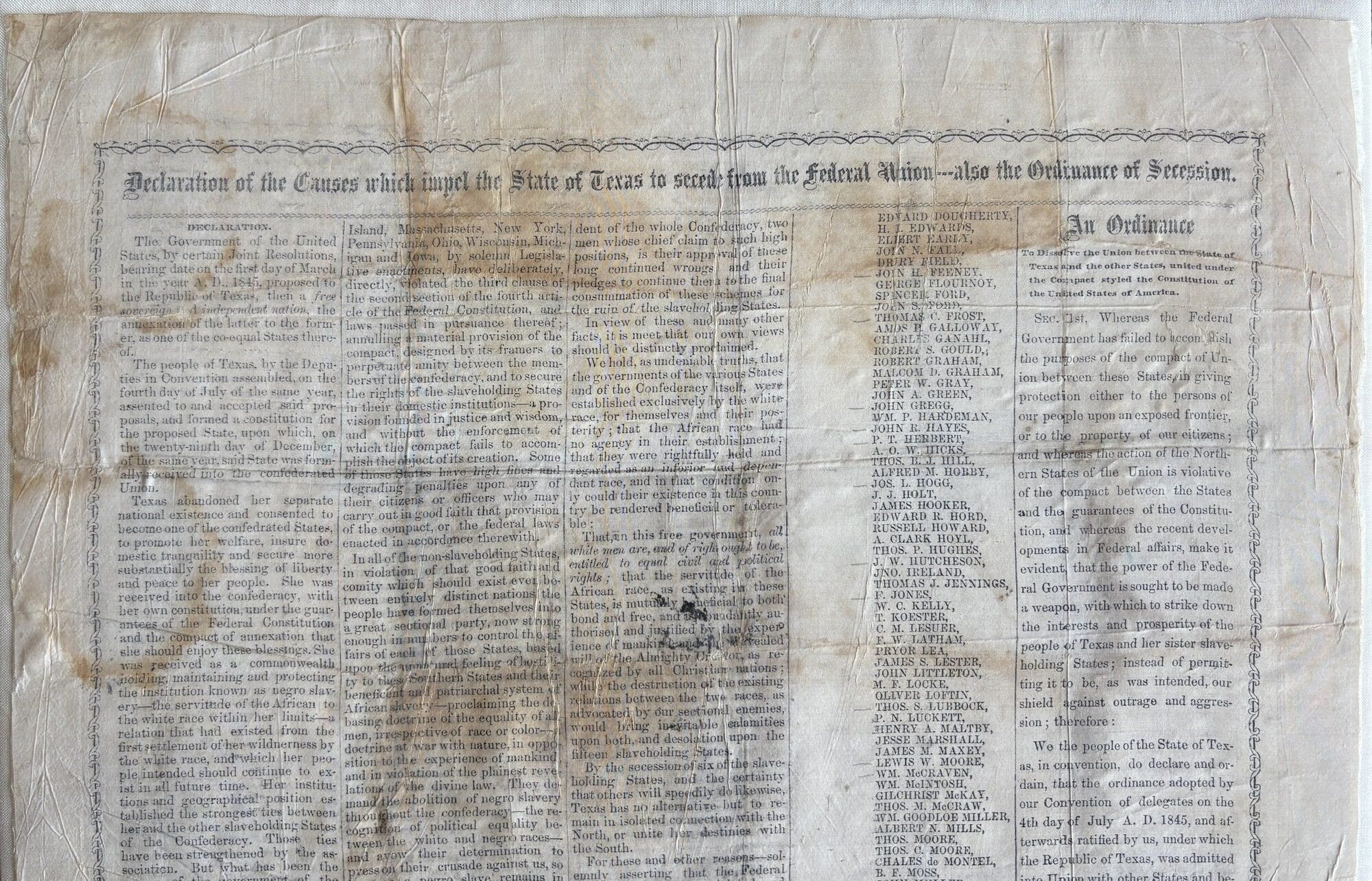
- [San Antonio]: February 2, 1861
[San Antonio]: February 2, 1861. Good.. Broadside on silk, 19.5 x 14 inches. Expertly cleaned and restored. Previously folded, with some creasing still visible. Moderate staining and a few small holes and separations aided by conservation. Scattered contemporary manuscript notations. An exceptionally rare Texas secession broadside, executed on silk satin in San Antonio in 1861. Printed in five columns with an ornamental border, the broadside features both the Ordinance of Secession and the Declaration of Causes, two of the three principal documents drafted by the Texas Secession Convention, along with a list of delegates. According to the colophon, "These sheets on Fine Satin may be had at the Herald Office for $1, or on fine Book Paper at 10 cents each." The present broadside belonged to Cyrus Halbert Randolph (1817-1889), who was the Texas State Treasurer at the time of secession. Randolph arrived in Texas in March 1838 and quickly became established as an attorney and politician. A member of the Snively Expedition in 1843, he served in several political roles in Houston County, including justice of the peace (1840), chief justice of the county (circa 1843), and sheriff (1847). He also represented the county in the Texas Legislature in two terms between November 1851 and November 1857. Randolph was elected state treasurer 1859, and won re-election in 1860. Notably, small pencil notations are next to the names of several delegates in the list, perhaps associates of Randolph. Other known copies have connections to delegates, and it seems likely that the sheets printed "on Fine Satin" were ideal souvenirs for prominent Texas politicians.
After South Carolina's secession in December 1860, Texas was not far behind in joining them. The Constitutional Convention was organized on February 1, 1861, and voted overwhelmingly in favor of secession. The ordinance was ratified by popular vote on February 23rd. The document begins with the Declaration of Causes, a fiery assertion of Texas's rights, which highlights her unique history as an independent country and leaves no doubt as to the core issue at stake: "Texas abandoned her separate national existence and consented to become one of the Confederated States to promote her welfare, insure domestic tranquility and secure more substantially the blessings of peace and liberty to her people. … She was received as a commonwealth holding, maintaining and protecting the institution known as negro slavery -- the servitude of the African to the white race within her limits -- a relation that had existed from the first settlement of her wilderness by the white race, and which her people intended should exist in all future time. Her institutions and geographical position established the strongest ties between her and other slave-holding States of the confederacy. Those ties have been strengthened by association. But what has been the course of the government of the United States, and of the people and authorities of the non-slave-holding States, since our connection with them?"
Continuing in scathing language, the authors accuse the North of interfering directly as they "encouraged and sustained lawless organizations to steal our slaves;" "invaded Southern soil and murdered reoffending citizens;" "sent seditious pamphlets and papers among us to stir up servile insurrection and bring blood and carnage to our fireside;" "sent hired emissaries among us to burn our towns and distribute arms and poison to our slaves;" and, "finally, by the combined sectional vote of the seventeen free or non-slave-holding States, they have elected as President and Vice President of the whole Confederacy, two men whose chief claims to such high positions, is their approval of these long continued wrongs, and their pledges to continue them to the final consummation of these schemes for the ruin of the slaveholding States."
What follows is a list of the 168 delegates ending with Philip A. Work, distinguishing this copy as a first edition. Noted bibliographer and Texas historian Everett C. Wilkie, Jr. made a detailed study of the Texas secession documents in The 1861 Printings of the Ordinance of Secession (Dallas, 2011), and identifies three separate editions of the broadside, essentially differentiated by the list of delegates. The first edition (Wilkie 23) was almost certainly printed in February 1861 and ends the delegate list with Philip A. Work. The later editions (Wilkie 24 & 25) were printed in early and mid-March, respectively, with additional delegates added to the list. The present edition is also the only one to include six lines naming the delegates who voted against secession.
Printed in the right-hand column is the Ordinance of Secession, stating the Texas is once again "a separate sovereign state." The preamble encapsulates the grievances of the state, "Whereas the action of the Northern States of the Union is violative of the compact between the States and the guarantees of the Constitution, and whereas the recent developments in Federal affairs make it evident that the power of the Federal Government is sought to be made a weapon with which to strike down the interests and prosperity of the people of Texas and her sister slave-holding states; instead of permitting it to be, as was intended, our shield against outrage and aggression; therefore...."
Parrish & Willingham note three institutional copies: University of North Carolina, University of Texas, and Baylor University. The Baylor, copy, however, is actually a 7-page pamphlet edition (Parrish & Willingham 4150). The UNC and Texas are therefore the only other known copies of the first edition. A unique opportunity to acquire one of the most significant broadsides in Texas history, in the first edition and on silk.
Crandall 2153. Parrish & Willingham 4151. Wilkie 23. Winkler & Friend 171.
After South Carolina's secession in December 1860, Texas was not far behind in joining them. The Constitutional Convention was organized on February 1, 1861, and voted overwhelmingly in favor of secession. The ordinance was ratified by popular vote on February 23rd. The document begins with the Declaration of Causes, a fiery assertion of Texas's rights, which highlights her unique history as an independent country and leaves no doubt as to the core issue at stake: "Texas abandoned her separate national existence and consented to become one of the Confederated States to promote her welfare, insure domestic tranquility and secure more substantially the blessings of peace and liberty to her people. … She was received as a commonwealth holding, maintaining and protecting the institution known as negro slavery -- the servitude of the African to the white race within her limits -- a relation that had existed from the first settlement of her wilderness by the white race, and which her people intended should exist in all future time. Her institutions and geographical position established the strongest ties between her and other slave-holding States of the confederacy. Those ties have been strengthened by association. But what has been the course of the government of the United States, and of the people and authorities of the non-slave-holding States, since our connection with them?"
Continuing in scathing language, the authors accuse the North of interfering directly as they "encouraged and sustained lawless organizations to steal our slaves;" "invaded Southern soil and murdered reoffending citizens;" "sent seditious pamphlets and papers among us to stir up servile insurrection and bring blood and carnage to our fireside;" "sent hired emissaries among us to burn our towns and distribute arms and poison to our slaves;" and, "finally, by the combined sectional vote of the seventeen free or non-slave-holding States, they have elected as President and Vice President of the whole Confederacy, two men whose chief claims to such high positions, is their approval of these long continued wrongs, and their pledges to continue them to the final consummation of these schemes for the ruin of the slaveholding States."
What follows is a list of the 168 delegates ending with Philip A. Work, distinguishing this copy as a first edition. Noted bibliographer and Texas historian Everett C. Wilkie, Jr. made a detailed study of the Texas secession documents in The 1861 Printings of the Ordinance of Secession (Dallas, 2011), and identifies three separate editions of the broadside, essentially differentiated by the list of delegates. The first edition (Wilkie 23) was almost certainly printed in February 1861 and ends the delegate list with Philip A. Work. The later editions (Wilkie 24 & 25) were printed in early and mid-March, respectively, with additional delegates added to the list. The present edition is also the only one to include six lines naming the delegates who voted against secession.
Printed in the right-hand column is the Ordinance of Secession, stating the Texas is once again "a separate sovereign state." The preamble encapsulates the grievances of the state, "Whereas the action of the Northern States of the Union is violative of the compact between the States and the guarantees of the Constitution, and whereas the recent developments in Federal affairs make it evident that the power of the Federal Government is sought to be made a weapon with which to strike down the interests and prosperity of the people of Texas and her sister slave-holding states; instead of permitting it to be, as was intended, our shield against outrage and aggression; therefore...."
Parrish & Willingham note three institutional copies: University of North Carolina, University of Texas, and Baylor University. The Baylor, copy, however, is actually a 7-page pamphlet edition (Parrish & Willingham 4150). The UNC and Texas are therefore the only other known copies of the first edition. A unique opportunity to acquire one of the most significant broadsides in Texas history, in the first edition and on silk.
Crandall 2153. Parrish & Willingham 4151. Wilkie 23. Winkler & Friend 171.
Details
Title
Declaration of the Causes Which Impel the State of Texas to Secede from the Federal Union -- Also the Ordinance of Secession [caption title]
Author
[Texas]. [Civil War]
Condition
Good
Publisher
February 2: [San Antonio]
Date
1861