

Autograph Manuscript
[Footnotes from "The Ninth Bridgewater Treatise; A Fragment"]
- SIGNED
- London, 1837
London, 1837. Footnotes from "The Ninth Bridgewater Treatise; A Fragment"] London: 1837.
Full Description:
BABBAGE, Charles. Autograph Manuscript. [Footnotes from "The Ninth Bridgewater Treatise; A Fragment"] London: 1837.
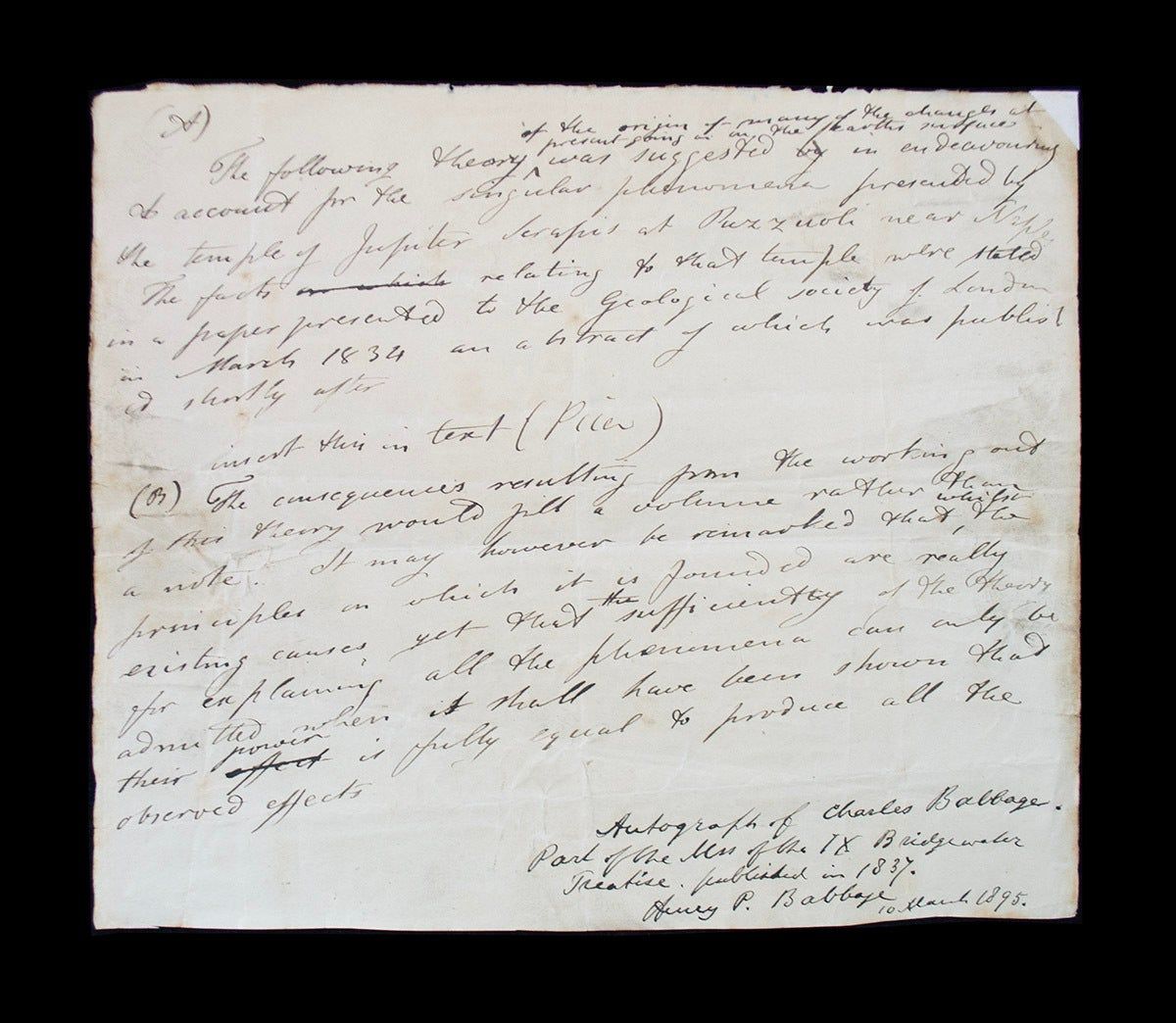
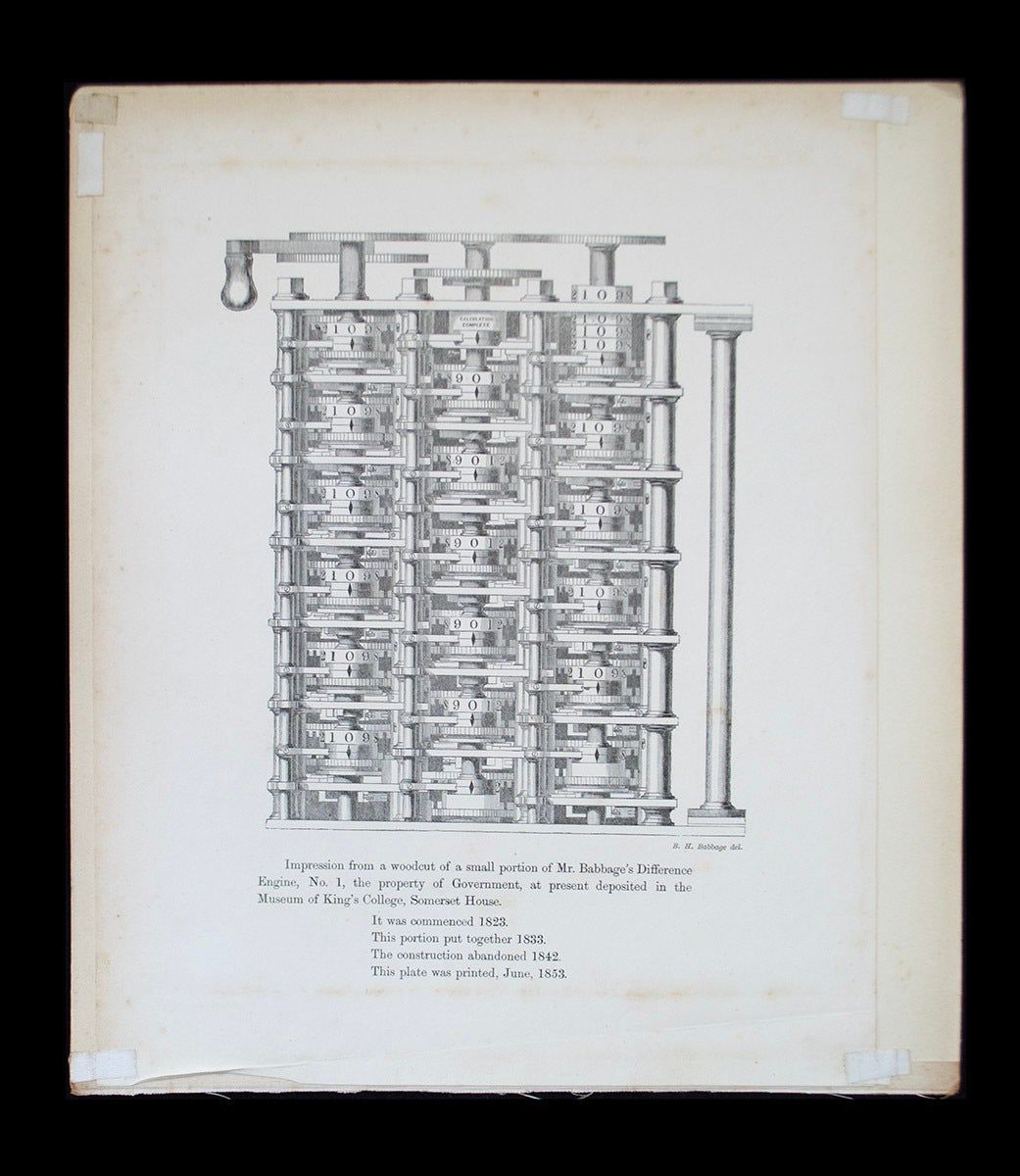
One half-sheet of manuscript. Two paragraphs with seventeen lines of text in black ink. (9 x 7 1/2 inches; 230 x 187 mm). Additionally docket signed by Henry P. Babbage, (Charles's Son) at the bottom. Text on recto only, verso blank. Some creases and smudging to leaf. A small corner protector to top upper corner. Blank verso with some ink staining. Still a very good example. [Together with]: An engraving, dated 1853, of 'Mr Babbage's Difference Engine, no.1' mounted on a paper board. 10 3/4 x 8 1/4 inches; 275 x 210 mm). Some minimal toning and a bit of creasing at the bottom blank edge. Manuscripts of Babbage are rare.
These two paragraphs in Charles Babbage's hand labeled "A"and "B" are portions of "Note G: On the Action of Existing Causes in Producing Elevations and Subsidences in Portions of the Earth's Surface" of the Appendix of Babbage's "The Ninth Bridgewater Treatise; A Fragment" London: J. Murray, 1837. Only two word in paragraph "A" have been changed in the published first edition, and paragraph "B" is verbatim.
Paragraph "A" is the first paragraph of "Note G" and reads: "The following theory of the origin of many of the changes at present going on on the earth's surface, was suggested in endeavouring to account for the singular phenomena presented by the temple of Jupiter Serapis, at Puzzuoli, near Naples. The facts relating to that temple were stated in a paper presented to the Geological Society of London, in March, 1834 ; an abstract of which was published shortly after."
Paragraph "B" is the final paragraph of "Note G" and reads: "The consequences resulting from the working out of this theory would fill a volume, rather than a note. It may, however, be remarked, that whilst the principles on which it is founded are really existing causes, yet that the sufficiency of the theory for explaining all the phenomena can only be admitted when it shall have been shown, that their power is fully equal to produce all the observed effects."
The bottom Signature reads: "Autograph of Charles Babbage./ Part of the Mss of the IX Bridgewater/ Treatise, published in 1837./Henry P. Babbage/ 10 March 1895." Henry Prevost Babbage collated his father's papers after his death.
"The Ninth Bridgewater Treatise (1837), though fragmentary in parts, is Babbage's most philosophically rewarding work. Eight Bridgewater Treatises were officially commissioned under the terms of the will of the eighth earl of Bridgewater. The purpose of the essays was to close the widening rift between rational science and natural theology. Babbage's Ninth was a supernumerary offering, not an official commission. In it he argued against William Whewell's assertion that scientific and religious modes of thought were incompatible and that mathematicians and mechanists were therefore disqualified from theological debate. This was anathema to Babbage, who set out to reconcile rational science with deism. One of Babbage's more intriguing arguments involved an explanation of miracles. He argued that just as programmed discontinuities in a sequence of numbers generated by his calculating engine were not a violation of computational rule, so, by analogy, miracles in nature were not a violation of natural law but a manifestation of a higher law-God's law, as yet undiscovered. In the pre-Darwinian decades there was major scientific opposition between uniformitarians who held that geological changes and by implication natural law were essentially gradual, and catastrophists who posited that extreme and comparatively sudden phenomena were responsible for geological discontinuities. Babbage visited the Temple of Serapis at Pozzuoli in 1828 and the geological speculations in his Treatise were based on observations he made there. His position was essentially allied to the views of the geologist Charles Lyell, a leading advocate of the uniformitarian doctrine." (Oxford DNB).
Provenance: Discovered in a disbound album possibly related to the Wedgwood family, to which Babbage's wife Georgina Whitmore was connected.
HBS 69577.
$2,850.
Full Description:
BABBAGE, Charles. Autograph Manuscript. [Footnotes from "The Ninth Bridgewater Treatise; A Fragment"] London: 1837.
One half-sheet of manuscript. Two paragraphs with seventeen lines of text in black ink. (9 x 7 1/2 inches; 230 x 187 mm). Additionally docket signed by Henry P. Babbage, (Charles's Son) at the bottom. Text on recto only, verso blank. Some creases and smudging to leaf. A small corner protector to top upper corner. Blank verso with some ink staining. Still a very good example. [Together with]: An engraving, dated 1853, of 'Mr Babbage's Difference Engine, no.1' mounted on a paper board. 10 3/4 x 8 1/4 inches; 275 x 210 mm). Some minimal toning and a bit of creasing at the bottom blank edge. Manuscripts of Babbage are rare.
These two paragraphs in Charles Babbage's hand labeled "A"and "B" are portions of "Note G: On the Action of Existing Causes in Producing Elevations and Subsidences in Portions of the Earth's Surface" of the Appendix of Babbage's "The Ninth Bridgewater Treatise; A Fragment" London: J. Murray, 1837. Only two word in paragraph "A" have been changed in the published first edition, and paragraph "B" is verbatim.
Paragraph "A" is the first paragraph of "Note G" and reads: "The following theory of the origin of many of the changes at present going on on the earth's surface, was suggested in endeavouring to account for the singular phenomena presented by the temple of Jupiter Serapis, at Puzzuoli, near Naples. The facts relating to that temple were stated in a paper presented to the Geological Society of London, in March, 1834 ; an abstract of which was published shortly after."
Paragraph "B" is the final paragraph of "Note G" and reads: "The consequences resulting from the working out of this theory would fill a volume, rather than a note. It may, however, be remarked, that whilst the principles on which it is founded are really existing causes, yet that the sufficiency of the theory for explaining all the phenomena can only be admitted when it shall have been shown, that their power is fully equal to produce all the observed effects."
The bottom Signature reads: "Autograph of Charles Babbage./ Part of the Mss of the IX Bridgewater/ Treatise, published in 1837./Henry P. Babbage/ 10 March 1895." Henry Prevost Babbage collated his father's papers after his death.
"The Ninth Bridgewater Treatise (1837), though fragmentary in parts, is Babbage's most philosophically rewarding work. Eight Bridgewater Treatises were officially commissioned under the terms of the will of the eighth earl of Bridgewater. The purpose of the essays was to close the widening rift between rational science and natural theology. Babbage's Ninth was a supernumerary offering, not an official commission. In it he argued against William Whewell's assertion that scientific and religious modes of thought were incompatible and that mathematicians and mechanists were therefore disqualified from theological debate. This was anathema to Babbage, who set out to reconcile rational science with deism. One of Babbage's more intriguing arguments involved an explanation of miracles. He argued that just as programmed discontinuities in a sequence of numbers generated by his calculating engine were not a violation of computational rule, so, by analogy, miracles in nature were not a violation of natural law but a manifestation of a higher law-God's law, as yet undiscovered. In the pre-Darwinian decades there was major scientific opposition between uniformitarians who held that geological changes and by implication natural law were essentially gradual, and catastrophists who posited that extreme and comparatively sudden phenomena were responsible for geological discontinuities. Babbage visited the Temple of Serapis at Pozzuoli in 1828 and the geological speculations in his Treatise were based on observations he made there. His position was essentially allied to the views of the geologist Charles Lyell, a leading advocate of the uniformitarian doctrine." (Oxford DNB).
Provenance: Discovered in a disbound album possibly related to the Wedgwood family, to which Babbage's wife Georgina Whitmore was connected.
HBS 69577.
$2,850.
Details
Title
Autograph Manuscript
Author
BABBAGE, Charles
Condition
Unknown
Publisher
London
Date
1837