

[ASTRONOMY AND PHOTOGRAPHY]. Beitrage zur Fixsternenkunde [3 scholarly papers extracted from the 1846 Abhandlungen der Koniglichen Bohmischen Gesellschaft der Wissenschaften]
![[ASTRONOMY AND PHOTOGRAPHY]. Beitrage zur Fixstern](https://d3525k1ryd2155.cloudfront.net/h/461/222/1743222461.0.x.jpg)
- Prague: Gottlieb Haase & Sons, 1846
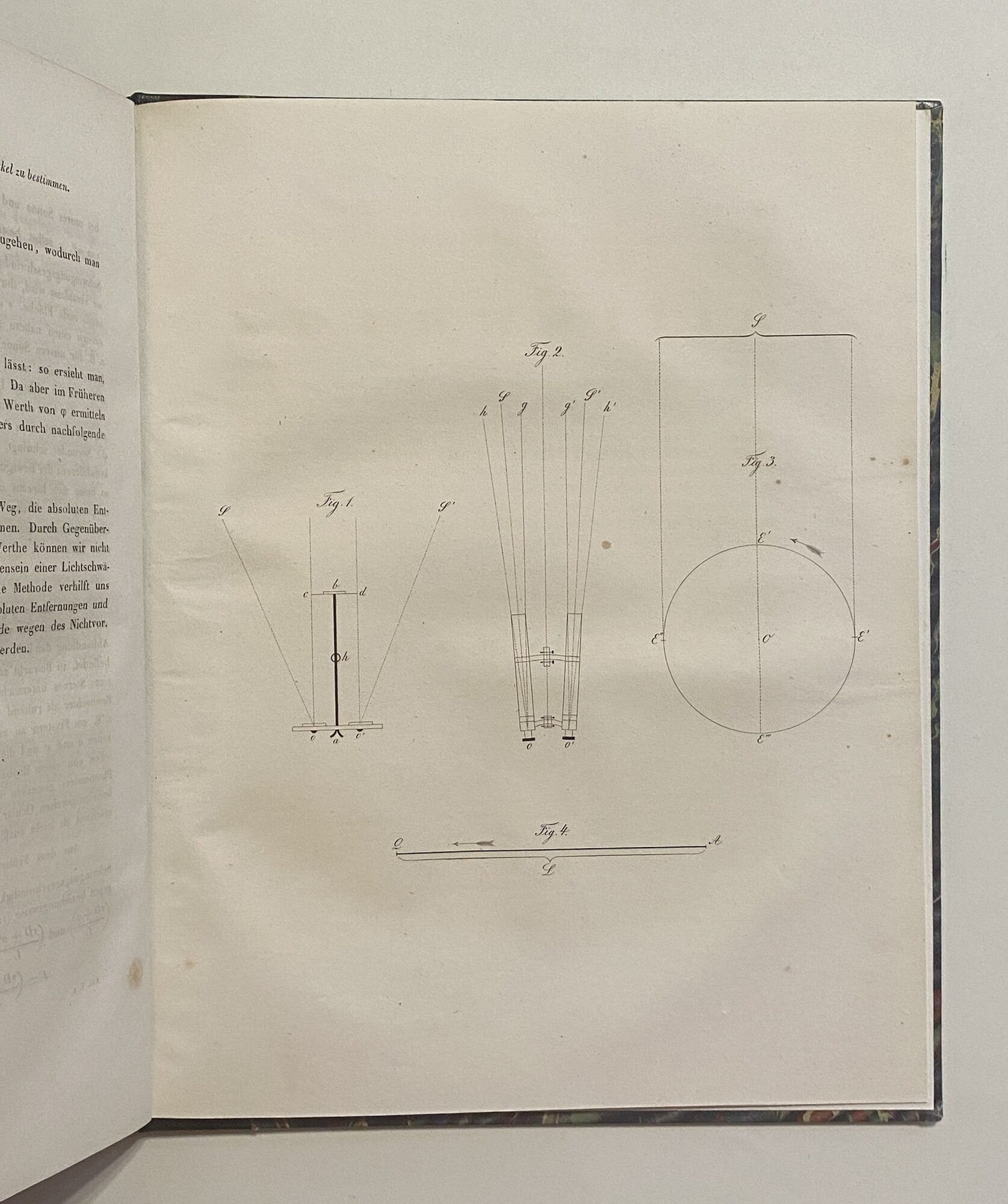
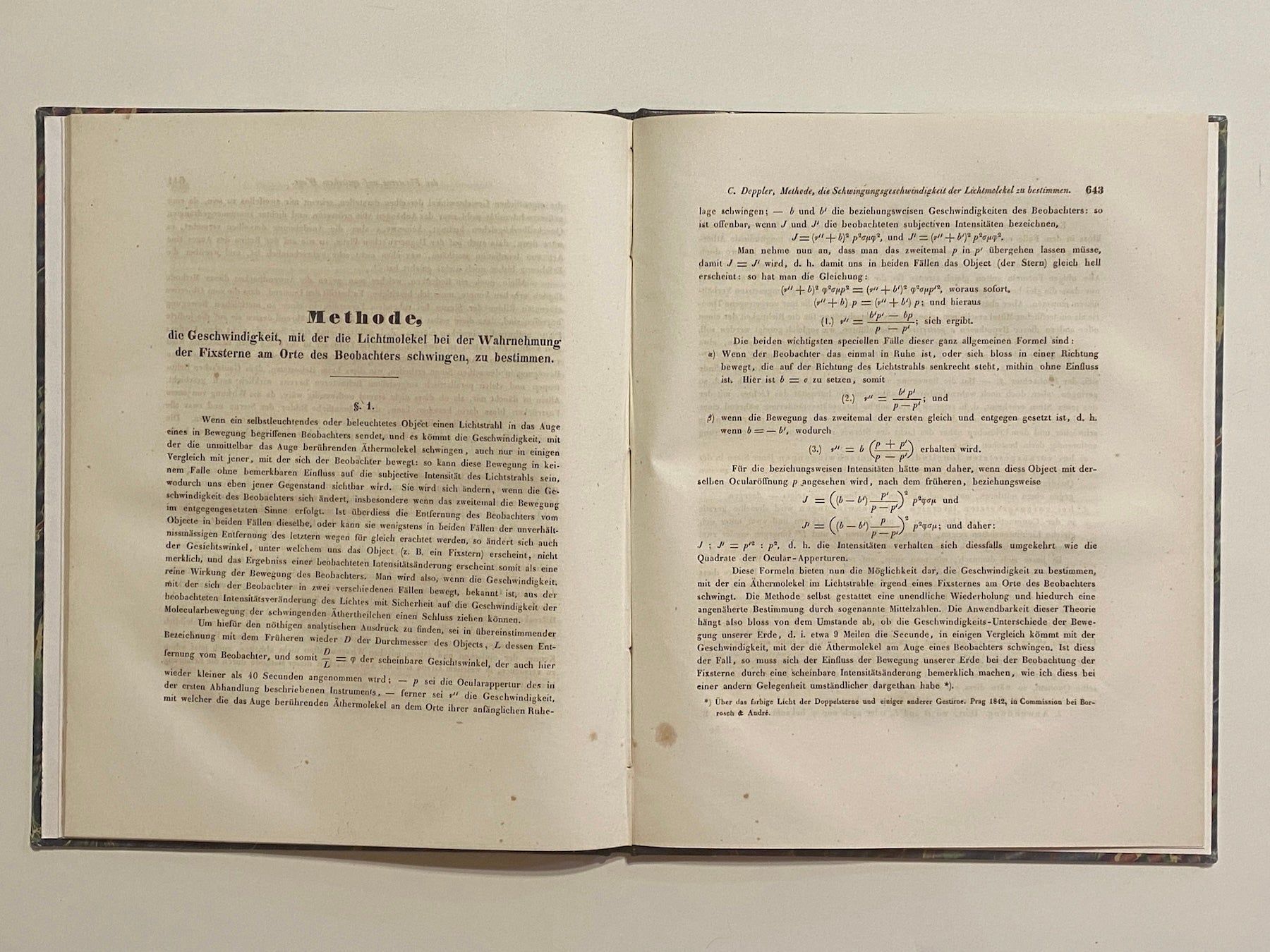
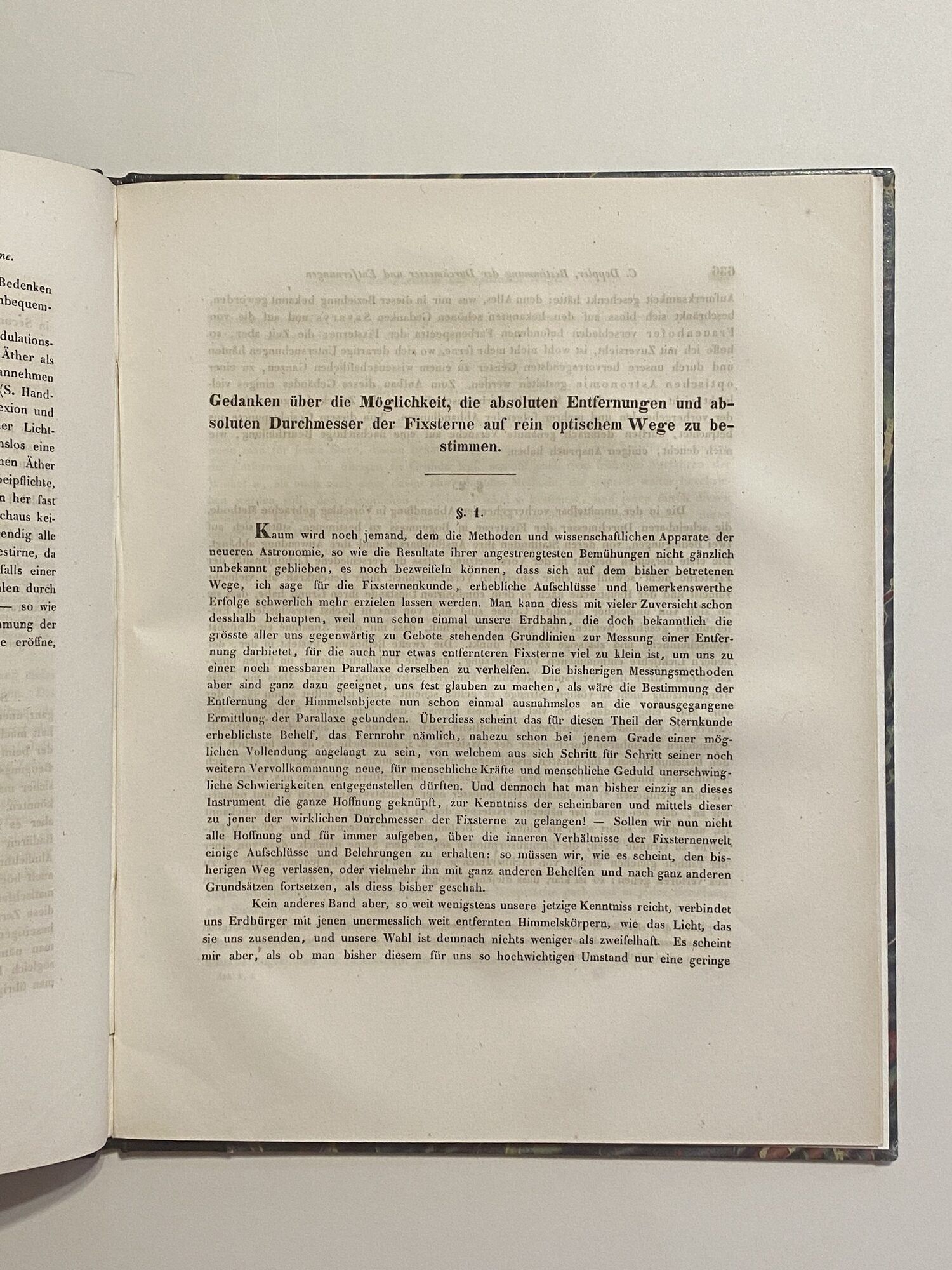
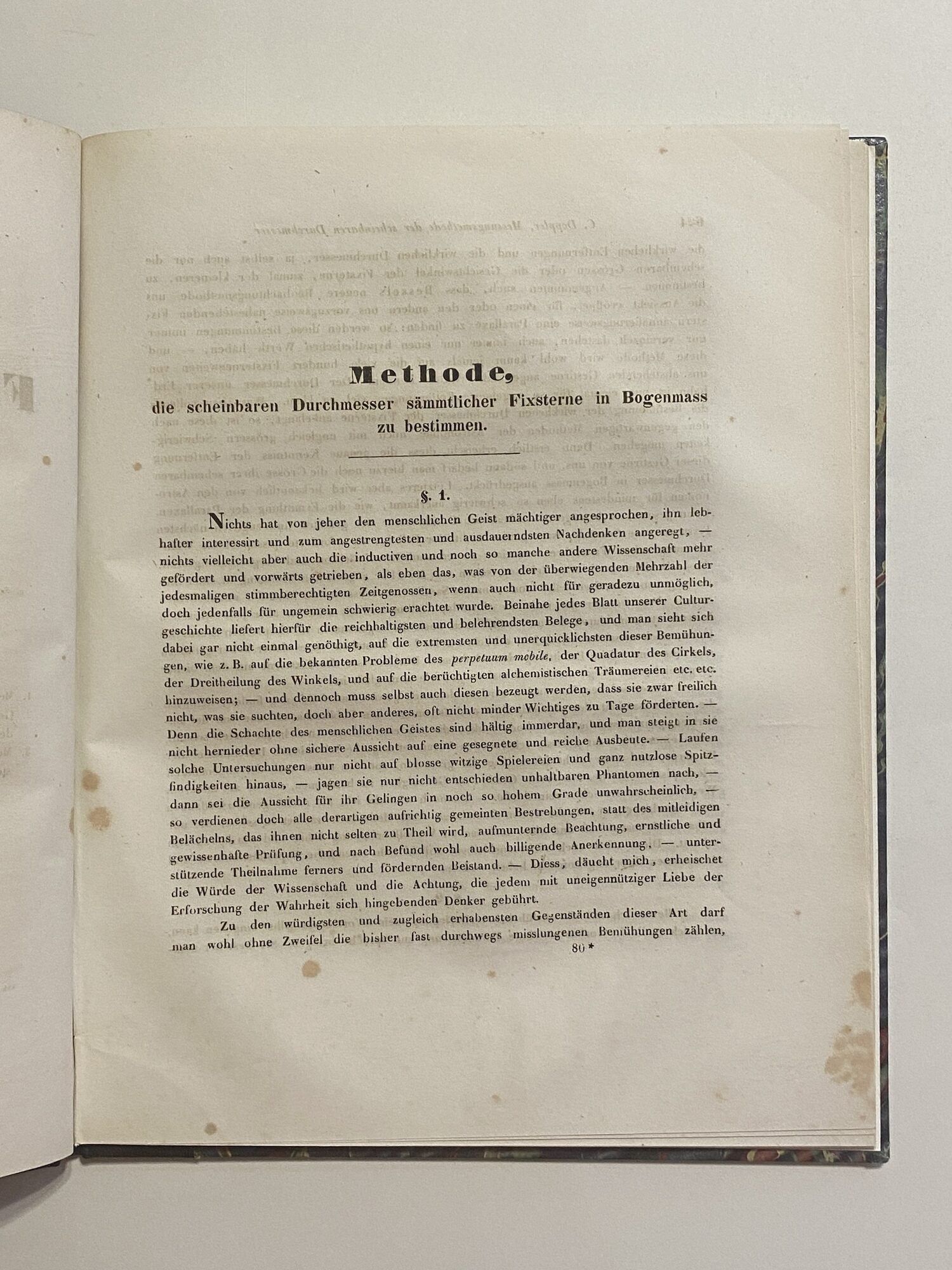
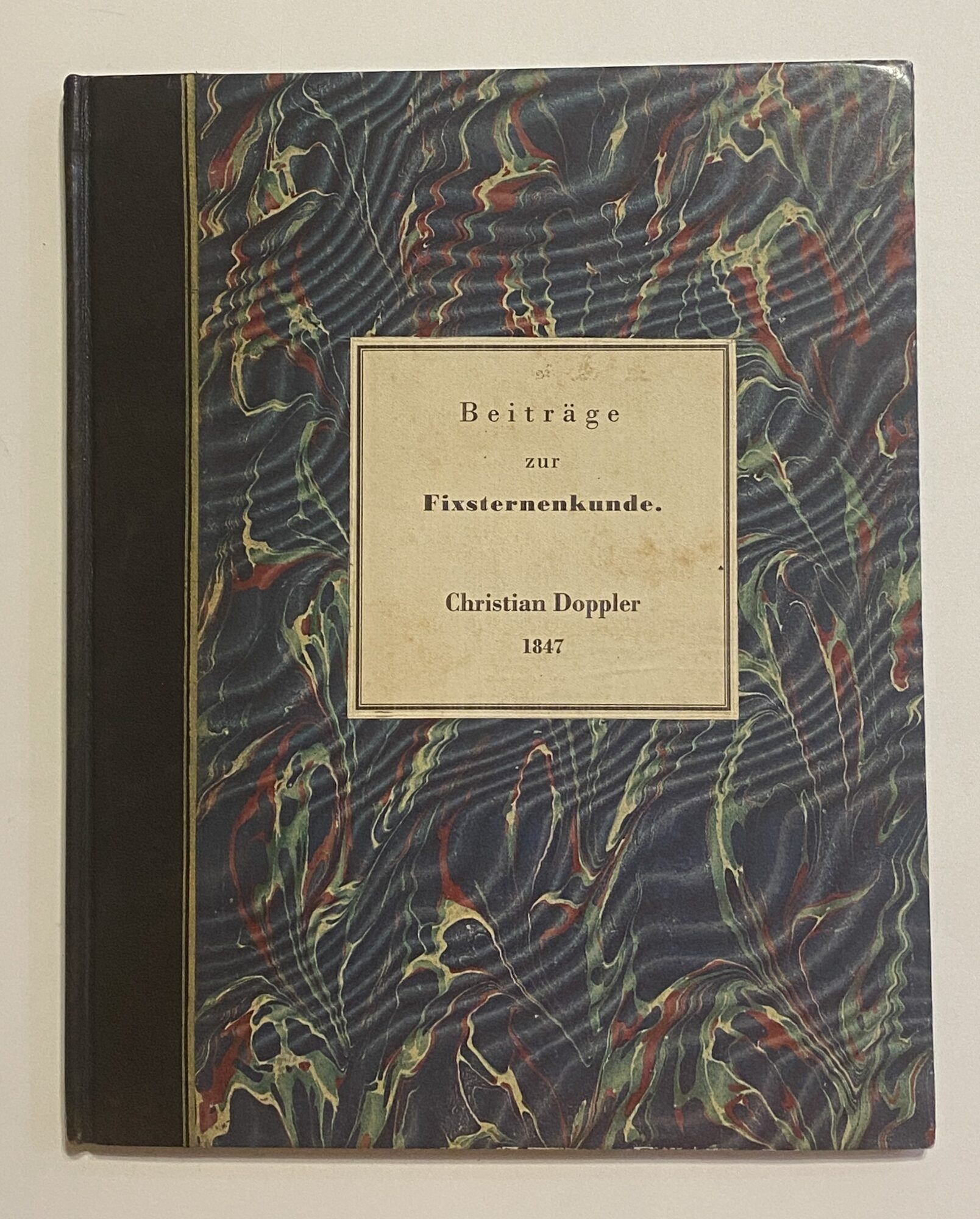
Prague: Gottlieb Haase & Sons, 1846. First Edition. Very good. 4to. Together 3 papers in one volume. 1) Methode, die scheinbaren Durchmesser sammtlicher Fixsterne in Bogenmass zu bestimmen (pp. 623-634). 2). Gedanken uber die Moglichkeit, die absoluten Entfernungen und absoluten Durchmesser der Fixsterne auf rein optischem Wege zu bestimmen (pp. 635-641). 3). Methode, die Geschwindigkeit, mit der die Lichtmolekel bei der Wahrnehmung der Fixsterne am Orte des Beobachters schwingen, zu bestimmen (pp. 642-646, with one full-page diagram). Minor spotting to first few leaves. Modern quarter-calf over marbled boards, title-label on upper cover. THE FIRST PROPOSAL OF PHOTOGRAPHY TO DETERMINE THE SIZE, DISTANCE, AND BEHAVIOR OF FIXED STARS.
This volume brings together three papers by Christian Doppler that build on his 1842 discovery of what we now call the "Doppler Effect." Instead of just developing his great theory further, these papers show Doppler trying to solve the most basic and most daunting practical astronomical problems. Doppler's principle "provided the science of astrophysics with one of its most important tools for measuring the size and the structure of the universe" (DSB).
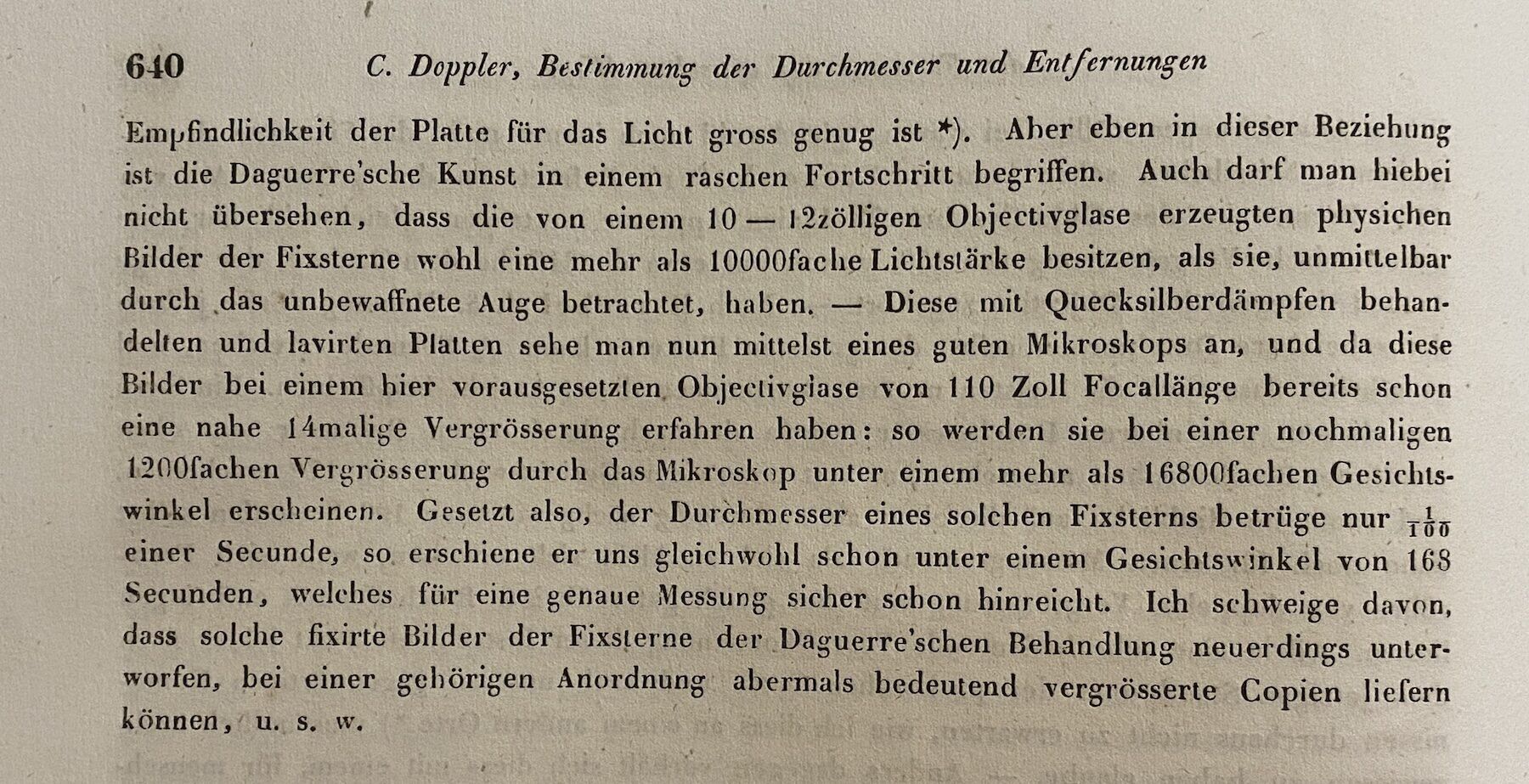
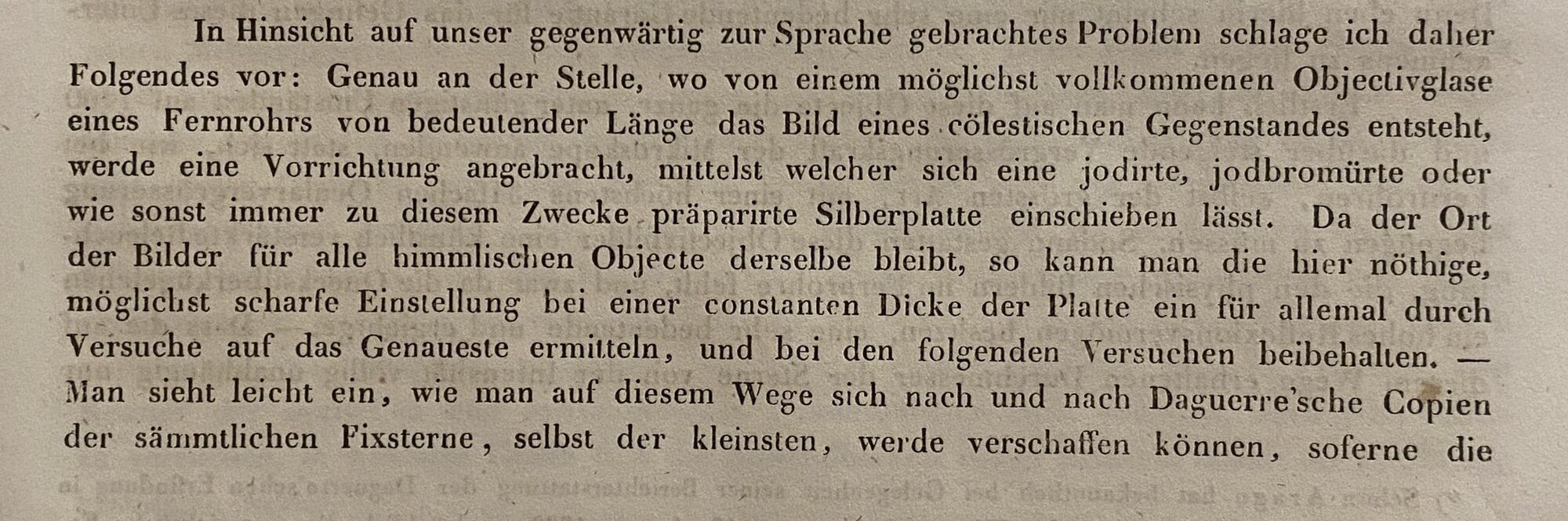
In the first paper, Doppler presents a method to determine the apparent diameter of all fixed stars in an arc. In our opinion, the most striking idea comes in his second paper. Here he proposes using photography -- specifically Daguerreotype plates -- as a tool for astronomy. Doppler argues that Daguerrotype plates are far more sensitive to light than the human eye -- possibly tens of thousands of times more. Instead of endlessly improving telescopes, he suggests capturing images of stars on photographic plates and then enlarging those images with microscopes. This would make it possible to study stars that otherwise look like tiny, indistinct points.
This is a major conceptual leap. Doppler is essentially saying that observation should not rely on the eye alone, but on recorded images that can be examined, measured, and reanalyzed. He also points toward early forms of photometry, suggesting that brightness could be measured more accurately from photographic images than by human judgment. Even though the technology at the time was not yet adequate, the idea clearly anticipates how the entire field of astronomy would later develop.
The third paper returns to theory, expanding his earlier work by showing that motion affects not just the color (frequency) of light, but also its strength (intensity). This helps connect what astronomers observe more directly to the physical behavior of light.
Taken together, these papers show Doppler pushing astronomy in a new direction. He moves it away from simple observation and toward measurement, instruments, and especially photography, laying out ideas that would later become central to modern astrophysics.
This volume brings together three papers by Christian Doppler that build on his 1842 discovery of what we now call the "Doppler Effect." Instead of just developing his great theory further, these papers show Doppler trying to solve the most basic and most daunting practical astronomical problems. Doppler's principle "provided the science of astrophysics with one of its most important tools for measuring the size and the structure of the universe" (DSB).
In the first paper, Doppler presents a method to determine the apparent diameter of all fixed stars in an arc. In our opinion, the most striking idea comes in his second paper. Here he proposes using photography -- specifically Daguerreotype plates -- as a tool for astronomy. Doppler argues that Daguerrotype plates are far more sensitive to light than the human eye -- possibly tens of thousands of times more. Instead of endlessly improving telescopes, he suggests capturing images of stars on photographic plates and then enlarging those images with microscopes. This would make it possible to study stars that otherwise look like tiny, indistinct points.
This is a major conceptual leap. Doppler is essentially saying that observation should not rely on the eye alone, but on recorded images that can be examined, measured, and reanalyzed. He also points toward early forms of photometry, suggesting that brightness could be measured more accurately from photographic images than by human judgment. Even though the technology at the time was not yet adequate, the idea clearly anticipates how the entire field of astronomy would later develop.
The third paper returns to theory, expanding his earlier work by showing that motion affects not just the color (frequency) of light, but also its strength (intensity). This helps connect what astronomers observe more directly to the physical behavior of light.
Taken together, these papers show Doppler pushing astronomy in a new direction. He moves it away from simple observation and toward measurement, instruments, and especially photography, laying out ideas that would later become central to modern astrophysics.
Details
Title
[ASTRONOMY AND PHOTOGRAPHY]. Beitrage zur Fixsternenkunde [3 scholarly papers extracted from the 1846 Abhandlungen der Koniglichen Bohmischen Gesellschaft der Wissenschaften]
Author
Doppler, Christian
Condition
Very Good
Publisher
Gottlieb Haase & Sons: Prague
Date
1846
Edition
First Edition