

Manuscript Provision Return for “one released Indian captive who lives with me,” Signed by Army Paymaster Caleb Swan, March 1796
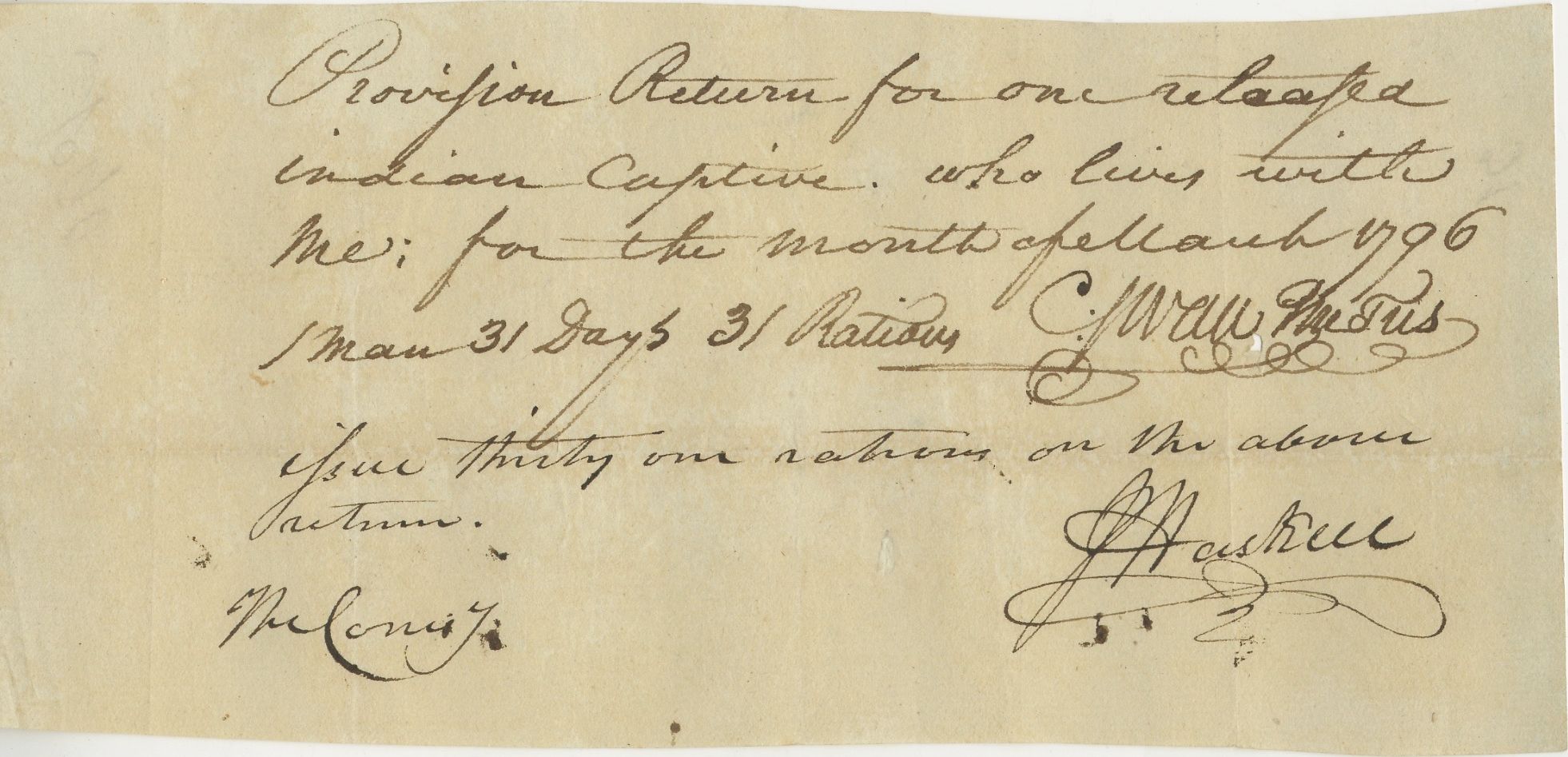
- One small slip, signed “C. Swan, PMG U.S.” with additional authorization by J. Haskell. Measuring appx. 3 ½ x 7 ½ inches
- United States , 1796
United States, 1796. One small slip, signed “C. Swan, PMG U.S.” with additional authorization by J. Haskell. Measuring appx. 3 ½ x 7 ½ inches. Near Fine.. In the 1790s, ongoing conflicts between the United States and Native nations produced large numbers of captives, taken in raids and only gradually returned through negotiation, exchange, and treaty. The U.S. Army was responsible not only for recovering these individuals but for housing and provisioning them while their status was resolved. Offered here is a concise U.S. Army ration return issued by Caleb Swan, documenting subsistence for “one released Indian captive who lives with me,” calculated at “1 Man 31 Days 31 Rations” for March 1796. Swan, appointed paymaster of the army in 1792 and attached to General Anthony Wayne’s Legion, was responsible for overseeing pay and provisions in the field. The document gains significance from Swan’s earlier experience. Before becoming paymaster, he had traveled through the southern frontier—particularly among the Muscogee (Creek) Nation—where he encountered firsthand the system of captivity produced by years of raiding along the Georgia border. Captives, both Black and white, were often absorbed into Native communities, sold, or retained under local customs, and U.S. officials struggled to secure their return.[1]
By 1796, Swan appears on the other side of that process. The present return shows that he himself had custody of a “released” captive, likely an American who had been held in a Native community. The individual was residing with Swan and being fed at government expense. This comes immediately after Swan’s presence at the Treaty of Greenville, which formally ended major fighting in the Northwest and included provisions for the return of prisoners. The Treaty of Greenville specifically required the mutual return of prisoners, with Native captives held by the United States released immediately and American captives to be delivered within ninety days, backed by the detention of chiefs as hostages. This places Swan’s 1796 ration return squarely in the aftermath of the administrative effort for restoring frontier captives.
[1] Andrew K. Pressley, A Southern Underground Railroad: Black Georgians and the Promise of Spanish Florida and Indian Country (University of Georgia Press, 2024).
By 1796, Swan appears on the other side of that process. The present return shows that he himself had custody of a “released” captive, likely an American who had been held in a Native community. The individual was residing with Swan and being fed at government expense. This comes immediately after Swan’s presence at the Treaty of Greenville, which formally ended major fighting in the Northwest and included provisions for the return of prisoners. The Treaty of Greenville specifically required the mutual return of prisoners, with Native captives held by the United States released immediately and American captives to be delivered within ninety days, backed by the detention of chiefs as hostages. This places Swan’s 1796 ration return squarely in the aftermath of the administrative effort for restoring frontier captives.
[1] Andrew K. Pressley, A Southern Underground Railroad: Black Georgians and the Promise of Spanish Florida and Indian Country (University of Georgia Press, 2024).
Details
Title
Manuscript Provision Return for “one released Indian captive who lives with me,” Signed by Army Paymaster Caleb Swan, March 1796
Author
[Early Republic – Indian Captivity – Treaty of Greenville – U.S. Army Rations] Swan, C.; Haskell, J.
Binding
One small slip, signed “C. Swan, PMG U.S.” with additional authorization by J. Haskell. Measuring appx. 3 ½ x 7 ½ inches
Condition
Near Fine
Publisher
United States
Date
1796