

Lavengro; The Scholar - The Gypsy - The Priest
- London: John Murray, 1851
London: John Murray, 1851. Extra-Illustrated with an Original Watercolor Cycle
A Fully Realized Victorian Vision of Lavengro
BORROW, George. Lavengro; The Scholar - The Gypsy - The Priest. London: John Murray, 1851.
First edition. Three octavo volumes (7 5/8 x 4 3/4 inches; 194 x 121 mm.). xx, 360; xii, 366; xii, 426 pp.
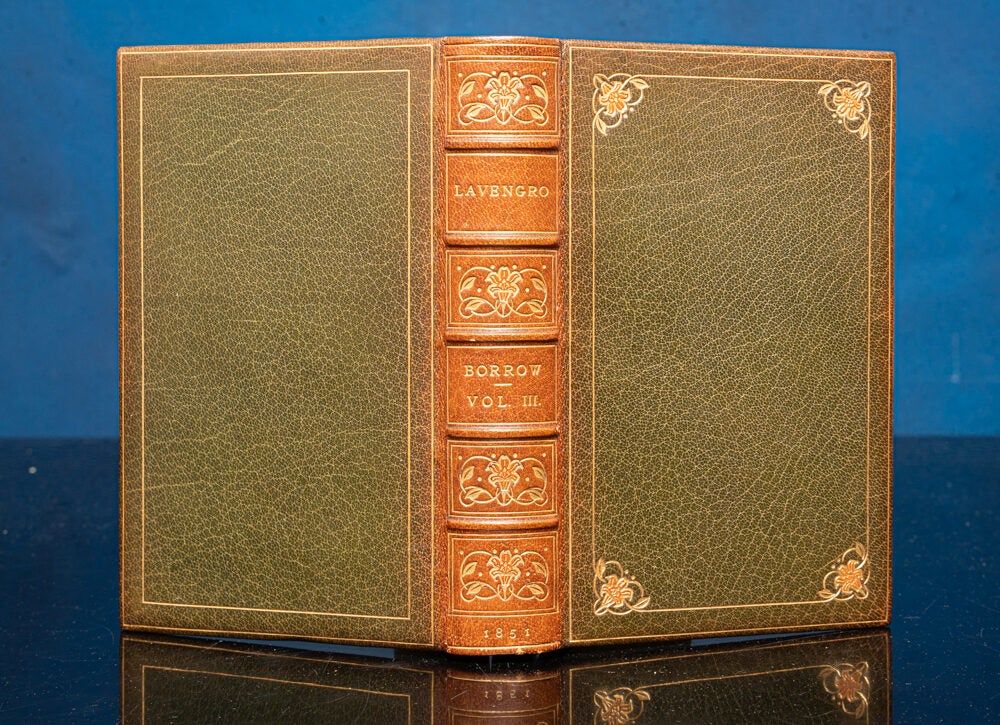
Finely bound by Cedric Chivers circa 1900 in full green crushed levant morocco. Covers elaborately inlaid with floral corner ornaments in pink levant and gilt, spines with five raised bands richly decorated and lettered in gilt in compartments. Gilt turn-ins, doublures and fly-leaves of green moiré silk, all edges gilt. Spines uniformly faded to a warm brown, as often encountered with this binding style. Each volume housed in a fleece-lined green cloth slipcase.
A coherent watercolor program - not mere decoration, but interpretation - this is not casual Grangerization, but a fully conceived illustrative scheme.
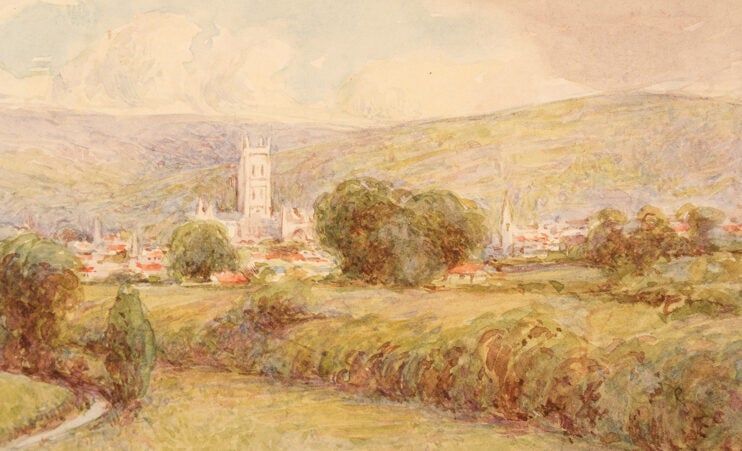
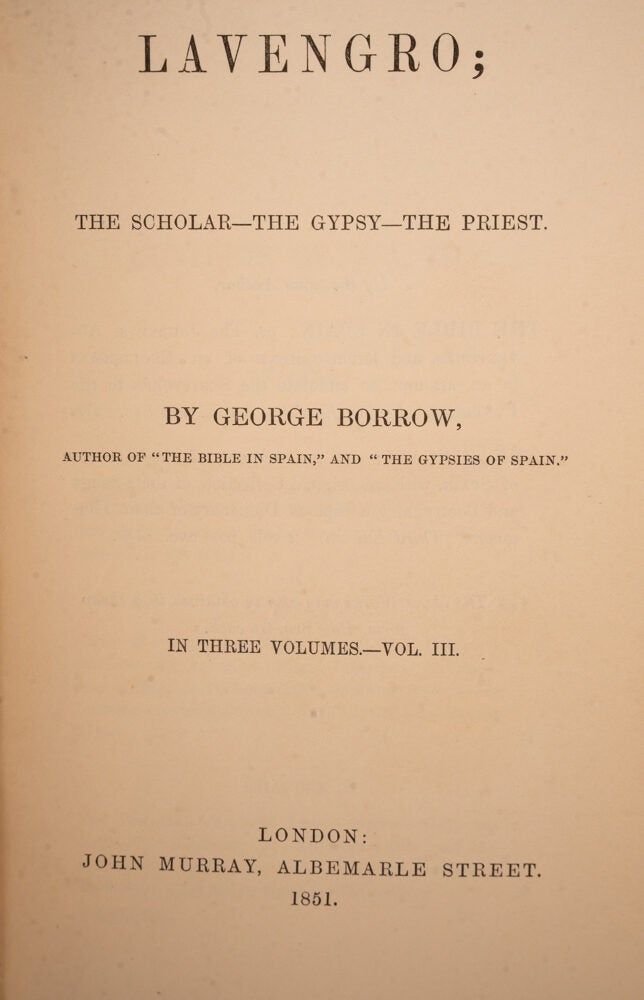
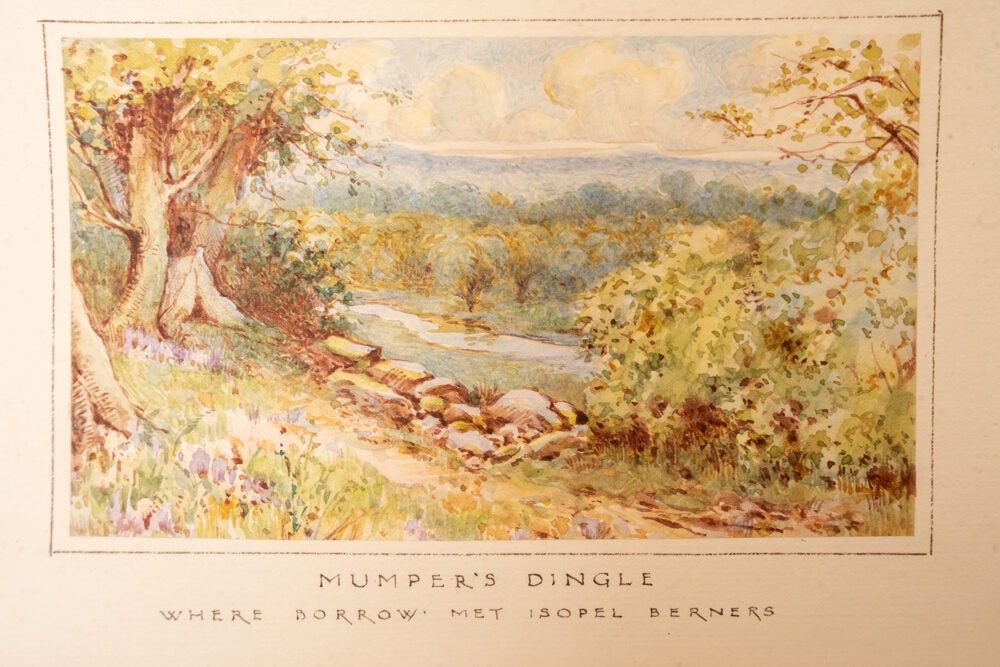
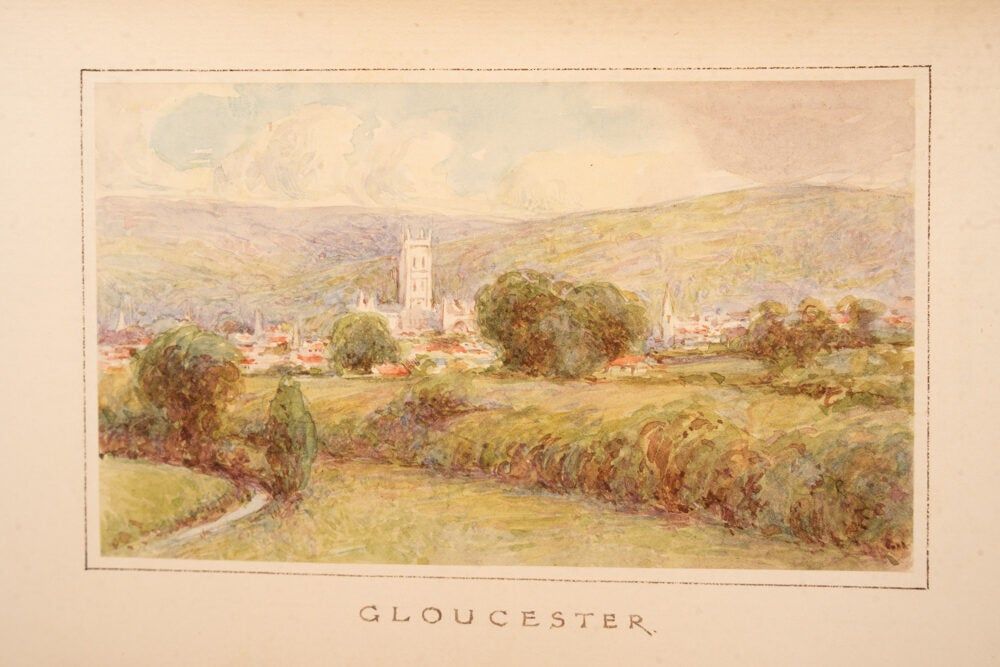
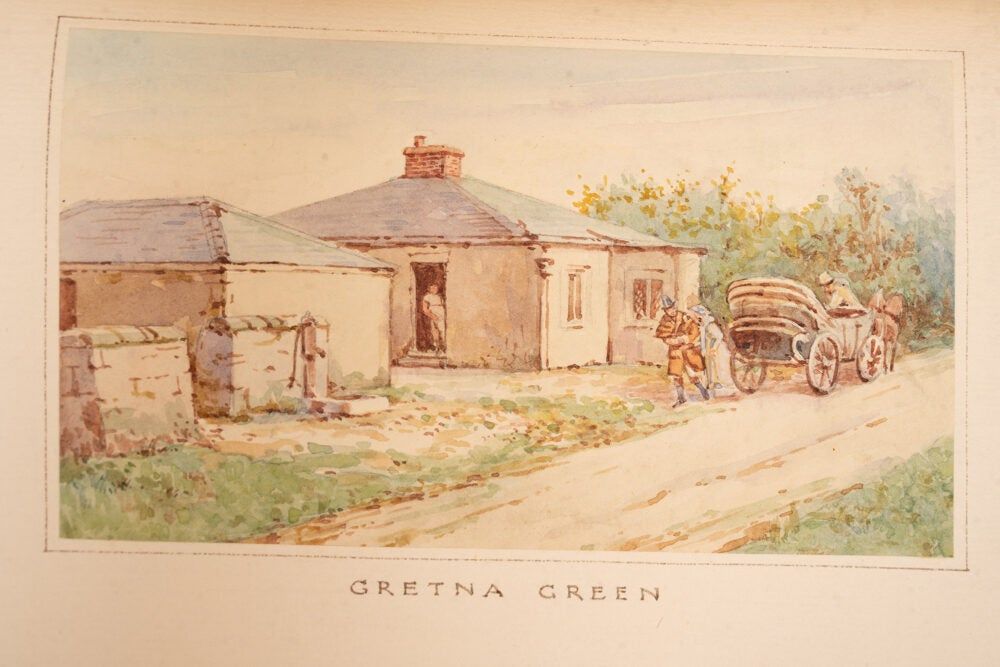
The set is enriched with specially executed calligraphic title-pages and an original watercolor portrait of George Borrow on vellum, after the early likeness by his brother John Thomas Borrow (now in the National Portrait Gallery), inserted as a frontispiece. Thirty-three original watercolor drawings, each carefully matched to specific passages and locations in the text and a manuscript index of the inserted illustrations, systematically organizing the cycle across the three volumes and in addition twenty-two engraved portraits, described contemporaneously as "brilliant impressions."
What distinguishes this example is the editorial discipline of the additions. The watercolor series is not random but follows Borrow's journey geographically and autobiographically - from East Dereham and Norwich through Edinburgh, London, and onward to the Continent (Rome, Naples, etc.). The inclusion of a formal "List of Original Water-Color Drawings Illustrating Lavengro" confirms that the project was conceived as a unified artistic enterprise rather than an accretion.
The drawings themselves - unsigned but confidently handled, suggest a commissioned hand, likely produced as a single campaign rather than assembled piecemeal.
They exhibit a restrained, atmospheric palette typical of late Victorian topographical watercolor, Architectural sensitivity (as in the Edinburgh and Norwich views), a consistent compositional format, often framed within ruled borders to harmonize with the printed page A documentary impulse - these are places as experienced, not merely imagined. The portrait of Borrow, executed on vellum, is particularly striking: a miniature of cabinet quality, bridging the worlds of book illustration and portrait painting.
This set represents the apogee of Victorian extra-illustration - when collectors sought not merely to augment texts, but to re-author them visually. Unlike more typical Grangerized books (often swollen with heterogeneous prints), this example achieves a unity of medium (a sustained watercolor cycle), narrative alignment (each image tied to text) and
bibliographic consciousness (indexed, structured, and planned).
Such sets were expensive to commission and are today exceptionally scarce in this level of completeness and coherence.
A Fully Realized Victorian Vision of Lavengro
BORROW, George. Lavengro; The Scholar - The Gypsy - The Priest. London: John Murray, 1851.
First edition. Three octavo volumes (7 5/8 x 4 3/4 inches; 194 x 121 mm.). xx, 360; xii, 366; xii, 426 pp.
Finely bound by Cedric Chivers circa 1900 in full green crushed levant morocco. Covers elaborately inlaid with floral corner ornaments in pink levant and gilt, spines with five raised bands richly decorated and lettered in gilt in compartments. Gilt turn-ins, doublures and fly-leaves of green moiré silk, all edges gilt. Spines uniformly faded to a warm brown, as often encountered with this binding style. Each volume housed in a fleece-lined green cloth slipcase.
A coherent watercolor program - not mere decoration, but interpretation - this is not casual Grangerization, but a fully conceived illustrative scheme.
The set is enriched with specially executed calligraphic title-pages and an original watercolor portrait of George Borrow on vellum, after the early likeness by his brother John Thomas Borrow (now in the National Portrait Gallery), inserted as a frontispiece. Thirty-three original watercolor drawings, each carefully matched to specific passages and locations in the text and a manuscript index of the inserted illustrations, systematically organizing the cycle across the three volumes and in addition twenty-two engraved portraits, described contemporaneously as "brilliant impressions."
What distinguishes this example is the editorial discipline of the additions. The watercolor series is not random but follows Borrow's journey geographically and autobiographically - from East Dereham and Norwich through Edinburgh, London, and onward to the Continent (Rome, Naples, etc.). The inclusion of a formal "List of Original Water-Color Drawings Illustrating Lavengro" confirms that the project was conceived as a unified artistic enterprise rather than an accretion.
The drawings themselves - unsigned but confidently handled, suggest a commissioned hand, likely produced as a single campaign rather than assembled piecemeal.
They exhibit a restrained, atmospheric palette typical of late Victorian topographical watercolor, Architectural sensitivity (as in the Edinburgh and Norwich views), a consistent compositional format, often framed within ruled borders to harmonize with the printed page A documentary impulse - these are places as experienced, not merely imagined. The portrait of Borrow, executed on vellum, is particularly striking: a miniature of cabinet quality, bridging the worlds of book illustration and portrait painting.
This set represents the apogee of Victorian extra-illustration - when collectors sought not merely to augment texts, but to re-author them visually. Unlike more typical Grangerized books (often swollen with heterogeneous prints), this example achieves a unity of medium (a sustained watercolor cycle), narrative alignment (each image tied to text) and
bibliographic consciousness (indexed, structured, and planned).
Such sets were expensive to commission and are today exceptionally scarce in this level of completeness and coherence.
Details
Title
Lavengro; The Scholar - The Gypsy - The Priest
Author
BORROW, George
Condition
Unknown
Publisher
London: John Murray, 1851