

THE ANGEL IN THE HOUSE
- London: George Bell and Sons, 1908
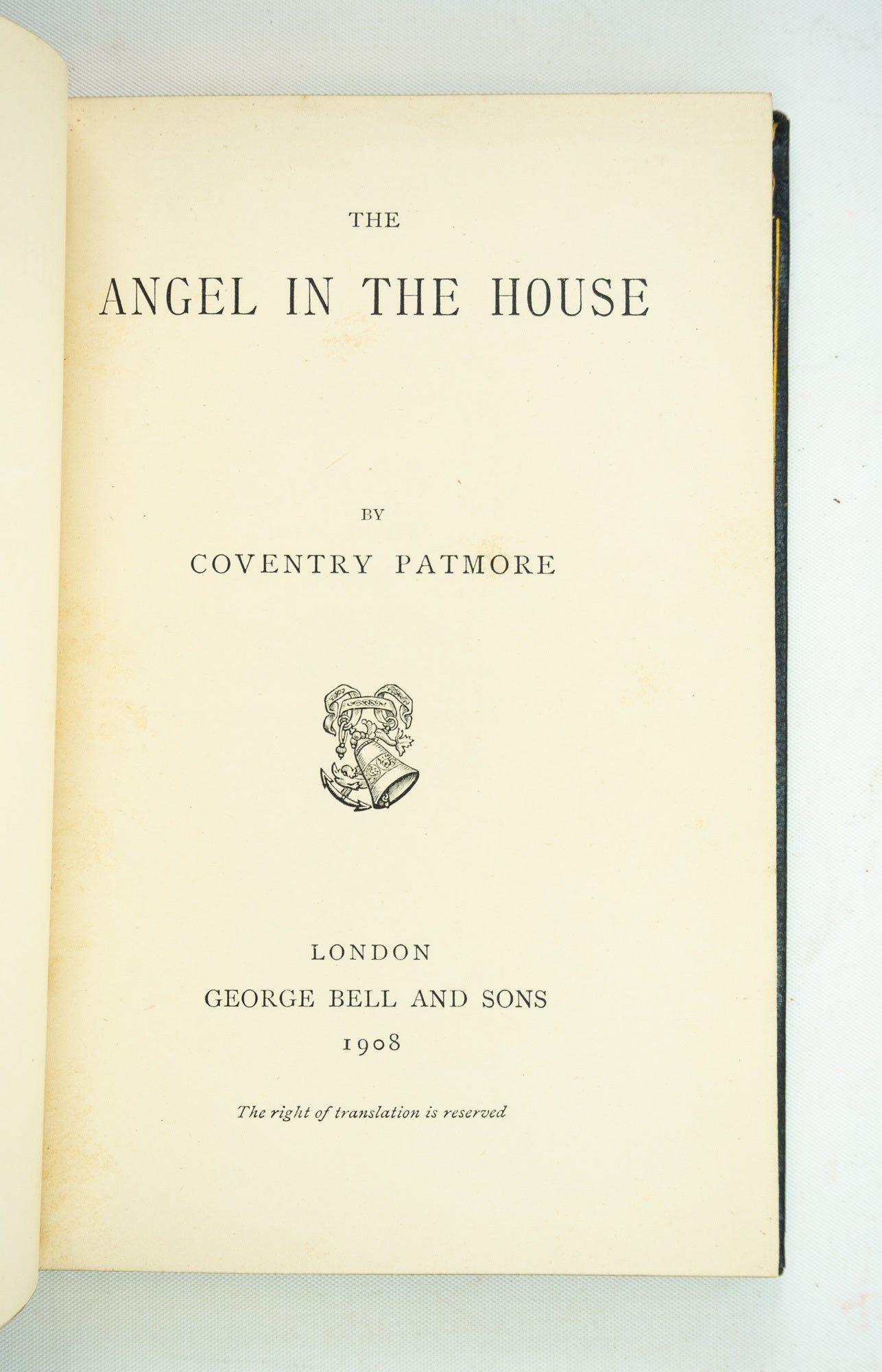
London: George Bell and Sons, 1908. 165 x 106 mm. (6 1/2 x 4 1/4"). 2 p.l., xii, 153, [1] pp.
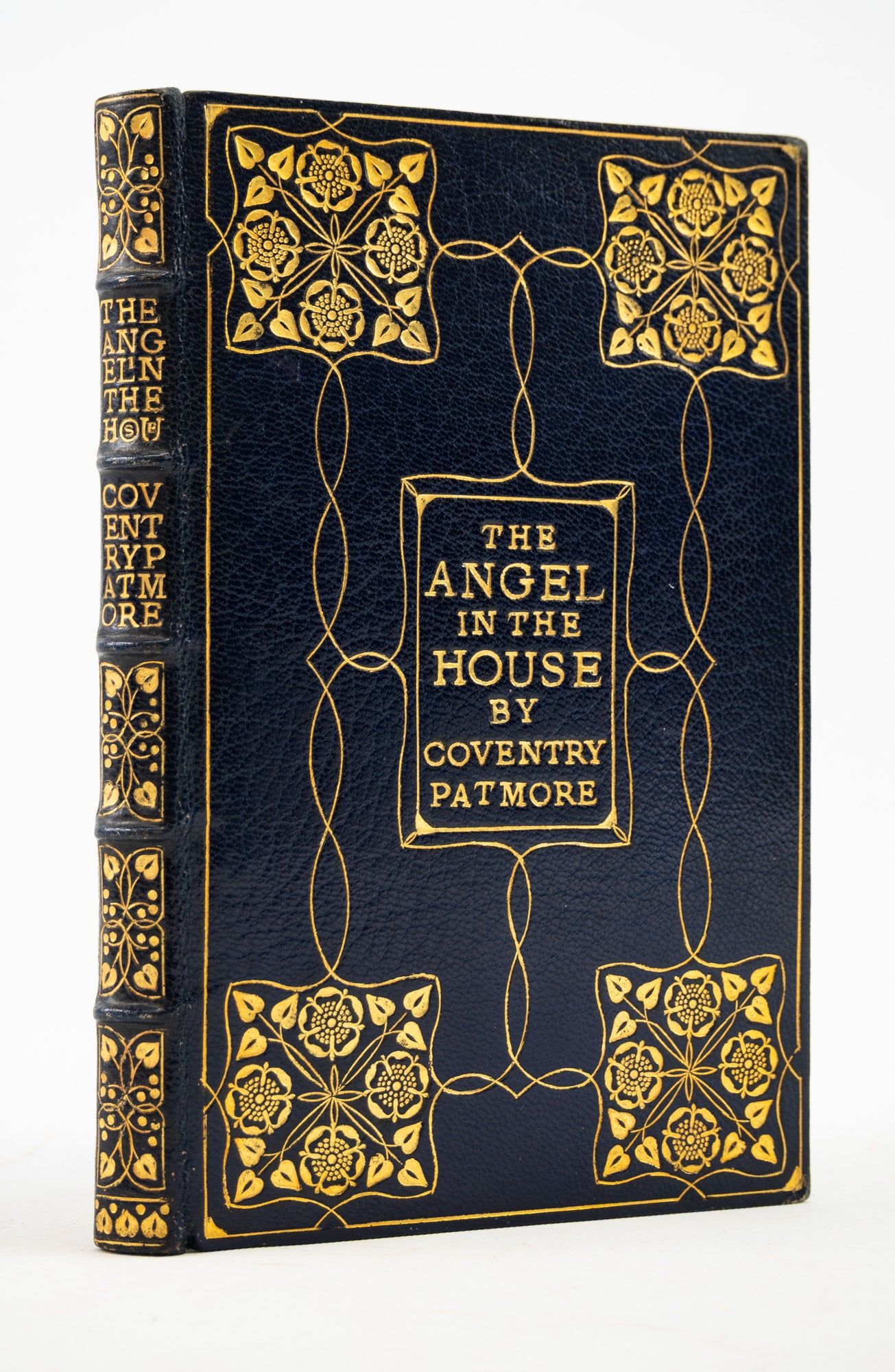
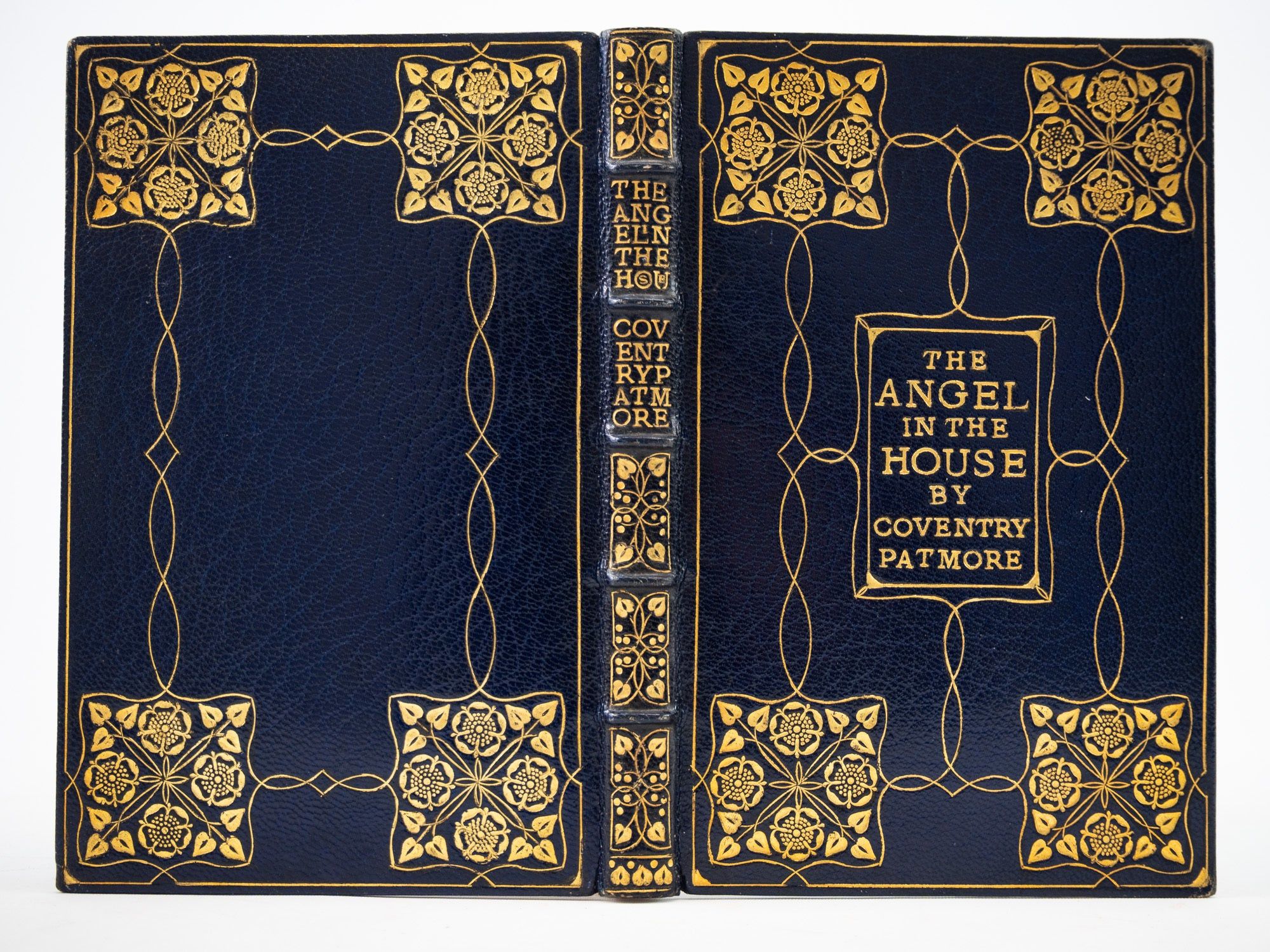
LOVELY COBALT BLUE MOROCCO, gilt in an Arts & Crafts design, covers with four decorative panels of four Tudor rose tools interspersed with radiating leaves enclosed and linked to one another by twining gilt rolls, the front cover titled in a central panel, similarly framed, raised bands, spine panels gilt with four leaves within interlocking lobe-shaped gilt frames studded with dots, wide turn-ins similarly decorated, endpapers marbled in pale blue and pink, all edges gilt. See Virginia Woolf, "Professions for Women," in "Killing the Angel in the House: Seven Essays," p. 4. A VERY FINE COPY, the binding very lustrous and virtually unworn, and entirely clean and fresh internally.
Victorian poet and essayist Coventry Patmore's best-remembered work--a romantic ode to married life--is offered here in a very attractive Arts & Crafts binding that is designed like, and finished as skillfully as, Doves Bindery volumes. Patmore (1823-96) was an associate of the older generation of Pre-Raphaelites, whose poems dealt with love, grief, and spirituality, particularly following his conversion to Roman Catholicism. He composed "The Angel in the House" as an idealized narrative of a courtship, which is said to have been based on his relationship with his first wife. The book was initially published as two separate works, "The Espousals" (1854) and "The Betrothal" (1856), which are sometimes combined with follow-up works, "Faithful for Ever" (1860) and "The Victories of Love" (1862-63). In DNB's words, "as Tennyson had recently made his mark by a connected series of poems on death and grief, Patmore determined to write the poetic series on that other Victorian obsession, married love." The work gained in popularity through the later Victorian and Edwardian periods, with the "Angel in the House" becoming synonymous with the ideal of domestic middle-class femininity. An indication of the poem's cultural impact is the degree to which the "Angel" became a symbol of women's oppression for early feminist writers. Virginia Woolf famously spoke of killing "the Angel in the House" being the only way to liberate herself as an author: "had I not killed her," Woolf wrote, "she would have killed me." Our copy of this influential work comes in a particularly pleasing binding. The influence of the Doves Bindery, in operation from 1893-1916, is clearly evident here, both in terms of design and titling. And the work is so skillfully done that even a studied look at the binder's execution would not assign a level of success measurably below Doves work..
LOVELY COBALT BLUE MOROCCO, gilt in an Arts & Crafts design, covers with four decorative panels of four Tudor rose tools interspersed with radiating leaves enclosed and linked to one another by twining gilt rolls, the front cover titled in a central panel, similarly framed, raised bands, spine panels gilt with four leaves within interlocking lobe-shaped gilt frames studded with dots, wide turn-ins similarly decorated, endpapers marbled in pale blue and pink, all edges gilt. See Virginia Woolf, "Professions for Women," in "Killing the Angel in the House: Seven Essays," p. 4. A VERY FINE COPY, the binding very lustrous and virtually unworn, and entirely clean and fresh internally.
Victorian poet and essayist Coventry Patmore's best-remembered work--a romantic ode to married life--is offered here in a very attractive Arts & Crafts binding that is designed like, and finished as skillfully as, Doves Bindery volumes. Patmore (1823-96) was an associate of the older generation of Pre-Raphaelites, whose poems dealt with love, grief, and spirituality, particularly following his conversion to Roman Catholicism. He composed "The Angel in the House" as an idealized narrative of a courtship, which is said to have been based on his relationship with his first wife. The book was initially published as two separate works, "The Espousals" (1854) and "The Betrothal" (1856), which are sometimes combined with follow-up works, "Faithful for Ever" (1860) and "The Victories of Love" (1862-63). In DNB's words, "as Tennyson had recently made his mark by a connected series of poems on death and grief, Patmore determined to write the poetic series on that other Victorian obsession, married love." The work gained in popularity through the later Victorian and Edwardian periods, with the "Angel in the House" becoming synonymous with the ideal of domestic middle-class femininity. An indication of the poem's cultural impact is the degree to which the "Angel" became a symbol of women's oppression for early feminist writers. Virginia Woolf famously spoke of killing "the Angel in the House" being the only way to liberate herself as an author: "had I not killed her," Woolf wrote, "she would have killed me." Our copy of this influential work comes in a particularly pleasing binding. The influence of the Doves Bindery, in operation from 1893-1916, is clearly evident here, both in terms of design and titling. And the work is so skillfully done that even a studied look at the binder's execution would not assign a level of success measurably below Doves work..
Details
Title
THE ANGEL IN THE HOUSE
Author
(BINDINGS - ARTS & CRAFTS-STYLE). PATMORE, COVENTRY
Condition
Unknown
Publisher
George Bell and Sons: London
Date
1908