

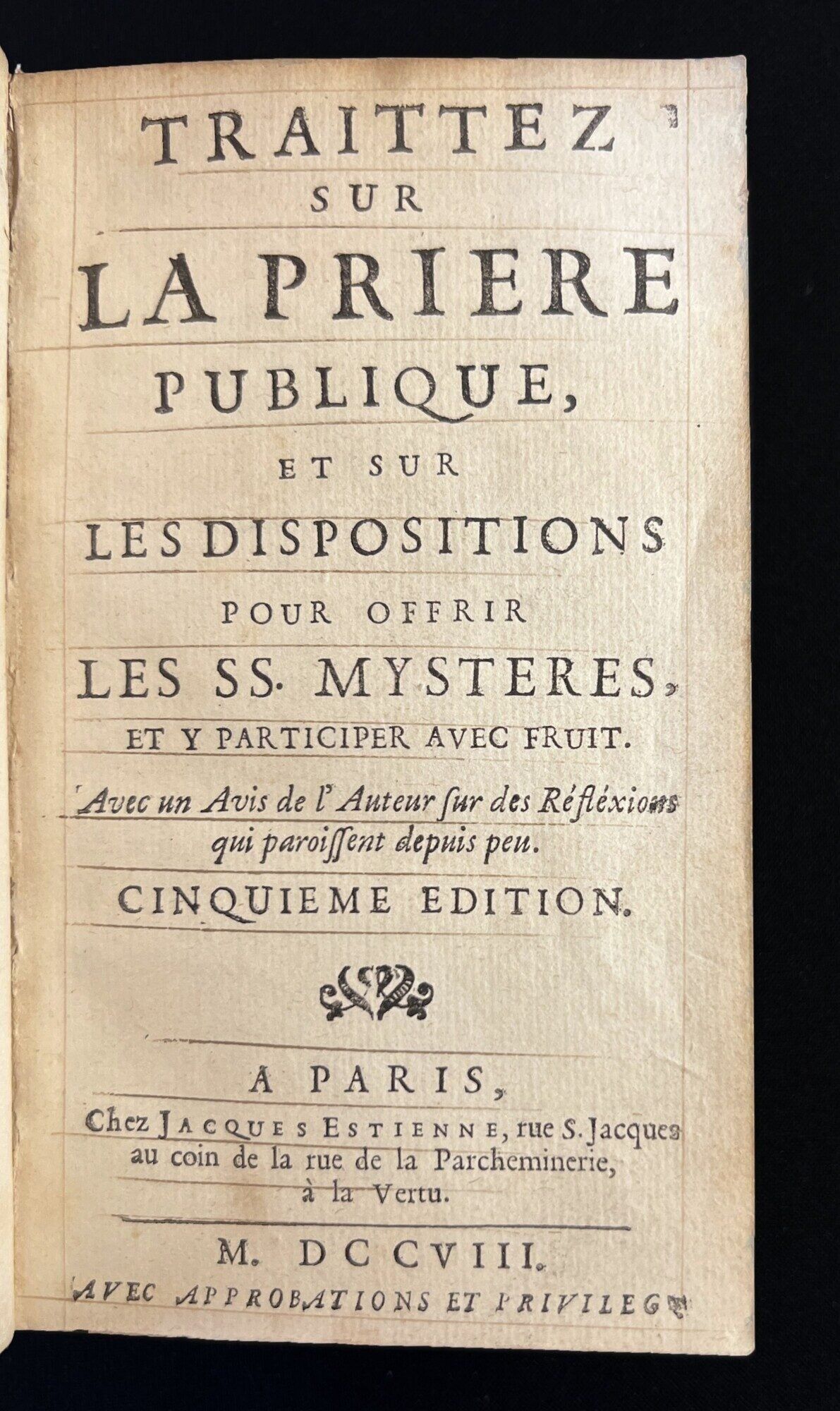
Traittez sur la priere publique et sur les dispositions pour offrir les SS. Mysteres ... Cinquième édition

- Paris: (Jacques Vincent for) Jacques Estienne, 1708
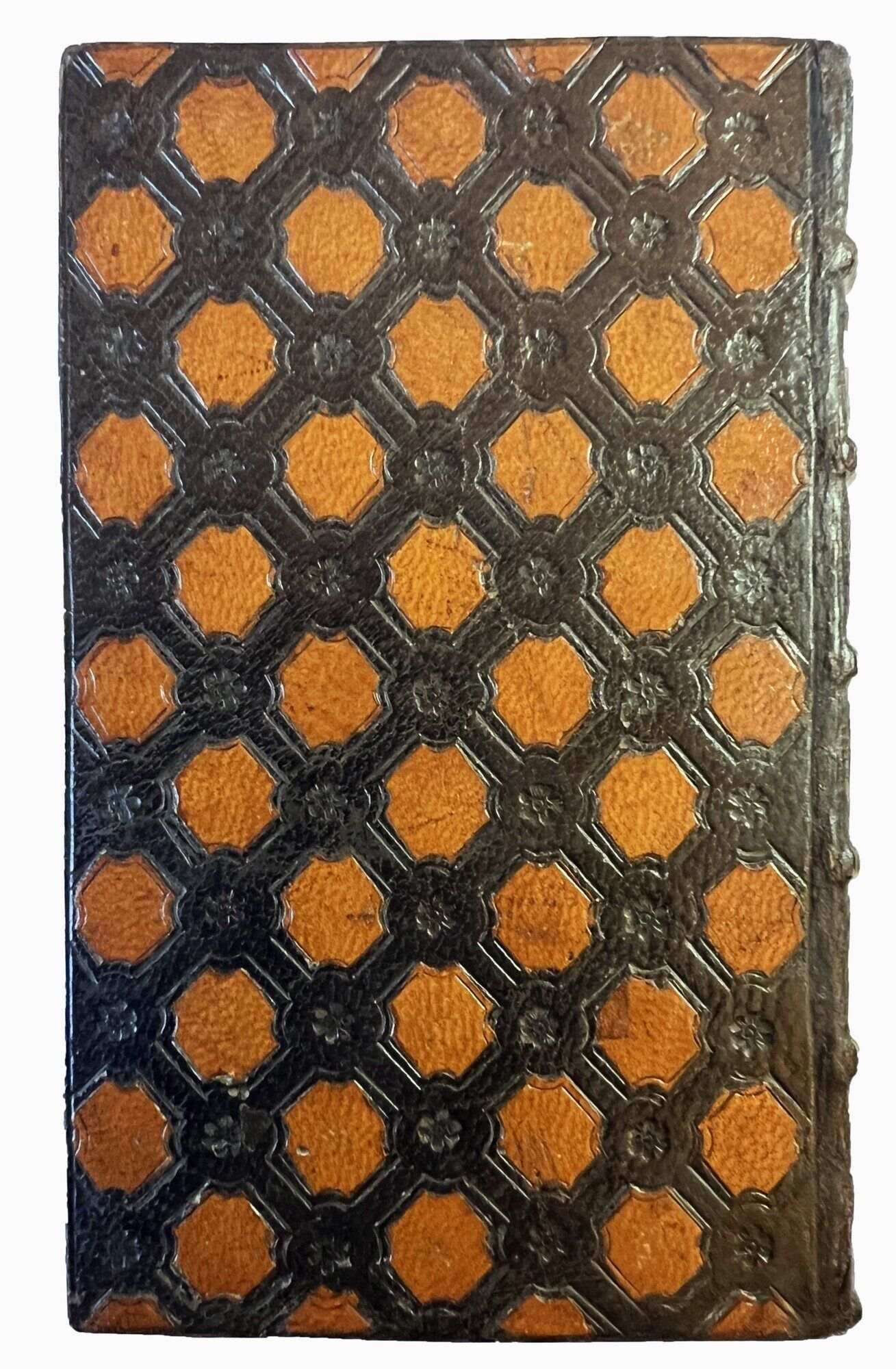
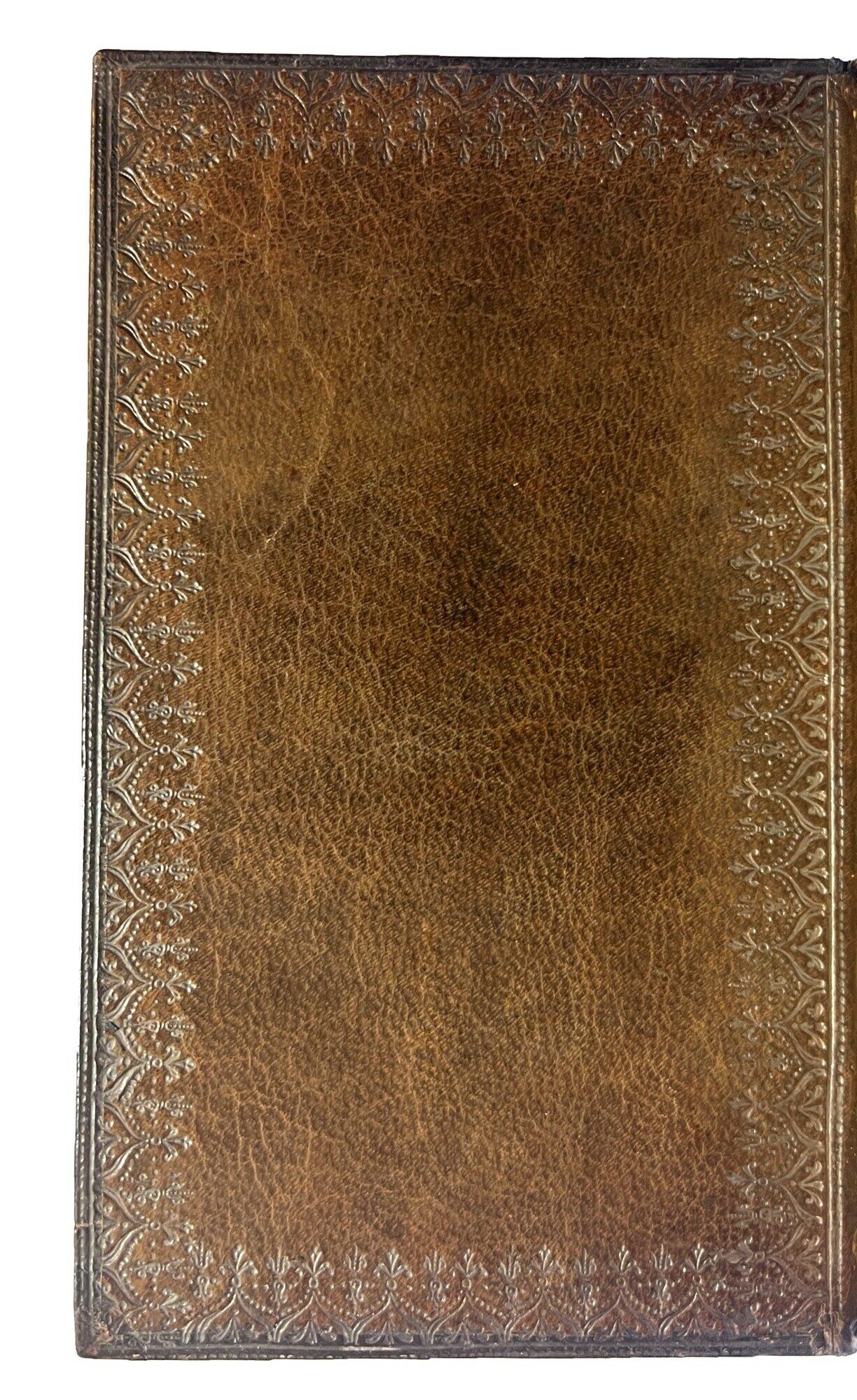
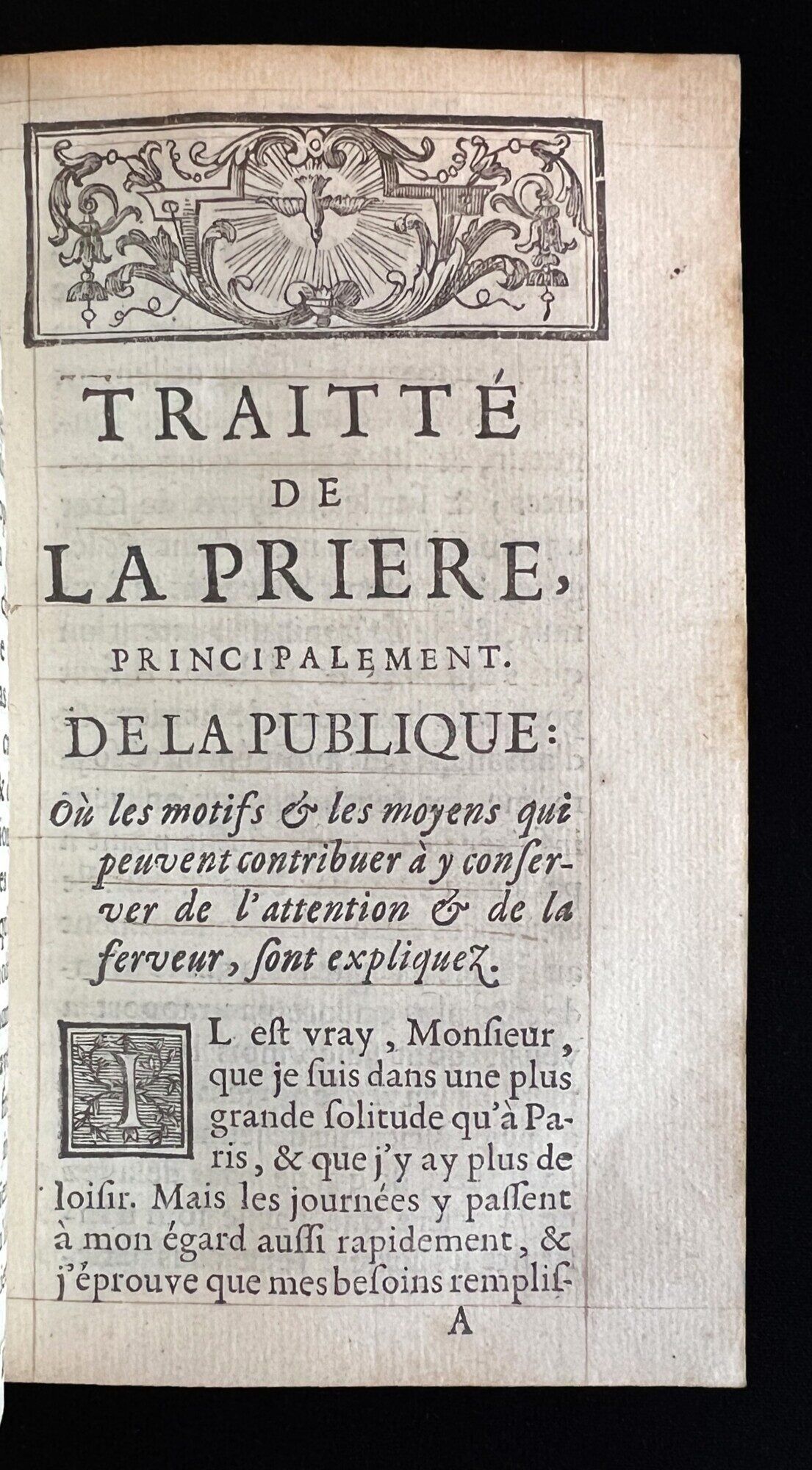
Paris: (Jacques Vincent for) Jacques Estienne, 1708. 2 parts in one, 12mo (binding 137 x 85 mm). [16], 284, [4], 252, [12] pages. Woodcut head- and tail-pieces and initial. Ruled in red throughout. At the end is a 4-page catalogue of books sold by Jacques Estienne. (Bifolium g6-7 in part 2 bound in reverse order.) Mosaic binding of black morocco, probably ca. 1725-1735, covers with an all-over design of repeated concave-cornered lozenges of onlaid light brown morocco, within a blind-tooled lattice design of double fillets and tiny six-petalled blossoms, spine in six compartments, five similarly decorated, each with one onlaid lozenge, second compartment with onlaid silver-tooled brown morocco lettering-piece, doublures of dark brown morocco with silver-tooled arabesque roll border, edges gilt over marbling (rehinged, upper joint chipping); modern suede-lined morocco folding box. Provenance: Paul-Louis Weiller (1893-1993), bookplate, his sale Paris, 30 Nov 1998, lot 32; modern booklabel, “non nove sed nova," initials CL.***
A mosaic “tile” or tessellated binding, attributable to Antoine-Michel Padeloup, on a popular Jansenist devotional text. This unusual binding reverses the usual color scheme of the small corpus of similar known bindings, providing a sober yet striking cover for the book.
“Around 1707 mosaic work ... began to be used in binding as it did in furniture and became the leading element in the design,.... These designs [were] now provided by onlay (as opposed to the sixteenth-century use of paint and wax)... Such mosaic work was either in a new form of the all-over semis (now incorporating a framed structure so that it often resembled a tessellated pavement and was sometimes termed à répétition), or with free-hand floral or other asymmetric realistic work” (Barber, Rothschild Waddesdon Manor catalogue, p. 201).
Tile-patterned mosaic bindings were usually used on small format books. Their invention is credited to the binder Antoine-Michel Padeloup, or Padeloup le jeune (1685-1758), who bound for the entourage of the Regent Philippe II d’Orléans (d. 1723). The height of the fashion for this style was probably the late 1720s and 1730s (Barber, p. 226). This style of decoration had the advantage of requiring little materiel. While “very labour-intensive, [the tile pattern style] requires only a few tools, all being common lines and curves (`gouges’) and hardly any `figure,’ that is, expensive, engraved tools. It would, as such, have suited under-capitalised, younger binders.... [But such designs] “clearly required careful planning and, doubtless, the preparation of a scaled plan based on both the exact size of the book and on the tools to be used” (loc. cit). The present binding contains only one tool on the outer covers, the small fleuron (Waddesdon catalogue, p. 384, fig. 11), and one roll, which was also apparently used only on doublures (Waddesdon catalogue I, p. 436, RBT 8).
Other tessellated mosaic bindings in this style, all attributed to Padeloup, are known: five, of which three using the same tools, are described and illustrated in the Waddesdon catalogue; another was reproduced by Michon and in the Esmérian catalogue. Those bindings use black or dark mororcco lozenges (gold-tooled) on a citron or light brown morocco ground, with gold-tooled lattice-work, creating a luminous effect. In contrast to those bindings, here Padeloup reversed the color scheme: a black ground with restrained silver and blind tooling serves as background for the tile design of unadorned brown morocco lozenges. While visually striking, the effect, enhanced by the silver-bordered doublures, is one of restraint, no doubt intentional, to reflect the book’s Jansenist content.
Barbier Anonymes IV: 814. Giles Barber, The James A. de Rothschild Bequest at Waddesdon Manor, The National Trust: Printed Books and Bookbindings, 2 vols. (2013); see nos. 90, 91, 92, 93 and 572. Cf. Louis Michon, Les reliures mosaïquées du XVIIIe siècle, no. 89 = Bibliothèque Raphaël Esmérian II, no. 89.
A mosaic “tile” or tessellated binding, attributable to Antoine-Michel Padeloup, on a popular Jansenist devotional text. This unusual binding reverses the usual color scheme of the small corpus of similar known bindings, providing a sober yet striking cover for the book.
“Around 1707 mosaic work ... began to be used in binding as it did in furniture and became the leading element in the design,.... These designs [were] now provided by onlay (as opposed to the sixteenth-century use of paint and wax)... Such mosaic work was either in a new form of the all-over semis (now incorporating a framed structure so that it often resembled a tessellated pavement and was sometimes termed à répétition), or with free-hand floral or other asymmetric realistic work” (Barber, Rothschild Waddesdon Manor catalogue, p. 201).
Tile-patterned mosaic bindings were usually used on small format books. Their invention is credited to the binder Antoine-Michel Padeloup, or Padeloup le jeune (1685-1758), who bound for the entourage of the Regent Philippe II d’Orléans (d. 1723). The height of the fashion for this style was probably the late 1720s and 1730s (Barber, p. 226). This style of decoration had the advantage of requiring little materiel. While “very labour-intensive, [the tile pattern style] requires only a few tools, all being common lines and curves (`gouges’) and hardly any `figure,’ that is, expensive, engraved tools. It would, as such, have suited under-capitalised, younger binders.... [But such designs] “clearly required careful planning and, doubtless, the preparation of a scaled plan based on both the exact size of the book and on the tools to be used” (loc. cit). The present binding contains only one tool on the outer covers, the small fleuron (Waddesdon catalogue, p. 384, fig. 11), and one roll, which was also apparently used only on doublures (Waddesdon catalogue I, p. 436, RBT 8).
Other tessellated mosaic bindings in this style, all attributed to Padeloup, are known: five, of which three using the same tools, are described and illustrated in the Waddesdon catalogue; another was reproduced by Michon and in the Esmérian catalogue. Those bindings use black or dark mororcco lozenges (gold-tooled) on a citron or light brown morocco ground, with gold-tooled lattice-work, creating a luminous effect. In contrast to those bindings, here Padeloup reversed the color scheme: a black ground with restrained silver and blind tooling serves as background for the tile design of unadorned brown morocco lozenges. While visually striking, the effect, enhanced by the silver-bordered doublures, is one of restraint, no doubt intentional, to reflect the book’s Jansenist content.
Barbier Anonymes IV: 814. Giles Barber, The James A. de Rothschild Bequest at Waddesdon Manor, The National Trust: Printed Books and Bookbindings, 2 vols. (2013); see nos. 90, 91, 92, 93 and 572. Cf. Louis Michon, Les reliures mosaïquées du XVIIIe siècle, no. 89 = Bibliothèque Raphaël Esmérian II, no. 89.
Details
Title
Traittez sur la priere publique et sur les dispositions pour offrir les SS. Mysteres ... Cinquième édition
Author
MOSAIC BINDING — [DUGUET, Jacques-Joseph (1649-1733), abbé]
Condition
Unknown
Publisher
(Jacques Vincent for) Jacques Estienne: Paris
Date
1708