

Here begynneth the prologue or prohemye of the book callid Caton" Disticha de moribus, in English and Latin. Translated from the French by William Caxton. With a paraphrase and commentary
- Hardcover
- Westminster: William Caxton, after 23 December, 1483
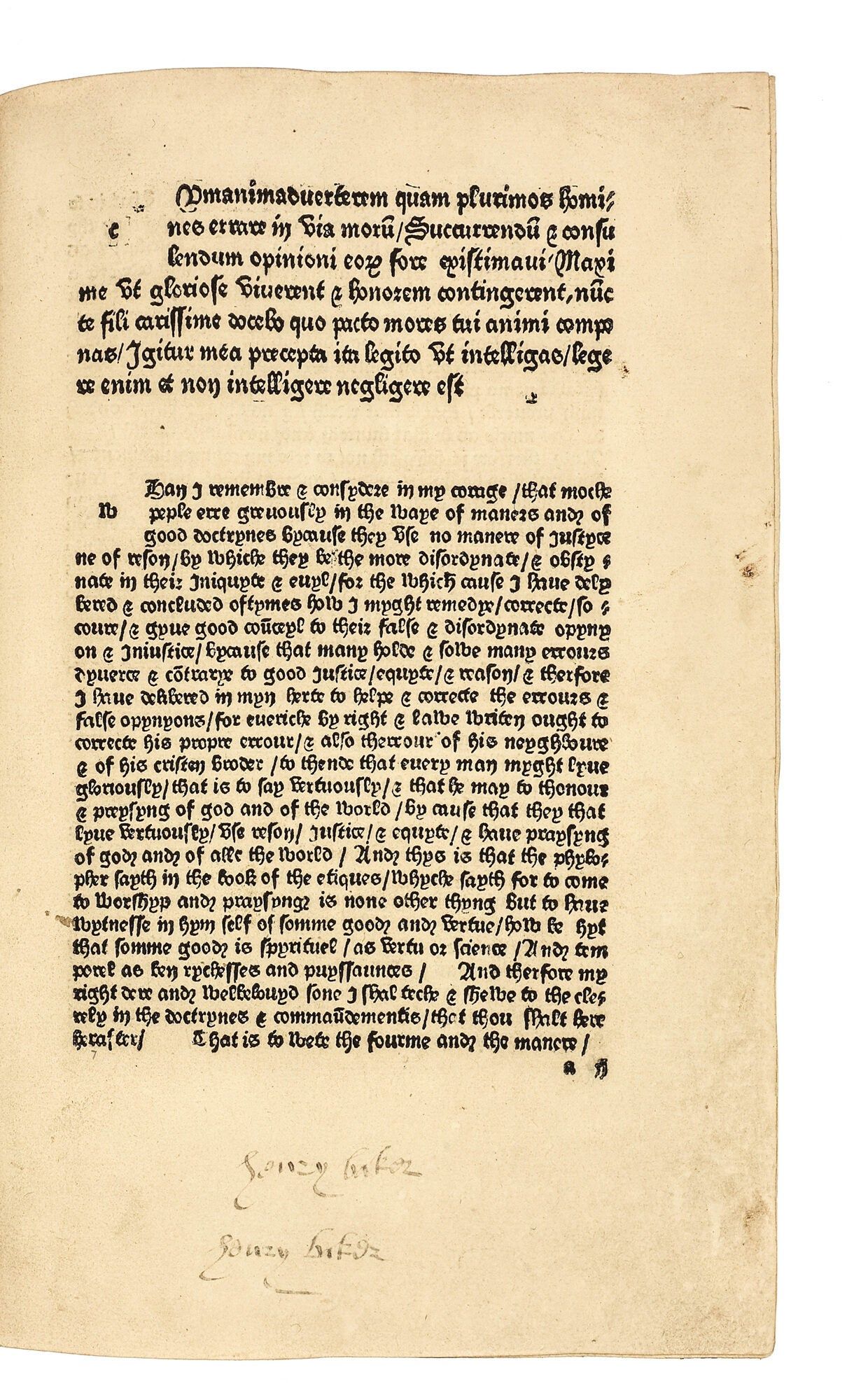
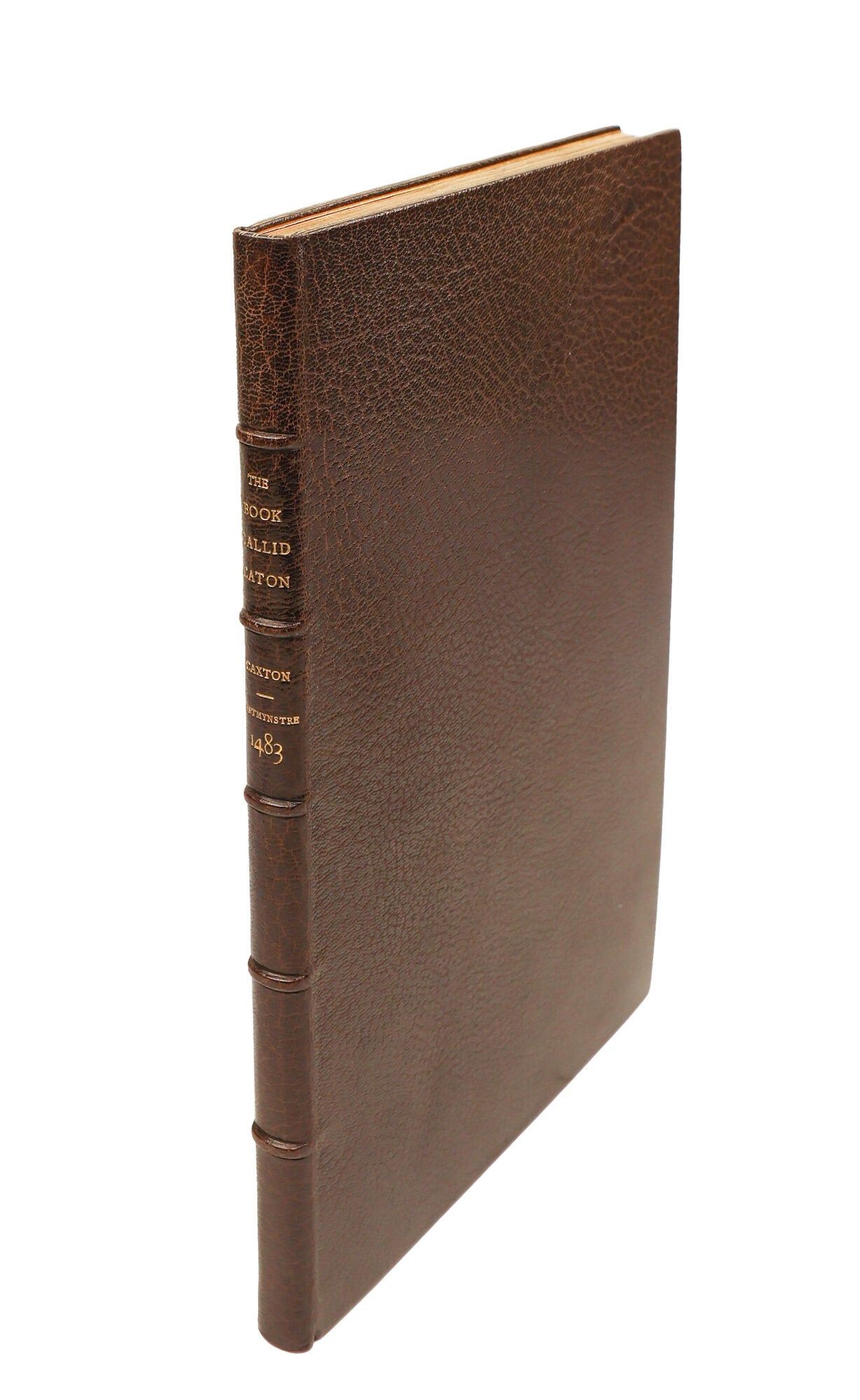
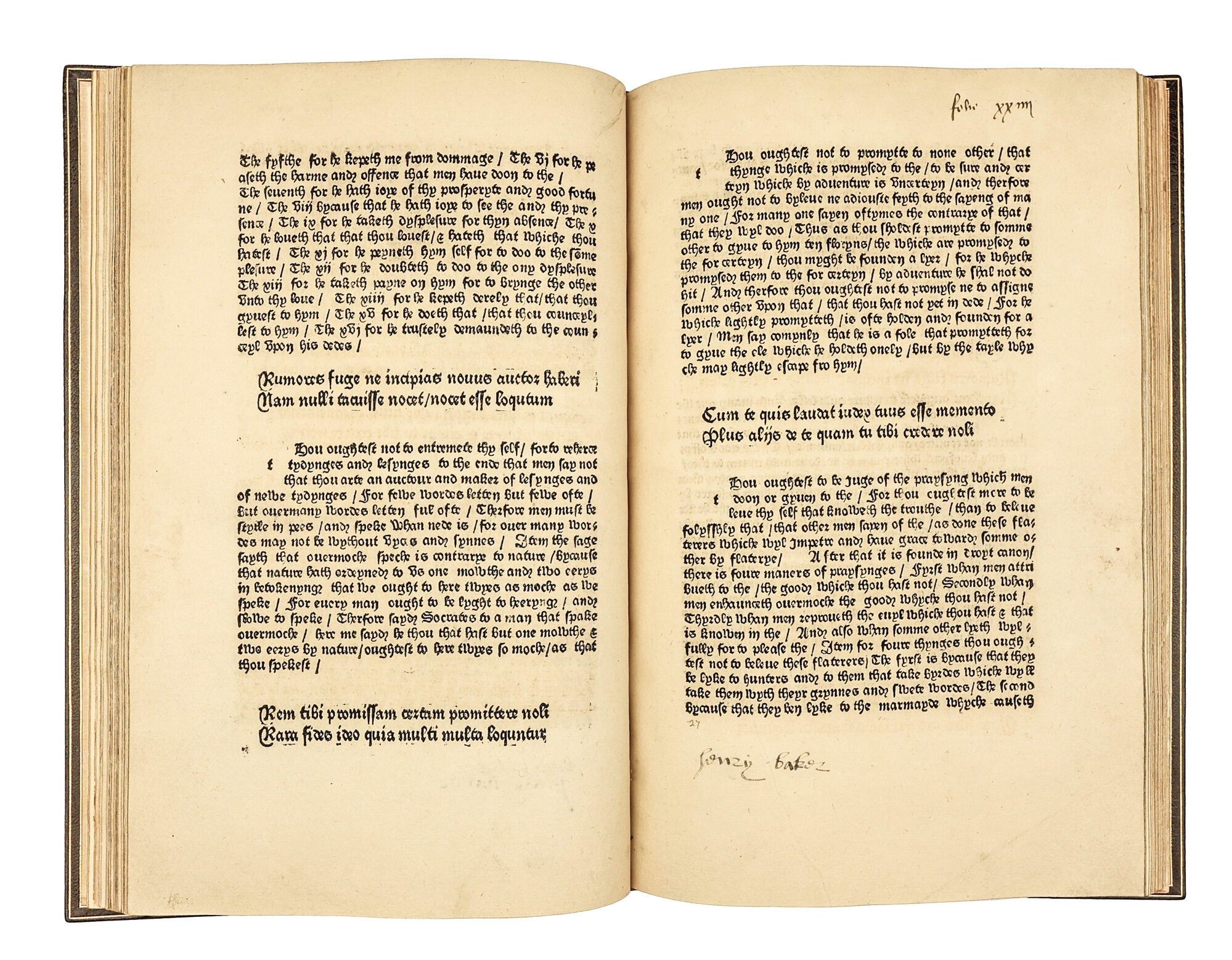
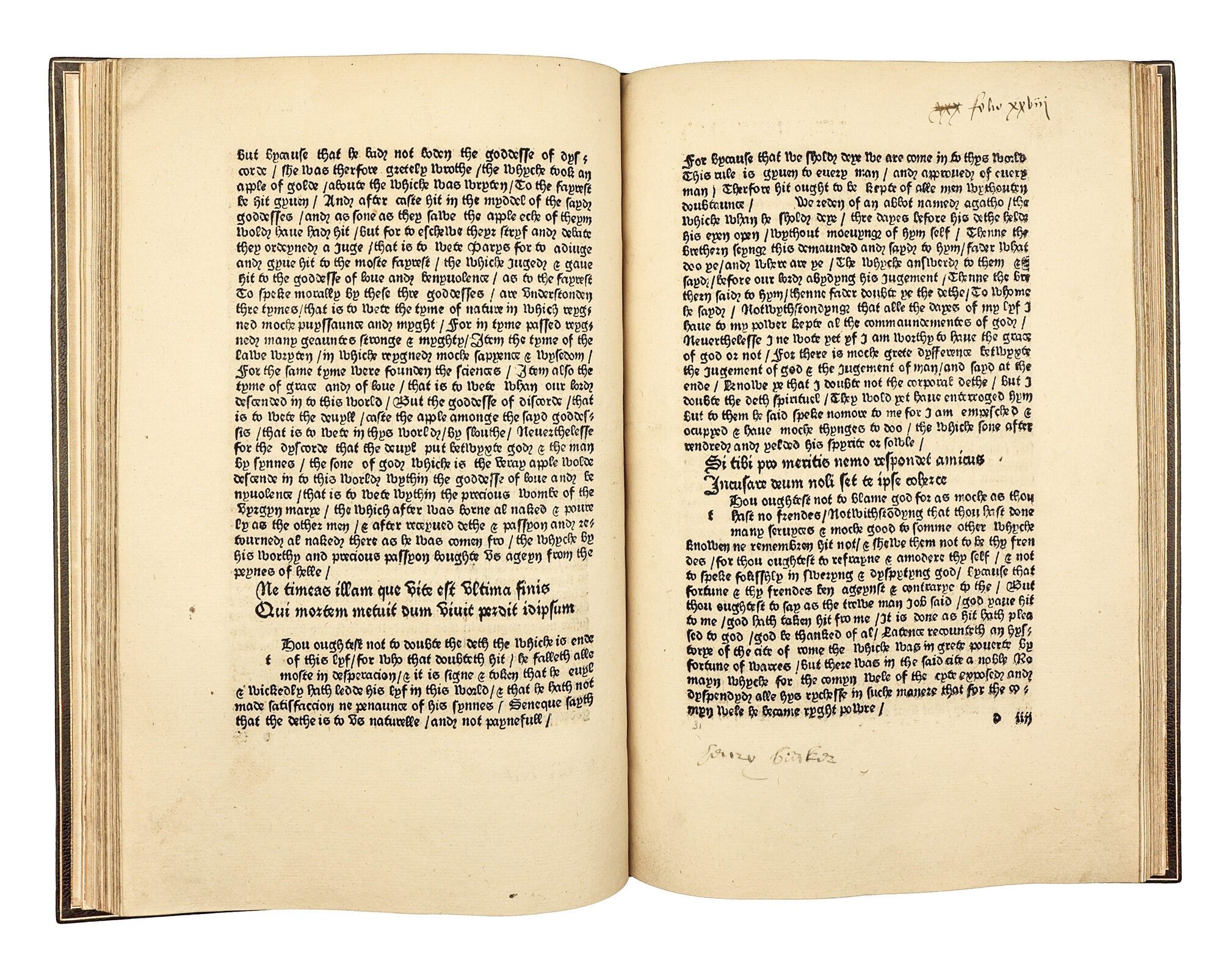
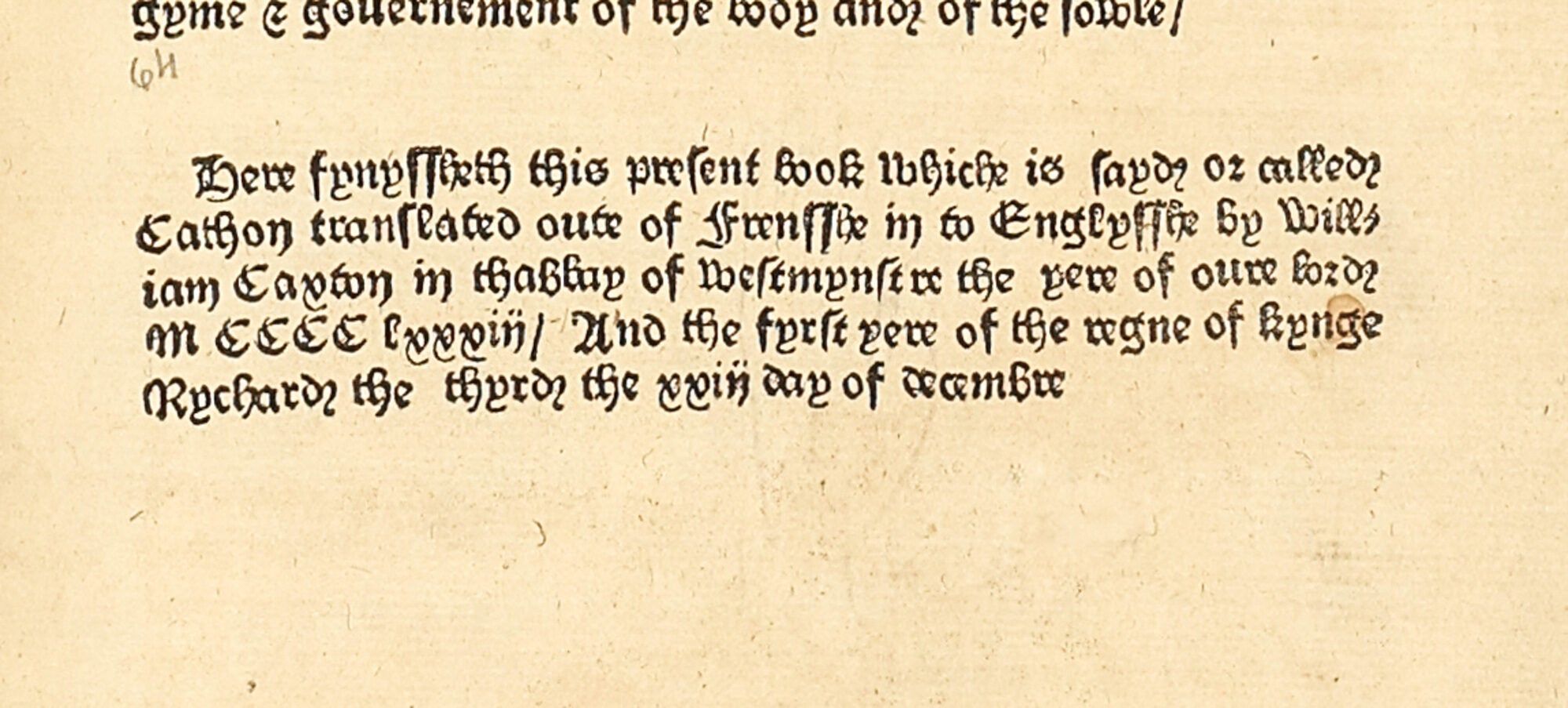
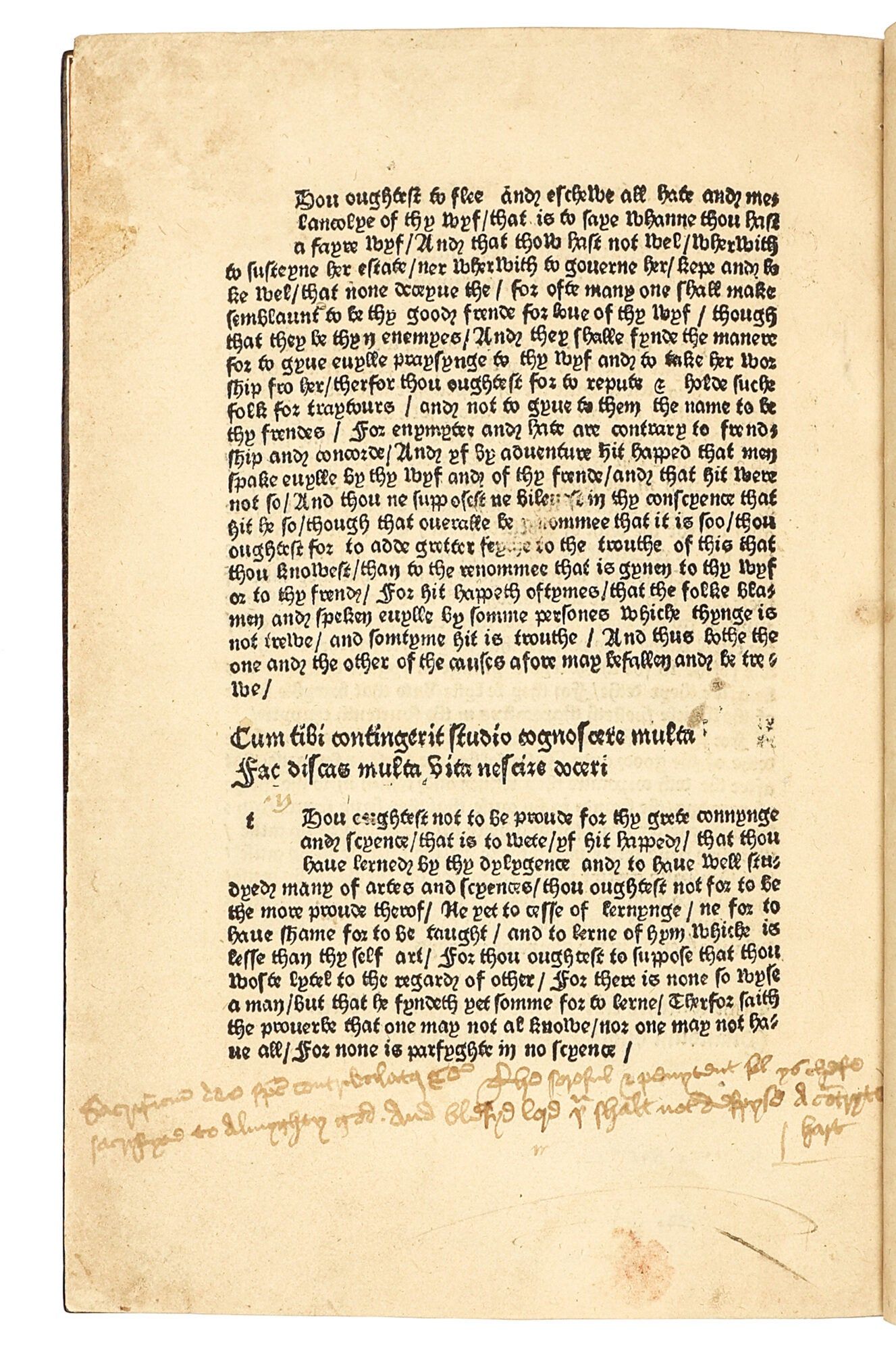
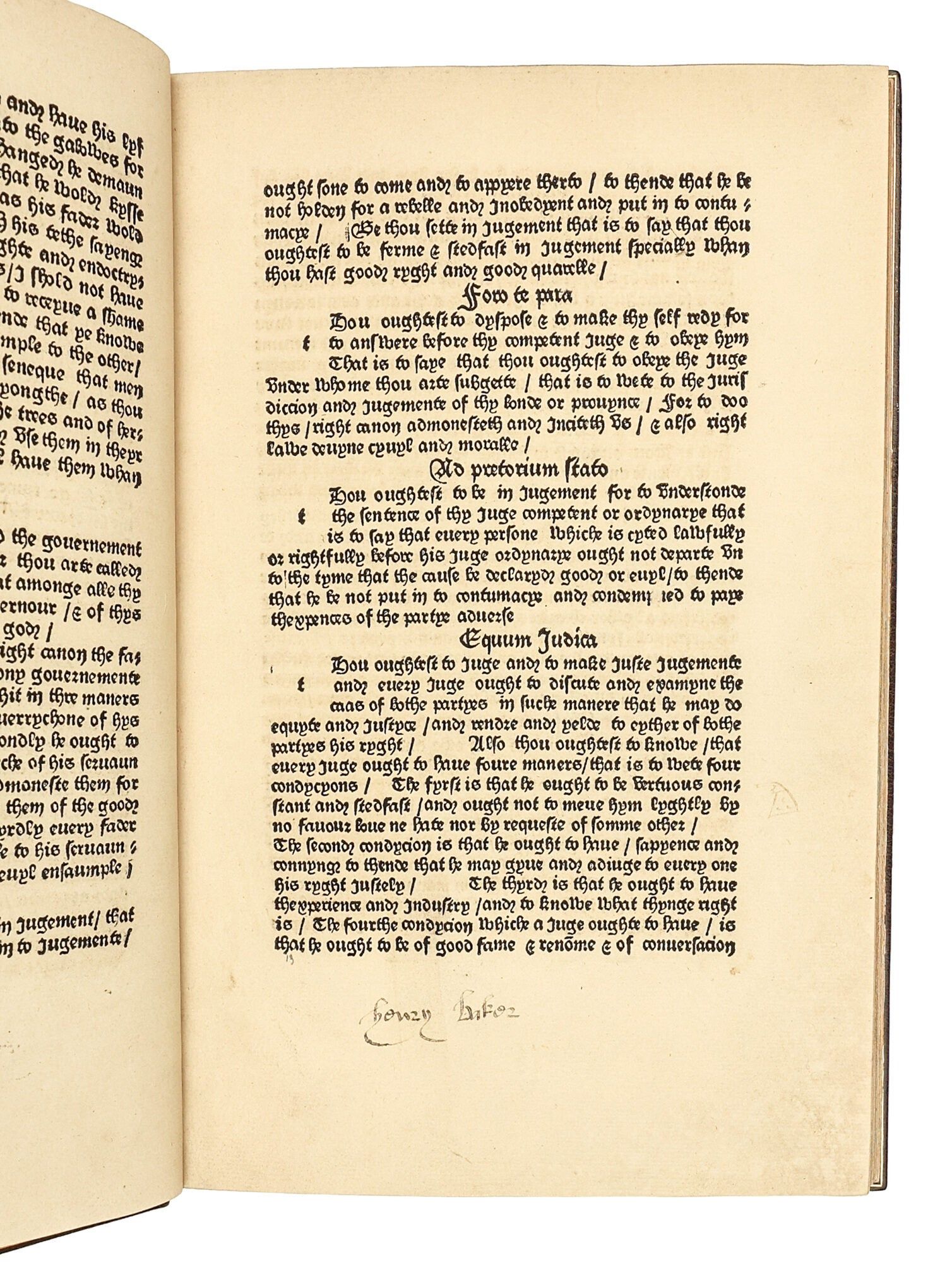
Westminster: William Caxton, after 23 December, 1483. FIRST EDITION. Hardcover. Fine. Bound in brown crushed morocco by Riviere and son, spine lettered in gilt, gilt edges. With 18 leaves in facsimile. Partly foliated in a contemporary hand (one tiny hole in penultimate leaf, washed and pressed, occasional small stain) Provenance: Henry Baker (contemporary signature on most lower margins) - "Richard" (contemporary inscription on giii) - Sir Joseph Whatley, KCH (1765-?1844; armorial bookplate and manuscript notes) - Bertram, 4th Earl of Ashburnham (1797-1878; his sale, Sotheby, Wilkinson & Hodge, 30 June 1897, lot 976; sold by Pickering to:) - Richard Bennett (1844-1900; pencil note) - [Phyllis Goodhart Gordan; by descent]. First edition, printed by England's first printer, William Caxton, of his own translation of Cato's Distichs, a popular 3rd c. collection of ethical proverbs and maxims intended to instill rules of honest living in accordance with good morals at all levels of society. The book features Caxton's remarkable prologue condemning the state of affairs in London, where "no one intends the common good, but only each man his own private profit." Caxton had printed three previous editions of an English verse translation (by Benedict Burgh) of the Distichs, but for the present edition, referred to as Cato IV, Caxton translated the work himself from a Latin original with a French prose version and commentary.
Little is known of William Caxton's early life; the first record of him is in 1438 when he is listed as an apprentice in the Mercers' Company. He became involved in foreign trade, and by 1465 he was head of the English merchant fraternity in Bruges. He moved to Cologne in 1471 to acquire a press and learn the printing business. In Cologne, Caxton completed his translation of "History of Troy" before returning to Bruges, where he set up his press and printed "Troy", the first book printed in English. About 1476 Caxton returned to England and set up his press at Westminster Abbey at the sign of the Red Pale.
Caxton began his translation of Cato's "Distichs" shortly after completing the "Golden Legend" in November 1483, and finished it on December 23. This book was probably printed in February 1484, between "Knight of the Tower" and "Aesop". "The last quire of this Cato IV contains the printed paragraph marks which were ordered for use in Aesop . . . so it seems that both these books were printed concurrently, and finished just at the moment when the new type material became available." (Painter, "Caxton: A Biography" 139)
Caxton's Cato:
The literature of edifying proverbs and "sententiae" enjoyed enormous success during the early Middle Ages. The "Distichs of Cato" were a particularly successful example of this genre, being read widely from the Carolingian period up to the 16th century. The book's misattributed to the great Roman statesman Cato the Elder (the book is now believed to be a late antique work by a Dionysius Cato) gave the book the weight of authority. From the 12th century onward, the readership broadened and it began to be used outside of the "collective" settings of the schools and universities, as edifying reading for private, personal contemplation.
Caxton dedicated his translation to the City of London, writing "I William Caxton, citizen of London... owe of right my service and good will, and, of very duty, am bound naturally to assist, aid, and counsel [London and its citizens], as far forth as I can to my power, as to my mother, of whom I have received my nurture and living. And shall pray for the good prosperity and policy of the same during my life."
Caxton believed that the moral and ethical instruction found in the book would be of great help to the citizens of London, a city in decline, where every man was concerned "with his singular profit" rather than the good of the "common weal". He considered the lessons of the Distichs especially important for children, calling it "the best book to be taught to young children in school." Caxton observed that by the time the well-born youth of London, born with every advantage, became adults, the excellent qualities that they exhibited in their early years had evaporated. Fewer than two in ten go on to become successful, moral men:
"And because I see that the children that be born within the said city increase and profit not like their fathers and elders, but for the most part after that they be come to their perfect years of discretion and ripeness of age, how well that their fathers have left to them great quantity of goods, yet scarcely two among ten thrive. And in this noble city of London it can scarcely continue unto the third heir, or scarcely to the second. I cannot judge the cause; but fairer, nor wiser, nor better bespoken children in their youth be nowhere than there be in London; but at their full ripening there is no kernel nor good corn found, but chaff for the most part."
In 1483, London was in turmoil following the death of King Edward IV. Richard, Duke of Gloucester, was named Lord Protector for the 12-year-old Edward V. However, before the coronation, Edward was deemed illegitimate because his parents' marriage was declared bigamous. Richard claimed the throne and was crowned in June. The last recorded sighting of Edward V and his brother Richard (the Princes in the Tower) was shortly after Richard's coronation. In October, the Duke of Buckingham launched a revolt against King Richard with the aim of installing Henry Tudor as king. The rebellion failed, but less than two years later Tudor would defeat King Richard at Bosworth Field, ending the Plantagenet Dynasty, beginning the Tudor era, and setting the stage for the English Renaissance.
The Distichs was the right text for these turbulent times, a text whose author "left so that all people might always learn from it how every person ought to rule and govern himself in this life, both in temporal matters and in spiritual life.".
Little is known of William Caxton's early life; the first record of him is in 1438 when he is listed as an apprentice in the Mercers' Company. He became involved in foreign trade, and by 1465 he was head of the English merchant fraternity in Bruges. He moved to Cologne in 1471 to acquire a press and learn the printing business. In Cologne, Caxton completed his translation of "History of Troy" before returning to Bruges, where he set up his press and printed "Troy", the first book printed in English. About 1476 Caxton returned to England and set up his press at Westminster Abbey at the sign of the Red Pale.
Caxton began his translation of Cato's "Distichs" shortly after completing the "Golden Legend" in November 1483, and finished it on December 23. This book was probably printed in February 1484, between "Knight of the Tower" and "Aesop". "The last quire of this Cato IV contains the printed paragraph marks which were ordered for use in Aesop . . . so it seems that both these books were printed concurrently, and finished just at the moment when the new type material became available." (Painter, "Caxton: A Biography" 139)
Caxton's Cato:
The literature of edifying proverbs and "sententiae" enjoyed enormous success during the early Middle Ages. The "Distichs of Cato" were a particularly successful example of this genre, being read widely from the Carolingian period up to the 16th century. The book's misattributed to the great Roman statesman Cato the Elder (the book is now believed to be a late antique work by a Dionysius Cato) gave the book the weight of authority. From the 12th century onward, the readership broadened and it began to be used outside of the "collective" settings of the schools and universities, as edifying reading for private, personal contemplation.
Caxton dedicated his translation to the City of London, writing "I William Caxton, citizen of London... owe of right my service and good will, and, of very duty, am bound naturally to assist, aid, and counsel [London and its citizens], as far forth as I can to my power, as to my mother, of whom I have received my nurture and living. And shall pray for the good prosperity and policy of the same during my life."
Caxton believed that the moral and ethical instruction found in the book would be of great help to the citizens of London, a city in decline, where every man was concerned "with his singular profit" rather than the good of the "common weal". He considered the lessons of the Distichs especially important for children, calling it "the best book to be taught to young children in school." Caxton observed that by the time the well-born youth of London, born with every advantage, became adults, the excellent qualities that they exhibited in their early years had evaporated. Fewer than two in ten go on to become successful, moral men:
"And because I see that the children that be born within the said city increase and profit not like their fathers and elders, but for the most part after that they be come to their perfect years of discretion and ripeness of age, how well that their fathers have left to them great quantity of goods, yet scarcely two among ten thrive. And in this noble city of London it can scarcely continue unto the third heir, or scarcely to the second. I cannot judge the cause; but fairer, nor wiser, nor better bespoken children in their youth be nowhere than there be in London; but at their full ripening there is no kernel nor good corn found, but chaff for the most part."
In 1483, London was in turmoil following the death of King Edward IV. Richard, Duke of Gloucester, was named Lord Protector for the 12-year-old Edward V. However, before the coronation, Edward was deemed illegitimate because his parents' marriage was declared bigamous. Richard claimed the throne and was crowned in June. The last recorded sighting of Edward V and his brother Richard (the Princes in the Tower) was shortly after Richard's coronation. In October, the Duke of Buckingham launched a revolt against King Richard with the aim of installing Henry Tudor as king. The rebellion failed, but less than two years later Tudor would defeat King Richard at Bosworth Field, ending the Plantagenet Dynasty, beginning the Tudor era, and setting the stage for the English Renaissance.
The Distichs was the right text for these turbulent times, a text whose author "left so that all people might always learn from it how every person ought to rule and govern himself in this life, both in temporal matters and in spiritual life.".
Details
Title
Here begynneth the prologue or prohemye of the book callid Caton" Disticha de moribus, in English and Latin. Translated from the French by William Caxton. With a paraphrase and commentary
Author
Pseudo-CATO, Dionysius (c.3rd-4th centuries C.E.). CAXTON, William (ca. 1422-1492)
Binding
Hardcover
Condition
Fine
Publisher
William Caxton, after 23 December: Westminster
Date
1483
Edition
FIRST EDITION