

Le sacre du printemps. Tableaux de la Russie Paienne en Deux Parties d'Igor Strawinsky et Nicolas Roerich. Reduction pour piano a quatre mains par l'auteur
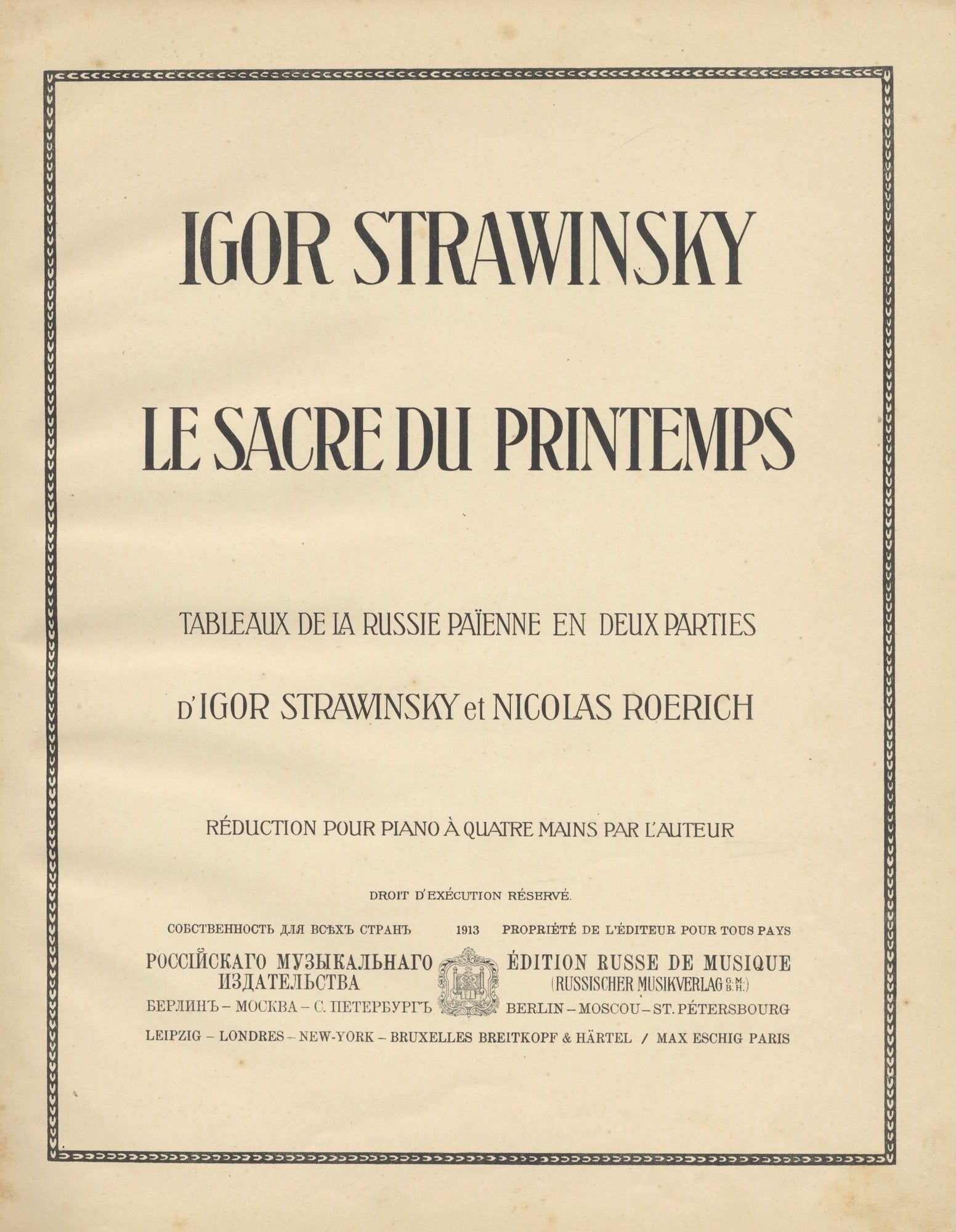
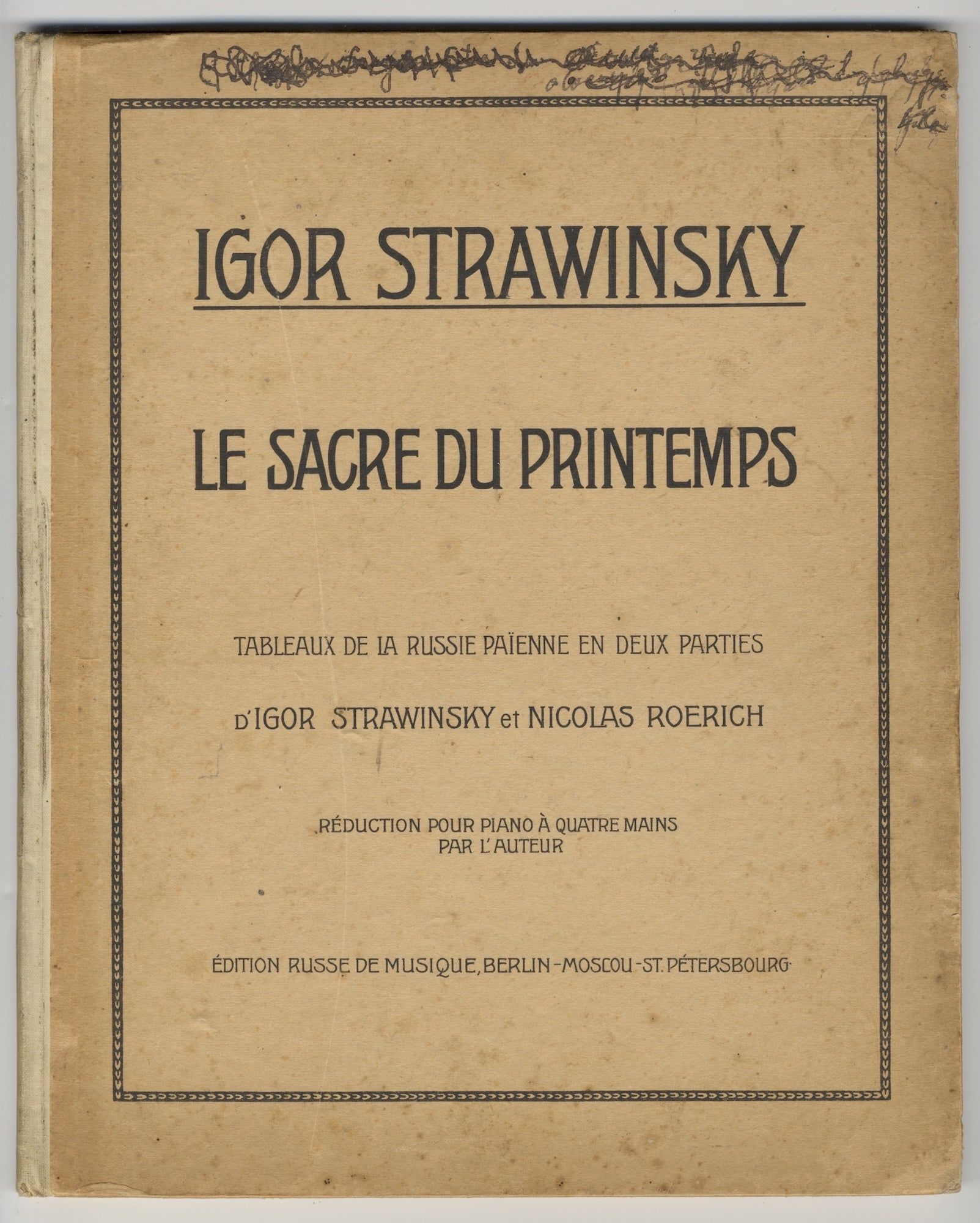
- Berlin - Moscou - St. Petersbourg: Édition Russe de Musique [PN R.M.V. 196], 1913
Berlin - Moscou - St. Petersbourg: Édition Russe de Musique [PN R.M.V. 196], 1913. Folio. Original publisher's ivory cloth-backed dark ivory printed boards 1f. (reco title, verso blank), 1f. (recto half-title in French, verso blank), 1f. (recto half title in Russian, verso blank), 1f. (recto dedication to Nicolas Roerich, verso blank), 9-89. [i] (blank) pp.
Binding slightly worn, browned, and foxed, with manuscript annotation to blank upper margin of upper deleted in black ink. Slightly browned throughout; corners thumbed; some minor imperfections.
In very good condition overall. First Edition, first issue of the four-hand piano arrangement, and the first appearance in print of the music, pre-dating the full score by eight years. Rare. Kirchmeyer 15-1. De Lerma S3. White 21, p. 207. Crawford p. 543.
"Unlike the orchestral score, which did not appear in print until early 1922, the piano-duet version was published by Édition Russe de Musique shortly before the première, and was soon reissued in response to considerable demand. But special importance attaches to this [four-hand] version not only for historical reasons, but because of its specific aesthetic quality, for it directly brings out the "pianistic" nature of many of the work's musical ideas. True, not for a moment do we forget that The Rite of Spring owes a large part of its impact to its orchestral sound, now subtly differentiated, now brutally violent. But it allows the structural workings of a piece invented at the piano, and developed in close contact with the instrument, to come all the more trenchantly to the fore. It was not least because of this trenchancy and "closeness to the origin" that the piano version has, in recent decades, begun to emerge from its primary role as an object of study and a rehearsal aid and to take on a second life as an independent concert piece. It has even formed the basis of a number of ballet productions." Meyer, ed.: Igor Stravinsky Le Sacre du printemps Manuscript of the Version for Piano Four Hands Facsimile, p. 23
The momentous first performance of The Rite took place in Paris at the Théâtre des Champs-Elysées on 29 May 1913. It was conducted by Monteux, with choreography by Vaslav Nijinsky and set and costume designs by Nicolas Roerich.
"It is now theatrical history that the first performance by the Russian Ballet ... created a scandal of the first magnitude ..." White: Stravinsky. The Composer and His Works, p. 216.
Since that time there have been a number of other versions of the ballet, one choreographed by Leonide Massine (1920, at the Théâtre des Champs-Elysées, with Roerich's original set designs), and another by Kenneth Macmillan (1962, at Covent Garden, with set designs by Sydney Nolan), "but the work is more popular and seems to make a greater impact in the concert hall than on the stage.
Its triumphant rehabilitation as one of the most important works in the symphonic repertory of the twentieth century dates from its first concert performances - in Moscow (February 1914; conductor, S. Koussevitzky), Paris (Casino de Paris, April 1914; conductor, Monteux), and London (Queen's Hall, 7 June 1921; conductor, Eugene Goossens)." Ibid
Diaghilev referred to The Rite of Spring as "the 20th century's Ninth Symphony." Austin: Music in the 20th Century, p. 252.
"[Le sacre du printemps] was to remain the most notoriously violent score of a time when huge, noisy orchestras and harsh dissonance were more or less commonplace appurtenances of the new music. The primitive imagery of Russian symbolism, of the kind exploited by Roerich, had always carried a certain revolutionary tone, a note of challenge to ossified social structures. But behind all the racket, behind the wilfully discordant harmonies and convulsive metric irregularities lay a genuinely innovatory kind of musical thinking whose point would not become clear until Stravinsky himself began to deconstruct it in subsequent works." Stephen Walsh in Grove Music Online.
Binding slightly worn, browned, and foxed, with manuscript annotation to blank upper margin of upper deleted in black ink. Slightly browned throughout; corners thumbed; some minor imperfections.
In very good condition overall. First Edition, first issue of the four-hand piano arrangement, and the first appearance in print of the music, pre-dating the full score by eight years. Rare. Kirchmeyer 15-1. De Lerma S3. White 21, p. 207. Crawford p. 543.
"Unlike the orchestral score, which did not appear in print until early 1922, the piano-duet version was published by Édition Russe de Musique shortly before the première, and was soon reissued in response to considerable demand. But special importance attaches to this [four-hand] version not only for historical reasons, but because of its specific aesthetic quality, for it directly brings out the "pianistic" nature of many of the work's musical ideas. True, not for a moment do we forget that The Rite of Spring owes a large part of its impact to its orchestral sound, now subtly differentiated, now brutally violent. But it allows the structural workings of a piece invented at the piano, and developed in close contact with the instrument, to come all the more trenchantly to the fore. It was not least because of this trenchancy and "closeness to the origin" that the piano version has, in recent decades, begun to emerge from its primary role as an object of study and a rehearsal aid and to take on a second life as an independent concert piece. It has even formed the basis of a number of ballet productions." Meyer, ed.: Igor Stravinsky Le Sacre du printemps Manuscript of the Version for Piano Four Hands Facsimile, p. 23
The momentous first performance of The Rite took place in Paris at the Théâtre des Champs-Elysées on 29 May 1913. It was conducted by Monteux, with choreography by Vaslav Nijinsky and set and costume designs by Nicolas Roerich.
"It is now theatrical history that the first performance by the Russian Ballet ... created a scandal of the first magnitude ..." White: Stravinsky. The Composer and His Works, p. 216.
Since that time there have been a number of other versions of the ballet, one choreographed by Leonide Massine (1920, at the Théâtre des Champs-Elysées, with Roerich's original set designs), and another by Kenneth Macmillan (1962, at Covent Garden, with set designs by Sydney Nolan), "but the work is more popular and seems to make a greater impact in the concert hall than on the stage.
Its triumphant rehabilitation as one of the most important works in the symphonic repertory of the twentieth century dates from its first concert performances - in Moscow (February 1914; conductor, S. Koussevitzky), Paris (Casino de Paris, April 1914; conductor, Monteux), and London (Queen's Hall, 7 June 1921; conductor, Eugene Goossens)." Ibid
Diaghilev referred to The Rite of Spring as "the 20th century's Ninth Symphony." Austin: Music in the 20th Century, p. 252.
"[Le sacre du printemps] was to remain the most notoriously violent score of a time when huge, noisy orchestras and harsh dissonance were more or less commonplace appurtenances of the new music. The primitive imagery of Russian symbolism, of the kind exploited by Roerich, had always carried a certain revolutionary tone, a note of challenge to ossified social structures. But behind all the racket, behind the wilfully discordant harmonies and convulsive metric irregularities lay a genuinely innovatory kind of musical thinking whose point would not become clear until Stravinsky himself began to deconstruct it in subsequent works." Stephen Walsh in Grove Music Online.
Details
Title
Le sacre du printemps. Tableaux de la Russie Paienne en Deux Parties d'Igor Strawinsky et Nicolas Roerich. Reduction pour piano a quatre mains par l'auteur
Author
STRAVINSKY, Igor 1882-1971
Condition
Unknown
Publisher
Édition Russe de Musique [PN R.M.V. 196]: Berlin - Moscou - St. Petersbourg
Date
1913