

Pétrouchka Scènes Burlesques en 4 Tableaux d'Igor Strawinsky et Alexandre Benois. Partition d'Orchestre. [Full score]
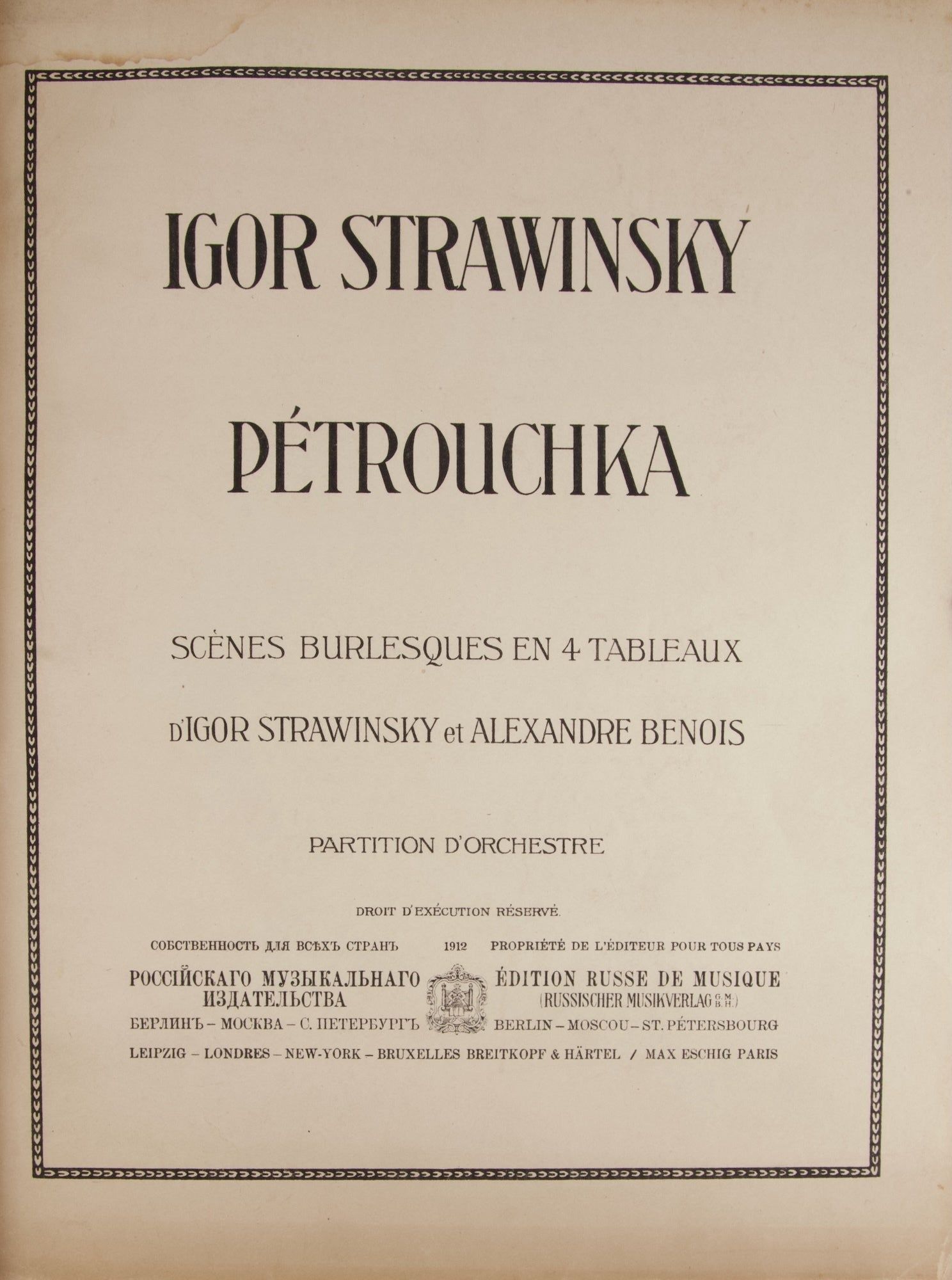
- Berlin, Moscou, St. Pétersbourg ..: Édition Russe de Musique [PN R.M.V. 127], 1912
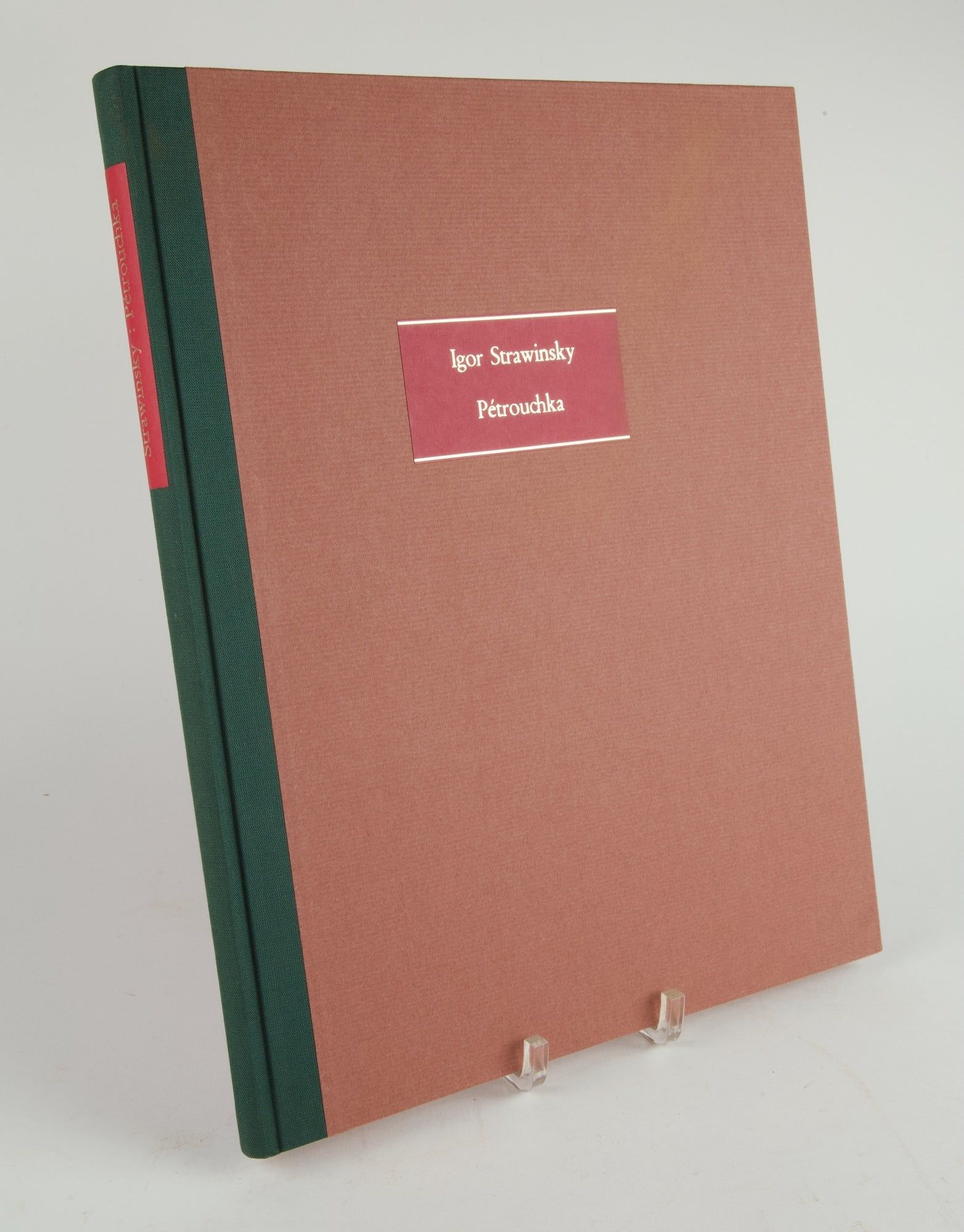
Berlin, Moscou, St. Pétersbourg ..: Édition Russe de Musique [PN R.M.V. 127], 1912. Folio. Newly bound in quarter dark green cloth with mid-brown paper boards, dark red title label gilt to upper and spine. 1f. (recto title, verso blank), [i] (named cast list), [ii] (synopsis), [i] (orchestration), [i] (recto dedication "À Alexandre Benois," verso blank), 7-156 pp. + 1f. (errata) tipped in to rear pastedown. With text in Russian and French.
Named cast for the first performance by Diaghilev's Ballets Russes at the Théâtre du Chatelet in Paris on 13 June 1911 includes Tamar Karsavina (Le Ballerine), Vaslav Nijinsky (Petrushka), Orlow (Le Maure), and Enrico Ceccheti (Le vieux Charlatan); the performance was conducted by Monteux, with maître du ballet Fokine, and sets and costumes designed by Benois and executed by Anisfeld (sets) and Caffi and Worobiew (costumes).
Small area of faint dampstaining and minor cockling to upper inner margins.
An attractive copy. First Edition, first issue. Rare. Kirchmeyer 12-1. Hirsch II, 905. De Lerma, P15. White, p. 193. Crawford, p. 533.
"The emergence of Stravinsky as a modernist, with an individual manner unlike any other, can be dated with some precision to his early work on Petrushka. In March 1910, during the later stages of composing The Firebird, he had experienced the famous 'fleeting vision' out of which The Rite of Spring was to grow. But when Diaghilev and Nijinsky visited him in Lausanne in September 1910 they found him at work on something quite different, a concert piece for piano and orchestra called 'Petrushka's Cry'. Together with a 'Russian Dance' composed soon afterwards, this music was to form the basis of the ballet which Diaghilev instinctively urged him to write instead. ...
It is from the systematic attempt to render [the] particular flavour of traditional Russian life into music that Petrushka derives many of its freshest and most original qualities. ...
Looked at in general terms, [the] opening sequence of Petrushka is a prototype of later Stravinskian form. Its underlying rhythmic design may not be complex in the same way as that of The Rite of Spring or the later Russian works, but its intricacy of rhythmic detailing and its mixture of a highly fluid pattern of melodic stress with an inert background harmony laid the groundwork for a technique which, through many changes of superficial style, was to serve him for the rest of his life." Walsh: The Music of Stravinsky, pp. 24-29.
"Petroushka proved just as successful with the public and critics as The Firebird had been; but it was undoubtedly a more original work. In the first place, Stravinsky had been able to play a leading part in the construction of the scenario, which had not been the case with The Firebird. Secondly, whereas the music of The Firebird showed that the pupil had learnt all that his master had had to teach him, in Petrushka for the first time the authentic voice of the new master is heard." TNG Vol. 18, pp. 244-245.
The rare first edition, first issue of Stravinsky's colorful and well-loved ballet, inspired by the St. Petersburg Shrove-tide Fair.
Named cast for the first performance by Diaghilev's Ballets Russes at the Théâtre du Chatelet in Paris on 13 June 1911 includes Tamar Karsavina (Le Ballerine), Vaslav Nijinsky (Petrushka), Orlow (Le Maure), and Enrico Ceccheti (Le vieux Charlatan); the performance was conducted by Monteux, with maître du ballet Fokine, and sets and costumes designed by Benois and executed by Anisfeld (sets) and Caffi and Worobiew (costumes).
Small area of faint dampstaining and minor cockling to upper inner margins.
An attractive copy. First Edition, first issue. Rare. Kirchmeyer 12-1. Hirsch II, 905. De Lerma, P15. White, p. 193. Crawford, p. 533.
"The emergence of Stravinsky as a modernist, with an individual manner unlike any other, can be dated with some precision to his early work on Petrushka. In March 1910, during the later stages of composing The Firebird, he had experienced the famous 'fleeting vision' out of which The Rite of Spring was to grow. But when Diaghilev and Nijinsky visited him in Lausanne in September 1910 they found him at work on something quite different, a concert piece for piano and orchestra called 'Petrushka's Cry'. Together with a 'Russian Dance' composed soon afterwards, this music was to form the basis of the ballet which Diaghilev instinctively urged him to write instead. ...
It is from the systematic attempt to render [the] particular flavour of traditional Russian life into music that Petrushka derives many of its freshest and most original qualities. ...
Looked at in general terms, [the] opening sequence of Petrushka is a prototype of later Stravinskian form. Its underlying rhythmic design may not be complex in the same way as that of The Rite of Spring or the later Russian works, but its intricacy of rhythmic detailing and its mixture of a highly fluid pattern of melodic stress with an inert background harmony laid the groundwork for a technique which, through many changes of superficial style, was to serve him for the rest of his life." Walsh: The Music of Stravinsky, pp. 24-29.
"Petroushka proved just as successful with the public and critics as The Firebird had been; but it was undoubtedly a more original work. In the first place, Stravinsky had been able to play a leading part in the construction of the scenario, which had not been the case with The Firebird. Secondly, whereas the music of The Firebird showed that the pupil had learnt all that his master had had to teach him, in Petrushka for the first time the authentic voice of the new master is heard." TNG Vol. 18, pp. 244-245.
The rare first edition, first issue of Stravinsky's colorful and well-loved ballet, inspired by the St. Petersburg Shrove-tide Fair.
Details
Title
Pétrouchka Scènes Burlesques en 4 Tableaux d'Igor Strawinsky et Alexandre Benois. Partition d'Orchestre. [Full score]
Author
STRAVINSKY, Igor 1882-1971
Condition
Unknown
Publisher
Édition Russe de Musique [PN R.M.V. 127]: Berlin, Moscou, St. Pétersbourg ..
Date
1912