

Autograph Letter Signed, Corpus Christi, Texas, March 14, 1846, to General and Senator, and the future Secretary of War under Lincoln, Simon Cameron, Washington, mis-sent as Cameron was in Austin, Texas at the time
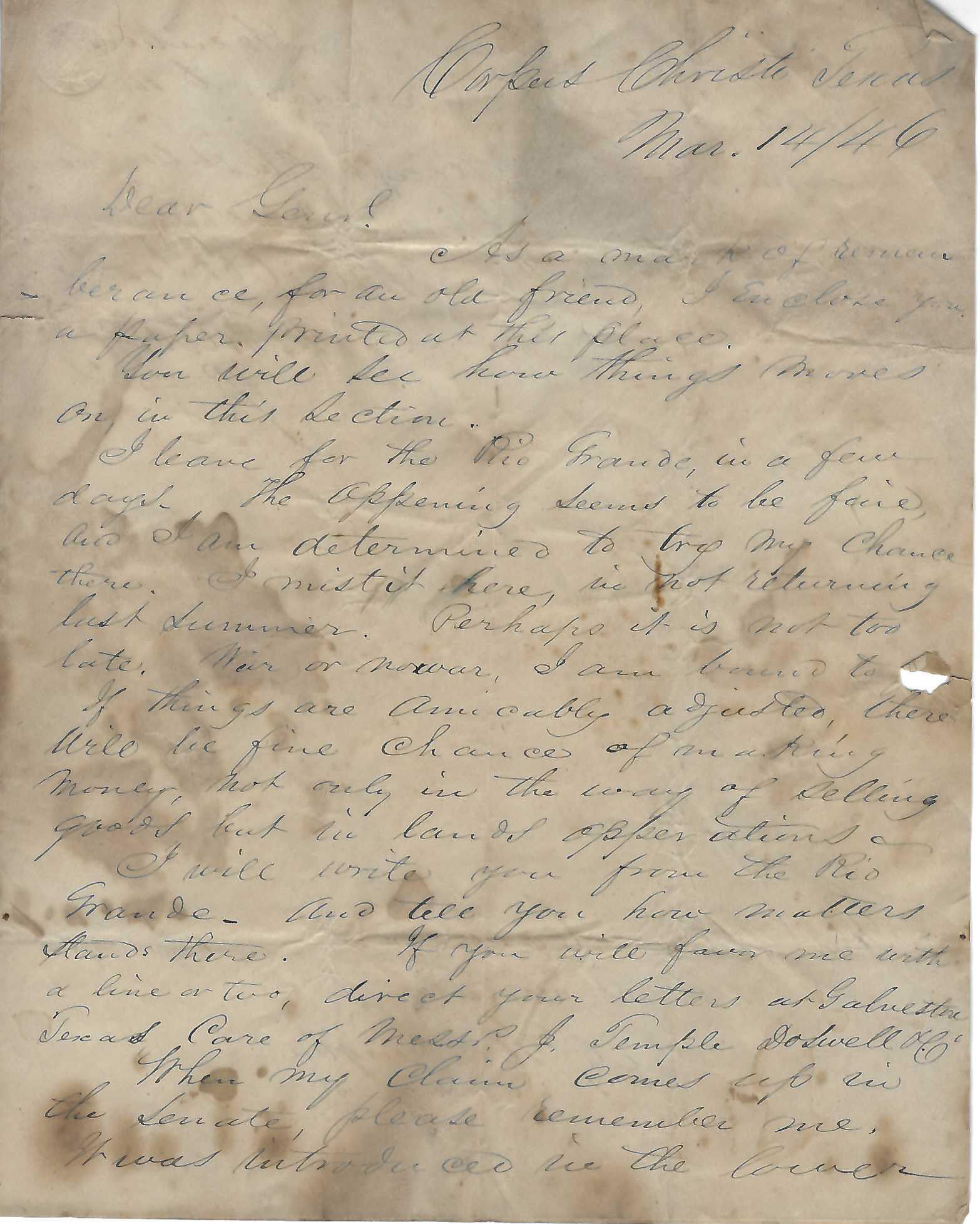
Quarto, 1 ¼ pages, plus stamp less address leaf, postal markings from New Orleans and Austin, heavy staining and soiling, else good.
"Dear Genl,
As a mark of remembrance for an old friend, I enclose a paper printed at this place. [not present] You will see how things moves in this section. I leave for the Rio Grande in a few days. The Oppening seems to be fine, and I am determined to try my chance there. I mist it here, in not returning last summer. Perhaps it is not too late. War or no war, I am bound to [go]. If things are amicably adjusted, there will be fine chance of making money, not only in the way of selling goods but in lands operations. –
I will write you from the Rio Grande – and tell you how matters stands there. If you will favor me with a line or two, direct your letters at Galveston Texas Care of Messrs. J. Temple Doswell & Co.
When my claim comes up in the Senate, please remember me. It was introduced in the lower House by the Hon. John Wentworth. Present my kind regards to Mrs. Cameron & family, Accept our very best wishes… N. Boilvin"
Nicholas Boilvin, Sr. (1761-1827) was an American frontiersman, fur trader and influential early U.S. Indian Agent. He was the first appointed agent to the Winnebagos, as well as the Sauk and Meskwaki, and one of the earliest pioneers to settle in present-day Prairie du Chien, Wisconsin. His sons Nicholas Boilvin, Jr. and William C. Boilvin both became successful business men. His wife was formerly a Miss St. Cyr of St. Louis. His daughter, Catherine Boilvin-Myott – also Metis, by her father's marriage to a Ho-Chunk woman, became prominent as a cultural mediator with early settlers in the next wave in the American era in Wisconsin, such as Henry and Susan Hempstead Gratiot of the founding family of St. Louis.
Boilvin was born in Quebec. Boilvin traveled to the Northwest Territory after the signing of the Second Treaty of Paris 1783 and, after settling in the Illinois Territory, he began trading with the local tribes in the Prairie du Chien area around February 1810. Boilvin was appointed principal Indian Agent for the Prairie du Chien region on March 14, 1811. Observing the lead mining activity in the area by the Iowas, Sauk, Meskwaki, and Canadians during this time, he communicated the future importance of the lead mining region to Secretary of War William Eustis. He also reported the growing unrest among the Winnebago and other local tribes prior to Tecumseh's War.
Boilvin and his family were forced to leave Prairie du Chien during the attack on the village by the British under Lt. Col. William McKay on July 14, 1814.
Boilvin studied the customs and culture of the Winnebago and provided the Department of War with a written vocabulary of the Winnebago language. In the years prior to the Black Hawk War, he had the trust and confidence of many of the tribes in the Upper Mississippi. A skilled interpreter, he was present at several treaties signed between the Winnebago and the United States during the 1810s and 1820s. He and Maurice Blondeau often negotiated directly with tribes on behalf of the federal government. Boilvin was also a close friend of Michel Brisbois, who resided near Boilvin's home in Prairie du Chien during his later years. After the 1837 Winnebago Treaty, John Baptiste Peon, the husband of Angelica Brisbois, Michel's daughter, claimed in an affidavit that Boilvin relied on his wife for interpreting, though she was never compensated for this work. Both Boilvin and Anjelica Brisbois were deceased by this time.
During the summer of 1827, Boilvin drowned while traveling upriver on a keel boat to St. Louis and was later buried there. His sub-agent John Marsh was in charge of the agency until the appointment of Joseph M. Street by then Secretary of War James Barbour under the recommendation of Henry Clay later that year.
His son, Nicholas Boilvin, Jr., the writer of this letter, was involved in similar business as that of his father, he evidently was a frontier trader as well. And as seen in this letter traveling as far south as Texas and the border to trade and make money during the coming war with Mexico. Nicholas Boilvin and Simon Cameron are linked through early 19th century American Indian policy, specifically the Simon Cameron Indian Commission of 1838. Cameron served as a federal commissioner to the Winnebago Indians to adjudicate the tribe's claims. From this episode arose the first of many charges that Cameron engaged in corrupt practices. In this case he was accused of purchasing at discount rates drafts issued to Indians and then paying off the notes at inflated rates from his own bank. Although no criminal proceedings were brought against him, Cameron's reputation was forever tainted by these claims of corruption. Boilvin was involved in transactions scrutinized by this commission, which investigated claims against Native American lands, particularly focusing on the Winnebago (Ho-Chunk) and other tribes in the Old Northwest. Boilvin petitioned Congress, as seen in this letter, for compensation for his family and received $ 6,000, while the other family members received $ 4000.00 each.
See: Street Ida M., The Simon Cameron Indian Commission of 1838, The Annals of Iowa, pp. 172-194
American National Biography, vol. 4 pp., 259-260
Details
Title
Autograph Letter Signed, Corpus Christi, Texas, March 14, 1846, to General and Senator, and the future Secretary of War under Lincoln, Simon Cameron, Washington, mis-sent as Cameron was in Austin, Texas at the time
Author
Boilvin, Nicholas, Jr.,
Condition
Unknown