

Autograph Letter Signed, Springfield, June 7, 1849, to his son, Rev. Cyrus Dickson, Wheeling, Virginia
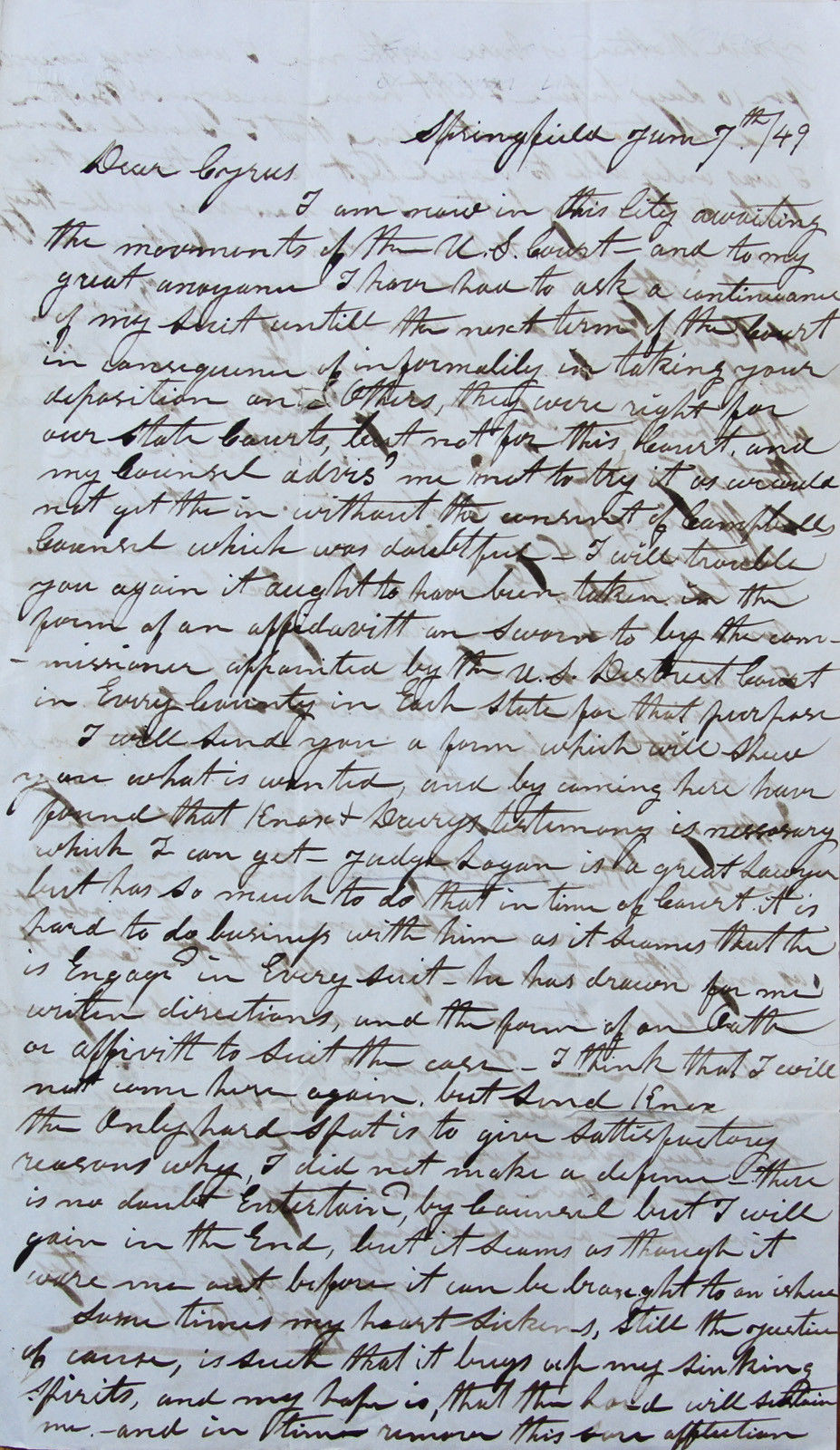
folio, two pages, plus stamp less address leaf, formerly folded, some light wrinkling to paper, otherwise in very good, clean and legible condition.
William Dickson, an Illinois pioneer, writes his son discussing a legal case he was involved in, taking place in Springfield. He mentions Stephen Trigg Logan (1800-1880), who was apparently trying the case. Logan was Abraham Linclon's law partner from 1841 – 1843. Logan apparently was fond of telling "backwoods" stories, not unlike Lincoln, according to Dickson, who was often invited into Logan's office and regaled with them.
"Dear Cyrus,
I am now in this city awaiting the movements of the U.S. Court – and to my great annoyance I have had to ask a continuance of my suit until the next term of the court in consequence of informality in taking your deposition and others, they were right for our State courts, but not for this court, and my counsel advises me not to try it as we could not get them in without the consent of Campbell's counsel which was doubtful – I will trouble you again it aught to have been in the form of an affidavit and sworn to by the commissioner appointed to the U.S. District Court.
I will send you a form which will show you what is wanted and by coming here have found that Knox & Drury's testimony is necessary which I can get – Judge Logan is a great Lawyer but has so much to do that in time of court it is hard to do business with him as it seems that he is engaged in every suit – he has drawn for me written directions, and the form of an Oath or affidavit to suit the case – I think that I will not come here again, but send Knox, the only hard spot is to give satisfactory reasons why, I did not make a defence – there is no doubt entertain'd by counsel but I will gain in the end, but it seems as though it ware me out before it can be brought to as issue some times my heart sickens, still the justice of cause, is such that it buoys up my sinking spirits, and my hope is, that the Lord will sustain me – and in time remove this sore affliction.
Your Mother is here with me I was very unwell for 10 days before I left home and your Brother and Sisters was not willing that I should alone. I was not able to travel but 16 miles the first day but kept getting better I am now very well - … I am now very well – they were all well at home when we left and it was healthy, there had been one case of Cholera at Rock Island a passenger off a Boat – there has been no Cholera here as yet and but little apprehensions about it, by Tellegraph it appears that N York, Cincinnati & Pittsburgh are suffering from Cholera to a great degree about 100 in NY yesterday – we came here last Satterday evening and expect to leave tomorrow morning when you receive this write I will write soon after we get home.
Springfield is a pleasant & society good them that has business in court has the worst of it, they sit about two hours in each day the judge is a stern but pleasant man he is in the habbit of inviting me into his room and we can talk as many back woods stories as any other two Lawyers about the Court he is older than I am and no doubt as good a Lawyer – The have 3 Presbyterian Ministers one new & 2 old school all doing well, the Sunday schools are large and well attended … Wm. Dickson"
"William Dickson was a farmer, War of 1812 veteran, and a pioneer settler and founder of Camden Mills, Illinois. He spent his early years in his native Newburgh, New York. After the American Revolution, Dickson relocated with his family to Westmoreland County, Pennsylvania, where he lived until he was eighteen, when he moved to a farm in Erie County, near Lake Erie and purportedly learned some engineering skills. In 1803, Dickson married Elizabeth Barron. Elizabeth Dickson died in September 1810, and in May 1812, Dickson married Christiana Moorhead, with whom he had at least one child. Dickson became fairly well-known in Erie County, serving as a captain in the War of 1812 and sitting for a time on the Pennsylvania Board of Canal Commissioners. In 1834, he rode on horseback from Erie County to Illinois, exploring the area for some time before returning to Pennsylvania. In January 1836, Christiana Dickson died, and in February 1837, Dickson married Mariam C. Davison. In the spring of 1837, he moved his family from Pennsylvania to a site of interest to him in Illinois, on the banks of the Rock River. He spent at least $9,000 acquiring land in the area, and in 1843, Dickson platted the village of Camden, which was renamed Camden Mills in 1848. In 1850, Dickson was farming and living near Camden Mills. Recognized as a prominent citizen, in 1858 he served as a delegate to the Democratic State Convention. In 1860, Dickson was still farming and owned $8,000 in real estate and another $2,900 in personal wealth. He owned and operated a successful water-powered grist mill and lived on the site of a previous Sac Nation town until moving to Camden Mills proper, two years before his death. Dickson fathered nine children during his lifetime."
https://papersofabrahamlincoln.org/persons/DI17066
"Stephen T. Logan received his elementary education in Frankfort, Kentucky, before moving to Glasgow in 1817 to study law under Judge Christopher Tompkins. He was admitted to the bar at the age of twenty and was appointed commonwealth attorney for the Glasgow district. Logan came to Springfield, Illinois, in 1832 to continue the practice of law, forming a partnership with William L. May. He married America T. Bush in June 1832, and their union produced eight children. In January 1835, Logan became judge of the First Judicial Circuit and held that position until March 1837. After resigning from the bench, Logan formed a legal partnership with Edward D. Baker, but that partnership soon ended because Logan found Baker to be reckless with money. In 1841, Abraham Lincoln became Logan's junior law partner. This partnership lasted until 1844, when they amicably dissolved the relationship so that Logan could practice law with his son, David Logan. Active in Whig politics, Logan was elected to the Illinois General Assembly in 1842, 1844, and 1846, served in the Illinois constitutional convention of 1848, and was elected again to the General Assembly in 1854. In 1854, he also branched into the business world, joining the Springfield Gas Light Company's board of directors. In 1860, he served as a delegate to the Republican National Convention. President Lincoln appointed Logan in 1862 to a commission to investigate claims against the government in Cairo, Illinois. That same year, Logan served as a delegate to the Washington Peace Conference. Logan amassed considerable wealth during his lifetime; by 1860, he had accumulated $175,000 in real estate and owned personal property worth $ 70,000.
https://papersofabrahamlincoln.org/persons/LO00310
Details
Title
Autograph Letter Signed, Springfield, June 7, 1849, to his son, Rev. Cyrus Dickson, Wheeling, Virginia
Author
Dickson, William (1783 -1869)
Condition
Unknown