

Autograph Letter Signed, Bombay, March 23, 1874, to a Mr. Hale
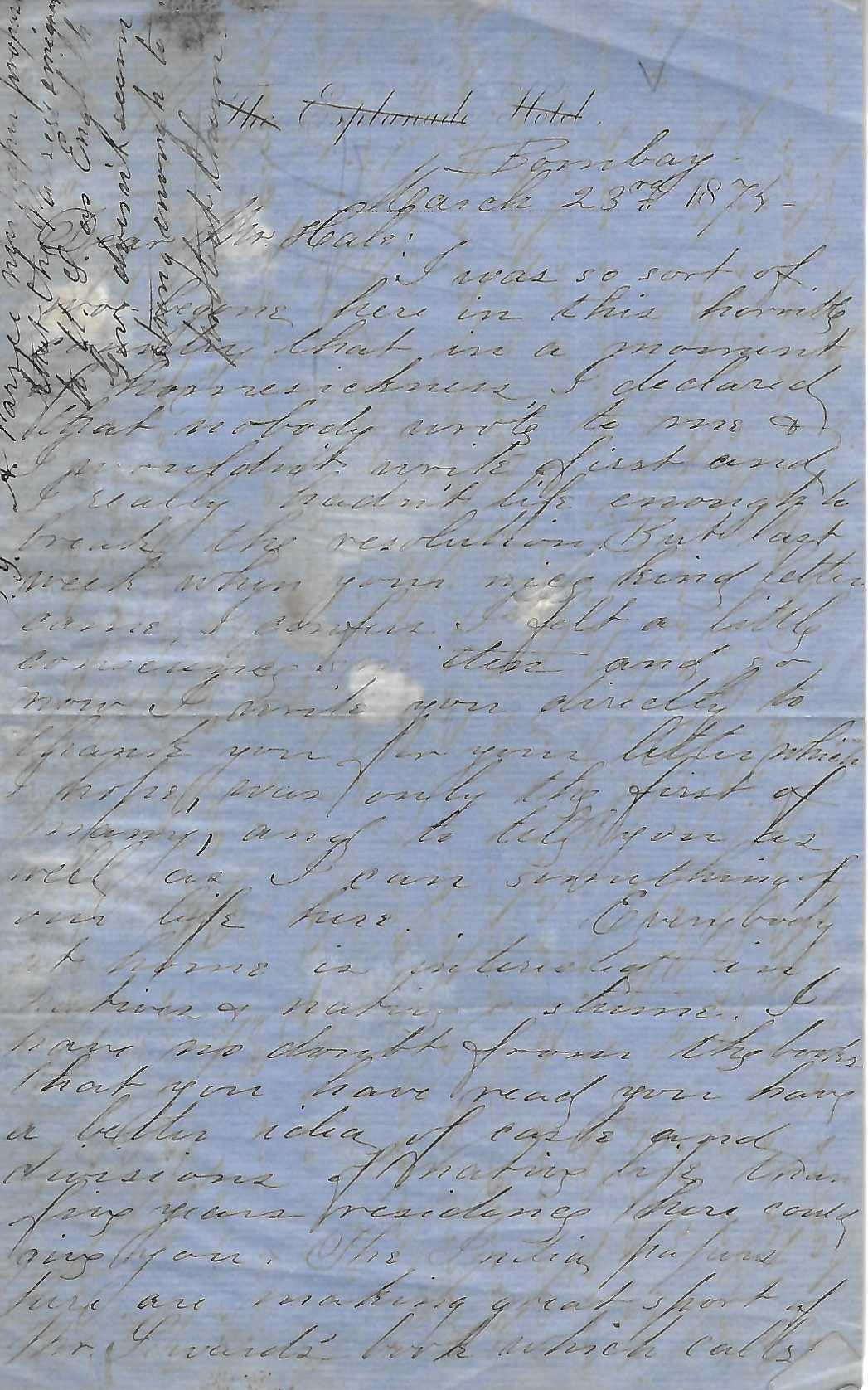
octavo, six pages, some spotting, foxing, and wear to letter, else in good condition.
American Woman in Bombay Excoriates English Gentlemen for their Treatment of Native Indians.
Minnie Whitman, an American woman, living in Bombay with her husband, writes a friend in America with news from Bombay, she describes rioting between Muslim and Parsee citizens of Bombay – and then excoriates Englishmen for their treatment of the Indian inhabitants, whom she has tremendous respect for.
'Dear Mr. Hale,
I was so sort of woebegone here in this horrible country that in a moment of homesickness I declared that nobody wrote to me & I wouldn't write first and I really hadn't really life enough to break the resolution But last week when your nice kind letter came … now I write you directly to thank you for your letter which I hope was only the first of many, and to tell you as well as I can something of our life here. … I have no doubt from the books that you have read you have a better idea caste and divisions of native life than five years residence here could give you. The India papers here are making great sport of Mr. Seward's book which calls a Parsee a Hindoo – To me it does not seem so strange a blunder as it does to natives or rather to the English here. I presume in hunting for some geographical name for the natives of Hindostan, he naturally thought of Hindoo & so used the word which here Is known only as referring to religion & there is no geographical name – unless it be Indian & that certainly refers to a larger tract of land than Hindostan. I thought I would be able to give some idea of customs here and for that purpose I have visited the native parts of the city, but with no avail I never seen such crowds in my life. Of an afternoon as you pass the side streets, broad or broader than Winter St it looks like a procession – the streets perfectly packed with human beings & every caste, every profession, every province, every little country has its separate & distinct - I mean by this that in former times they had. Now under English rule if the servant caste choose to wear the turban of a Brahmin, who can say no? - & many do – Perhaps you remember to have seen the picture of the converted Brahmin who has lately visited the States. Now, his turban was not a Bombay Brahmin turban but a Madras turban – totally different. … The Mussulmans & Parsees here have been having a riot lately & the English troops from Poona were called down to quell the disturbance & remained here some three or four weeks. It happened in this way – and it couldn't have happened under a better and wiser government, Some learned Parsee made a translation of Mahomed's life from Washington Irving and the Mahomedans chose to feel very much insulted. So they waited on the "Chief of Police" and demanded the suspension of the book and government who stands a little in fear of Mahomedans, suppressed it. Of course they weren't satisfied but presently assaulted the Parsees, broke open their temples, put out their fires attacked their houses & killed & wounded several Parsees – At a late hour the police arrived, but were perfectly inefficient. The Gov. a fine looking old gentleman who would be a good man to sit among "invited guests" & that sort of thing didn't know which way to turn and it took him several days to make up his mind. In the meantime there were outbreaks from time to time with more or less damage & more or less persons killed. After a while the troops were ordered out cannon placed near the native town& the troops from Poona sent for and all now seems peaceful tho' of course there must be a fire smouldering. There was no danger for Europeans or Hindoos and I pitied the poor Parsees who are a peace loving people. The English people as a rule hate Parsees & there is a great deal disagreeable about them … I have found out the reason of this dislike to Parsees is because in business the Parsees can compete with them and then there is not an English business house here that has not a Parsee clerk & finds it a necessity to have one. I tell you what I told an English gentleman the other day & he did not seem to relish it. "You call yourselves a Christian people and you call the natives heathen. You never misapplied words worse in your life, The English here as a rule are not Christians – are not followers of Christ and his precepts. They are in their treatment of natives, the verist heathen I ever saw, and these poor natives, worshipping idols and denying the name of Christ are more Christlike in their actions, more peaceable, more kind, more forgiving, than you & Heaven knows they are more tried than ever you were" and there is hardly a man here I always excepting the missionaries & my husband.) who wouldn't beat his servant for mislaying a coat or some such trivial thing & swear at him at table because he brought him a dish with too much pepper or too little salt. If you can take advantage of a native do so. Go to a native's house and accept his hospitality& they leave no stone unturned to entertain you& grumble at them all the time they are there & and after leaving say you never had so stupid a time in your life – never acknowledge courtesy from them in any way. If you are driving & some poor native destitute of clothes gets near your carriage, seize your whip and lash him as hard as you can. Do all these things and many more of the same sort and you will be recognized as an English gentleman. It makes my blood boil when I see these things as I daily do see them and I confess I delight in setting them out to Englishmen –
My time is up & I haven't told you about our house, we have just moved and are pleasantly situated, Of course we live outdoors – that is doors & windows all open & the little sparrows fly through the house and are at home. They even build nests in the drawing rooms & are not afraid. My servants are without number and Bombay house keeping in some respects is easy but hardly satisfactory. You can't feel at home with us here for we are not at home ourselves & will be glad to see the last of India. Last night I went to church (T's all high church here & the missionaries preach in native tongues) and the minister preached of the Pharisee who was thankful that he was not as other men and much good he did me for we came away thankful that we were not educated as other men, thankful that we were born in a free & enlightened country and thankful that we were born into a good common sense religion… Minnie C. Whitman"
Details
Title
Autograph Letter Signed, Bombay, March 23, 1874, to a Mr. Hale
Author
Whitman, Minnie C.
Condition
Unknown