

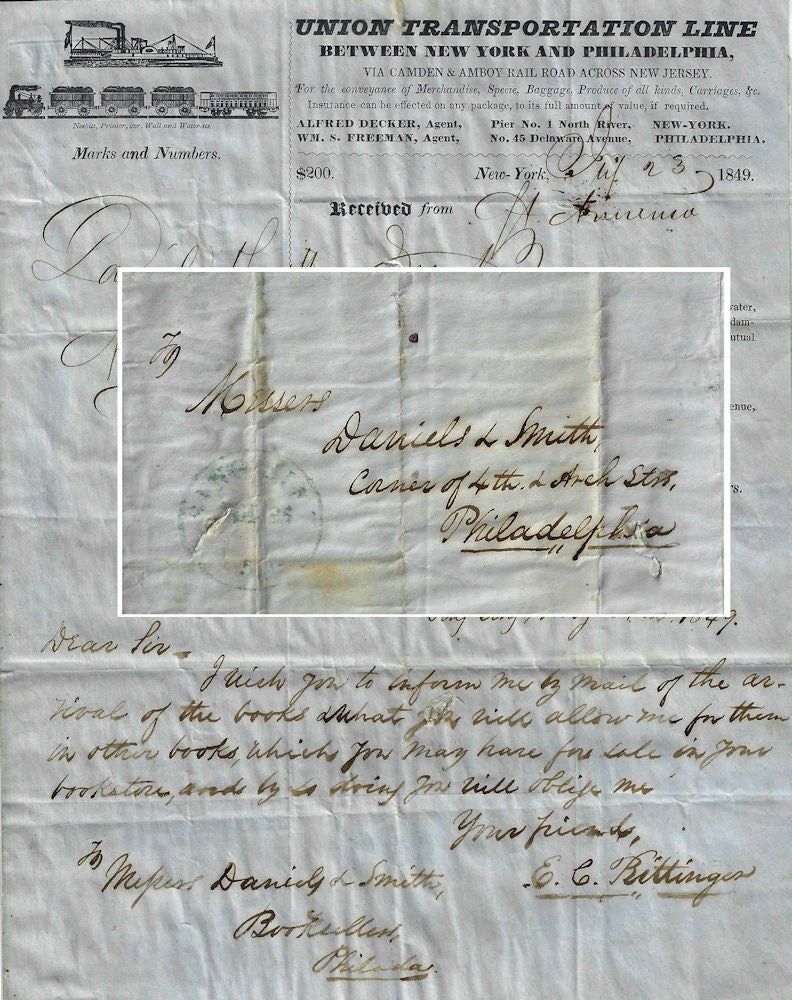
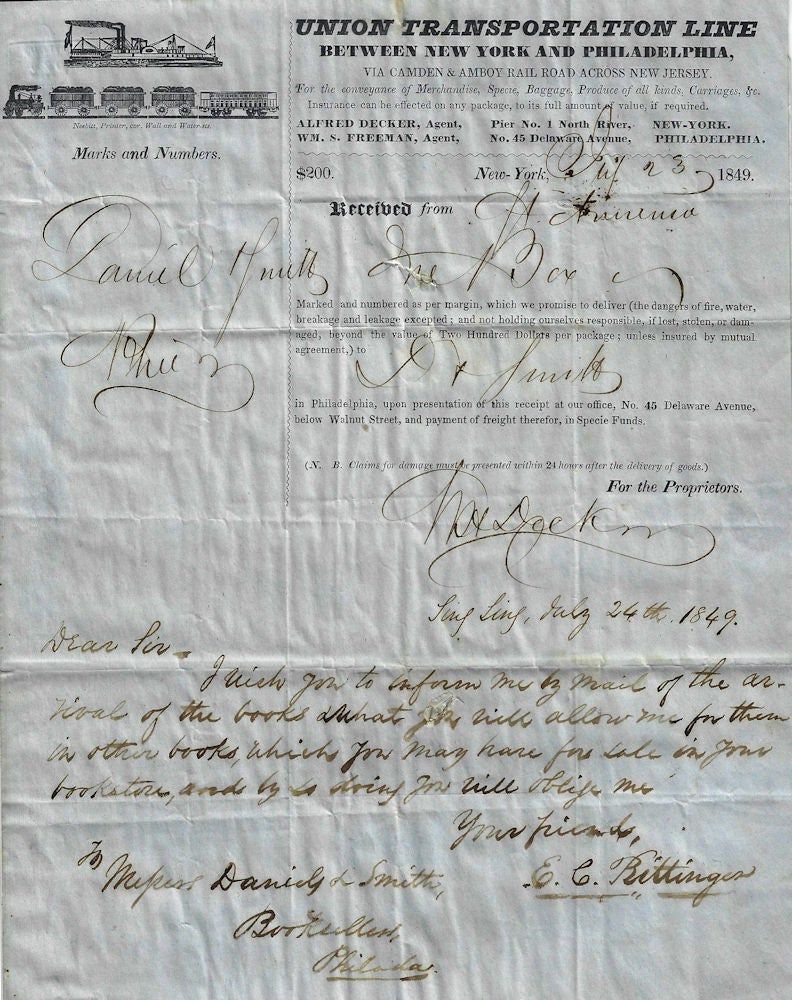
1849 – Shipping document and purchase inquiry from a prominent, but rather infamous Navy Chaplain at Sing Sing, New York, regarding a shipment of books he wished to sell to a Philadelphia bookselling firm which in several years’ time would become a major publishing house
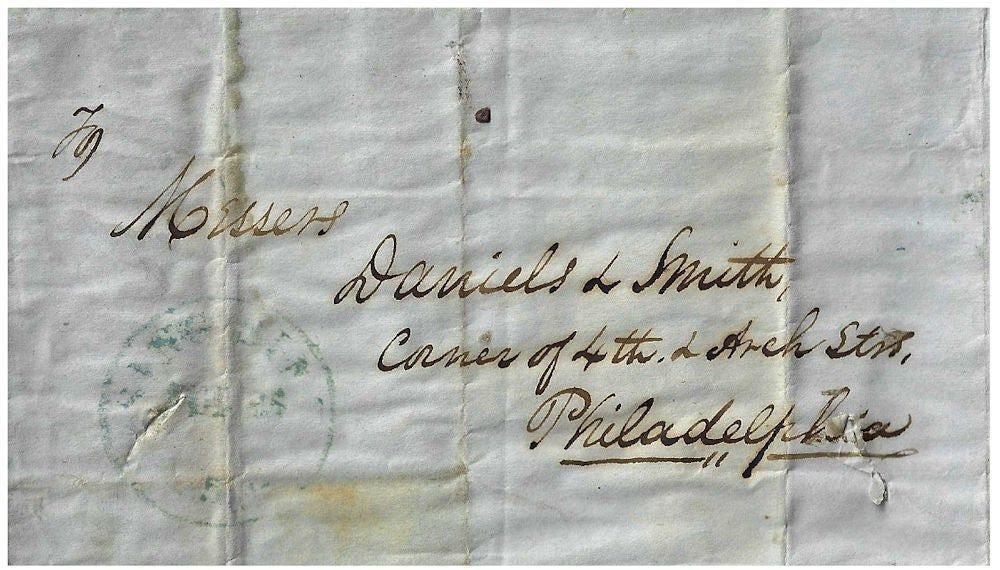
- Envelope or Cover
- Sing Sing, New Yor , 1849
Bittinger included a manuscript paragraph on the form that reads in part:
“I wish you to inform me by mail of the arrival of the books & what you will allow me for them in other books which you may have for sale in your bookstore, and by so doing you will oblige me.”
Docketing indicates Bittinger was likely able to exchange his books for $1,200.
. Bittinger, a Presbyterian minister, was about to embark on a prominent career as a U. S. Navy chaplain, a position in which he served for the next 43 years. His service included two tours at the Philadelphia Navy Yard and afloat service in the frigates Susquehanna and Macedonian, as well as the USS Delaware, flagship of the Pacific Squadron. Stubborn and self-centered, he was noted for wearing a uniform sword with his uniform (something not done by chaplains) which he would brandish during arguments. During his most important assignment, serving in Commodore Perry’s inaugural voyages to Japan, Bittinger created an international incident when he ignored Japan’s laws and disobeyed Japanese officials to travel outside of the port into the city of Tokyo where he coerced a shopkeeper to trade Japanese coins for his American pocket change. Perry, himself, became engaged in resolving the issue, and Bittinger was forced to return his souvenirs.Daniels & Smith ran into financial difficulties and sold their firm to their attorney’s son-in-law, Robert E. Peterson, who took on a partner, George C. Childs, in 1851, transitioning the company into an important publishing house. Childs, who had a flair for marketing, invented the use of “blurb” endorsements by famous people as well “book tours.” After Peterson retired in 1858, Childs purchased the money-losing newspaper, the Philadelphia Public Ledger, and turned it into one of the most widely-read journals in the country. By 1866, it was generating annual profits of over $500,000. Childs was a generous philanthropist and funded a number of Philadelphia projects. He also served as a President of Drexel University’s Board of Trustees and a member of both the American Antiquarian and American Philosophical Societies.
(For more information, see The History of the [Navy] Chaplain’s Corps, Part I, Necrological reports and annual proceedings of the [Princeton Theological Seminary] Alumni Association: 1875-1932, “Peterson, Henry [and George]” in Jordan’s Encyclopedia of Pennsylvania Biography, and “Childs, George William” in the 1911 edition of the Encyclopedia Britanica, all available on line.).
Details
Title
1849 – Shipping document and purchase inquiry from a prominent, but rather infamous Navy Chaplain at Sing Sing, New York, regarding a shipment of books he wished to sell to a Philadelphia bookselling firm which in several years’ time would become a major publishing house
Author
Edward C Bittinger
Binding
Envelope or Cover
Condition
Very Good
Publisher
Sing Sing, New Yor
Date
1849