

Spanish-American War Veteran Pension and New Deal Policies, 1935 Indiana Law and Election Documents Archive
- 1935
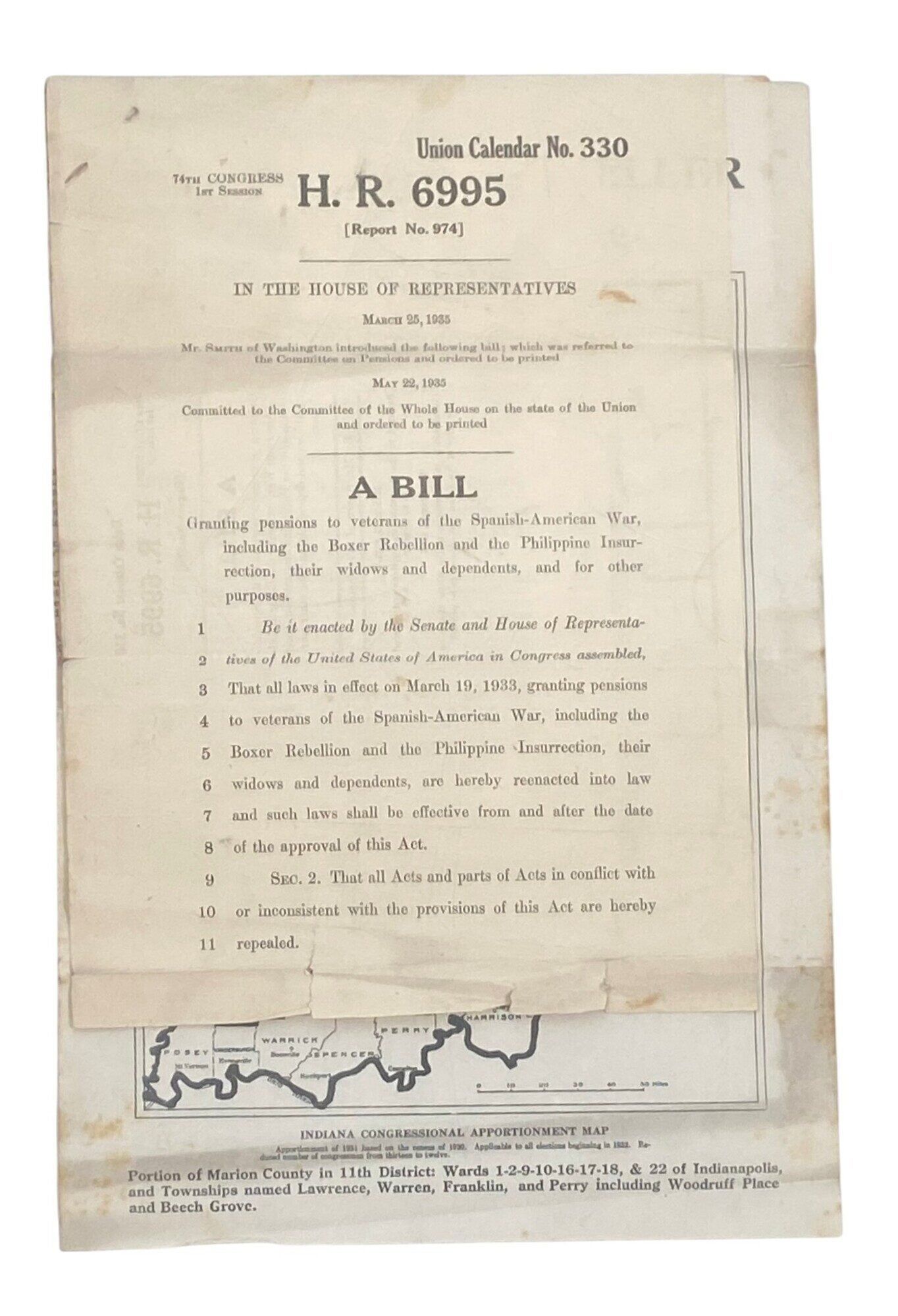
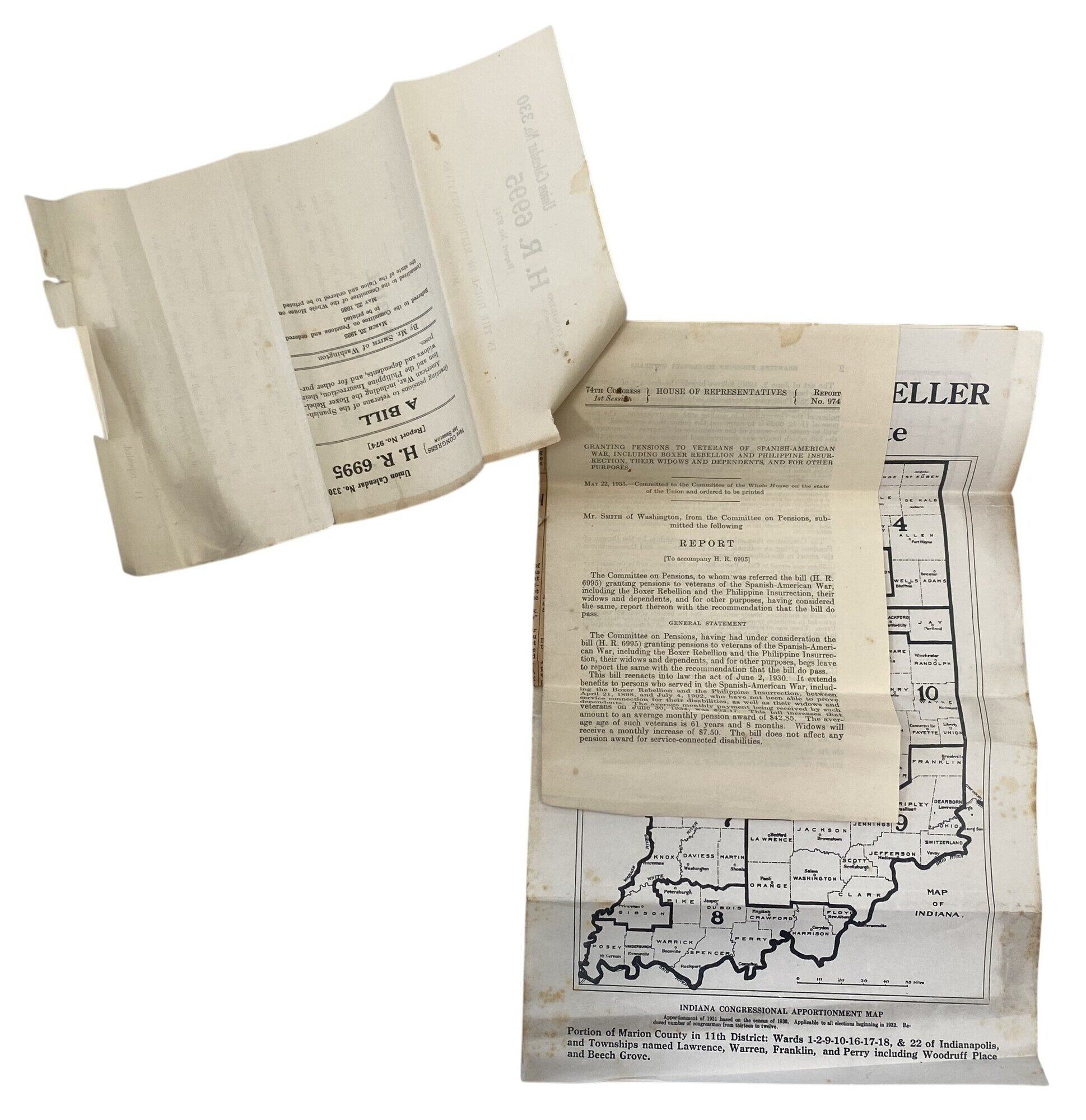
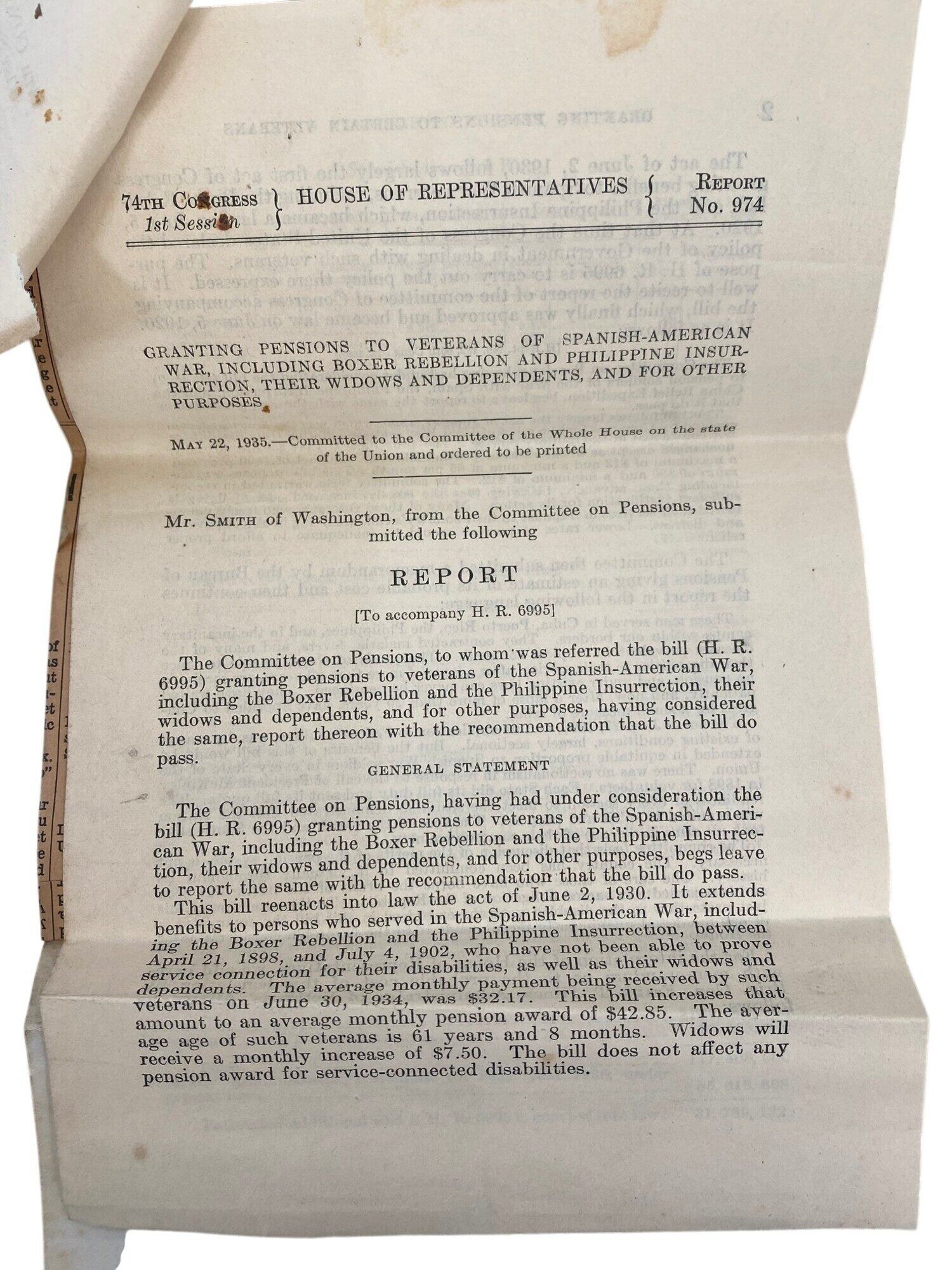
1935. [Law and Policy][Indiana][Spanish-American War] U.S. Congress and local government document archive of five pieces concerning Indiana politics in 1935 on veterans' care, social welfare legislation, and the domestic aftermath of U.S. colonization in the Caribbean. The archive centers on a March 25, 1935 bill proposing pensions for veterans of the Spanish-American War, including the Boxer Rebellion and the Philippine Insurrection, their widows and dependents, and the accompanying House report dated May 22, 1935 extending that claim into committee language, cost projections, and Veterans' Administration statistics. The documents connect federal pension policy to state electoral geography through August G. Mueller's Indiana congressional apportionment map and to campaign messaging through tabulated votes on the AAA, TVA, Gold Bill, Silver Bill, Securities Exchange Act, Norris-HOLC Amendment, Navy Construction Act, Housing Bill, and Labor Disputes Bill.
Five documents, stapled at top left corner. 1935, chiefly Indiana with federal legislative and campaign material extending to Iowa, Kansas, Kentucky, Louisiana, Oklahoma, Oregon, and Pennsylvania. 16 pages in total. Documents comprised of one official House bill, one official House committee report, one Indiana congressional district map, one Indiana newspaper clipping of candidates by district, and one multi-page ballot-style voting-record leaflet.
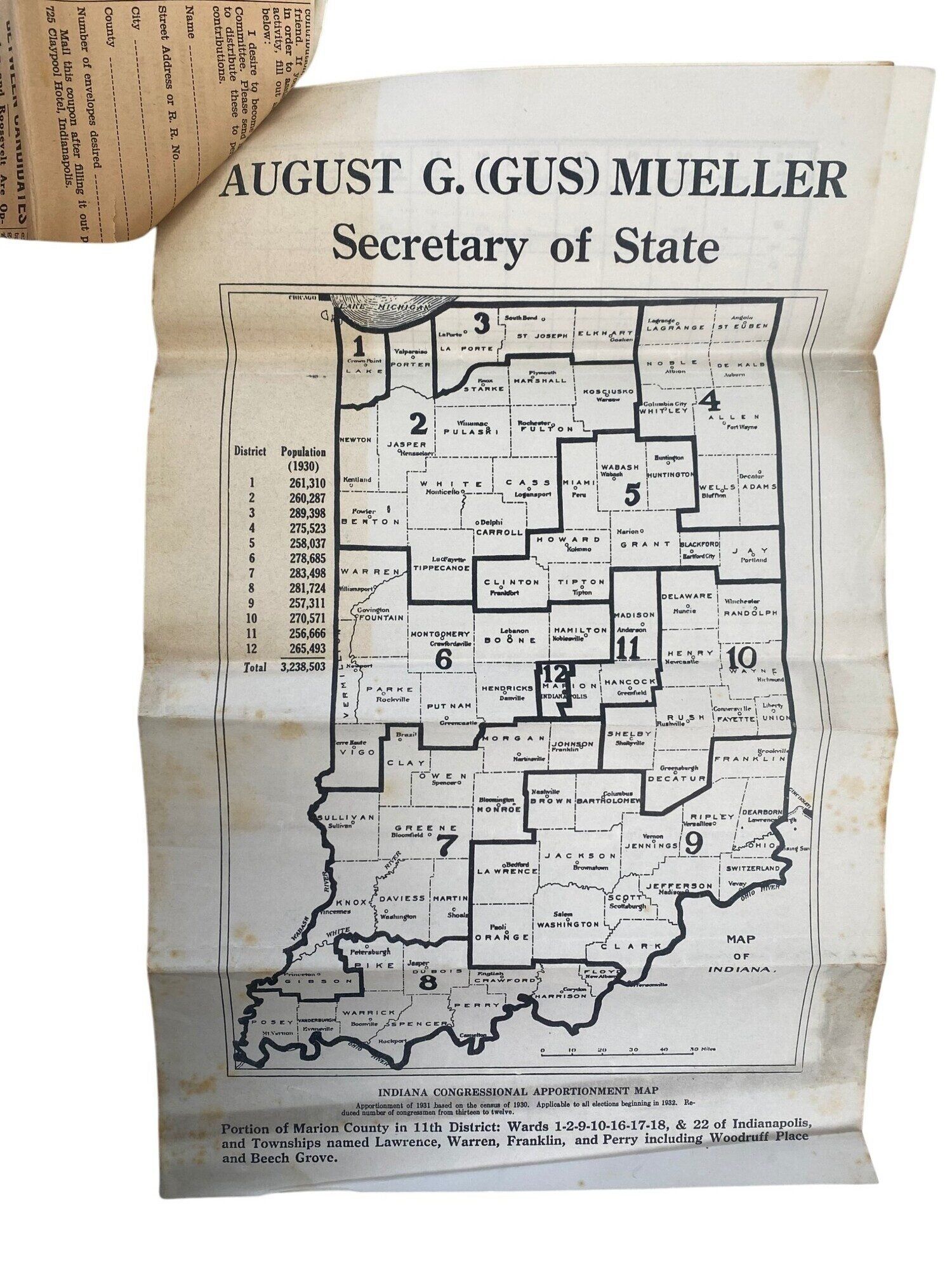
[1] Mueller, August G. (Gus). Indiana Congressional Apportionment Map. Indiana, ca. 1935. One page. Large printed map headed "August G. (Gus) Mueller / Secretary of State," showing Indiana's twelve congressional districts with county boundaries and population figures. Lower text notes the "Apportionment of 1931 based on the census of 1930," applicable to elections beginning in 1932, and specifically identifies the portion of Marion County in the 11th District, tying the archive's pension and campaign material to the district structure within which Indiana candidates were contesting office.
[2] United States House of Representatives. H.R. 6995. In the House of Representatives, March 25, 1935. One sheet, two pages. Official printed bill for the 74th Congress, 1st Session, titled "A Bill Granting pensions to veterans of the Spanish-American War, including the Boxer Rebellion and the Philippine Insurrection, their widows and dependents, and for other purposes." The bill states that laws in effect on March 19, 1933 granting such pensions were to be reenacted, making the document a direct record of New Deal era restoration and enlargement of benefits for aging veterans of the 1898 war and subsequent U.S. campaigns in China and the Philippines.
[3] Newspaper clipping. Indiana candidates by congressional district, ca. 1935. Narrow printed clipping listing Indiana candidates district by district, including names such as Andrew J. Hickey in the Third District, David Hogg in the Fourth, Gerald W. Landis in the Seventh, Charles F. Werner in the Eighth, Chester A. Davis in the Ninth, Clarence M. Brown in the Tenth, Don Roberts in the Eleventh, and Homer Elliott in the Twelfth. In this file the clipping functions as the electoral counterpart to the pension and voting documents, showing the candidate field to which these legislative issues were being attached.
[4] United States House of Representatives. Report No. 974, To Accompany H.R. 6995. Washington, D.C., May 22, 1935. Four pages on one sheet, bifolded. House report submitted by Mr. Smith of Washington from the Committee on Pensions, recommending passage of the bill and giving the most detailed policy language in the archive. Its "General Statement" specifies that the bill would extend benefits to those who served between April 21, 1898 and July 4, 1902, gives the average monthly payment then being received as $32.17, proposes an average monthly pension award of $42.85, states the average age of such veterans as "61 years and 8 months," and includes a May 9, 1935 letter from Frank T. Hines to Allard H. Gasque discussing the estimated surviving veteran population and projected fiscal effect.
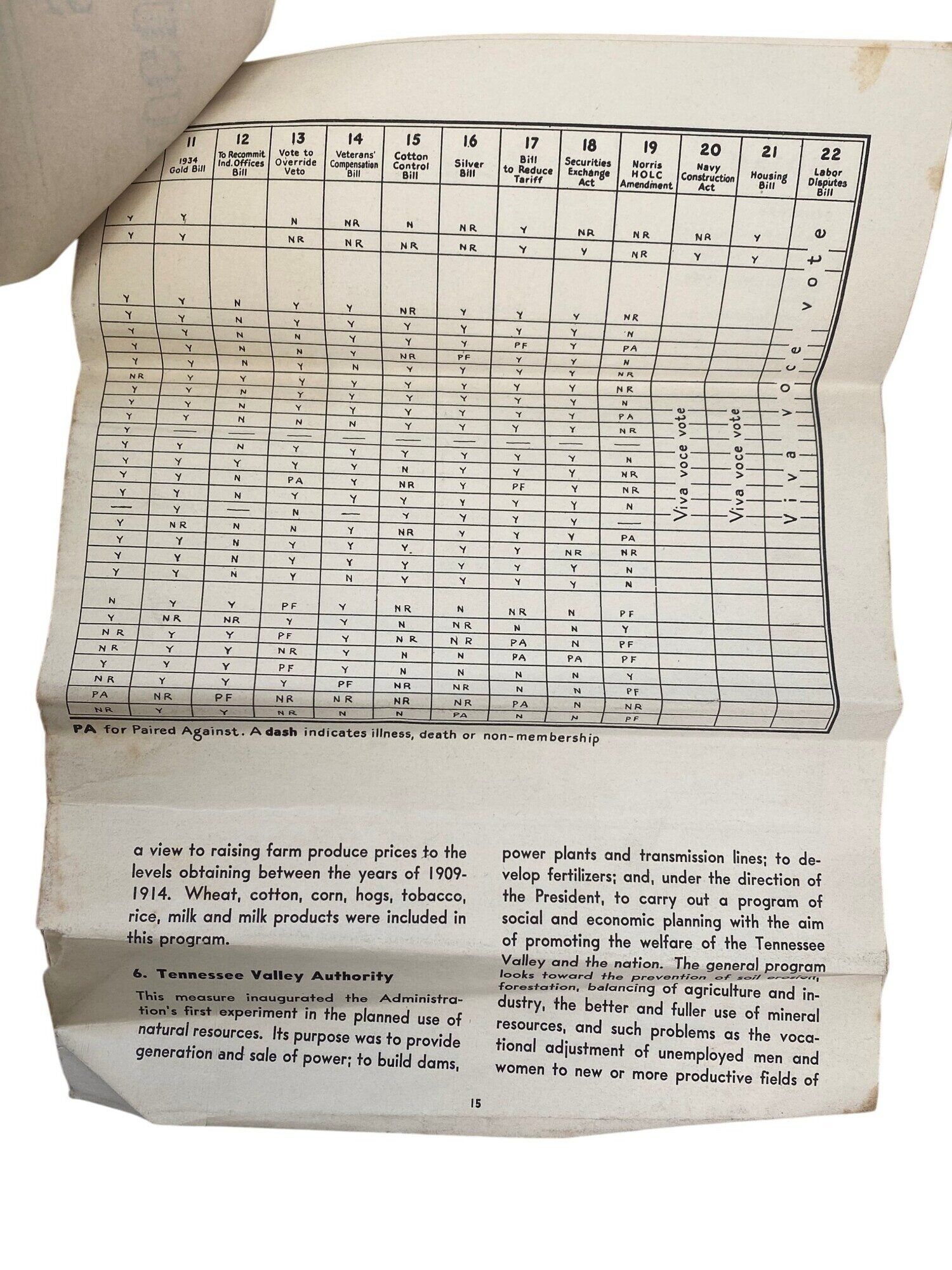
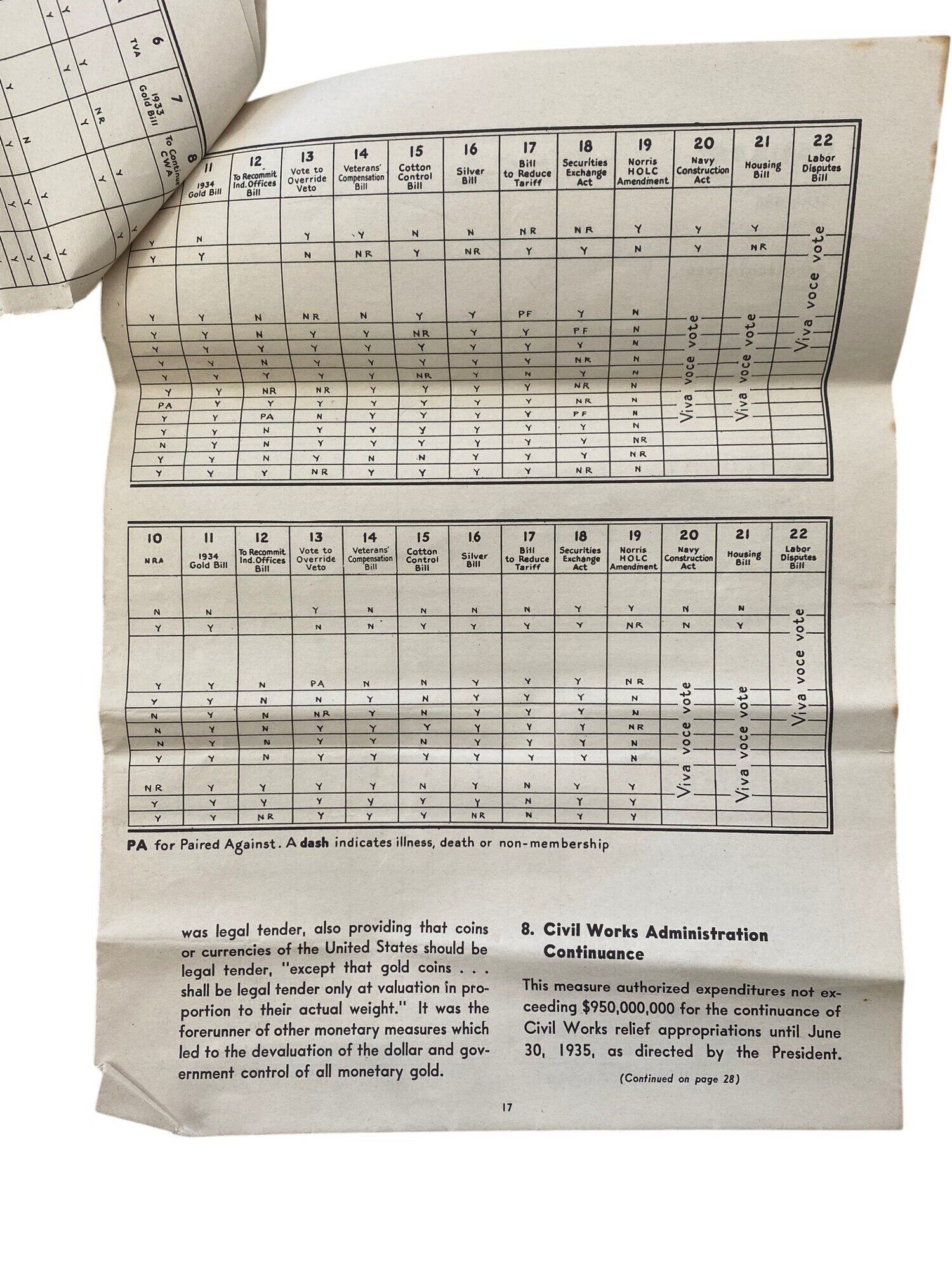
[5] Voting-record leaflet, ca. 1935. Eight page ballot-style political leaflet tabulating senators' and representatives' votes across several states, with photographed sections for Indiana, Iowa, Kansas, Kentucky, Louisiana, Oklahoma, Oregon, and Pennsylvania. The tables reduce congressional politics to a usable campaign matrix, marking "Y," "N," "NR," and "PF" across measures including the Emergency Banking Act, National Economy Act, 1933 Independent Offices Bill, Beer, AAA, TVA, 1933 Gold Bill, CWA continuance, 1934 Revenue Bill, Veterans' Compensation Bill, Bill to Reduce Tariff, Securities Exchange Act, Norris HOLC Amendment, Navy Construction Act, Housing Bill, and Labor Disputes Bill; accompanying text summarizes selected measures such as the Civil Works Administration continuance, Cotton Control Bill, Silver Purchase Act, and Tariff Act of 1934.
The two federal pension papers form the archive's documentary center because they preserve the precise legislative language by which Congress revisited the status of veterans of the Spanish-American War, the Boxer Rebellion, and the Philippine Insurrection in 1935, decades after those campaigns had extended U.S. power into the Caribbean and Pacific. The supporting Indiana documents show how that policy landscape was translated into district-based electoral work, while the voting leaflet widens the view to a national New Deal contest over social provision, public spending, agriculture, currency, housing, labor, and veterans' compensation. Folded and stapled as assembled, with pronounced creasing, moderate toning and scattered staining to edges; complete and legible. Overall good condition. A snapshot of U.S. policy in the Midwest in 1935, preserving legislation on veteran's pensions, New Deal vote-tracking, and Indiana electoral geography.
Five documents, stapled at top left corner. 1935, chiefly Indiana with federal legislative and campaign material extending to Iowa, Kansas, Kentucky, Louisiana, Oklahoma, Oregon, and Pennsylvania. 16 pages in total. Documents comprised of one official House bill, one official House committee report, one Indiana congressional district map, one Indiana newspaper clipping of candidates by district, and one multi-page ballot-style voting-record leaflet.
[1] Mueller, August G. (Gus). Indiana Congressional Apportionment Map. Indiana, ca. 1935. One page. Large printed map headed "August G. (Gus) Mueller / Secretary of State," showing Indiana's twelve congressional districts with county boundaries and population figures. Lower text notes the "Apportionment of 1931 based on the census of 1930," applicable to elections beginning in 1932, and specifically identifies the portion of Marion County in the 11th District, tying the archive's pension and campaign material to the district structure within which Indiana candidates were contesting office.
[2] United States House of Representatives. H.R. 6995. In the House of Representatives, March 25, 1935. One sheet, two pages. Official printed bill for the 74th Congress, 1st Session, titled "A Bill Granting pensions to veterans of the Spanish-American War, including the Boxer Rebellion and the Philippine Insurrection, their widows and dependents, and for other purposes." The bill states that laws in effect on March 19, 1933 granting such pensions were to be reenacted, making the document a direct record of New Deal era restoration and enlargement of benefits for aging veterans of the 1898 war and subsequent U.S. campaigns in China and the Philippines.
[3] Newspaper clipping. Indiana candidates by congressional district, ca. 1935. Narrow printed clipping listing Indiana candidates district by district, including names such as Andrew J. Hickey in the Third District, David Hogg in the Fourth, Gerald W. Landis in the Seventh, Charles F. Werner in the Eighth, Chester A. Davis in the Ninth, Clarence M. Brown in the Tenth, Don Roberts in the Eleventh, and Homer Elliott in the Twelfth. In this file the clipping functions as the electoral counterpart to the pension and voting documents, showing the candidate field to which these legislative issues were being attached.
[4] United States House of Representatives. Report No. 974, To Accompany H.R. 6995. Washington, D.C., May 22, 1935. Four pages on one sheet, bifolded. House report submitted by Mr. Smith of Washington from the Committee on Pensions, recommending passage of the bill and giving the most detailed policy language in the archive. Its "General Statement" specifies that the bill would extend benefits to those who served between April 21, 1898 and July 4, 1902, gives the average monthly payment then being received as $32.17, proposes an average monthly pension award of $42.85, states the average age of such veterans as "61 years and 8 months," and includes a May 9, 1935 letter from Frank T. Hines to Allard H. Gasque discussing the estimated surviving veteran population and projected fiscal effect.
[5] Voting-record leaflet, ca. 1935. Eight page ballot-style political leaflet tabulating senators' and representatives' votes across several states, with photographed sections for Indiana, Iowa, Kansas, Kentucky, Louisiana, Oklahoma, Oregon, and Pennsylvania. The tables reduce congressional politics to a usable campaign matrix, marking "Y," "N," "NR," and "PF" across measures including the Emergency Banking Act, National Economy Act, 1933 Independent Offices Bill, Beer, AAA, TVA, 1933 Gold Bill, CWA continuance, 1934 Revenue Bill, Veterans' Compensation Bill, Bill to Reduce Tariff, Securities Exchange Act, Norris HOLC Amendment, Navy Construction Act, Housing Bill, and Labor Disputes Bill; accompanying text summarizes selected measures such as the Civil Works Administration continuance, Cotton Control Bill, Silver Purchase Act, and Tariff Act of 1934.
The two federal pension papers form the archive's documentary center because they preserve the precise legislative language by which Congress revisited the status of veterans of the Spanish-American War, the Boxer Rebellion, and the Philippine Insurrection in 1935, decades after those campaigns had extended U.S. power into the Caribbean and Pacific. The supporting Indiana documents show how that policy landscape was translated into district-based electoral work, while the voting leaflet widens the view to a national New Deal contest over social provision, public spending, agriculture, currency, housing, labor, and veterans' compensation. Folded and stapled as assembled, with pronounced creasing, moderate toning and scattered staining to edges; complete and legible. Overall good condition. A snapshot of U.S. policy in the Midwest in 1935, preserving legislation on veteran's pensions, New Deal vote-tracking, and Indiana electoral geography.
Details
Title
Spanish-American War Veteran Pension and New Deal Policies, 1935 Indiana Law and Election Documents Archive
Author
Veterans Care; Social Welfare
Condition
Unknown
Date
1935