

Lễ ngũ bách quan thế âm danh nghi 禮五百觀世音名儀 [Ritual for Honoring the Names of Five Hundred Avalokiteśvara] [or] Ngũ bách danh quan thế âm kinh 五百名觀世音經 [The Avalokiteśvara Scripture of Five Hundred Names]
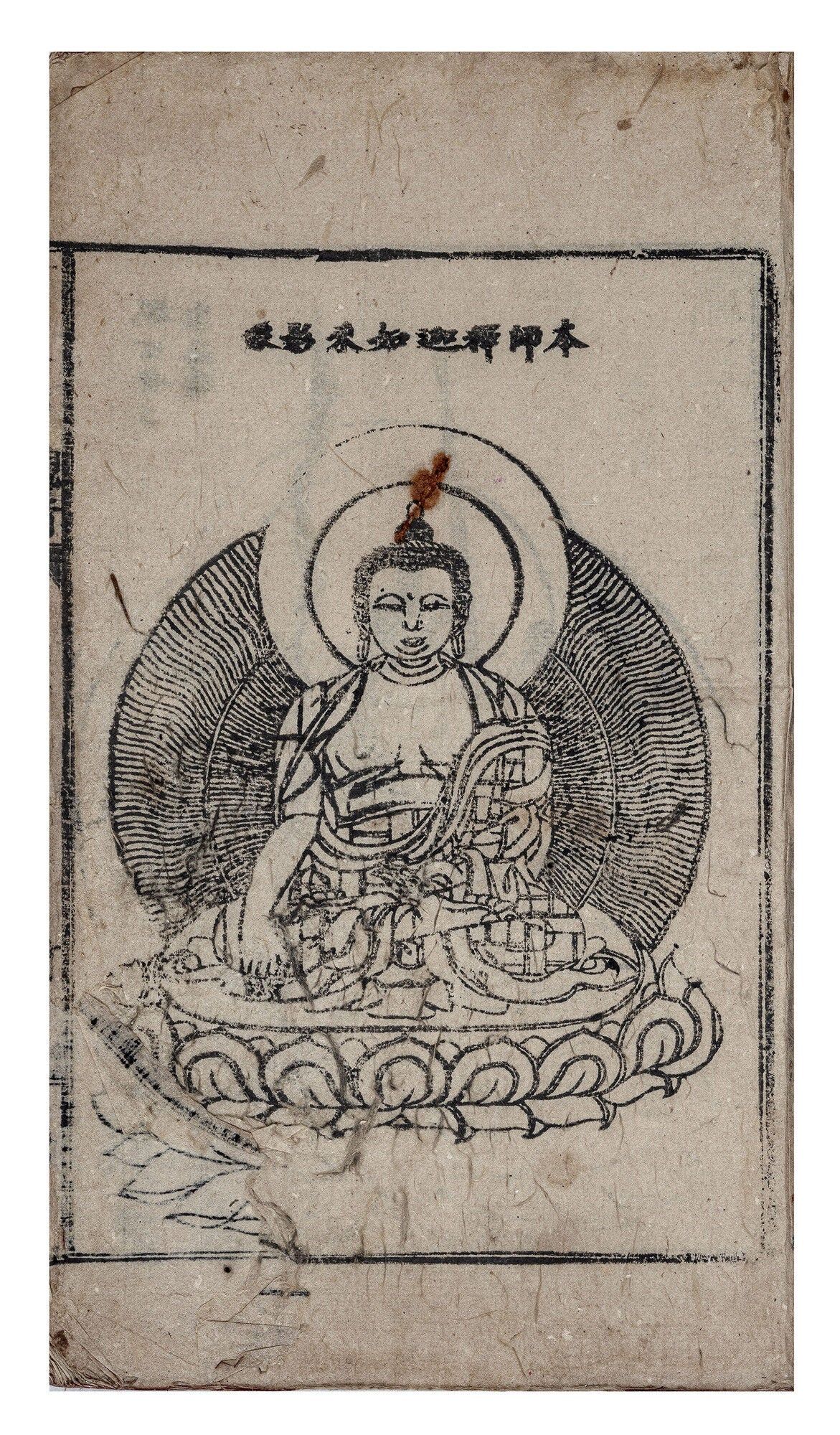
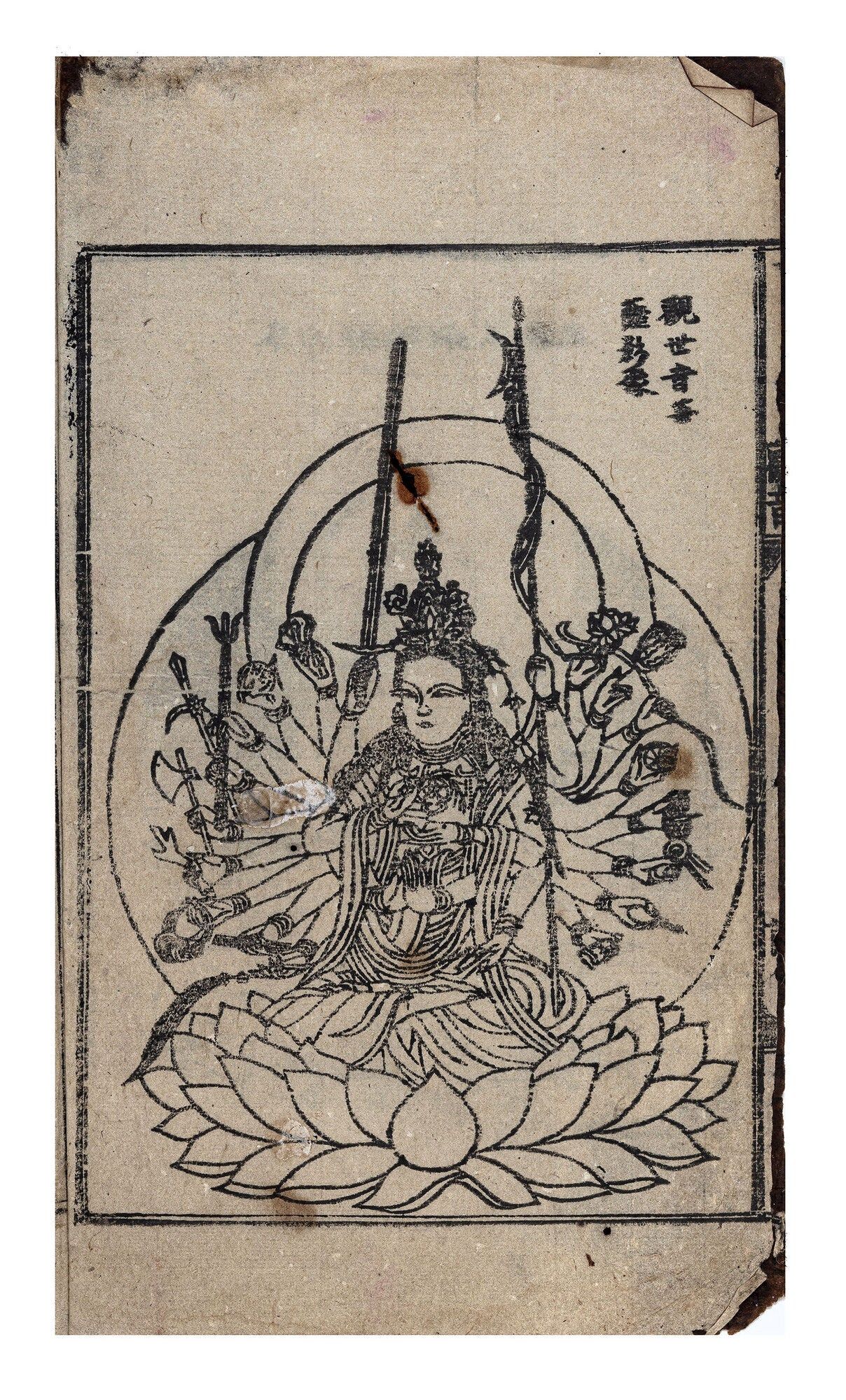
Two half-page woodcut illustrations of Śākyamuni and Avalokiteśvara. Woodblock-printed. [1] (lacking title), 48 folding leaves, red edges. 8vo, orig. semi-stiff wrappers (frayed & rubbed), knot-bound with waxed cords. [Hà Nội: Xiển Pháp tự 闡法寺, 1898].
The most popular of Vietnamese apocryphal Buddhist scriptures, the Avalokiteśvara Scripture of Five Hundred Names emblematizes the popularity of Avalokiteśvara (V. Quan thế âm; Ch. Guan shi yin) worship during the Nguyễn dynasty (1802-1945). Early printed copies of this work are very rare: we find no copies outside of Vietnam.
"The total number of apocryphal Buddhist scriptures from Vietnam has not been fully calculated. Among them, the Avalokiteśvara Scripture of Five Hundred Names is the most well-known, likely due to the Vietnamese people's fondness for reciting the name of Quan thế âm. This scripture, like the Gaowang guanshiyin jing 高王觀世音經 [T. 2898, a Chinese apocryphal text], contributed greatly to the development of Avalokiteśvara worship in Vietnam. The earliest extant edition is that of Minh Mạng 21 (1840), but scholars believe the appearance of the 'Names of Five Hundred Avalokiteśvara' practice in Vietnam can be traced to before Cảnh Thịnh 5 (1797)," the date of the earliest edition of a liturgical compilation by the influential monk Tuệ Đăng Chân Nguyên 慧燈真源 (1647-1726) of the Trúc Lâm 竹林 lineage of Vietnamese Buddhism, who already mentions the 500 names of the bodhisattva. See 李貴民, "再製與變異--越南漢傳佛教典籍的轉化" (2021), pp. 127-28.
The indigenization of the Buddhist figure of Avalokiteśvara in Vietnamese society has been the topic of an emergent body of scholarship. In their 2018 article, Nguyễn Tô Lan and Rostislav Berezkin point out that the monk Tuệ Đăng Chân Nguyên, mentioned above is also responsible for an early adaptation of the bodhisattva's hagiography written in the indigenous nôm characters, titled Wondrously Composed National Version of the Original Deeds of Guanyin of the Southern Sea (V. Nam Hải Quan Âm bản hạnh quốc ngữ diệu soạn 南海觀音本行國語妙撰). "The form of [this text] is noteworthy. It is written in the indigenous six-eight verse meter, which...reveals that this early adaptation was intended to be recited...[and] undoubtedly facilitated the memorization of such texts. It is quite probable that the National Version of the Original Deeds of Guanyin was transmitted orally and thus represented the popularization of this vernacular story among the common people, especially women, in Vietnam."-Nguyễn & Berezkin, "From Chinese Precious Scrolls to Vietnamese True Scriptures," p. 155.
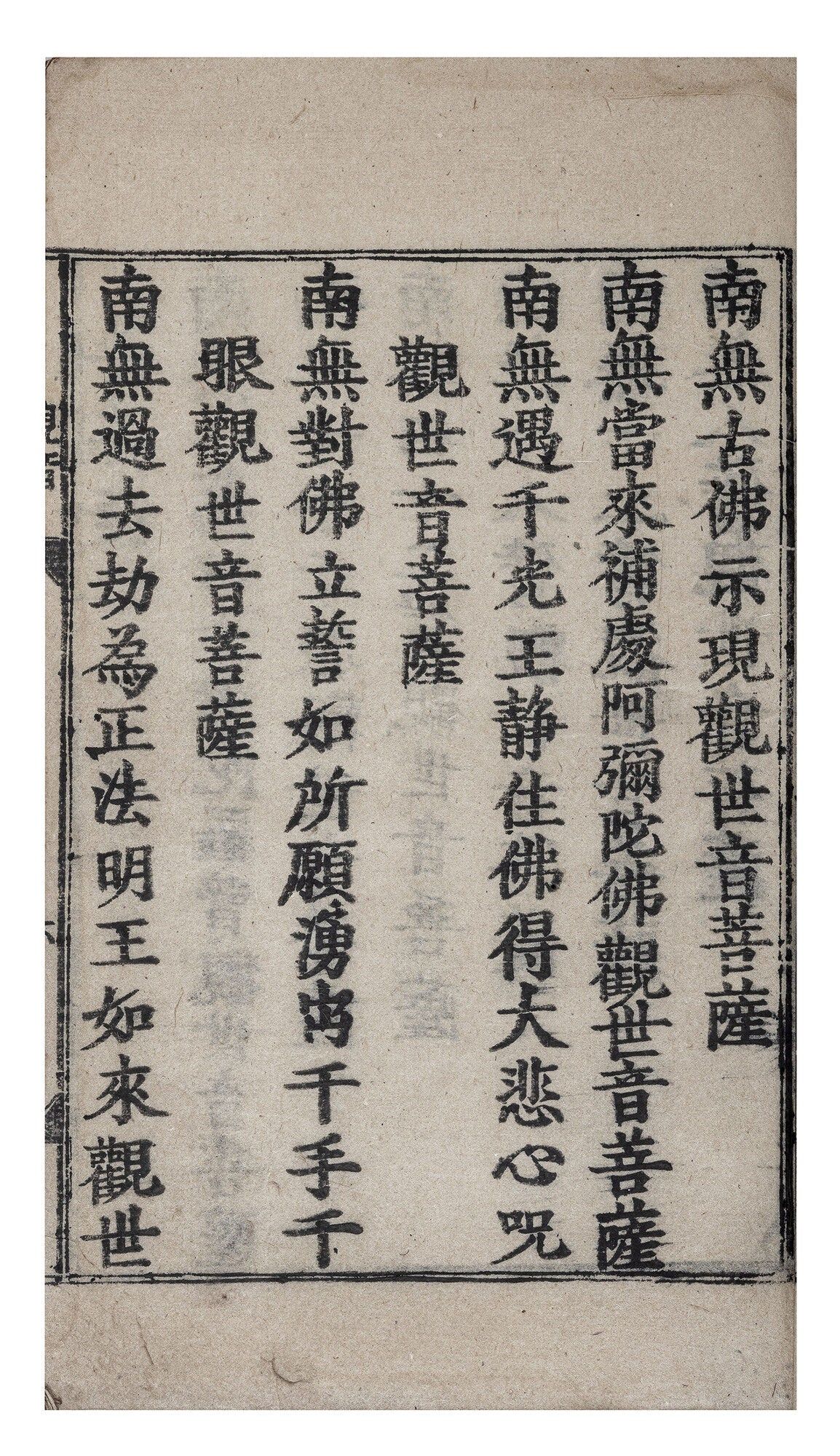
Written entirely in Chinese rather than nôm characters, the Avalokiteśvara Scripture of Five Hundred Names - which was part of the same religious complex around the bodhisattva - is also composed to facilitate oral recitation, having the structure of a liturgy rather than a typical sutra. The text opens with two half-leaf woodcut illustrations of Śākyamuni and Avalokiteśvara, followed by incense offering and willow-branch cleansing prayers, including Sanskrit mantras in sinographic transliteration. The bulk of the text is a long series of homages (V. nam mô 南無) to the names of 500 Avalokiteśvara, concluding with the prayers of repentance and aspiration. This main text is followed by a short True Scripture of Deliverance from Suffering, As Said by the Buddha (V. Phật thuyết cứu khổ chân kinh 佛說救苦真經) in three folding leaves, containing additional texts and mantra for incantation. The volume ends with the dedication of merit and the instruction that "the crowd may stand up and be released from their seats," suggesting the liturgical use of the text within a community consisting of both monastic and lay practitioners.
A comparison with the digitized copies held at the National Library of Vietnam (shelf no. R.1057) and the Thắng Nghiêm temple (shelf no. TN.043) shows our copy to be the Thành Thái 成泰 10 (1898) edition, the woodblocks for which were kept at the Xiển Pháp temple 闡法寺 in Hà Nội. The title-page is lacking in our copy. As mentioned above, we find no other copy of this text outside Vietnam.
Good copy. Small stains on the opening leaves, and the first leaf is frayed on lower corner.
❧ Yuenan Hannan wenxian ziliaoku 越南漢喃文獻資料庫, Academia Sinica. 李貴民, "再製與變異--越南漢傳佛教典籍的轉化," 佛光學報 7, No. 1 (2021), pp. 111-37. Nguyễn Tô Lan & Rostislav Berezkin, "From Chinese Precious Scrolls to Vietnamese True Scriptures: Transmission and Adaptation of the Miaoshan Story in Vietnam," East Asian Publishing and Society 18 (2018), pp. 107-44. Nguyễn Tuấn Cường, Phạm Văn Tuấn, & Nguyễn Văn Thanh, "Buddhist print culture in nineteenth-century northern Vietnam: a case study of the woodblock collection in Khê Hồi temple," Journal of Vietnamese Studies 13, No. 2 (2018), pp. 63-64.
The most popular of Vietnamese apocryphal Buddhist scriptures, the Avalokiteśvara Scripture of Five Hundred Names emblematizes the popularity of Avalokiteśvara (V. Quan thế âm; Ch. Guan shi yin) worship during the Nguyễn dynasty (1802-1945). Early printed copies of this work are very rare: we find no copies outside of Vietnam.
"The total number of apocryphal Buddhist scriptures from Vietnam has not been fully calculated. Among them, the Avalokiteśvara Scripture of Five Hundred Names is the most well-known, likely due to the Vietnamese people's fondness for reciting the name of Quan thế âm. This scripture, like the Gaowang guanshiyin jing 高王觀世音經 [T. 2898, a Chinese apocryphal text], contributed greatly to the development of Avalokiteśvara worship in Vietnam. The earliest extant edition is that of Minh Mạng 21 (1840), but scholars believe the appearance of the 'Names of Five Hundred Avalokiteśvara' practice in Vietnam can be traced to before Cảnh Thịnh 5 (1797)," the date of the earliest edition of a liturgical compilation by the influential monk Tuệ Đăng Chân Nguyên 慧燈真源 (1647-1726) of the Trúc Lâm 竹林 lineage of Vietnamese Buddhism, who already mentions the 500 names of the bodhisattva. See 李貴民, "再製與變異--越南漢傳佛教典籍的轉化" (2021), pp. 127-28.
The indigenization of the Buddhist figure of Avalokiteśvara in Vietnamese society has been the topic of an emergent body of scholarship. In their 2018 article, Nguyễn Tô Lan and Rostislav Berezkin point out that the monk Tuệ Đăng Chân Nguyên, mentioned above is also responsible for an early adaptation of the bodhisattva's hagiography written in the indigenous nôm characters, titled Wondrously Composed National Version of the Original Deeds of Guanyin of the Southern Sea (V. Nam Hải Quan Âm bản hạnh quốc ngữ diệu soạn 南海觀音本行國語妙撰). "The form of [this text] is noteworthy. It is written in the indigenous six-eight verse meter, which...reveals that this early adaptation was intended to be recited...[and] undoubtedly facilitated the memorization of such texts. It is quite probable that the National Version of the Original Deeds of Guanyin was transmitted orally and thus represented the popularization of this vernacular story among the common people, especially women, in Vietnam."-Nguyễn & Berezkin, "From Chinese Precious Scrolls to Vietnamese True Scriptures," p. 155.
Written entirely in Chinese rather than nôm characters, the Avalokiteśvara Scripture of Five Hundred Names - which was part of the same religious complex around the bodhisattva - is also composed to facilitate oral recitation, having the structure of a liturgy rather than a typical sutra. The text opens with two half-leaf woodcut illustrations of Śākyamuni and Avalokiteśvara, followed by incense offering and willow-branch cleansing prayers, including Sanskrit mantras in sinographic transliteration. The bulk of the text is a long series of homages (V. nam mô 南無) to the names of 500 Avalokiteśvara, concluding with the prayers of repentance and aspiration. This main text is followed by a short True Scripture of Deliverance from Suffering, As Said by the Buddha (V. Phật thuyết cứu khổ chân kinh 佛說救苦真經) in three folding leaves, containing additional texts and mantra for incantation. The volume ends with the dedication of merit and the instruction that "the crowd may stand up and be released from their seats," suggesting the liturgical use of the text within a community consisting of both monastic and lay practitioners.
A comparison with the digitized copies held at the National Library of Vietnam (shelf no. R.1057) and the Thắng Nghiêm temple (shelf no. TN.043) shows our copy to be the Thành Thái 成泰 10 (1898) edition, the woodblocks for which were kept at the Xiển Pháp temple 闡法寺 in Hà Nội. The title-page is lacking in our copy. As mentioned above, we find no other copy of this text outside Vietnam.
Good copy. Small stains on the opening leaves, and the first leaf is frayed on lower corner.
❧ Yuenan Hannan wenxian ziliaoku 越南漢喃文獻資料庫, Academia Sinica. 李貴民, "再製與變異--越南漢傳佛教典籍的轉化," 佛光學報 7, No. 1 (2021), pp. 111-37. Nguyễn Tô Lan & Rostislav Berezkin, "From Chinese Precious Scrolls to Vietnamese True Scriptures: Transmission and Adaptation of the Miaoshan Story in Vietnam," East Asian Publishing and Society 18 (2018), pp. 107-44. Nguyễn Tuấn Cường, Phạm Văn Tuấn, & Nguyễn Văn Thanh, "Buddhist print culture in nineteenth-century northern Vietnam: a case study of the woodblock collection in Khê Hồi temple," Journal of Vietnamese Studies 13, No. 2 (2018), pp. 63-64.
Details
Title
Lễ ngũ bách quan thế âm danh nghi 禮五百觀世音名儀 [Ritual for Honoring the Names of Five Hundred Avalokiteśvara] [or] Ngũ bách danh quan thế âm kinh 五百名觀世音經 [The Avalokiteśvara Scripture of Five Hundred Names]
Author
(AVALOKITEŚVARA)
Condition
Unknown