

Ye ban zhong sheng 夜半鐘聲 [The Sound of Bells at Midnight] [or] Jie guan fan ren kou chu yang lun 戒拐販人口出洋論 [An Argument Against Human Trafficking Abroad]
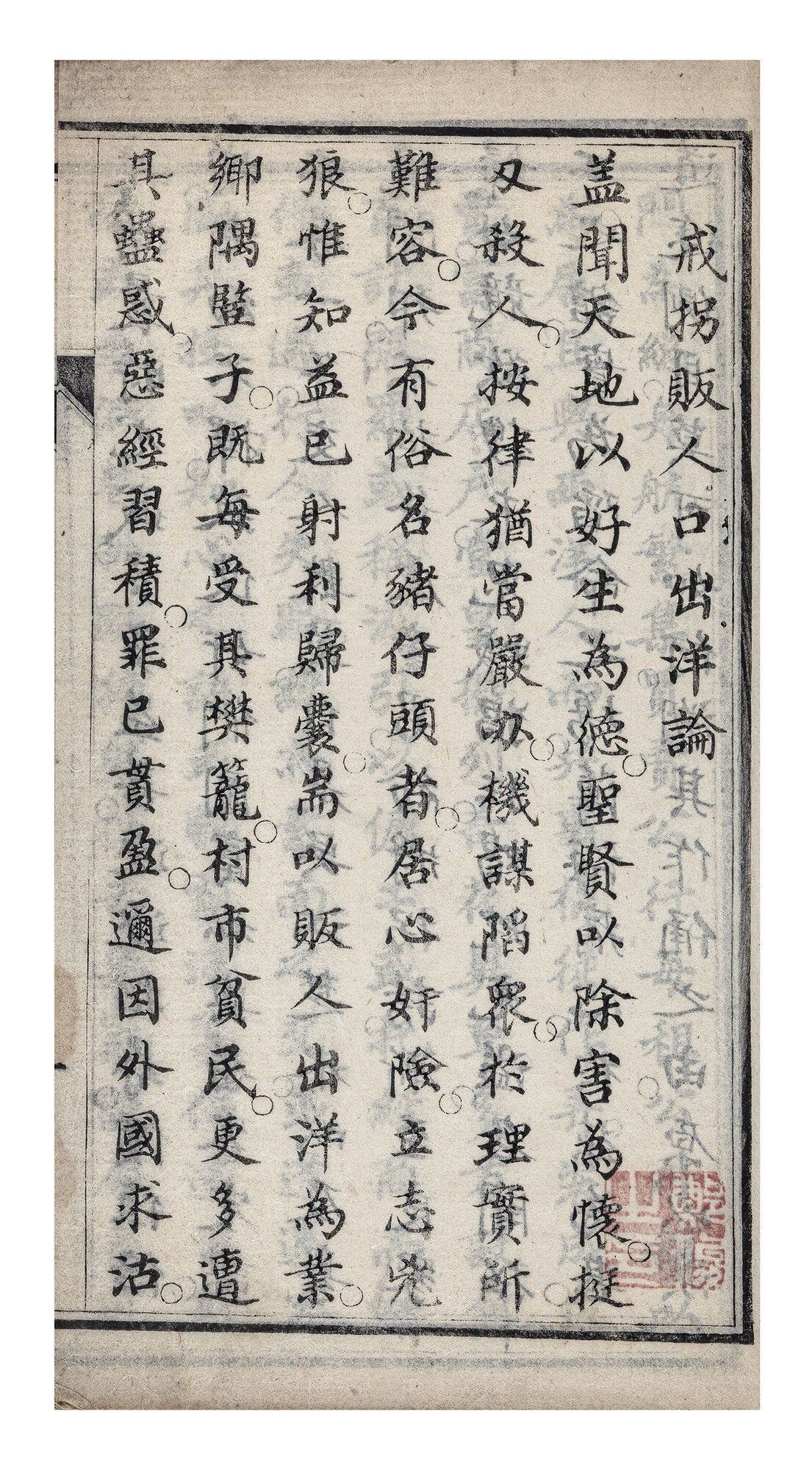
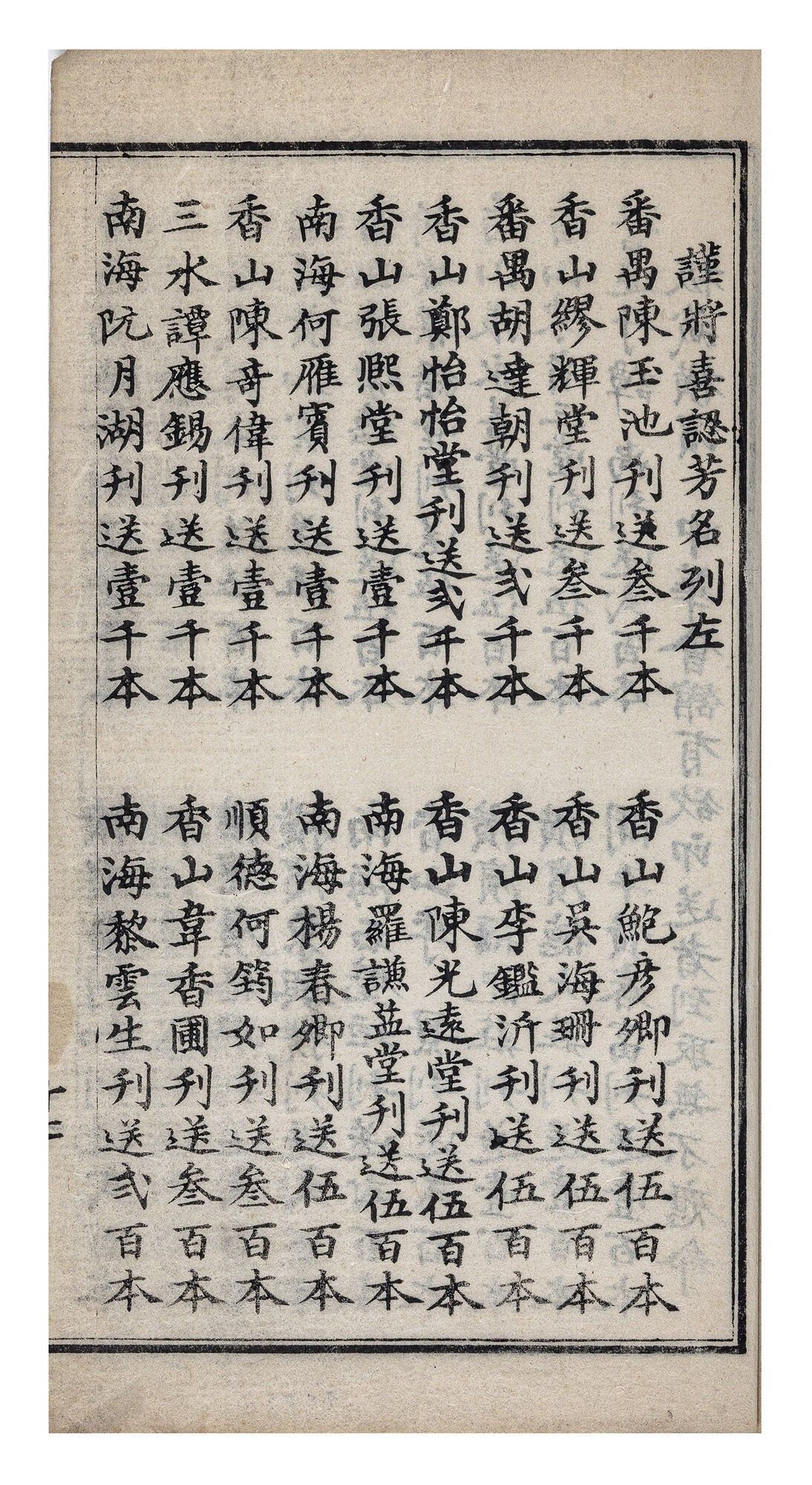
Woodblock-printed. 17 folding leaves. 8vo, orig. semi-stiff wrappers with printed title-slip on upper cover, new stitching. Yokohama: Chūka kaikan, 1872.
First edition of this rare work criticizing the Chinese-Cuba "coolie" trade, with numerous eyewitness accounts of the laborers' suffering. It was published in Yokohama by a person from Shunyi Shijiang 順邑獅江 (in Guangdong) under the alias Tan Jingmizi. Our first edition, published by the Chinese Association in Yokohama, is very rare: we find only two copies in WorldCat (accession no. 32041293), at Harvard and Cornell. Part of the pamphlet was reprinted a year later in the Shanghai-based newspaper Shenbao 申報, which published some of the earliest labor reportage in China.
"To supplement a dwindling slave labor force on their sugar plantations, Cuban planters turned to south China's Fujian and especially Guangdong provinces. From 1847 to 1874 they recruited 141,000 male laborers (125,000 of whom arrived in Cuba alive). Slave-like work and living conditions on plantations, with proximity to large numbers of slaves notwithstanding, Chinese coolies were not permanent or lifelong slaves"-Hu-DeHart, "From Slavery to Freedom," p. 31.
In her recent study, literary historian Ping Zhu observes that the year 1872 marked the publication of some of the earliest labor reportage in China, including five essays by the well-known merchant-scholar Zheng Guanying 鄭觀應 (1842-1922) on the Chinese laborers that appeared in the newspaper Shenbao (founded in the same year). A few months later, on 14 February, 1883, Shenbao published a longer essay on its front page, titled Argument Against Human Trafficking Abroad.
"The author was listed as Shunyi Shi[jiang] Tanjingmizi 順邑獅[江]譚警迷子, but it seems to be a collective work because the editorial uses the plural subject 'we' (yudeng 余等) and claims that those 'truthful words' (zhenyan 真言) were written after they traveled around the world and witnessed the outrageous deeds done to Chinese coolies. Crafted in the classical parallel prose style...the authors used a string of metaphors (rats, fish, ants, dogs, snakes, cows, horses, and shrimp) to portray the miserable conditions of the Chinese coolies."-Ping Zhu, "Tales of Chinese Coolies in Late Qing Labor Reportage," pp. 205-6.
In these essays that appeared in the Shenbao, Ping Zhu comments that the "Chinese authors consistently exposed the sufferings endured by Chinese overseas workers, both during the voyage and while on foreign soil, calling for intervention to rectify these injustices and uphold basic humanity. Considering that Chinese overseas laborers constituted the first cohort of the Chinese working class in the modern sense, these writings can be regarded as the earliest labor reportage in China and as precursors to the reportage literature that would be championed by leftist writers in the 1930s"-ibid., pp. 194-95.
The February 1873 article she mentions, in fact, was a partial reprint of our pamphlet, first published in Yokohama a few months earlier, around the mid-autumn of 1872. Our first edition of the pamphlet includes not only that essay but also a longer collection of first-person testimonies (jianwen shilu 見聞實錄) by the laborers themselves, including their names, places of origin, and the date of their escape from tranport ships. These laborers tell of how they were tricked into indentured servitude not only by foreigners but also by their own relatives and friends, how their hands were forced to sign contracts and, soon after, into chains. Humiliated and abused on the ships, some of their peers died, while others threw themselves into the sea.
The author(s) of the pamphlet, who were members of the Chinese Association (J. Chūka kaikan 中華会館) in Yokohama, learned about the human trafficking schemes when the transport ships passed by the Yokohama port, and the cases of escapees were brought to the attention of Japanese and British authorities. Appalled by the stories they heard, the Chinese Association raised funds in 1871 for a lawsuit against the traffickers, securing the freedom of over 200 laborers aboard, who were subsequently sent back to Shanghai. This pamphlet was completed a few months later, communicating the gravity of the trafficking to others in Yokohama, with plans to disseminate copies in Guangdong and Fujian, the home of the Chinese Association members and the laborers alike.
Although the Chinese Association planned to print thousands of copies of the pamphlet for distribution in China and Japan, very few copies of this important document in transpacific labor history survive today. As mentioned above, we find only two copies in WorldCat. Our copy is in very good condition, with only light staining and worming in the margins. The name of Yoshijima Toshiaki 吉島俊明 (fl. ca. 1900), professor of Japanese in colonial Taiwan, is handwritten on the upper cover, and the red collector's seal on f. 1 reads 鄭俊之印.
Fine condition. A bit of worming at beginning, mostly marginal. Preserved in a chitsu.
❧ Evelyn Hu-DeHart, "From Slavery to Freedom: Chinese Coolies on the Sugar Plantations of Nineteenth Century Cuba," Labour History 113 (2017), pp. 31-51. Ping Zhu, "Tales of Chinese Coolies in Late Qing Labor Reportage," in Reportage in the Chinese-Speaking World (Michigan, 2026), pp. 195-214.
First edition of this rare work criticizing the Chinese-Cuba "coolie" trade, with numerous eyewitness accounts of the laborers' suffering. It was published in Yokohama by a person from Shunyi Shijiang 順邑獅江 (in Guangdong) under the alias Tan Jingmizi. Our first edition, published by the Chinese Association in Yokohama, is very rare: we find only two copies in WorldCat (accession no. 32041293), at Harvard and Cornell. Part of the pamphlet was reprinted a year later in the Shanghai-based newspaper Shenbao 申報, which published some of the earliest labor reportage in China.
"To supplement a dwindling slave labor force on their sugar plantations, Cuban planters turned to south China's Fujian and especially Guangdong provinces. From 1847 to 1874 they recruited 141,000 male laborers (125,000 of whom arrived in Cuba alive). Slave-like work and living conditions on plantations, with proximity to large numbers of slaves notwithstanding, Chinese coolies were not permanent or lifelong slaves"-Hu-DeHart, "From Slavery to Freedom," p. 31.
In her recent study, literary historian Ping Zhu observes that the year 1872 marked the publication of some of the earliest labor reportage in China, including five essays by the well-known merchant-scholar Zheng Guanying 鄭觀應 (1842-1922) on the Chinese laborers that appeared in the newspaper Shenbao (founded in the same year). A few months later, on 14 February, 1883, Shenbao published a longer essay on its front page, titled Argument Against Human Trafficking Abroad.
"The author was listed as Shunyi Shi[jiang] Tanjingmizi 順邑獅[江]譚警迷子, but it seems to be a collective work because the editorial uses the plural subject 'we' (yudeng 余等) and claims that those 'truthful words' (zhenyan 真言) were written after they traveled around the world and witnessed the outrageous deeds done to Chinese coolies. Crafted in the classical parallel prose style...the authors used a string of metaphors (rats, fish, ants, dogs, snakes, cows, horses, and shrimp) to portray the miserable conditions of the Chinese coolies."-Ping Zhu, "Tales of Chinese Coolies in Late Qing Labor Reportage," pp. 205-6.
In these essays that appeared in the Shenbao, Ping Zhu comments that the "Chinese authors consistently exposed the sufferings endured by Chinese overseas workers, both during the voyage and while on foreign soil, calling for intervention to rectify these injustices and uphold basic humanity. Considering that Chinese overseas laborers constituted the first cohort of the Chinese working class in the modern sense, these writings can be regarded as the earliest labor reportage in China and as precursors to the reportage literature that would be championed by leftist writers in the 1930s"-ibid., pp. 194-95.
The February 1873 article she mentions, in fact, was a partial reprint of our pamphlet, first published in Yokohama a few months earlier, around the mid-autumn of 1872. Our first edition of the pamphlet includes not only that essay but also a longer collection of first-person testimonies (jianwen shilu 見聞實錄) by the laborers themselves, including their names, places of origin, and the date of their escape from tranport ships. These laborers tell of how they were tricked into indentured servitude not only by foreigners but also by their own relatives and friends, how their hands were forced to sign contracts and, soon after, into chains. Humiliated and abused on the ships, some of their peers died, while others threw themselves into the sea.
The author(s) of the pamphlet, who were members of the Chinese Association (J. Chūka kaikan 中華会館) in Yokohama, learned about the human trafficking schemes when the transport ships passed by the Yokohama port, and the cases of escapees were brought to the attention of Japanese and British authorities. Appalled by the stories they heard, the Chinese Association raised funds in 1871 for a lawsuit against the traffickers, securing the freedom of over 200 laborers aboard, who were subsequently sent back to Shanghai. This pamphlet was completed a few months later, communicating the gravity of the trafficking to others in Yokohama, with plans to disseminate copies in Guangdong and Fujian, the home of the Chinese Association members and the laborers alike.
Although the Chinese Association planned to print thousands of copies of the pamphlet for distribution in China and Japan, very few copies of this important document in transpacific labor history survive today. As mentioned above, we find only two copies in WorldCat. Our copy is in very good condition, with only light staining and worming in the margins. The name of Yoshijima Toshiaki 吉島俊明 (fl. ca. 1900), professor of Japanese in colonial Taiwan, is handwritten on the upper cover, and the red collector's seal on f. 1 reads 鄭俊之印.
Fine condition. A bit of worming at beginning, mostly marginal. Preserved in a chitsu.
❧ Evelyn Hu-DeHart, "From Slavery to Freedom: Chinese Coolies on the Sugar Plantations of Nineteenth Century Cuba," Labour History 113 (2017), pp. 31-51. Ping Zhu, "Tales of Chinese Coolies in Late Qing Labor Reportage," in Reportage in the Chinese-Speaking World (Michigan, 2026), pp. 195-214.
Details
Title
Ye ban zhong sheng 夜半鐘聲 [The Sound of Bells at Midnight] [or] Jie guan fan ren kou chu yang lun 戒拐販人口出洋論 [An Argument Against Human Trafficking Abroad]
Author
TAN JINGMIZI 譚警迷子
Condition
Unknown