

Variety
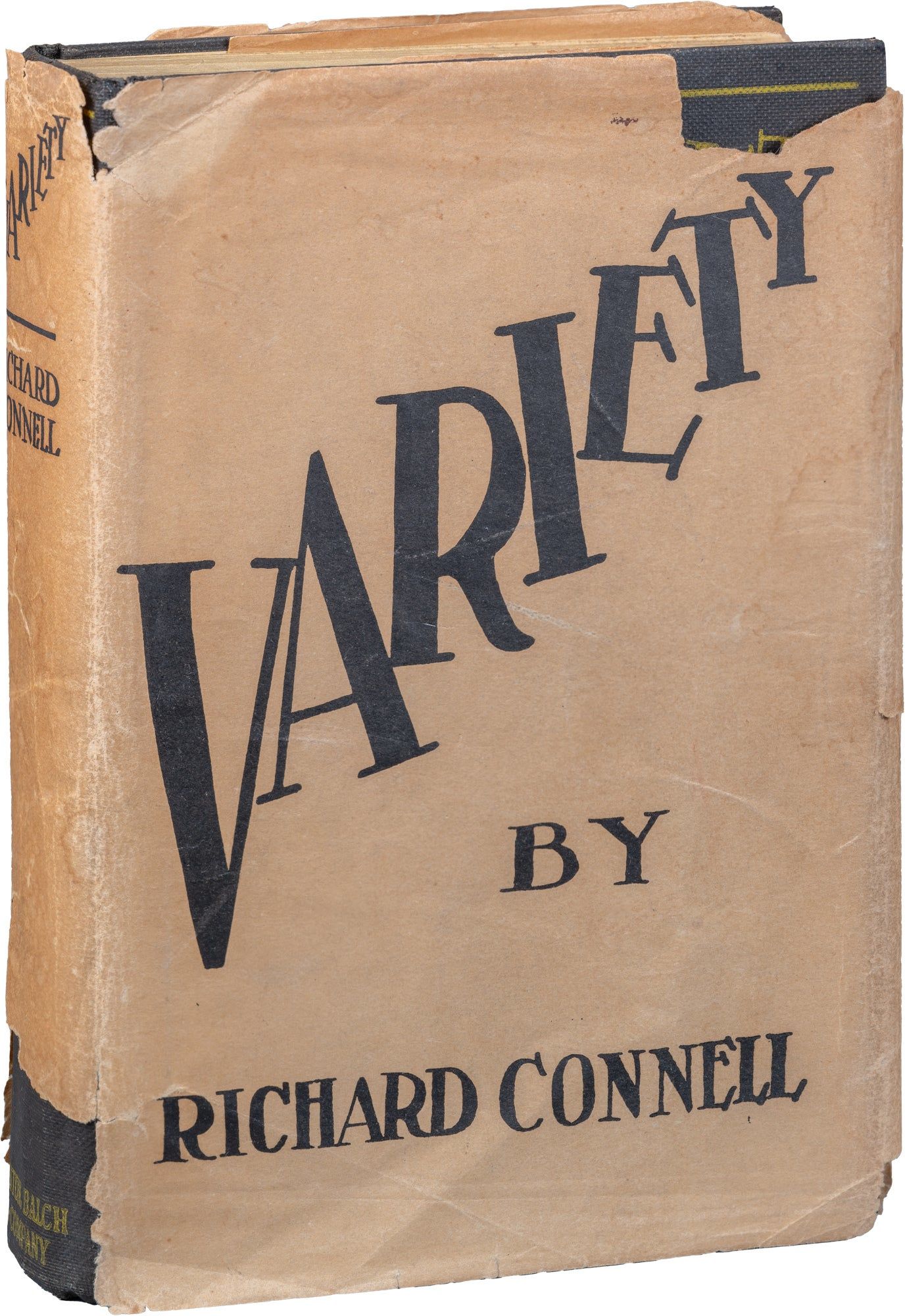

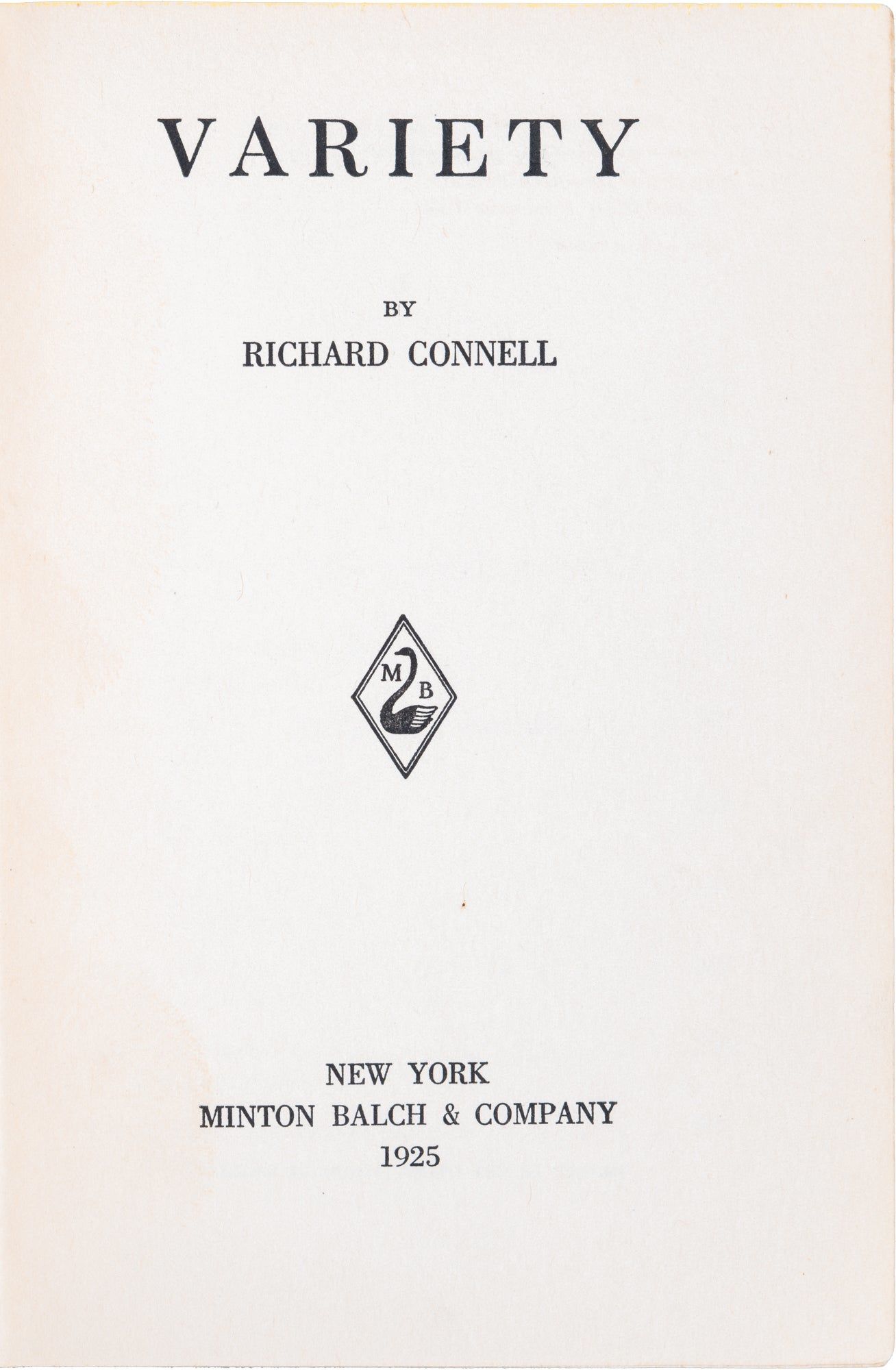
- SIGNED
- New York: Minton Balch & Co, 1939
New York: Minton Balch & Co, 1939. First Edition. 8vo, pp. 322. Preceding the London edition of the same year. Inscribed by Connell on the front blank. Original black cloth (also seen in tan, with no priority), light rubbing, spine creases and a light stain to the gutter of the page block, very good, in a good dust jacket, with chips and an old tape repair to the spine fold. A scarce book in dust jacket. A collection of 13 short stories called Variety because the 13 stories are of 13 different types (business, sex, comic, sentiment, war, etc.) The most famous of which is "The Most Dangerous Game" is labeled a "mystery" though that isn't quite accurate. The Most Dangerous Game became one of cinema's most adapted stories. The first film appeared in 1932, produced by RKO and directed by Merian C. Cooper and Ernest B. Schoedsack, who filmed it simultaneously with "King Kong" using the same elaborate jungle sets-a strategy that maximized RKO's investment in expensive tropical construction. Joel McCrea starred as the hunted man and Leslie Banks as the aristocratic General Zaroff. The rain forest sets (soon to become iconic in "King Kong") and intense chase sequences established the template for countless adaptations that followed: a 1943 version called "A Game of Death," the 1956 "Run for the Sun" starring Richard Widmark, and a 2022 film, among others. The premise-a wealthy hunter bored with animals who turns to hunting humans on his private island-has influenced everything from "Predator" to "Battle Royale" to "The Hunger Games."
General Zaroff, a Russian aristocrat fleeing the Bolshevik Revolution, recreates the exact power relations that sparked the uprising by establishing his private island as a space of absolute dominion over those he deems inferior. His careful cataloging of victims by race and class ("sailors from tramp ships, lascars, blacks, Chinese, whites, mongrels") exposes how aristocratic privilege and colonialism function through the same logic of categorization and dehumanization. The story illuminates the fundamental violence underlying aristocratic leisure: the inherited right to rule requires an underclass whose suffering and deaths provide entertainment for those born into power. Zaroff's boredom with hunting animals mirrors the colonial impulse to continuously expand dominion once existing territories fail to provide adequate stimulation. His island operates as every colonial outpost has, as a self-contained world where metropolitan rules dissolve and the powerful exercise unrestrained violence against those without institutional protection. The hunt becomes the purest distillation of how colonial systems function, with subjugated populations navigating hostile terrain while aristocratic rulers spectate from safety, their survival treated as sport rather than moral imperative. Rainsford's social Darwinism ("The world is made up of two classes: the hunters and the huntees") merely articulates what aristocratic ideology already assumes but politely obscures through the language of civilization and natural order.
General Zaroff, a Russian aristocrat fleeing the Bolshevik Revolution, recreates the exact power relations that sparked the uprising by establishing his private island as a space of absolute dominion over those he deems inferior. His careful cataloging of victims by race and class ("sailors from tramp ships, lascars, blacks, Chinese, whites, mongrels") exposes how aristocratic privilege and colonialism function through the same logic of categorization and dehumanization. The story illuminates the fundamental violence underlying aristocratic leisure: the inherited right to rule requires an underclass whose suffering and deaths provide entertainment for those born into power. Zaroff's boredom with hunting animals mirrors the colonial impulse to continuously expand dominion once existing territories fail to provide adequate stimulation. His island operates as every colonial outpost has, as a self-contained world where metropolitan rules dissolve and the powerful exercise unrestrained violence against those without institutional protection. The hunt becomes the purest distillation of how colonial systems function, with subjugated populations navigating hostile terrain while aristocratic rulers spectate from safety, their survival treated as sport rather than moral imperative. Rainsford's social Darwinism ("The world is made up of two classes: the hunters and the huntees") merely articulates what aristocratic ideology already assumes but politely obscures through the language of civilization and natural order.
Details
Title
Variety
Author
Connell, Richard
Condition
Unknown
Publisher
Minton Balch & Co: New York
Date
1939
Edition
First Edition