

Governor Thomas Jefferson, in a Letter to Maj. Gen. Nathanael Greene Calls His State to Arms: ""Cornwallis has advanced to the Roanoke.""
"I am in consequence issuing orders to embody every man between this & that for whom a firelock can be procured, & that they march to join you.""
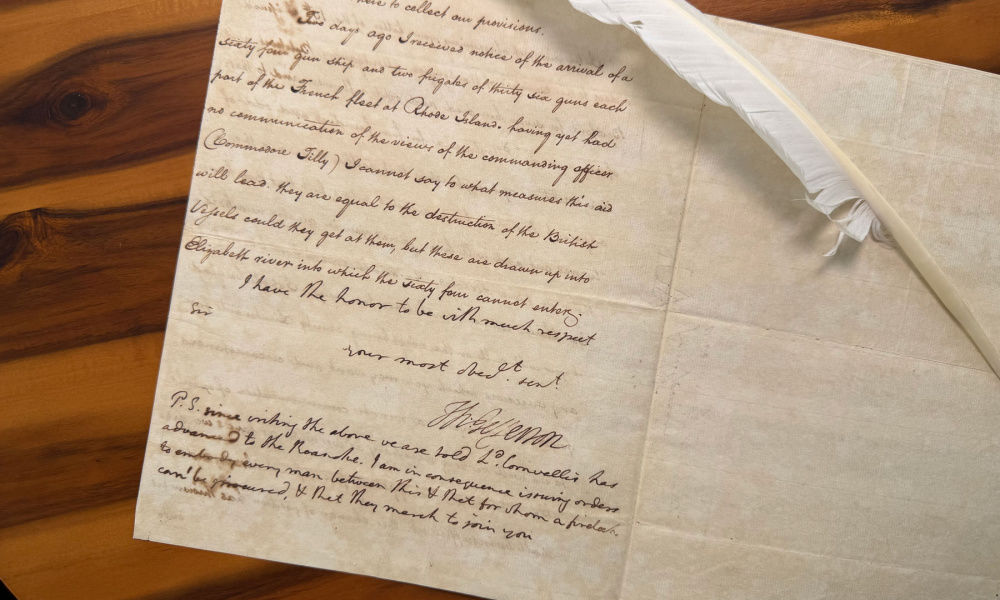
- SIGNED
- 17/02/1781
With Cornwallis and the British converging on Virginia, Jefferson reports to Greene that he will defend the state
Jefferson notes “the arrival of a sixty four gun ship and two frigates of thirty six guns each, part of the French fleet at Rhode Island”
This is our first letter of Jefferson to Greene, nor do we recall seeing another
[embed]https://vimeo.com/1186337282?share=copy&fl=sv&fe=ci[/embed]
As 1781 dawned, Virginia had been essentially out of the war as a theater of significant armed conflict, having experienced just a few nuisance raids in the Tidewater country early in 1776 and some raiding parties in 1779. However, the fall of Charleston in 1780 set in motion a significant expansion of the British southern offensive, both as a way to offset the stalemate in the Northern theater, and as part of a “Southern strategy”, in which British forces attempted to retake control over the South under the belief that there was a significant and sympathetic Loyalist population there.
Virginia became a focus. On the first of January 1781, the British sent an expedition into the Chesapeake Bay of Virginia under the command of their new general, Benedict Arnold. Arnold conducted a lightening raid up the James River to Richmond, severely damaging or destroying American logistics lines and supply capacity. He then returned to the Chesapeake, fortifying his army at Portsmouth.
The Battle of Cowpens was fought on January 17, 1781, near the town of Cowpens, South Carolina. An American army of regulars and militia under Gen. Daniel Morgan defeated a force of British and Loyalist troops, in the worst defeat suffered by the British in North America since the 1777 Saratoga campaign. Tactically, the battle demonstrated that militia, when deployed properly, could defeat experienced regulars, something which American military and political leaders had previously considered impossible.
Morgan's militiamen disbanded after the battle, leaving 550 regulars under his command. British General Lord Cornwallis pursued Morgan, who evaded Cornwallis and joined Maj. Gen. Nathanael Greene’s army. Throughout early February, Cornwallis pursued Greene, aiming to destroy the American army in the South. Greene’s army successfully crossed the Dan River from North Carolina into Virginia on February 13-14, escaping Cornwallis. Seeing that Greene had crossed the Dan, Cornwallis withdrew and encamped in North Carolina. But Virginia remained on Cornwallis’ radar, and he would attack it ere long.
In February 1781, Washington dispatched the Marquis de Lafayette with some 1,200 men to Virginia’s aid. Also in February, a small French naval squadron under Captain de Tilly was dispatched from Newport, RI, to Virginia to assist Lafayette against British forces under Arnold. This squadron arrived in the Chesapeake Bay area, capturing the British frigate HMS Romulus and several transports. The larger French fleet would not arrive until August.
Meanwhile, Jefferson received a report that Cornwallis had already established a position at the Roanoke River in Virginia, which alarmed him. His alarm was increased when he received a letter from Greene dated February 15, 1781, about the urgent need for defensive measures in Virginia. Greene wrote, “The Country is inevitably lost unless decided Measures are taken. You will consider the necessity and act accordingly. I have not time to enter into a farther detail of matters, being pressed on every side with a multiplicity of business, and almost fatigued to death having had a retreat to conduct for upwards of 200 Miles maneuvering constantly in the face of the enemy, to give time for the Militia to turn out and to get off our Stores. In addition to the common difficulties incident to all retreats, we have had several large rivers to cross and the enemy at our heels before we could get over. Necessity has and will oblige me to take many measures to effect the removal of our Stores contrary to the established laws of the different States; the occasion must justify the measure, and I trust the Legislature will make charitable allowances accordingly. The Army is all that the States have to depend upon for their political existence. I trust therefore whatever is necessary to its support will meet their approbation.”
Jefferson responded quickly. Letter signed, two pages, Richmond, February 17, 1781, to Greene, reporting that he has ordered over 1,000 rifleman to join Greene, that even more reinforcements might arrive, and showing his concern that Cornwallis might already be in Virginia. ""In the moment of receiving your letter of the 10th, I issued orders to the Counties of Washington, Montgomery, Botetout and Bedford for seven hundred and odd riflemen, and to those of Henry and Pittsylvania for four hundred and odd of their militia. Yet my trust is that neither these nor the adjacent Counties have awaited orders, but they have turned out and will have joined you in greater numbers than we have directed. The reinforcement from Chesterfield Courthouse cannot march these ten days. I shall be glad if you will call on the neighboring county Lieutenants for any succurs which you may want, and circumstances forbid to be delayed. A minute communication of events to us will be very necessary as we wish as far as we are able to increase the opposing force, if that already ordered shall be insufficient. This change of position has thrown us into great doubt where to collect our provisions.
""Two days ago I received notice of the arrival of a sixty four gun ship and two frigates of thirty six guns each, part of the French fleet at Rhode Island. Having yet had no communication of the views of the commanding officer (Commodore Tilly) I cannot say to what measures this aid will lead. They are equal to the destruction of the British Vessels could they get at them, but these are drawn up into Elizabeth river into which the sixty four cannot enter.
“P.S. Since writing the above we are told Ld. Cornwallis has advanced to the Roanoke. I am in consequence issuing orders to embody every man between this & that for whom a firelock can be procured, & that they march to join you.""
The next battle occurred at Guilford Court House in North Carolina on March 15, and it resulted in a British victory. Virginia continued to be threatened for another seven months. On April 18 the British began a major campaign up the James River, striking at Yorktown, Williamsburg, and the Virginia state naval docks on the Chickahominy River. Cornwallis then went to Petersburg on May 20, with the aim of cutting off American supply lines and forcing a decisive battle. He combined forces in Petersburg, uniting with roughly 3,500 men under generals Phillips and Arnold. They then chased Lafayette and launched raids. In June, Jefferson stepped down as governor and narrowly escaped capture by the British at Charlottesville. In August Cornwallis made his base at Yorktown, but this turned out to be a trap instead of a springboard. The following month the combined Continental Army and French forces, with George Washington at the head, laid siege to the place. On October 19, 1781, Cornwallis surrendered, ending not merely the threat to Virginia but the entire British war effort.
Details
Title
Governor Thomas Jefferson, in a Letter to Maj. Gen. Nathanael Greene Calls His State to Arms: ""Cornwallis has advanced to the Roanoke.""
Author
Thomas Jefferson
Condition
Unknown
Date
17/02/1781