

Just Weeks Before the Outbreak of World War II, Winston Churchill Announces He is Leaving for France to Inspect the Maginot Line
Churchill foresees that a crisis is coming on, which may force him to return to Britain sooner than hoped
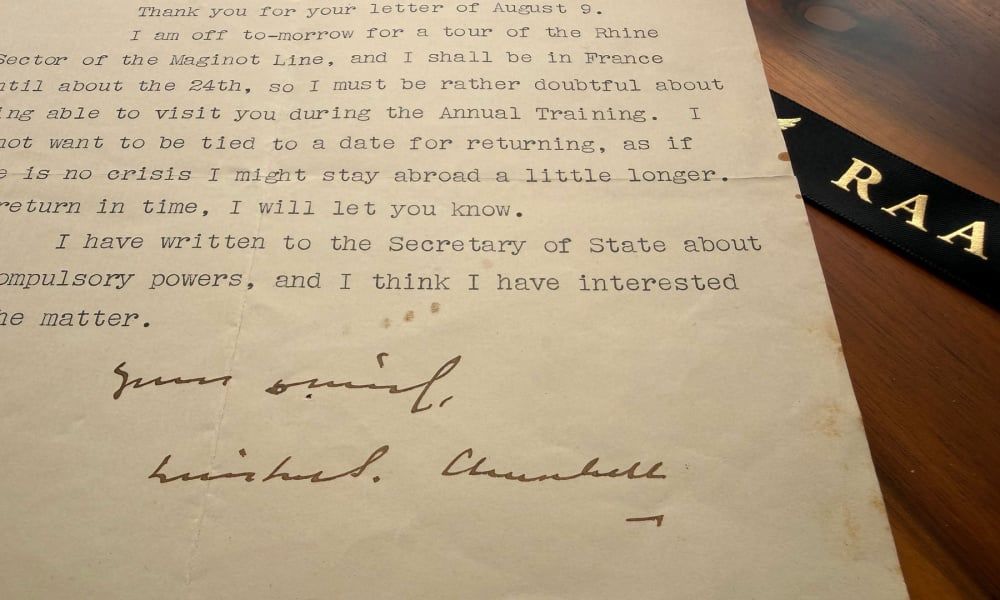
- SIGNED
- 13/08/1939
To ready for the oncoming war, he wants the British Secretary of State to use compulsory powers, such as mobilization measures and war-related administrative powers
This letter shows Churchill prescience and foresight as a lone voice in the wilderness years, noting the importance of the Maginot and arguing for emergency government powers
“I am off to-morrow for a tour of the Rhine Sector of the Maginot Line, and I shall be in France until about the 24th…I do not want to be tied to a date for returning, as if there is no crisis I might stay abroad a little longer.”
Listen to the Inspired by History Podcast
[embed]https://vimeo.com/1186280095?share=copy&fl=sv&fe=ci[/embed]
On August 8, 1939, on the threshold of the outbreak of World War II, Winston Churchill gave a radio address containing his analysis of the international situation and appealing for solidarity between democracies facing the very real threat of invasion from aggressive, militaristic dictatorships. He painted the situation in stark terms, enumerating the actions of Japan, Italy, and particularly Germany against their neighbors and pointing out that they have not been checked, were escalating, and were continuing their advance. He sharply criticized the policy of appeasement.
Churchill said in part: “Alas! it is the hush of suspense, and in many lands it is the hush of fear. Listen! No, listen carefully; I think I hear something-yes, there it was quite clear. Don’t you hear it? It is the tramp of armies crunching the gravel of the parade- grounds, splashing through rain-soaked fields, the tramp of two million German soldiers and more than a million Italians- “going on maneuvers”-yes, only on maneuvers!…Besides, these German and Italian armies may have another work of Liberation to perform. It was only last year they liberated Austria from the horrors of self-government…No wonder the armies are tramping on when there is so much liberation to be done, and no wonder there is a hush among all the neighbors of Germany and Italy while they are wondering which one is going to be “liberated” next…Therefore, if war should come there can be no doubt upon whose head the blood-guiltiness will fall. Thus lies the great issue at this moment, and none can tell how it will be settled.”
Just five days later, on April 13, 1939, Churchill delivered a significant speech to the House of Commons regarding the European situation, emphasizing the need for a ""Grand Alliance"" to stop Nazi aggression. While acknowledging the strength of the Maginot Line, Churchill noted that it was an immobile ""shield,"" whereas Germany's offensive strategy was designed to be highly mobile. Churchill criticized the government's lack of a long-term policy and urged Britain to ""wake up,"" advocating for a strong Anglo-French alliance and collective security to resist German pressure. The next day, Churchill headed to France to assess its defenses against a German attack. Among the places he visited was the Maginot Line.
The Maginot Line was conceived by French Minister of Defense André Maginot, and was built between 1928 and 1935. It consisted of a series of strong points along the Rhine River, complete with anti-tank obstacles, camouflaged machine gunner/grenadier positions made of cement, heavy artillery trained on major road junctions, underground railroads, underground cement-and-steel barracks and storage rooms, ventilation system to filter poison gas, field artillery teams, plus many other intricate systems of defense to ensure no German could cross the French border. The primary purpose of it was to secure the eastern border of France so that in event of German aggression, the line of fortifications would hold the enemy advances while French mobile forces could counterattack through Belgium.
On August 16, 1939, in a now famous trip, Churchill and a London Times journalist toured the front lines in France. Churchill was ""amazed"" to see a duel of political-slogans billboards on the two sides of the Rhine. ""Ein Volk, ein Reich, ein Führer"", said the east bank; the French responded with ""Liberté, Égalité, Fraternité"". When he looked closer, he was also shocked by the presence of the German garrisons. ""The trip tore to shreds any illusion that it was not Germany's intention to wage war and to wage it soon."" Despite nearing the age of 65, Churchill climbed in and out of every anti-tank ditch and every pillbox he passed by during his tour, commenting on the construction and placement. After this trip to the Maginot Line, he later noted his belief that it was a strong fortification, but there was one major weakness; France called it its ""shield"", but Churchill noted a shield can be moved to cover any part of a soldier's body, while the Maginot Line was immovable. Additionally, while the French boasted that the line protected their nation from Switzerland to the sea, the portion of the line on the Belgium border was extremely weak and the stretch along the ""impénétrable"" Ardennes Forest was nearly undefended. Instead, troops were diverted to the Metz, Lauter, and Alsace regions to protect France's heavy industries. On the opposite side of the Rhine, the Germans were already planning strategies to put French defense to the test in just two weeks time.
In 1939, at the outbreak of World War II, Britain moved swiftly to grant sweeping compulsory powers to the state under the Emergency Powers (Defence) Act 1939. Introduced by the government of Neville Chamberlain and administered in part by Home Secretary Sir John Anderson, these measures authorized ministers to regulate nearly every aspect of civilian life, from evacuation and identity registration to industrial control and conscription. This law, enacted later in 1939, is Churchill's reference to ""compulsory powers."" Churchill was arguing for this a full month before its passage.
Typed letter signed, on his letterhead, Chartwell, August 13, 1939, the day before he left for France, to Arthur Vere Harvey, Commanding Officer of 615 Fighter Squadron. In April 1939, Arthur persuaded Churchill to visit the squadron and offered him the position of Honorary Air Commodore, a position Churchill was grateful to accept and continued to hold until the squadron were disbanded in 1957.
“Thank you for your letter of August 9. I am off to-morrow for a tour of the Rhine Sector of the Maginot Line, and I shall be in France until about the 24th, so I must be rather doubtful about being able to visit you during the Annual Training. I do not want to be tied to a date for returning, as if there is no crisis I might stay abroad a little longer. If I return in time, I will let you know. I have written to the Secretary of State about using compulsory powers, and I think I have interested him in the matter.""
An extraordinary letter, showing Churchill's active engagement in policy advocacy even before holding office, and reflecting his persistent foresight regarding the looming conflict. At the time of the writing of this letter, while Neville Chamberlain's government languished in hopes of avoiding war, Churchill was preoccupied with Britain's preparedness for it. His examination of the Maginot line in mid-August 1939, referred to in this letter, was expressly for the purpose of assessing France's defenses in the event of a German attack. He states 'if there is no crisis’, which that means such a crisis was on his mind and he was evidently readying himself for one. Furthermore, his weight as an opposition MP is clear in this letter, where he notes that he had 'interested' the Secretary of State in his letter to him about using compulsory powers — likely relating to mobilization measures, conscription, or war-related administrative powers.
Details
Title
Just Weeks Before the Outbreak of World War II, Winston Churchill Announces He is Leaving for France to Inspect the Maginot Line
Author
Winston Churchill
Condition
Unknown
Date
13/08/1939