

President Andrew Jackson Appoints a Hero of the Battle of New Orleans a Captain in the Navy
Thomas ap Catesby Jones had enabled Jackson to arrive in New Orleans on time to defend the city, and the two men became friends
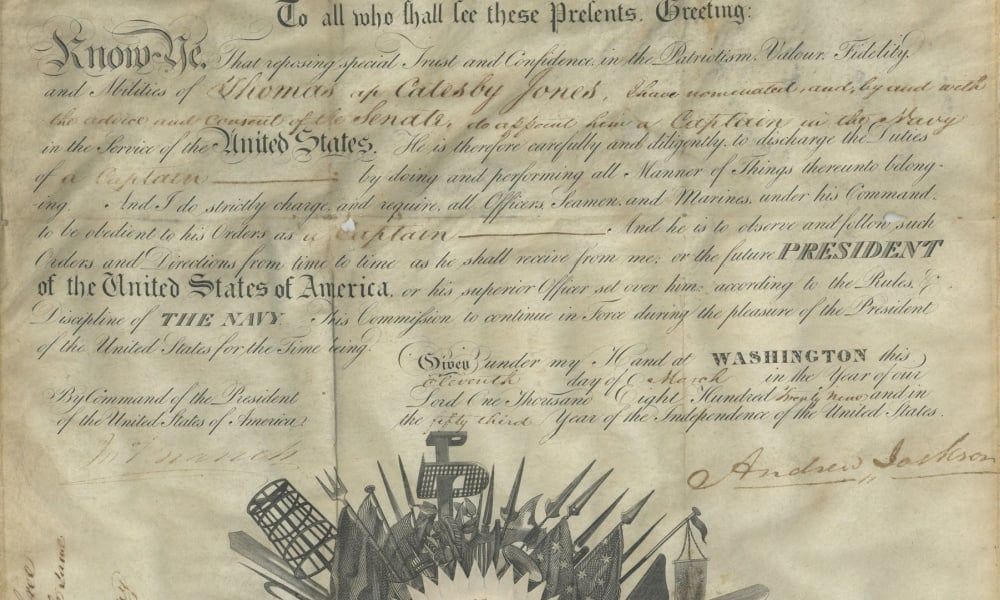
- SIGNED
- 11/03/1829
Jones, as famed Captain and Commodore, also concluded a treaty with the king of Hawaii, and defended San Francisco during the Gold Rush
Thomas ap Catesby Jones was one of the most controversial officers in the U.S. Navy during the first half of the nineteenth century. He served from 1805 until 1858. A fascinating representative of a period of tumultuous change for both the Navy and the country, he was a firebrand with a desire for reform and willingness to experiment. He was also a friend of Andrew Jackson, both before, during and after his presidency.
Jones saw his first active service as a gunboat commander assigned to the New Orleans station from 1808 to 1815. Fourteen months after entering the service he had his own boat. He was only nineteen then, and the youngest man aboard. The first years were spent in the suppression of piracy and smuggling on the Gulf Coast, and he was so active that it is said that the arch pirate Jean Lafitte offered him $10,000 to leave those waters. After the outbreak of the War of 1812, Commodore Dan Patterson decided to break up the nest of pirates at Barataria. Lieutenant Jones was his second in command by this time, and led the gunboats into action when the attack was made. After the successful conclusion of the affair he was mentioned in dispatches for gallantry.
Jones received honors for bravery at the 1814 Battle of Lake Borgne in Louisiana, where he succeeded in delaying the British advance prior to the Battle of New Orleans. When the British attackers arrived, Jones was stationed inside Ship Island, at the entrance of Lake Borgne, with only five gunboats. On the approach of a British force in barges, he withdrew to the more defensible Malheureux Island Passage, and there, outnumbered about six to one, he fought the battle of Lake Borgne. Before he was overwhelmed, he so battered the attacking force that British general Pakenham did not land his army for another week. Thus he and Commodore Dan Patterson were partly responsible for the presence of Jackson’s army at New Orleans in time to meet Pakenham, and only the sacrifice of the naval force to delay the British advance made the successful defense of the city possible. In this sacrifice Patterson was the directing force and Jones his chief instrument.
Jones then spent a year in the Mediterranean learning deep-water seamanship and serving as first lieutenant of the Constellation. This was followed by a Pacific cruise in command of the Peacock, notable for the conclusion of the first trade agreements with several South Sea Island chiefs, and one with the king of Hawaii. Then came promotion to the rank of captain while serving as chief ordnance officer of the navy. In 1836 he raised his commodore’s broad pennant over the Macedonian as commander of the South Seas Exploring Expedition which later sailed under the command of Lieutenant Charles Wilkes.
From 1841 to 1844, Jones commanded the United States Pacific Squadron, and again from 1848 to 1850. The most important event was his premature capture of Monterey, which almost precipitated the inevitable war with Mexico in 1842.
While lying at Callao, Commodore Jones heard a rumor that Mexico was at war with the United States and had ceded California to Great Britain. At the same time the British flagship Dublin slipped her cables immediately after the arrival of the mail steamer and sailed northward under sealed orders. The American commander immediately decided to forestall the British and sailed for Monterey. The taking of the city led to a huge clamor in Mexico. Jones was later recalled to still the anger in Mexico City, but was never censured for his action. In fact, he received a private letter of commendation from the Secretary of the Navy, John Y. Mason.
When the Mexican War was nearly over Commodore Jones was again given command of the Pacific squadron; it was his last command. Too late for action against Mexico, he arrived at California in time for the Gold Rush. During those chaotic days, Jones provided a U.S. Navy presence in the San Francisco area. Thomas ap Catesby Jones was an outstanding example of the type of officer produced by the navy of his day, a strong character who stood out in a service full of strong characters.
Document signed, with engravings of an eagle, flags and cannons, Washington, March 11, 1829, naming Jones a captain. “I have nominated and by and with the advice and consent of the Senate do appoint him a Captan in the Navy.” This is one of the most significant military appointments we have ever carried.
Details
Title
President Andrew Jackson Appoints a Hero of the Battle of New Orleans a Captain in the Navy
Author
Andrew Jackson
Condition
Unknown
Date
11/03/1829