

Theodore Roosevelt: ""Friends, I shall ask you to be as quiet as possible; for I have just been shot and the bullet is in me""
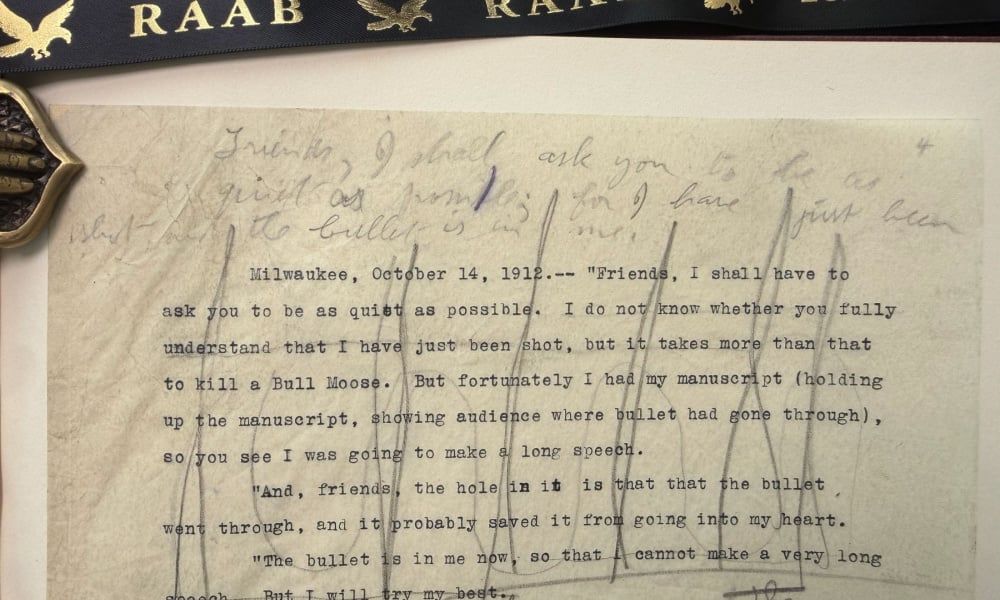
Roosevelt's copy of one of the great speeches in American history, with his heavy annotations and powerful handwritten language, typed out in the hours after the speech by Elbert Martin, his stenographer at the scene, who also tackled the would be assassi
- SIGNED
- Oct-12
One of the momentous quotations in American political history, in the hand of its speaker
In a private collection since shortly after the assassination attempt itself and never before on the market
Newly discovered, not known to have survived, the only other known copy being the corrected version with no marks from TR, belonging to the heirs of Martin
This version of the text, which appears only here and in Martin's copy, was the first printed version of the speech and the version that is closest to Roosevelt's own words and intent
It contains information not known to scholars and is a remarkable find
Listen to the Inspired by History podcast
[embed]https://vimeo.com/1188655742?share=copy&fl=sv&fe=ci[/embed]
On September 5, 1901, President William McKinley delivered a speech at the Pan-American Exposition in Buffalo, New York. Also in attendance that day was Leon Czolgosz. The following day the President was shot by Czolgosz and he died a week later. McKinley’s assassination made Theodore Roosevelt president. Eleven years later, Roosevelt, now running as the Progressive Party candidate for the presidency, was the victim of the same act of violence.
John Schrank was born in Bavaria and emigrated to America at the age of 13. His parents died soon after and Schrank came to work for his uncle, a New York tavern owner and landlord. Later, he drifted around the East Coast, becoming profoundly religious and a Bible preacher whose debating skills were well-known around his neighborhood’s watering holes and public parks. He spent a great deal of time walking around city streets at night.
On October 14, 1912, Roosevelt arrived in Milwaukee at the end of a campaign visit to the area. Schrank stood toward the head of a crowd waving to him as he attempted to enter his car, shooting him at close range. Schrank, claiming to have been motivated to kill by the ghost of assassinated President McKinley, said he wanted to dissuade future third term hopefuls. He wounded Roosevelt, who was saved only by a folded 60-plus page speech that was tucked inside his vest pocket, as well as a metal spectacle case, both of which slowed and deflected the bullet away from sensitive chest areas and the heart.
Roosevelt went on to make a moving and significant campaign speech, though not the one he had prepared and was carrying. Speaking extemporaneously, he quieted the crowd by reminding them that it was hard to speak given that he had just been shot. He started by addressing his being shot: “First of all, I want to say this about myself: I have altogether too important things to think of to feel any concern over my own death…I am telling you the literal truth when I say that my concern is for many other things…I am not thinking of my life or of anything connected with me personally. I am thinking of the movement.” He continued about his cause: “ I am in this cause with my whole heart and soul. I believe that the Progressive movement is making life a little easier for all our people; a movement to try to take the burdens off the men and especially the women and children of this country. I am absorbed in the success of that movement.” He made light of the wound, using a term associated with the Progressive Party: “It takes more than that to kill a Bull Moose.” He pleaded for honesty in government: “I cannot tell you of what infinitesimal importance I regard this incident as compared with the great issues at stake in this campaign, and I ask it not for my sake, not the least in the world, but for the sake of common country.” He ended with a call for “social and industrial justice.” And all this time, he held the speech that had helped save his life. However, as brave as he was, his campaign was finished and he was hospitalized in Chicago for 8 days.
In August, Roosevelt had hired a stenographer to come with him on the road and make official versions of his speeches. That man was former footballer Elbert Martin, an athlete who was responsible for taking down what Roosevelt said and who played a small but notable supporting role as one of Roosevelt’s aides. Martin was there on October 14 and was one of the men who immediately reacted to the gunshot. Along with others in the crowd, he helped subdue John Schrank, reportedly grabbing and helping restrain him before Schrank could cause further harm. While accounts vary slightly on who made first contact, Martin is commonly credited as being among those who physically tackled or pinned Schrank. Afterward, he returned to assist Roosevelt, who insisted on continuing with his speech despite being wounded, making Martin part of both the dramatic capture of the attacker and the controlled response that followed.
Martin’s job as Theodore Roosevelt’s stenographer meant he took down Roosevelt’s speeches in shorthand and then transcribed (typed) them afterward. Like most stenographers of the time, he would quickly record speeches, interviews, or dictation using shorthand during or immediately after delivery, and later prepare a clean typed version for records, newspapers, or campaign use.
Because the role of this was to create a version for immediate publication, the typed version would have been done in the immediate hours after the speech, likely that day.
Roosevelt's copy of the delivered speech, October 14, 1912, typed by Martin in the hours after the speech from shorthand, in-person notes, being the first appearance of this speech and given to Roosevelt for his edits, partial typed, partial printed, partial Autograph and extensively annotated, unsigned, containing information and text not previously known. This version differs from the known published version and appears only in Martin's own separate clean copy showing these edits. The articles quoted during the speeches are clipped and pasted for TR in their original form by Martin.
It contains, in Roosevelt's hand, the line that he has been shot, written likely just hours after the shooting.
A very few of the edits made in Roosevelt's hand, aside the many other edits that appear throughout the manuscript:
- ""Friends, I shall ask you to be as quiet as possible for I have just been shot and the bullet is in me.""
- ""I am thinking of the movement, and of what it means to my country, and to my people, to the people to whom I belong.""
- He crossed out: ""Colonel Roosevelt then unbuttoned coat and vest and showed his white shirt badly stained with blood. Now friends I am going to be as quiet as possible even if I am not able to give the challenge of the bull moose quite as loudly as usual.""
- He has crossed out ""(Voice from audience. 'Please sit down Colonel Roosevelt. You should rest.'""
- ""Now, friends, nine-tenths of wisdom is to be wise in time.""
- Wrong is wrong, by whomever committed; and to do injustice to others is a mean and sorry thing in a man who is asking for justice to himself.
- ""The Democratic Party in its platform and through the utterances of Mr . Wilson has definitely committed itself to outworn, muzzle-loading, flintlock theories of government, such as the doctrine of States' Rights, treated from the fetish standpoint.""
- The speech ends: ""Friends, I thank you for having been so quiet, I am ready for the Doctors now."" He has changed ""quiet"" to ""patient"" and deleted the final sentence.
The speech itself was a marvelous one.
It emphasized courage, duty, and his commitment to reform. Despite being wounded, Roosevelt insisted on speaking, using the moment to demonstrate strength and dedication to the public. In the speech, he reaffirmed his support for policies aimed at controlling corporate power, protecting workers, and promoting justice, while also stressing the importance of democracy and the will of the people. Overall, the speech became a powerful symbol of personal resilience and reinforced his message that bold leadership was necessary to address the challenges of modern American society. He railed against President Wilson and Senator LaFollette among others.
""I am saying this by way of introduction because I want to say something very serious to our people, and especially to the newspapers. I don't know who the man was who shot me tonight. He was se1zed by one of my stenographers, Mr . Martin , and I suppose 1s in the hands of the police now. He shot to kill me. I do not know who he was or what party he represented . He was a coward . He stood in the darkness in the crowd around the automobile and when they cheered me and I got up to bow he stepped forward and shot me in the breast. But it is a very natural thing that weak and vicious minds should be inflamed to acts of violence by the kind of foul mendacity and abuse that have been heaped on me for the last three months by the papers in the interests not only of Mr. Debs but of Mr . Wilson and Mr . Taft. Friends, I would indignantly disown and repudiate any man of my party who attacked with such vile and foul slander and abuse any of my opponents of any other party.... I am not speaking for myself at all, I give you my word. I do
not care a rap about being shot-- not a rap. I have had a good many experiences in my time and this is only one of them. What I care for is this country of ours.""
""Once, after a fight in Cuba, I promoted five men for gallantry in battle. After-wards it happened that I made some inquiries about them and found that two were Protestants, two Catholics and one a Jew, one Protestant having been born in Germany and one of the Catholics in Ireland. Now, friends, I did not promote them because of the way they happened to be divided up. If all five had been Jews I would have promoted them; if all five had been Catholics or Protestants, if all five had been born here or born abroad, I would have promoted them. In that regiment I had a man born in Italy who distinguished himself by gallantry; another was the son of Polish parents; another a young fellow who had come here from Bohemia when a child. Friends, was incapable of considering, and they were incapable of considering , any questions whatever but the worth of each individual as a fighting man. If he was a good fighting man then I saw
that Uncle Sam got the benefit of him, that was all.... In the same way I want our people to
stand by one another without regard to difference of class. I have always stood by the laboring man.... My appeal to him is to remember that as he wants justice so he must do justice. Wrong is wrong, by whomever committed; and to do injustice to others is a mean and sorry thing in a man who is asking for justice to himself. I want every laboring man, every labor leader, every organized union man, to take the lead in denouncing crimes of murderous violence and in denouncing all appeals to violence .
""The Democratic Party in its platform and through the utterances of Mr . Wilson has definitely committed itself to outworn, muzzle-loading, flintlock theories of government, such as the doctrine of States' Rights, treated from the fetish standpoint . We have said definitely that we are for the people's rights. We are for the rights of the people; if they can best be obtained through State action, then we are for States' rights. If they can best be obtained through the National Government then we are for National rights . In either case we are for the people's rights.""
This document was not known to have survived and has never been offered for sale, remaining in the same collection for nearly a century.
Details
Title
Theodore Roosevelt: ""Friends, I shall ask you to be as quiet as possible; for I have just been shot and the bullet is in me""
Author
Theodore Roosevelt
Condition
Unknown
Date
Oct-12