

Just Two Weeks Before Lexington and Concord, George Washington Tends to Mount Vernon’s Iconic Roof
In April 1775, he orders improvements to Mount Vernon
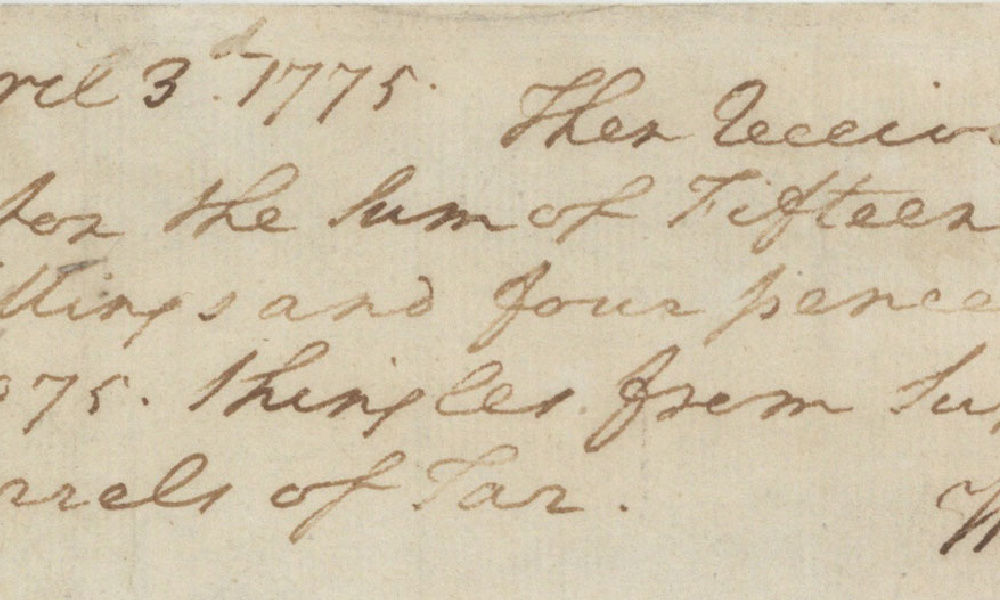
- SIGNED
- 03/04/1775
Washington's own file copy, with his docket on the back
Shingles act as a primary protective barrier on a building's roof, shielding it from rain, wind, snow, and sunlight. They prevent water from entering the structure, reduce mold growth, and add aesthetic value.
Wood was the overwhelming choice for the composition of Virginia roofs in George Washington's day. Washington purchased hundreds of thousands of wooden shingles for Mount Vernon during his lifetime, most of them split from cypress trees cut in the Dismal Swamp near Suffolk in southern Virginia. Cypress is naturally rot resistant, and an old-growth cypress roof was expected to provide cover for 50 years or more.
Today we know the iconic Mount Vernon roof as red. But originally it must have been blue. The Mount Vernon website states, “These encapsulated shingles were painted slate blue, indicating that the roof was likely this color from as early as 1775.” Additionally, in November 1775, Lund Washington, his nephew who did work at Mount Vernon, wrote to Washington confirming that the house had been shingled in preparation for the winter. This strongly suggests that changes were larger than normal changes were to the roof in 1775. The roof remained this slate blue color until later, when, according to letters from Washington, the roof was changed to red by 1793. Interestingly, in 1775 Washington also did other construction - he installed a plaster ceiling in the dining area with the fireplace.
Based on financial records from The Papers of George Washington, Washington paid William Loney for the freight of 5,000 shingles from Suffolk in May 1773. He made a similarly sized purchase the following year. Yet in 1775 the order had changed substantially; rather than a a few thousand, Washington upped the order to nearly 60,000 shingles in one year.
Autograph document signed in the 3rd person, April 3, 1775, being a receipt given to William Loney for shingles. “Then received from George Washington the sum of fifteen pounds fifteen shillings and four pence for freight of 57,075 shingles from Suffolk and for three barrels of tar.” It is signed by Loney as received.
An uncommon and interesting link between Washington and improvements for Mount Vernon at a crucial moment in American history. Although he did not know it, Washington's life was about to change. He officially joined the Revolutionary War effort when he was appointed commander-in-chief of the Continental Army by the Continental Congress on June 15, 1775. He formally took command of the army in Cambridge, Massachusetts, on July 3, 1775.
Details
Title
Just Two Weeks Before Lexington and Concord, George Washington Tends to Mount Vernon’s Iconic Roof
Author
George Washington
Condition
Unknown
Date
03/04/1775