

The French, With Recriminations About the Sale from Napoleon, Seek to Slow the Delivery of their Cession of Louisiana to the Desk of Thomas Jefferson
In a letter asking for copies to be made or the originals handed back, Napoleon's Minister Marbois and asks for the deferral of delivery
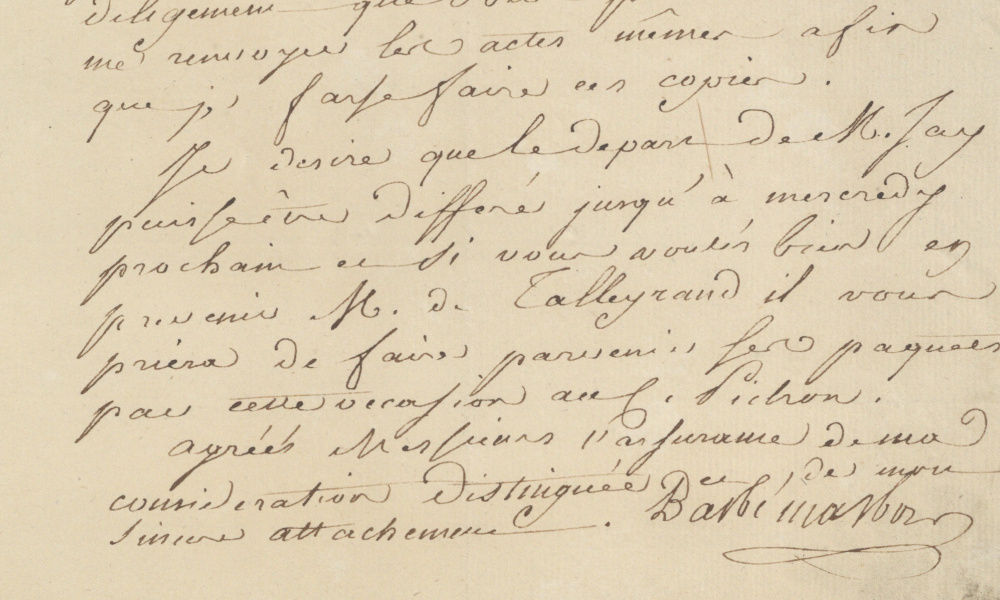
- SIGNED
- 28/05/1823
“I beg you to have them copied for me as diligently as possible...I desire that the departure of Mr. Jay (Peter Augustus) be deferred until next Wednesday…”
The French ratification of the Louisiana Purchase treaty and conventions was dated May 22nd and signed by Bonaparte, Foreign Minister Talleyrand, Minister of the Treasury Barbé de Marbois, and Hugues Bernard Maret, who, as the secretary of state, was responsible for promulgating laws and decrees. It was delivered to the representatives of the United States, Robert R. Livingston and James Monroe, who acknowledged receipt of the paperwork to be sent to President Thomas Jefferson ""without delay.""
It is interesting to note that Barbé de Marbois, who played a key role in negotiating the Louisiana Purchase Treaty and delivered the signed ratification, was former ambassador to the United States who had lived in the U.S. for years, spoke English, and married an American. He was well connected in the U.S. and was elected a Foreign Honorary Member to both the American Academy of Arts and Sciences (John Hancock and John Adams were also members), and the American Philosophical Society (Thomas Jefferson was also a member, and the two dealt extensively). He was a logical choice to negotiate the treaty.
Five days after delivery of the signed, ratified treaty, Marbois contacted the U.S. ministers to ask for the return of copies of the treaty or even the treaty itself so that official copies could be made.
Letter signed by Marbois, on French Public Treasury letterhead, Paris, May 28, 1803, to ""the Ministers of the United States”, in which he asks Livingston and Monroe to either send him copies of the First Consul's ratifications or else lend their own official copy to his office so that additional record copies could be made from it. He requested further that Peter Augustus Jay, the son of John Jay, who was assigned to carry the treaty back to President Jefferson, delay his voyage by a few days, to give time for Talleyrand to prepare official instructions for Louis A. Pichon, the French minister in Washington, D.C. ""I am in need of the ratifications given by the First Consul to the Treaty and the two conventions. I beg you to have them copied for me as diligently as possible or to have sent to me the acts themselves so that I might have them copied. I desire that the departure of Mr. Jay (Peter Augustus) be deferred until next Wednesday and if you might also notify Talleyrand, he will thereby request you to deliver the packages to Mr. Pichon.""
On June 2, Livingston sheds some light on the request. ""You know that the ratifications have been delivered & that we were to send them directly to you, we have accordingly applied for a passport for Mr Jay the bearer. To our note on this subject we received no answer. I called this day on Mr Talleyrand to accelerate it; he was at St Cloud I called on the Minister of the Treasury.... They have been these two days past in Council and principally basting Mr. Marbois on the subject of the Treaty for it seems that the Consul is less pleased with it since the ratification than before and I [am] persuaded that if he could conveniently get off he would...""
Livingston further explains that Napoleon felt it was not proper that Marbois delivered the ratifications, that it ought to have been Pichon, and that Marbois, in a fit to try to appease the Consul, was throwing in objections and slowing the process of allowing Jay to leave with the Treaty.
Jay's trip was indeed postponed, resulting in not merely in the brief delay requested by Marbois, but additional delays mainly resulting from the fact that war had again broken out between Great Britain and France, and Jay’s ship was repeatedly stopped by British frigates. Jefferson did not see the treaty and conventions until early July. Jefferson was then in a quandary. He had always advocated strict adherence to the letter of the Constitution, yet there was no provision empowering him to purchase territory. Given the public support for the purchase and the obvious value of Louisiana to the future growth of the United States, however, Jefferson decided to ignore the legalistic interpretation of the Constitution and forgo the passage of a Constitutional amendment to validate the purchase. This decision contributed to the principle of implied powers of the federal government.
Because the treaty stipulated that the American ratification must be concluded by October 30th, Jefferson hurriedly convened a special session of Congress on October 17th. The United States Senate consented to ratification of the treaty with a vote of 24 to 7 on October 20th. On the following day, October 21, 1803, the Senate authorized Jefferson to take possession of the territory and establish a temporary military government.
Details
Title
The French, With Recriminations About the Sale from Napoleon, Seek to Slow the Delivery of their Cession of Louisiana to the Desk of Thomas Jefferson
Author
Thomas Jefferson|Napoleon Bonaparte
Condition
Unknown
Date
28/05/1823