

Mere Days After Surviving a Failed Assassination Attempt, Theodore Roosevelt Responds to His Friend John Burroughs’ Concern
Letters of Roosevelt from immediately after his assassination, let alone to a close friend and someone so prominent, are very rare, this being our first
- SIGNED
- 25/10/1912
Together with Burroughs’ own retained copy of his letter to Roosevelt dated October 18, four days after the shooting, remarking, “I shall send you a copy of my new volume – ‘Time and Change’ – if you had had a copy of that in your vest pocket that night, I am sure the hostile bullet would not have penetrated all that geology.”
In a private collection since shortly after the assassination attempt itself and never before offered for sale
Written at a pivotal moment in Roosevelt’s life, having just survived an attempted assassination that upended his 1912 campaign for President as the Progressive or “Bull Moose” candidate
Theodore Roosevelt’s military exploits, particularly with his “Rough Riders” during the Spanish-American War, paved the way for his political career. He successfully ran for Governor of New York as a Republican in 1898, and he was soon asked to join the 1900 Republican ticket as vice-president under President William McKinley. They won.
Upon the assassination of McKinley in 1901, Roosevelt became President, serving from 1901 to 1909. After a brief pause, he returned to politics and again ran for President in 1912, this time as a member of the Progressive or “Bull Moose” party, touting a “Square Deal” that included women’s suffrage, 8-hour workdays, and social reform.
On October 14, 1912, Roosevelt arrived in Milwaukee, Wisconsin, at the end of a campaign visit to the area. John Schrank, a Bavarian immigrant, stood toward the head of a crowd waving to him as he attempted to enter his car and then shooting him at close range. Schrank, claiming to have been motivated to kill by the ghost of assassinated President McKinley, said he wanted to dissuade future third term hopefuls. He wounded Roosevelt, who was saved only by a folded 60-plus page speech that was tucked inside his vest pocket, as well as a metal spectacle case, both of which slowed and deflected the bullet away from sensitive chest areas and the heart.
Roosevelt went on to make a moving and significant campaign speech, though not the one he had prepared and was carrying. Speaking extemporaneously, he quieted the crowd by reminding them that it was hard to speak given that he had just been shot. He started by addressing his being shot: “First of all, I want to say this about myself: I have altogether too important things to think of to feel any concern over my own death…I am telling you the literal truth when I say that my concern is for many other things…I am not thinking of my life or of anything connected with me personally. I am thinking of the movement.”
However, as brave as he was, he was hospitalized in Chicago for 8 days. When the election took place in November, Roosevelt, as the third-party candidate, split the Republican vote and came in second, losing to Woodrow Wilson. The incumbent, William Howard Taft, came in third.
John Burroughs contributed to the American understanding of nature through his large literary output, which included works about Henry David Thoreau, and his friend Walt Whitman. He and Roosevelt bonded over their love of the natural world. In April 1903, the two men toured Yellowstone Park together, and Burroughs wrote about it in the book, Camping and Tramping with Roosevelt. Along with Henry Ford and Harvey Firestone, the two also took several famous camping trips starting in 1915, dubbing themselves the “Vagabonds.”
Burroughs visited Roosevelt at the White House, and Roosevelt visited Burroughs at his rustic summer cabin, Woodchuck Lodge, in Roxbury, New York. Roosevelt esteemed Burroughs and called him Oom John, an affectionate term meaning “uncle” in Dutch (the Roosevelts were of Dutch extraction).
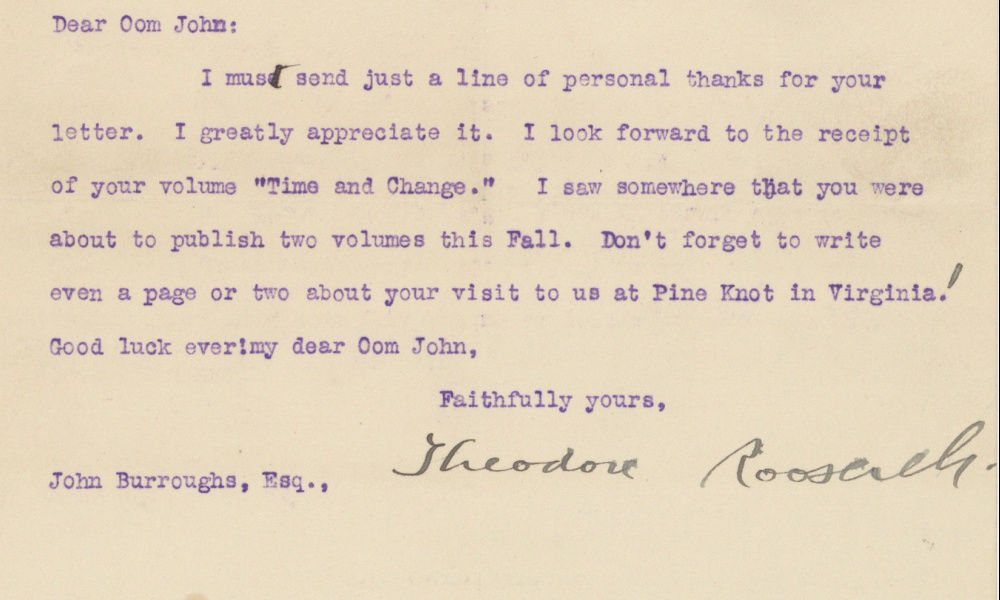
Typed letter signed, New York, October 25, 1912, to Burroughs offering his personal thanks for Burroughs’ concern. “Dear Oom John: I must send just a line of personal thanks for your letter. I greatly appreciate it. I look forward to the receipt of your volume ‘Time and Change.’ I saw somewhere that you were about to publish two volumes this Fall. Don’t forget to write even a page or two about your visit to us at Pine Knot in Virginia [Roosevelt’s country retreat]! Good luck ever! My dear Oom John, Faithfully yours, Theodore Roosevelt.”
The letter comes together with Burroughs’ own retained copy of his typed letter to Roosevelt, October 18, 1912, written from his home in West Park, New York, mere days after the shooting, expressing his anxiety about Roosevelt’s well-being and his staunch support for his political campaign. “Dear Colonel Roosevelt, I am thinking anxiously of you these days as is all the world and fervently hoping for your speedy recovery. The bullet of that would-be assassin evidently disturbed the hearts of your friends more than it did your own.
I have lamented that you were in the presidential race under such adverse conditions, but now you are in I devoutly want you to win. It would add to my length of days to witness the humiliation of the bosses, and the impotent rage of the big New York dailies.
In a few days I shall send you a copy of my new volume – ‘Time and Change’ – if you had had a copy of that in your vest pocket that night, I am sure the hostile bullet would not have penetrated all that geology.
I keep well and hope I shall again visit you in the White House. Your faithful and affectionate friend, John Burroughs.” Possibly containing a stamped signature.
Written at a pivotal moment in American political history, these letters also reveal the depth of the friendship between Roosevelt and Burroughs. And TR never did make it back to the White House.
Details
Title
Mere Days After Surviving a Failed Assassination Attempt, Theodore Roosevelt Responds to His Friend John Burroughs’ Concern
Author
Theodore Roosevelt
Condition
Unknown
Date
25/10/1912