

At the Height of His Empire, Napoleon Assigns Officers to the Army and Government of Italy
He consolidates military control and organization in Italy and Venice in the wake of the War of the Fifth Coalition
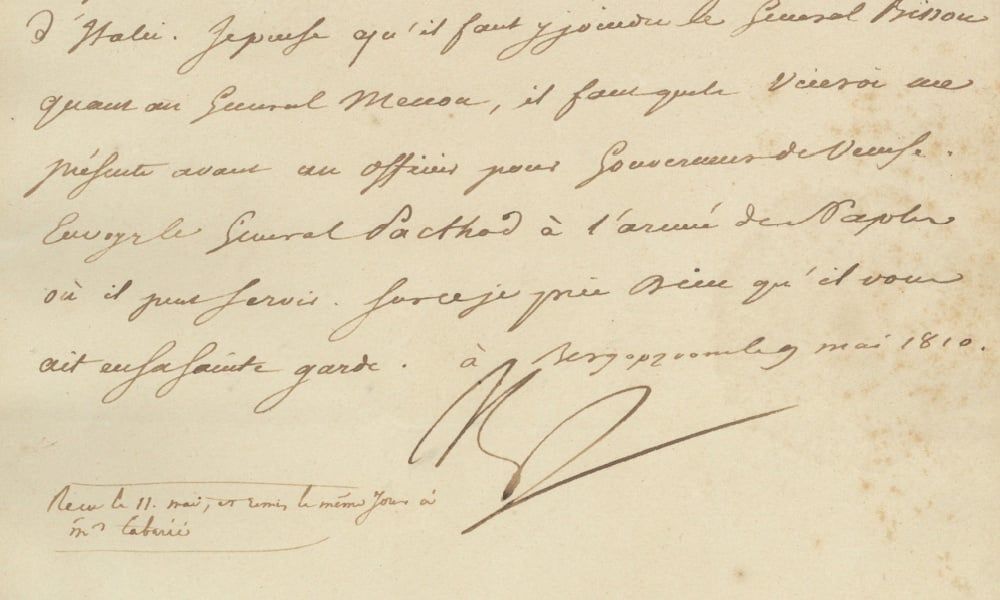
- SIGNED
- 09/05/1810
""I approve the slate of officers you propose to use for the Army of Italy. I think you should add General Bissonin. Regarding General Menou, the Vice Roy must first present to me an officer for Governor of Venice. Send General Pacthod to the Army of Naples where he can serve.""
In May 1810, Napoleon was at the high-water mark of his empire, strengthening and intensifying his Continental System against Britain. Napoleon focused then on restricting British commerce, and enhancing his alliance with Austria. His mind was also much on the Netherlands. On May 13, 1810, it was announced that the Netherlands were formally annexed to France, further consolidating Napoleon’s control over Europe. Bergen op Zoom, a fortified city in the Netherlands, was a key stronghold for French forces during Napoleon’s empire.
By 1810, Napoleon controlled most of the Italian peninsula, acting as King of Italy (crowned 1805) with his stepson, Eugène de Beauharnais, as viceroy. The region was restructured into the Kingdom of Italy in the north, and the Kingdom of Naples in the south, introducing modern law, abolishing feudal rights, and improving infrastructure, while by 1810 the Italian army achieved parity with French units.
The War of the Fifth Coalition was Austria’s final attempt to challenge Napoleon Bonaparte after earlier defeats, but it ended decisively with French victories at Battle of Wagram and the Treaty of Schönbrunn, which stripped Austria of further territory and influence in northern Italy and the Adriatic. In the aftermath, Napoleon moved to tighten and rationalize his control over the region, reinforcing the authority of his Italian client state under Eugène de Beauharnais and integrating Venice more fully into a centralized military-administrative system. Though already under French rule, Venice’s strategic importance—as a fortified lagoon city, naval arsenal, and forward position facing Austria—meant that after 1809 it became a focus of consolidation rather than conquest, with garrisons reviewed, command structures regularized, and trusted officers installed to ensure the city’s security and readiness in anticipation of future conflict.
Napoleon was at Bergen op Zoom in May 1810. The Duc de Feltre was an officer, diplomat, and statesman who served as Minister of War under Napoleon.
Letter signed, Bergen-op-Zoom, May 9, 1810, to the Duc de Feltre, assigning officers to the army and government of Italy. ""I approve the slate of officers you propose to use for the Army of Italy. I think you should add General Bisson. Regarding General Menou, the Vice Roy must first present to me an officer for Governor of Venice. Send General Pacthod to the Army of Naples where he can serve.""
In 1810, General Baptiste-Pierre-François Bisson was given a command at Verona where he remained until his death in 1811. General Jacques-François de Menou served as the administrator and Governor of Venice in the Kingdom of Italy. After a notable career, including commanding the Egyptian campaign, he died on August 13, 1810. In 1810 General Michel-Marie Pacthod was rewarded as a Knight of the Iron Crown and then given a division in the Army of Naples.
Here we see Napoleon exercising control over his occupied territories.
Details
Title
At the Height of His Empire, Napoleon Assigns Officers to the Army and Government of Italy
Author
Napoleon Bonaparte
Condition
Unknown
Date
09/05/1810