

Amidst the War of 1812, the U.S. Government Puts Humanitarian Considerations First and Protects Nova Scotia’s Sable Island Humane Establishment from American Ships
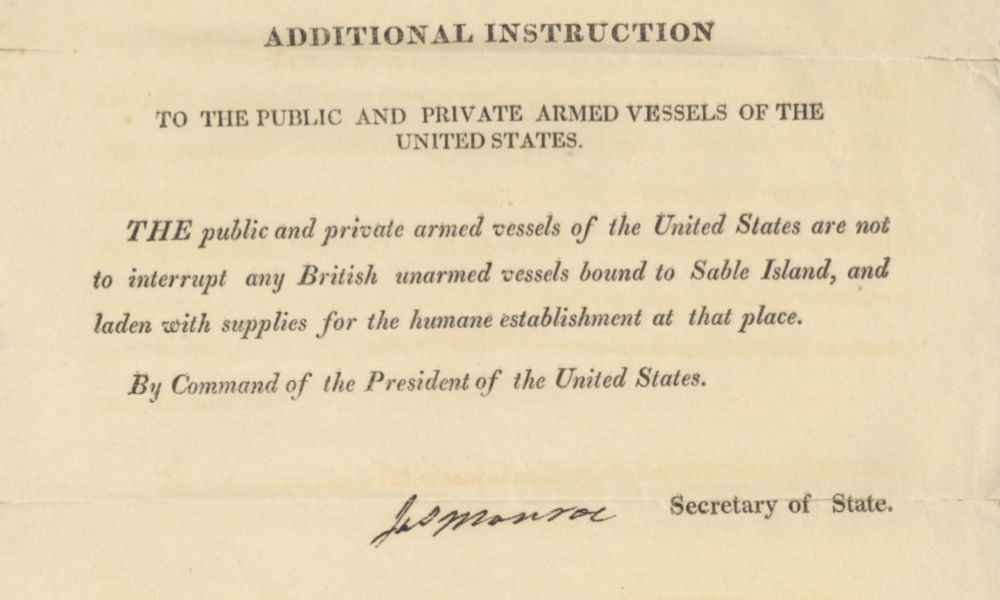
It issues Privateer’s Additional Instructions for a Ship Captained by Future Navy Secretary Benjamin Crowninshield, who is directed “not to interrupt any British unarmed vessels bound to Sable Island, and laden with supplies for the humane establishme
- SIGNED
- 07/11/1812
Sable Island, located off Nova Scotia, is a unique 42-km-long sand dune island known as the ""Graveyard of the Atlantic,"" with over 350 recorded shipwrecks since 1583. Famous for its wild horses—introduced in the 1700s—the island has a history of attempted settlement, lifesaving stations, lighthouse keeping, and now serves as a protected national park reserve.
To combat the death toll of shipwrecks, the Sable Island Humane Establishment for rescuing sailors was established there in 1801. This was a pioneering, government sponsored lifesaving organization, designed to rescue crews from the ""Graveyard of the Atlantic"". It established refuge houses, specialized salvage crews, and lighthouses, and acting as a crucial sanctuary for shipwreck survivors.
On June 18, 1812, Madison signed the Declaration of War, marking the beginning of the War of 1812. During that war, American privateers played a significant role in disrupting British maritime commerce and bolstering the American economy. Privateers often used fast-sailing schooners and sloops, well-suited for raiding and capturing merchant vessels. They captured a substantial number of British merchant vessels, far exceeding the U.S. Navy’s captures, and brought home valuable prizes. Privateers were privately owned and operated, commissioned by the U.S. government to attack enemy ships during wartime.
The Crowninshield family was historically prominent in shipbuilding and merchant shipping, and political and military leadership. George Crowninshield was a captain and merchant, and he had a son Benjamin, who was a captain, merchant, ship builder, and Secretary of the Navy between 1815 and 1818, during the administrations of Presidents James Madison and James Monroe. During the war, the Crowninshields were important figures in privateering and offered three vessels of their own to the U.S. government for service as privateers. These were the ship John, the sloop Jefferson, and the ship America. They were also involved with other privateers where they had an ownership interest, such as the Ship Alexander, which had 19 owners, including George Crowninshield. Benjamin Crowninshield was for a time Captain of the Alexander.
Privateer captains like Crowninshield were issued instructions, and this one shows the determination of the U.S. government that the humanitarian work of the Sable Island Humane Establishment must continue despite the war. It offered this instruction to protect it, and British ships supplying it, from American vessels.
Document signed, Washington, November 7, 1812, addressed to “Capt. Benjamin Crowninshield of the private armed Ship Alexander”: “Additional Instruction to the Public and Private Armed Vessels of the United States. The public and private armed vessels of the United States are not to interrupt any British unarmed vessels bound to Sable Island, and laden with supplies for the humane establishment at that place. By Command of the President of the United States.” This is signed by James Monroe as Secretary of State.
It is interesting that, amidst the war, the U.S. government put humanitarian considerations first.
Details
Title
Amidst the War of 1812, the U.S. Government Puts Humanitarian Considerations First and Protects Nova Scotia’s Sable Island Humane Establishment from American Ships
Author
James Monroe|Benjamin Crowninshield
Condition
Unknown
Date
07/11/1812