

Zachary Taylor Rejoices on the Election of William Henry Harrison as President, Seeing It as a Triumph Akin to the American Revolution
"A revolution next in importance to the country, to that of achieving by our ancestors our separation & independence from England, brought about by the force of reason through the ballot box without a drop of blood having been spilled, or a riot of a seri
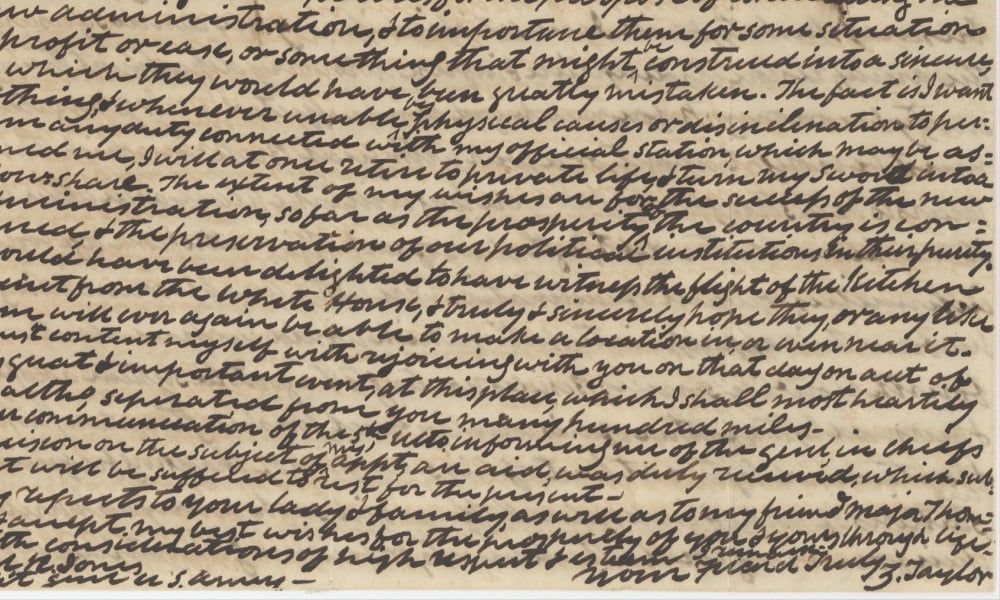
- SIGNED
- 10/02/1841
He compares the election to American independence, saying “A revolution next in importance to the country, to that of achieving by our ancestors our separation & independence from England, brought about by the force of reason through the ballot box without a drop of blood having been spilled.”
He manifests his own feelings: “There are but few if a single individual in the whole land, who rejoices more sincerely in spirit & in truth than I do, at the recent result of our most glorious political campaign, which I consider fully as important to the country as was the surrender of Burgoyne at Saratoga, & that of Cornwallis at Yorktown.”
He complains of the degeneration of integrity in government during the previous dozen years under Andrew Jackson and Martin Van Buren, and offers that his opinion “has been caused by acts committed almost daily by those in power, which I consider alike disgraceful to the country, as well as boding no good either to the purity, or permanency of our institutions.”
He seeks military reform, “restoring to the good old System adopted & pursued by the father of his country, Gen'l Washington”
Under the incoming President Harrison: “I flatter myself that the days of persecution and favoritism are nearly at an end, and the time soon will be when justice will be done to you, as well as that every officer of the government, civil and military, will not only be required, but compelled within their proper stations to do their duty as it was intended they should do by the framers of the Constitution for the benefit of the people”
Zachary Taylor and William Henry Harrison formed a mutual respect beginning in 1811 when Taylor, who became commander of Fort Knox, served under Harrison, who was governor of the Indiana Territory. Taylor then led American troops in the Seminole War in Florida in the 1830s. After that, he toured the nation with his family and met with military leaders. During this period, he began to be interested in politics and corresponded with soon-to-be-President Harrison.
In 1836, incumbent president Andrew Jackson decided to retire after two terms and supported his vice-president, Martin Van Buren, for the Democratic Party nomination. This support was decisive and Van Buren secured the nomination in Baltimore at the Democratic National Convention. The Whig Party emerged during the 1834 mid-term elections as the chief opposition to the Democrats, and in 1836 would participate in their first presidential election. By the middle of 1836, Harrison had replaced Daniel Webster as the preferred Whig candidate in the north and border states. The south boosted Tennessee Senator Hugh Lawson White as its contender. Unable to agree on a single candidate, the Whigs ended up with two tickets: William Henry Harrison for president and Francis Granger for vice- president in the north and border states, which made them the major Whig contenders, and Hugh Lawson White for president and John Tyler for vice-president in the south. The hope was that each would carry his region, and the House of Representatives would select between the two Whigs. This was the only race in American history in which a major political party intentionally ran two presidential candidates at once.
On March 4, 1841, William Henry Harrison was inaugurated, becoming the 9th president of the United States. As President, Harrison made Taylor commander of the Second Department of the Army's Western Division in May 1841. Taylor would himself become President in 1849, in the wake of the Mexican War.
This is an important letter of Taylor from the period after Harrison’s election, which he analyzes in depth, but before his inauguration. He focuses on many key public questions of the day, stresses the importance of the successful campaign of Harrison for president, comparing that to America's independence from Great Britain, and the military victories at Saratoga and Yorktown during the American Revolution. He complains of the degeneration of integrity in government during the previous dozen years under Andrew Jackson and Martin Van Buren, and blames those in government for forcing him to reach his conclusions, relishing the anticipated sinking into oblivion of the Van Buren’s ""Kitchen Cabinet"" of influential advisors who lacked public appointments or elected offices. He approves those who were expected to enter the cabinet of the new administration, listing his preferences for who should become Secretary of War, and hoping for a reform of the military. He characterizes the upcoming inauguration of Harrison as a triumph of reason over power, and explains that he cannot attend the inauguration without giving the impression of seeking some advantage from the new administration.
Autograph letter signed, 4 pages, Baton Rouge, LA, February 10, 1841, to General Roger Jones, Adjutant General of the U.S. Army and a friend of Taylor. “Your highly esteemed & interesting letter of the 7th ulto., marked private, was rec’d a few days since, for which I beg leave to tender you my best thanks. My not hearing from you direct in reply to my communication from Louisville alluded to, was assigned to the causes you mention, my friend Maj. Thomas having done so for you in a satisfactory manner, as well as informing me of your absence from the city. Knowing as I do the various duties you daily perform connected with your office when in Washington, I did not for a moment attribute your not writing either to a want of courtesy or kindness, not being aware of any occurrence which would have a tendency to interfere at least with the good understanding which I had flattered myself existed between us; at any rate I felt confident that nothing intentional on my part to interrupt the kindest feelings I may add friendship I had entertained for you.
""Notwithstanding I have little to complain of personally towards the administration, on the contrary have much to be thankful for as regards some of its members, yet there are but few if a single individual in the whole land, who rejoices more sincerely in spirit & in truth than I do, at the recent result of our most glorious political campaign, which I consider fully as important to the country as was the surrender of Burgoyne at Saratoga, & that of Cornwallis at Yorktown at the time those great & important achievements took place. I do not expect to be benefited an iota by the change, & altho' not in the habit of desponding in times of difficulty & danger be they ever so great, yet I should have despaired of the commonwealth had Mr. Van Buren been reelected; For in that case when we take into consideration the great deterioration of morals during the last twelve years, & a total disregard of honesty of every description during the same period, on the part of a majority of the office holders, even among those filling the highest places, with the aid of the Sub Treasury which appears to me, has placed the revenue of the country pretty much at the disposal of the chief magistrate of the nation, would have enabled the present incumbent, to appoint his successor which there is no doubt he would have done; The powers prescribed by the Constitution & Laws in regard to elections, might have been observed, but the substance would have been lost sight of; which state of things would have continued until restored if at all, to their original purity by the sword, neither the hope of honors or reward of any kind, or real or imaginary griefs has had the slightest effect in bringing my mind to this conclusion, it has been caused by acts committed almost daily by those in power, which I consider alike disgraceful to the country, as well as boding no good either to the purity, or permanency of our institutions.
“I am aware my dear general that great injustice has been done you by those in power whose official stations enabled them to outrage you, without having it in your power to obtain any redress other than by remonstrating, under such circumstances you have no cause to entertain feelings of kindness or respect for those individuals, but was it otherwise, I do not believe you would have approved the general course of the present administration or wished to have seen it continued in power a moment longer than the end of its present term. I flatter myself that the days of persecution and favoritism are nearly at an end, and the time soon will be when justice will be done you, as well as that every officer of the government, civil and military, will not only be required, but compelled within their proper stations to do their duty as it was intended they should do by the framers of the Constitution for the benefit of the people, not to rob them, which has for sometime past been the case with impunity in many instances, by withholding and appropriating the public money which had come into their hands to private purposes, considering I presume they were authorized in doing so, to remunerate for their subserviency to those filling higher places or on account of extra services rendered their party.
""There could not be better selections made than the individuals named by you, as likely to form in part the cabinet of president Harrison, besides possessing the first order of talents, they are men of sterling integrity, & above committing any act incompatible with their high stations, they are in fact ‘honest, capable & will be found faithful to the Constitution,' as well as being in reality what it was intended they should be, the legal & proper advisers of the President, & not his creatures, which they continue about the chief magistrate, nothing more will be heard of that miserable set who have contributed largely to degrade the executive, & the character of the nation, the Kitchen Cabinet, they will sink into oblivion. Had the app[ointmen]t of the War minister been left to me, Mr. [John] Bell is the individual I should have fixed on; ever since the success of Gen’l. Harrison was known, I had made up my mind that he, or the distinguished Senator from N. York Gen'l Talmedge [Nathaniel P. Tallmadge], would be called to that station. [Bell was selected Secretary of War]. Independent of his acquirements to Mr. B., unites great moral and political firmness with untiring industry and business habits, and will I am satisfied if anyone can do so, resuscitate the army, restore its discipline, and infuse into every department the proper unity and economy.
“Before much good can be effected, a reorganization must be brought about, or a war with Great Britain, which there appears to be a strong possibility ere long will take place, as in either case it would enable the dep't to get clear of such officers who from age, bodily infirmities, or want of inclination were either unable or unwilling to perform their appropriate duties, which would embrace about one fourth now in service; Besides restoring to the good old System adopted & pursued by the father of his country, Gen'l Washington, when President & continued by two at least of his successors, of changing frequently the stations of corps & individual officers, in such a way as to prevent their forming local attachments, or becoming identified with political parties, which has in some instances recently been the case in the States of Arkansas, & Missouri. Whoever may be the War Minister must necessarily consult & advise with the officers of the army on various subjects, particularly as to details, & much will depend on his successful management of the dep’t, on those we may confide in. Mr. B., I am satisfied, possesses a sufficient knowledge of men to enable him to avoid the errors of his predecessor, if errors were committed, who although highly talented and educated as regards books, he appears to have possessed only a superficial knowledge of mankind, hence called around him and selected for his advisors men of inferior rank and capacity, without experience, whose interest it was to mislead him for pecuniary considerations, or as you correctly remarked when I last saw you, for ‘filthy lucre’, to which may be attributed most if not all the extra troubles and difficulties the present Secretary has had to contend with. I do not believe there is an honester or purer man in the nation than Mr. [Joel] Poinsett [Van Buren’s Secretary of War], or one who was more disposed to use his office for the honor and benefit of the country; but owing to the causes above stated it has been too much done for the benefit of private and public individuals.
""There are but few events which could afford me more real gratification than meeting you & other of my friends in Washington on the fourth of March next to witness the inauguration of President Harrison, which event I look upon as a triumph of principle over power; A revolution next in importance to the country, to that of achieving by our ancestors our separation & independence from England, brought about by the force of reason through the ballot box without a drop of blood having been spilled, or a riot of a serious character taken place throughout the whole country in consequence of the same. Had I however paid a visit to the city at that time my motives in doing so would have by many been misconstrued, supposing or pretending to do so, it was for the purpose of conciliating the new administration, & to importune them for some situation of profit or ease, or something that might be construed into a sinecure, in which they would have been greatly mistaken. The fact is, I want nothing. And whenever and whenever unable by physical causes or disinclination to perform any duty connected to my official station, which may be assigned me, I will at once return to private life and turn my sword into a plowshare.
“The extent of my wishes are for the success of the new administration, so far as the prosperity of the country is concerned, & the preservation of our political institutions in their purity, I should have been delighted to have witness[ed] the flight of the Kitchen Cabinet from the White House, & truly & sincerely hope they, or any like them will ever again be able to make a location in, or even near it. I must content myself with rejoicing with you on that day on acc't of this great & important event, at this place, which I shall most heartily do, altho', separated from you many hundred miles.
“Your communication of the 5th ulmo. informing me of the genl. in chief’s decision on the subject of my appointment an aide was duly received, which subject will be suffered to rest for the present. My respects to your lady and family, as well as to my friend Maj. Thomas, and accept my best wishes for the prosperity of you and yours through life. With considerations of high respect, with esteem I remain your friend truly, Z. Taylor.”
Undoubtedly the most politically significant letter of Taylor we have ever seen, with its detailed assessments of the political scene of the day and concentration on the importance of the 1840 election.
Details
Title
Zachary Taylor Rejoices on the Election of William Henry Harrison as President, Seeing It as a Triumph Akin to the American Revolution
Author
Zachary Taylor
Condition
Unknown
Date
10/02/1841