

Theodore Roosevelt's Original Manuscript of his Great 1911 ""Peace of Righteousness"" Work: ""The true lovers of peace... have been those who followed, even though afar off, in the footsteps of Washington and Lincoln.""
21 dense pages: A very important statement in which Roosevelt was articulates his philosophy and a foreign policy that demanded high moral standards and strength, rather than pacifism
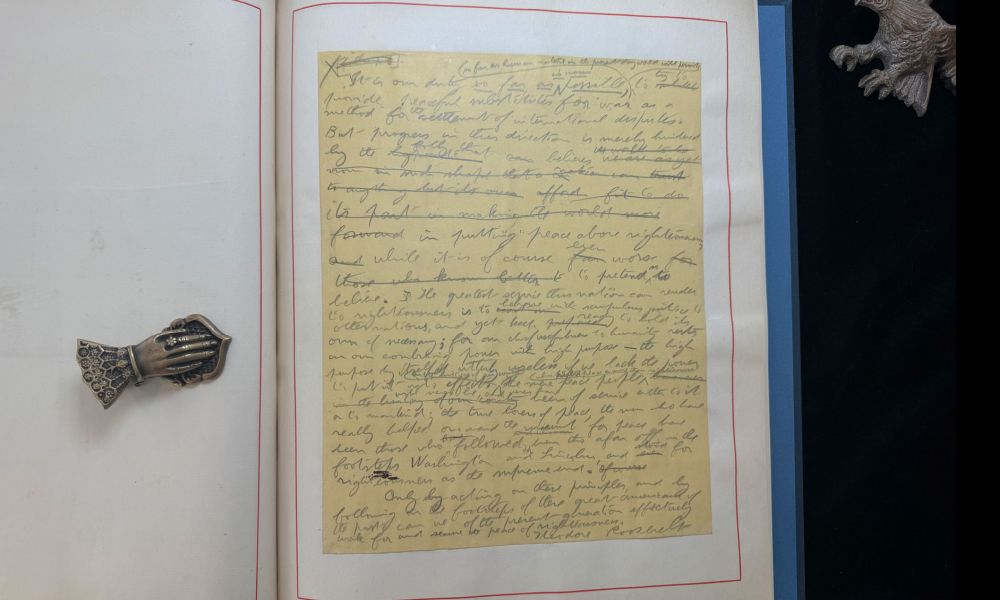
- SIGNED
- 9/9/11
He wrote “We, the people of the United States, cannot and will not surrender to outsiders the power to determine whether or not we are fit to decide for ourselves what are our vital needs, and what are the policies proper for meeting these needs. Only by acting on these principles, only by following in the footsteps of these great Americans of the past, can we of the present generation effectively work for and secure the peace of righteousness.""
His original article from 1911 opposing President Taft, in which he argued that while peace is desirable, it must be a peace based on moral righteousness and justice, not merely the absence of conflict
21 pages, of which 14 entirely handwritten; Entire manuscripts of Roosevelt are very rare, this one having been in a private collection for generations
As negotiated by U.S. Secretary of State Philander C. Knox, the Taft Arbitration Treaties were signed on August 3, 1911. They contained three significant features. First, they did not exempt matters affecting vital interests or national honor. They applied to “all differences hereafter arising"" between the parties, not settled by diplomatic means, ""relating to international matters in which the contracting parties are concerned by virtue of a claim of right made by one against the other under treaty or otherwise…and which are justiciable in their nature."" Second, the treaties explicitly invoked equity. An international dispute was deemed ""justiciable"" if it was ""susceptible of decision by the application of the principles of law or equity."" A third notable feature of the Taft Arbitration Treaties was their institutional mechanism for settling disagreements over whether a difference was subject to arbitration. If the parties disagreed about the justiciability of a dispute, a Joint High Commission of Inquiry would consider the matter.
In other words, it gave power to international arbiters over some aspects of US actions.
Theodore Roosevelt opposed the Taft treaties, and instead advocated that a peace must be that of righteousness. Roosevelt and a few other high-profile opponents, including Admiral Alfred Thayer Mahan, voiced themes like the importance of upholding national prestige and power and of furthering national goals. This disagreement between Taft and Roosevelt over the arbitration treaties was part of the wedge that drove them apart and led to TR’s running for president in 1912.
In The Outlook magazine on September 9, 1911, in an article covered at the time by the New York Times, TR assailed the Taft treaties of arbitration as making for peace without righteousness and as being hypocritical in that this country would not observe them in certain contingencies, even though it agreed to them. He repeatedly emphasized his point that righteousness is more important than peace. He wrote, ""It is one of our prime duties as a nation to seek peace. It is even a higher duty to seek righteousness”. So while international peace is important, pursuing moral righteousness and integrity is a superior national duty.
This is Roosevelt’s editorial article published in The Outlook. Typed article, with substantial revisions in his hand, 21 pages, being the original draft of the article, signed twice. The text reads, in part:
""It is one of our prime duties as a Nation to seek peace. It is an even higher duty to seek righteousness. It is also our duty not to indulge in shams, not to make believe we are getting peace by some patent contrivance which sensible men ought to know cannot work in practice, and which if we sought to make it work might cause irretrievable harm. I sincerely believe in the principle of arbitration; I believe in applying that principle, so far as practicable; but I believe that the effort to apply it where it is not practicable cannot do good and may do serious harm. Confused thinking and a willingness to substitute words for thought, even though inspired by an entirely amiable sentimentality, do not tend toward sound action.
""I think that the great majority of those persons who advocate any and every treaty which is called a treaty for peace or for arbitration would be less often drawn into a position that tends to humiliate their country if they would take the trouble to formulate clearly and definitely just what it is that they desire. Of course, there are persons wholly indifferent to the National honor and interest, who in consequence cannot be reached by an appeal to National honor and interest; and there are other persons whose ingrained personal timidity is such that they are more afraid of war than of any dishonor, personal or National.”
TR goes on to stress peace only with righteousness. “We, the American people, believe, and ought to believe, in righteousness first and in peace as the handmaid of righteousness. We abhor brutality and wrongdoing, whether exhibited by nations or by individuals. We hold that the same law of righteousness should obtain between nation and nation as between man and man. I, for one, would rather cut off my hand than see the United States adopt the attitude either of cringing before great and powerful nations who wish to wrong us or by bullying small and weak nations who have done us no wrong.”
""The American people desire to do justice and to act with frank generosity toward all the other nations of mankind; but I err greatly in my judgment of my countrymen if they are willing to submit to wrong and injustice. Again and again in the past they have shown, and rightly shown, that when the choice lay between righteousness and peace they chose righteousness, just exactly as they also chose righteousness when the choice lay between righteousness and war.""
Roosevelt cites the Revolutionary War, the Civil War, and the Spanish-American war as instances in which we put righteousness above peace. He also cites the existing arbitration treaties between the United States, Great Britain, and France as better than the proposed treaties, because they make no false pretenses and exclude questions affecting our vital interests, independence, or honor. He continues:
""Does the proposal in the treaties, if entered into with various nations, bind us to arbitrate the Monroe Doctrine, the Platt amendment with Cuba, the payment of State bonds to European bondholders, the question whether various European countries are entitled to the same concessions that Canada is to receive under the reciprocity agreement, the right of other foreign nations to interfere in Panama, our own right to exclude any immigrants whom we choose to exclude? If these questions arose, I am sure our representatives would, privately or publicly, inform foreign powers (and indeed would have to inform foreign powers) that the American people would never abide by an agreement to arbitrate them; in which case the only proper course to follow is that followed by the Senate Committee, and to say in honest fashion that there are certain questions which this Nation will not arbitrate at the dictation of an outside body.
""Most men of knowledge, who are willing to think, know perfectly well that this country would not, as a matter of fact, keep an agreement to arbitrate all questions of vital honor and interest, even though it were so unwise as to make it; and it is a wicked thing to put us in the position of promising what will not, and cannot, be performed. In such a matter the indulgence of false pretense in the present would with absolute certainty be followed by the breaking of faith in the future.
""The fatally objectionable feature of the proposed treaty is the clause providing that the Joint High Commission, which may be composed exclusively of 'nationals of the two countries, but which also may be composed exclusively of foreigners, may, by unanimous vote, or by a vote of all but one of its members, determine that any given question whatever must be arbitrated. It is difficult to characterize this provision truthfully without seeming to be offensive. Merely to speak of it as silly comes far short of saying what should be said.
""We, the people of the United States, cannot and will not surrender to outsiders the power to determine whether or not we are fit to decide for ourselves what are our vital needs, and what are the policies proper for meeting these needs. In other words, Uncle Sam does not intend to wrong any one, but neither does he intend to bind himself, if his pocket is picked, his house burglarized, or his face slapped, to arbitrate with the wrongdoer, and as long as he does not intend so to bind himself it would be offensive hypocrisy for him to say that he will so bind himself.
""The true lovers of peace, the men who have really helped onward the movement for peace, have been those who followed, even though afar off, in the footsteps of Washington and Lincoln, and stood for righteousness as the supreme end of National life. Only by acting on these principles, only by following in the footsteps of these great Americans of the past, can we of the present generation effectively work for and secure the peace of righteousness.""
A very important statement in which Roosevelt articulates his philosophy and a foreign policy that demanded high moral standards and strength, rather than pacifism. This perspective, often referred to as the ""peace of righteousness,"" was crucial to his view of America's role on the world stage, ensuring that national honor and international justice were prioritized.
Sheets affixed to leaves of the book into which they are bound.
Details
Title
Theodore Roosevelt's Original Manuscript of his Great 1911 ""Peace of Righteousness"" Work: ""The true lovers of peace... have been those who followed, even though afar off, in the footsteps of Washington and Lincoln.""
Author
Theodore Roosevelt
Condition
Unknown
Date
9/9/11