

Autograph Letter Signed
- SIGNED custom folder
- Berlin: np, 1905
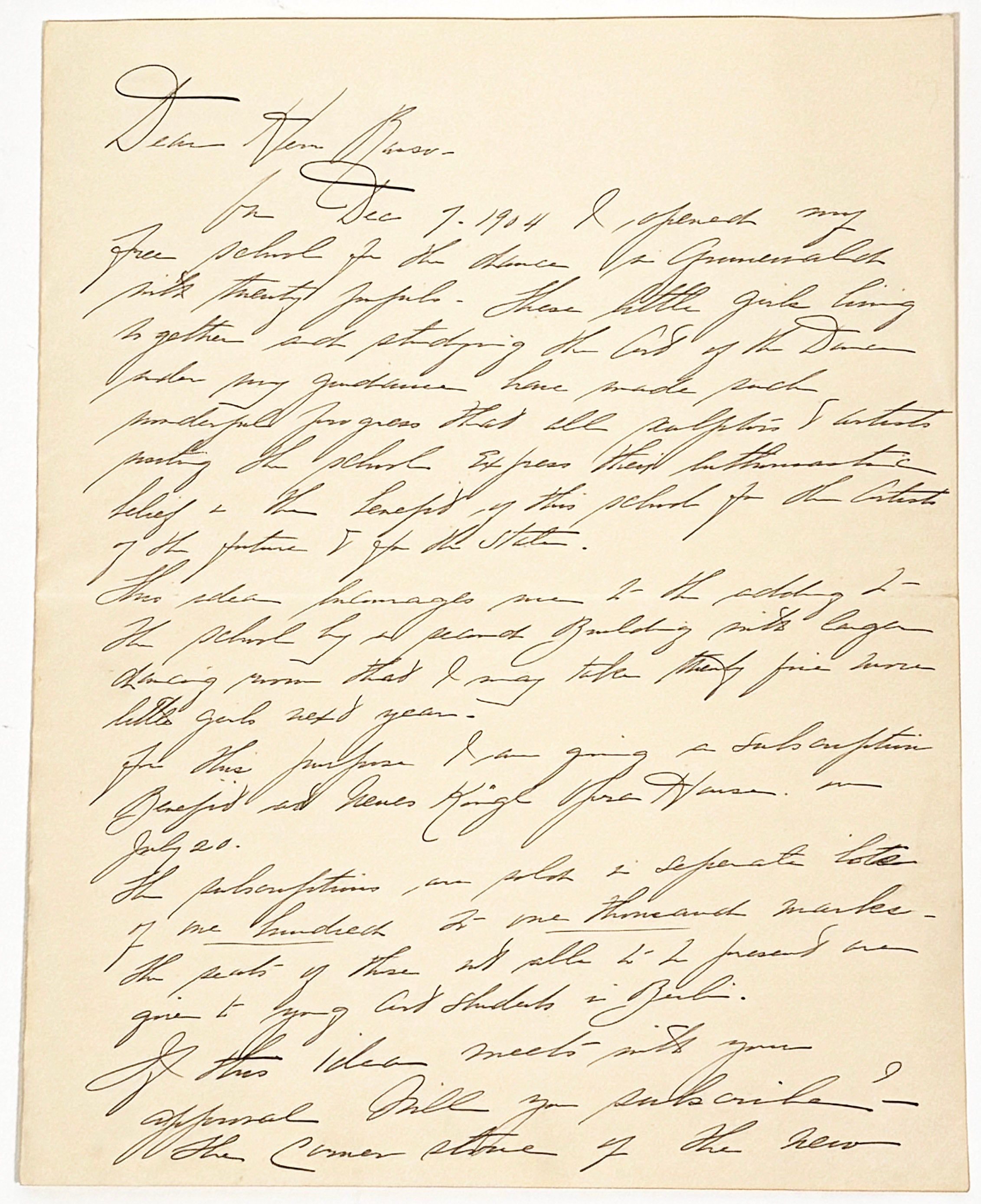
Berlin: np, 1905. first edition. custom folder. Fine. A PRIMARY DOCUMENT ON THE FOUNDING OF THE GRUNEWALD SCHOOL, THE INSTITUTION THAT PRODUCED THE ISADORABLES AND ESTABLISHED THE PEDAGOGICAL FOUNDATIONS OF MODERN DANCE. Writing from Berlin, Duncan describes the founding and early success of her "free school for the dance in Grunewald," opened on December 7, 1904, in a wooded district outside the city that she deliberately chose for its distance from academic conservatories and theatrical convention. The Grunewald school represented Duncan's first sustained effort to translate her revolutionary ideas about natural movement, rhythm, and expressive freedom into a residential pedagogical environment-and it was here that Anna, Erika, Irma, Lisa, Margot, and Maria-Theresa, the six pupils later celebrated as the Isadorables, first studied under her guidance.
She explains that "these little girls living together and studying the Art of the Dance under my guidance have made such wonderful progress" that sculptors and artists visiting the school expressed "their enthusiastic belief in the benefit of this school for the artists of the future & for the state." That final phrase-written to a potential German patron-was not rhetorical flourish but a calculated civic argument: Duncan was positioning her radical pedagogy as a public good, a claim she understood would resonate with the cultural and institutional priorities of her Berlin audience. The emphasis on communal living, bodily freedom, and immersion in nature simultaneously marked a sharp departure from classical ballet training and aligned her project with broader early-20th-century reform movements in education, art, and physical culture.
The school Duncan describes in this letter was not only a pedagogical experiment but a political one, and its politics were inseparable from the female body. Duncan's insistence on bare feet, loose tunics, and unencumbered natural movement was a direct challenge to the corseted, constrained body that Victorian and Wilhelmine culture demanded of women-a challenge she was now institutionalizing in a residential community of girls living and moving together outside the structures of conventional female education. Scholars have since read the Grunewald school, and Duncan's broader project, within the history of female separatist spaces and the emergence of a distinctly modern female subjectivity: a body that moved for its own expressive purposes rather than for the pleasure or approval of a male audience. Duncan's own life enacted these ideas beyond the studio-her refusal of marriage as an institution, her open relationships with both men and women, and her insistence on erotic and creative autonomy as inseparable from artistic freedom were understood by her contemporaries as continuous with her dance philosophy, not incidental to it. This letter, in which she solicits patronage for an all-female residential school from a male Berlin patron by arguing its value to "the state," captures with particular sharpness the negotiation at the center of her project: radical female autonomy framed in the civic language her audience required.
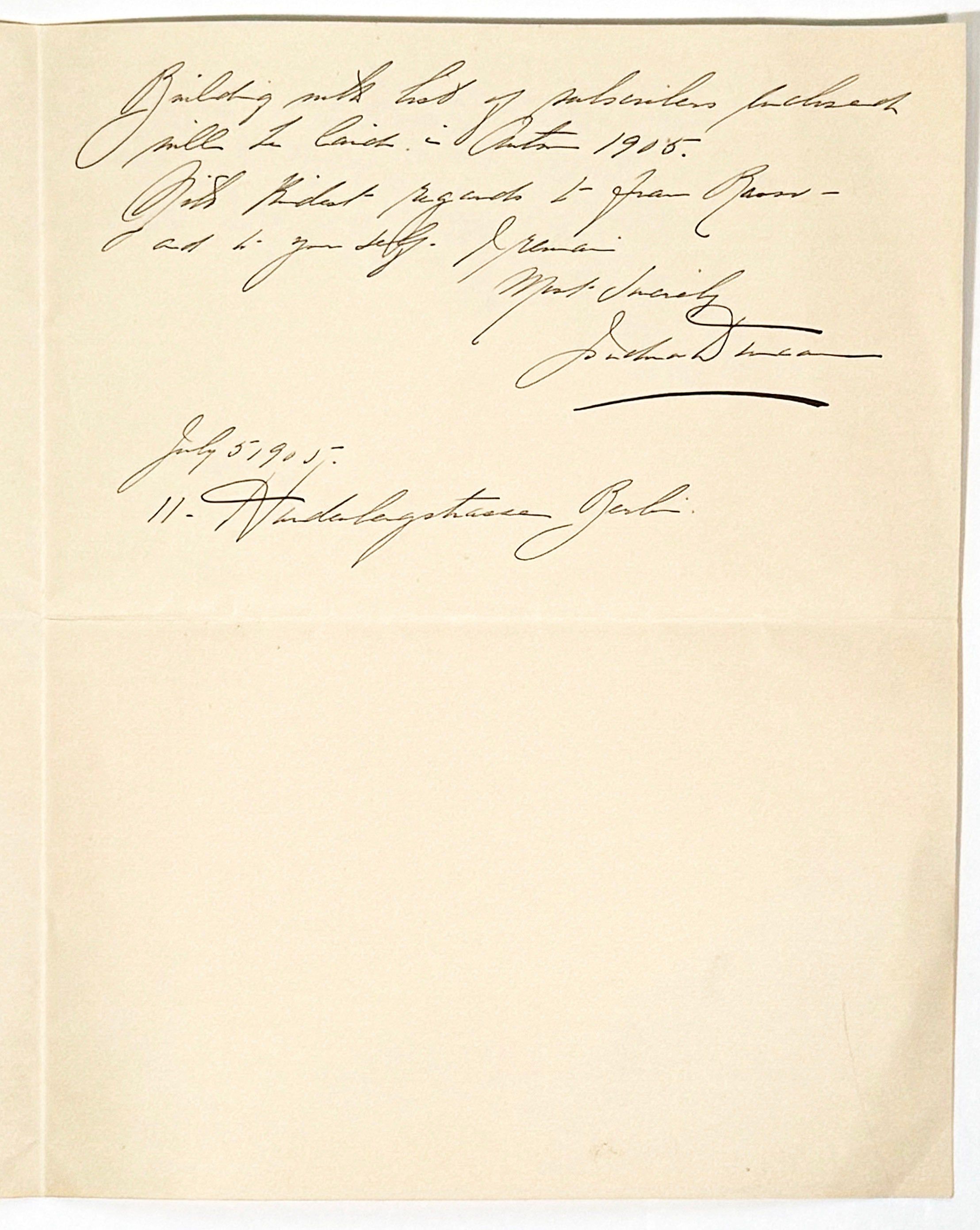
In her letter, Duncan outlines her plan to expand the school, proposing a subscription benefit performance at the Kroll Opera House on July 20-one of Berlin's premier cultural venues-with lots available from 100 to 1,000 marks, proceeds directed to young art students in Berlin. That concert, now documented in dance history, marked the first public appearance of the Grunewald students: the girls who would go on to perform more than seventy times across Germany, Holland, Switzerland, Russia, England, and France before their celebrated American debut at Carnegie Hall in December 1914. This letter, dated just seventeen days before that performance, captures the school at the precise moment of its emergence into public life. Duncan invites Russo's support directly: "If this idea meets with your approval will you subscribe-the corner stone of the new building with list of subscribers enclosed will be laid in October 1905," adding plans to take "twenty five more little girls next year."
The choice of the Kroll Opera House as the vehicle for her fundraising is telling: Duncan was simultaneously operating at the center of Berlin's cultural establishment and presenting herself as its reforming conscience. The identity of the recipient merits attention. The recipient's precise role in Berlin's cultural networks has not been fully established, but the nature of Duncan's appeal-combining artistic vision, civic argument, and a concrete financial proposition-suggests she regarded him as a patron of standing, someone whose name on a subscriber list would carry weight with others.
Historically, the Grunewald school occupies a critical place in dance history. It was Duncan's first attempt to create a permanent educational structure for modern dance-preceding her later schools in Paris and Moscow-and it was the nursery of the Isadorables, whose subsequent careers as performers and teachers became the primary vehicle through which Duncan's principles were transmitted to the next generation. The pedagogical ideas articulated in this letter-movement derived from nature, the unity of art and life, dance as a formative social and cultural force-became foundational not only to modern dance but to performance theory more broadly.
Duncan's influence has proved anything but historical. In dance, her principles-movement originating from the solar plexus, the body as the direct expression of inner life, choreography as an act of personal and political freedom-remain active presences in contemporary practice, traceable through Doris Humphrey, José Limón, and Mark Morris, and kept in living transmission by the Isadora Duncan Dance Foundation and the Isadora Duncan International Institute, both of which continue to teach and perform her original repertory. In gender and sexuality studies, the scholarly recovery of Duncan has accelerated markedly since the 1990s: her work now figures centrally in debates about the female body as a site of resistance, the politics of visibility and exposure, the history of queer female community and erotic autonomy, and the relationship between modernist aesthetics and feminist practice. The Grunewald school in particular-the all-female residential community whose founding this letter
documents-has attracted renewed attention as an early instance of the kind of separatist female space that second- and third-wave feminist theory would later theorize explicitly.
This letter captures Duncan not as a touring icon but as a cultural architect at a pivotal moment: seventeen days before the school's first public performance, soliciting the patronage that would allow her to build the institution whose students would carry her legacy into the twentieth century.
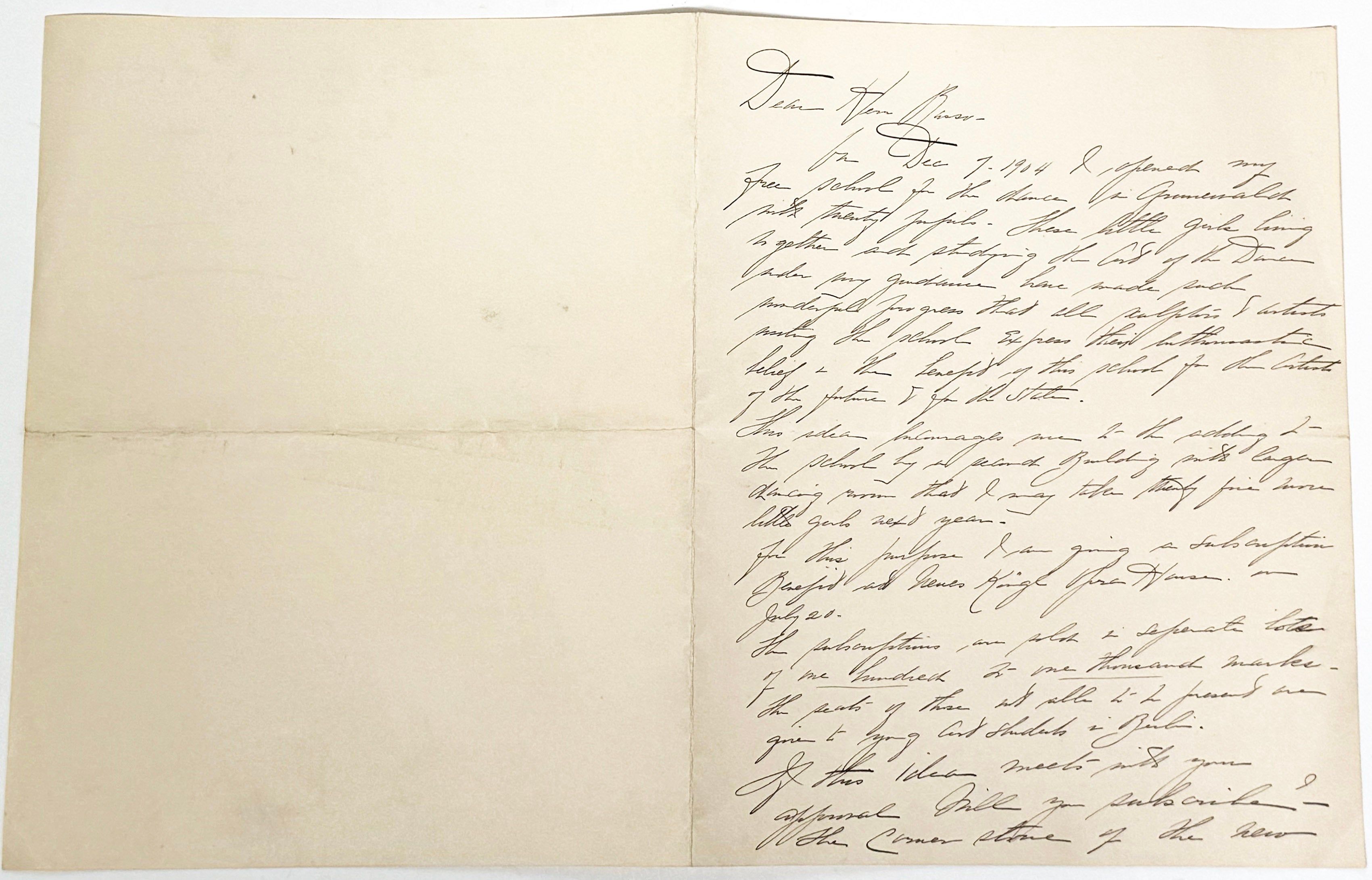
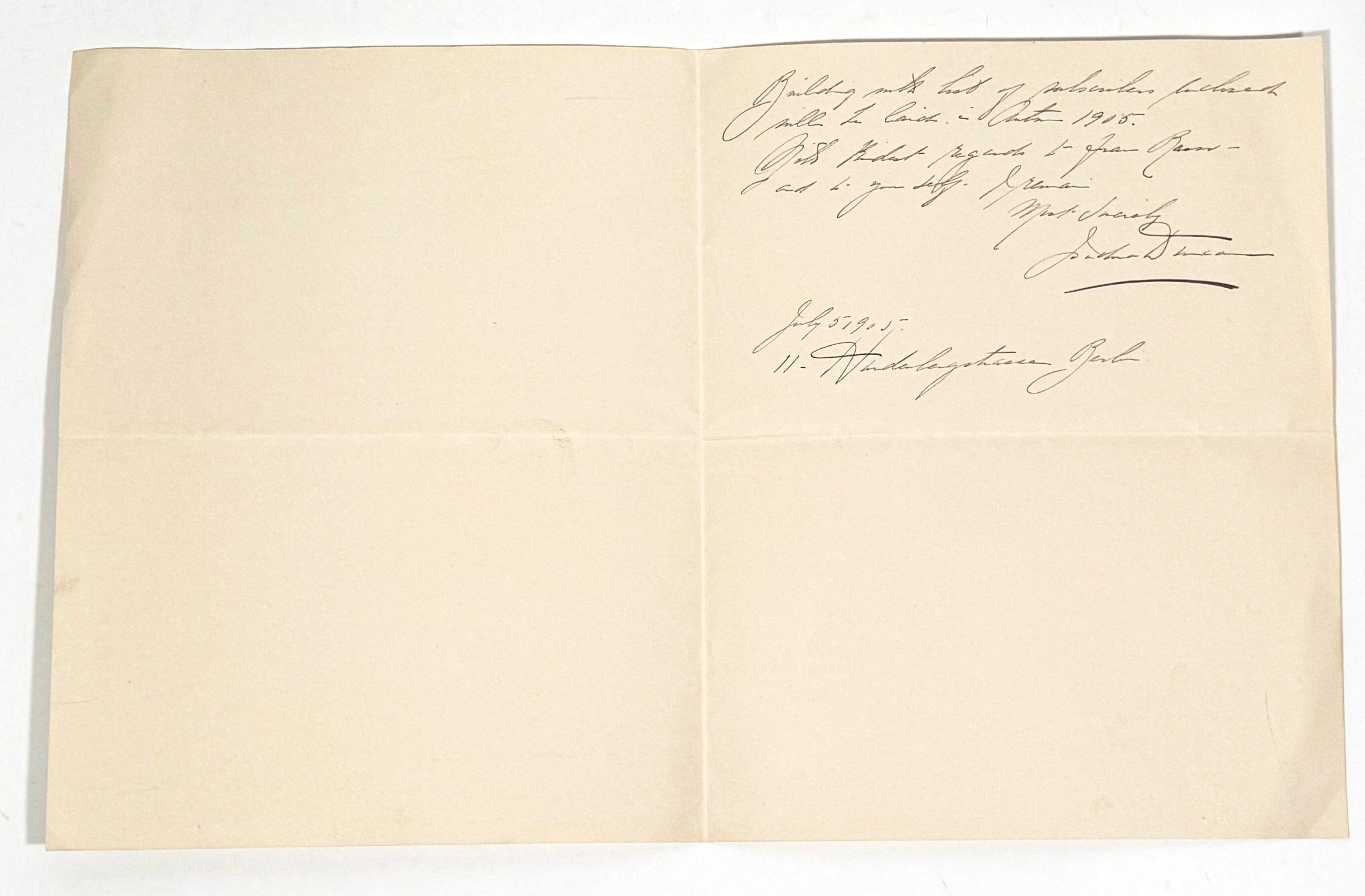
The letter in full:
Dear Herr Russo -
On Dec 7. 1904 I opened my free school for the Dance in Grunewald with twenty pupils. These little girls living together and studying the Art of the Dance under my guidance have made such wonderful progress that all sculptors & artists visiting the school express their enthusiastic belief in the benefit of this school for the artists of the future & for the State.
This idea encourages me to the adding to the school by a second building with larger dancing room that I may take thirty five more little girls next year. For this purpose I am giving a subscription Benefit at Knes Knigl Opera House on July 20.
The subscriptions are sold in separate lots of one hundred to one thousand marks - the seats of those not able to be present are given to young Art Students in Berlin. If this idea meets with your approval will you subscribe - the Corner Stone of the new building with list of subscribers enclosed will be laid in October 1905. With kindest regards to Frau Russo - and to yourself. I remain
Most Sincerely / Isadora Duncan / July 5, 1905 - 11 Hardenbergstrasse Berlin.
Two pages on two adjoining sheets, 7 × 9 in. Written to "Herr Russo" (unidentified). Berlin (Grunewald): July 5, 1905. Fine condition.
ISADORA DUNCAN LETTERS OF ANY IMPORTANCE ARE VERY RARE.
She explains that "these little girls living together and studying the Art of the Dance under my guidance have made such wonderful progress" that sculptors and artists visiting the school expressed "their enthusiastic belief in the benefit of this school for the artists of the future & for the state." That final phrase-written to a potential German patron-was not rhetorical flourish but a calculated civic argument: Duncan was positioning her radical pedagogy as a public good, a claim she understood would resonate with the cultural and institutional priorities of her Berlin audience. The emphasis on communal living, bodily freedom, and immersion in nature simultaneously marked a sharp departure from classical ballet training and aligned her project with broader early-20th-century reform movements in education, art, and physical culture.
The school Duncan describes in this letter was not only a pedagogical experiment but a political one, and its politics were inseparable from the female body. Duncan's insistence on bare feet, loose tunics, and unencumbered natural movement was a direct challenge to the corseted, constrained body that Victorian and Wilhelmine culture demanded of women-a challenge she was now institutionalizing in a residential community of girls living and moving together outside the structures of conventional female education. Scholars have since read the Grunewald school, and Duncan's broader project, within the history of female separatist spaces and the emergence of a distinctly modern female subjectivity: a body that moved for its own expressive purposes rather than for the pleasure or approval of a male audience. Duncan's own life enacted these ideas beyond the studio-her refusal of marriage as an institution, her open relationships with both men and women, and her insistence on erotic and creative autonomy as inseparable from artistic freedom were understood by her contemporaries as continuous with her dance philosophy, not incidental to it. This letter, in which she solicits patronage for an all-female residential school from a male Berlin patron by arguing its value to "the state," captures with particular sharpness the negotiation at the center of her project: radical female autonomy framed in the civic language her audience required.
In her letter, Duncan outlines her plan to expand the school, proposing a subscription benefit performance at the Kroll Opera House on July 20-one of Berlin's premier cultural venues-with lots available from 100 to 1,000 marks, proceeds directed to young art students in Berlin. That concert, now documented in dance history, marked the first public appearance of the Grunewald students: the girls who would go on to perform more than seventy times across Germany, Holland, Switzerland, Russia, England, and France before their celebrated American debut at Carnegie Hall in December 1914. This letter, dated just seventeen days before that performance, captures the school at the precise moment of its emergence into public life. Duncan invites Russo's support directly: "If this idea meets with your approval will you subscribe-the corner stone of the new building with list of subscribers enclosed will be laid in October 1905," adding plans to take "twenty five more little girls next year."
The choice of the Kroll Opera House as the vehicle for her fundraising is telling: Duncan was simultaneously operating at the center of Berlin's cultural establishment and presenting herself as its reforming conscience. The identity of the recipient merits attention. The recipient's precise role in Berlin's cultural networks has not been fully established, but the nature of Duncan's appeal-combining artistic vision, civic argument, and a concrete financial proposition-suggests she regarded him as a patron of standing, someone whose name on a subscriber list would carry weight with others.
Historically, the Grunewald school occupies a critical place in dance history. It was Duncan's first attempt to create a permanent educational structure for modern dance-preceding her later schools in Paris and Moscow-and it was the nursery of the Isadorables, whose subsequent careers as performers and teachers became the primary vehicle through which Duncan's principles were transmitted to the next generation. The pedagogical ideas articulated in this letter-movement derived from nature, the unity of art and life, dance as a formative social and cultural force-became foundational not only to modern dance but to performance theory more broadly.
Duncan's influence has proved anything but historical. In dance, her principles-movement originating from the solar plexus, the body as the direct expression of inner life, choreography as an act of personal and political freedom-remain active presences in contemporary practice, traceable through Doris Humphrey, José Limón, and Mark Morris, and kept in living transmission by the Isadora Duncan Dance Foundation and the Isadora Duncan International Institute, both of which continue to teach and perform her original repertory. In gender and sexuality studies, the scholarly recovery of Duncan has accelerated markedly since the 1990s: her work now figures centrally in debates about the female body as a site of resistance, the politics of visibility and exposure, the history of queer female community and erotic autonomy, and the relationship between modernist aesthetics and feminist practice. The Grunewald school in particular-the all-female residential community whose founding this letter
documents-has attracted renewed attention as an early instance of the kind of separatist female space that second- and third-wave feminist theory would later theorize explicitly.
This letter captures Duncan not as a touring icon but as a cultural architect at a pivotal moment: seventeen days before the school's first public performance, soliciting the patronage that would allow her to build the institution whose students would carry her legacy into the twentieth century.
The letter in full:
Dear Herr Russo -
On Dec 7. 1904 I opened my free school for the Dance in Grunewald with twenty pupils. These little girls living together and studying the Art of the Dance under my guidance have made such wonderful progress that all sculptors & artists visiting the school express their enthusiastic belief in the benefit of this school for the artists of the future & for the State.
This idea encourages me to the adding to the school by a second building with larger dancing room that I may take thirty five more little girls next year. For this purpose I am giving a subscription Benefit at Knes Knigl Opera House on July 20.
The subscriptions are sold in separate lots of one hundred to one thousand marks - the seats of those not able to be present are given to young Art Students in Berlin. If this idea meets with your approval will you subscribe - the Corner Stone of the new building with list of subscribers enclosed will be laid in October 1905. With kindest regards to Frau Russo - and to yourself. I remain
Most Sincerely / Isadora Duncan / July 5, 1905 - 11 Hardenbergstrasse Berlin.
Two pages on two adjoining sheets, 7 × 9 in. Written to "Herr Russo" (unidentified). Berlin (Grunewald): July 5, 1905. Fine condition.
ISADORA DUNCAN LETTERS OF ANY IMPORTANCE ARE VERY RARE.
Details
Title
Autograph Letter Signed
Author
DUNCAN, ISADORA
Binding
custom folder
Condition
Fine
Publisher
np: Berlin
Date
1905
Edition
first edition