

Perspectiva communis
- Hardcover
- Venice: Giovanni Battista Sessa, June, 1504
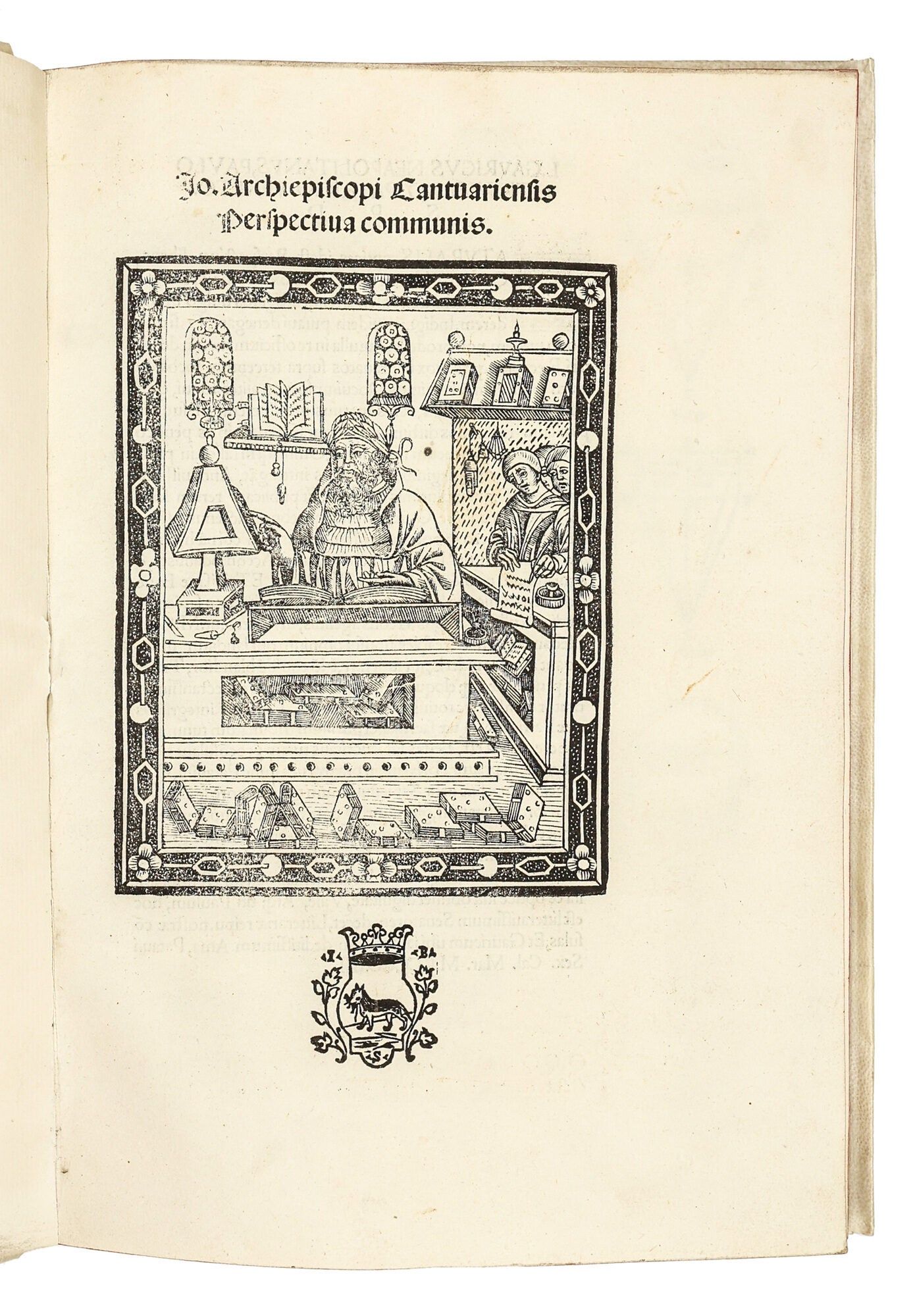
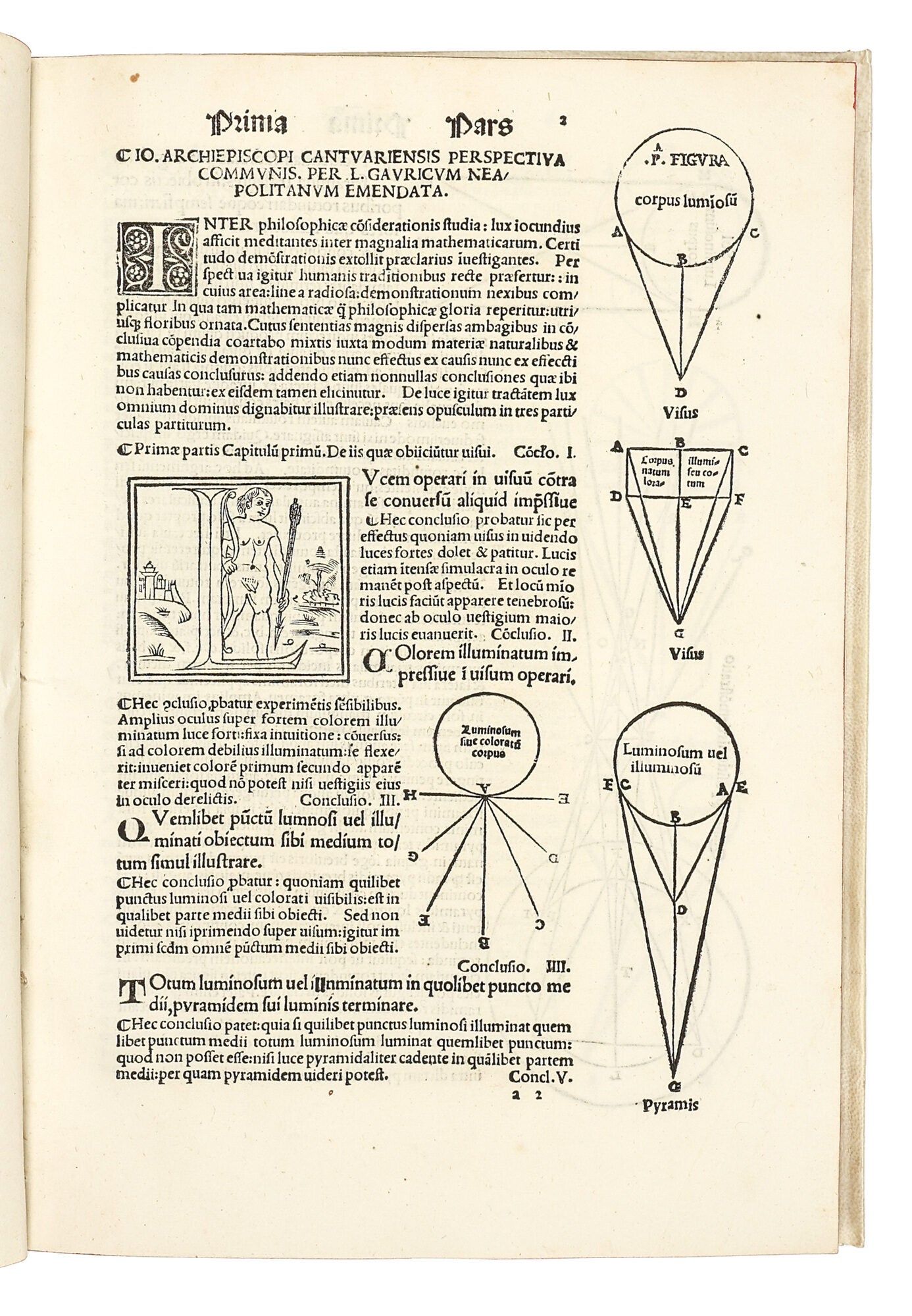
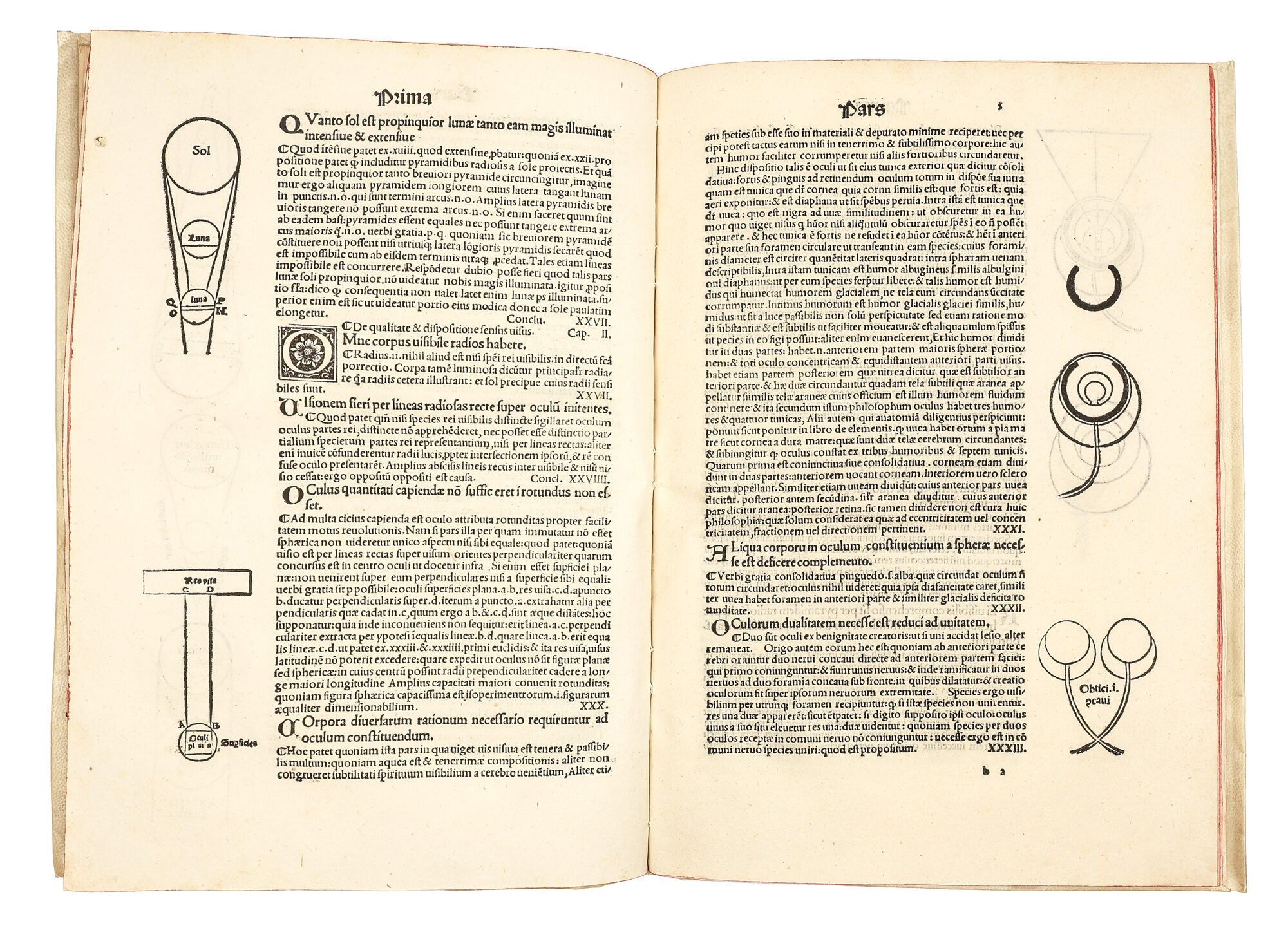
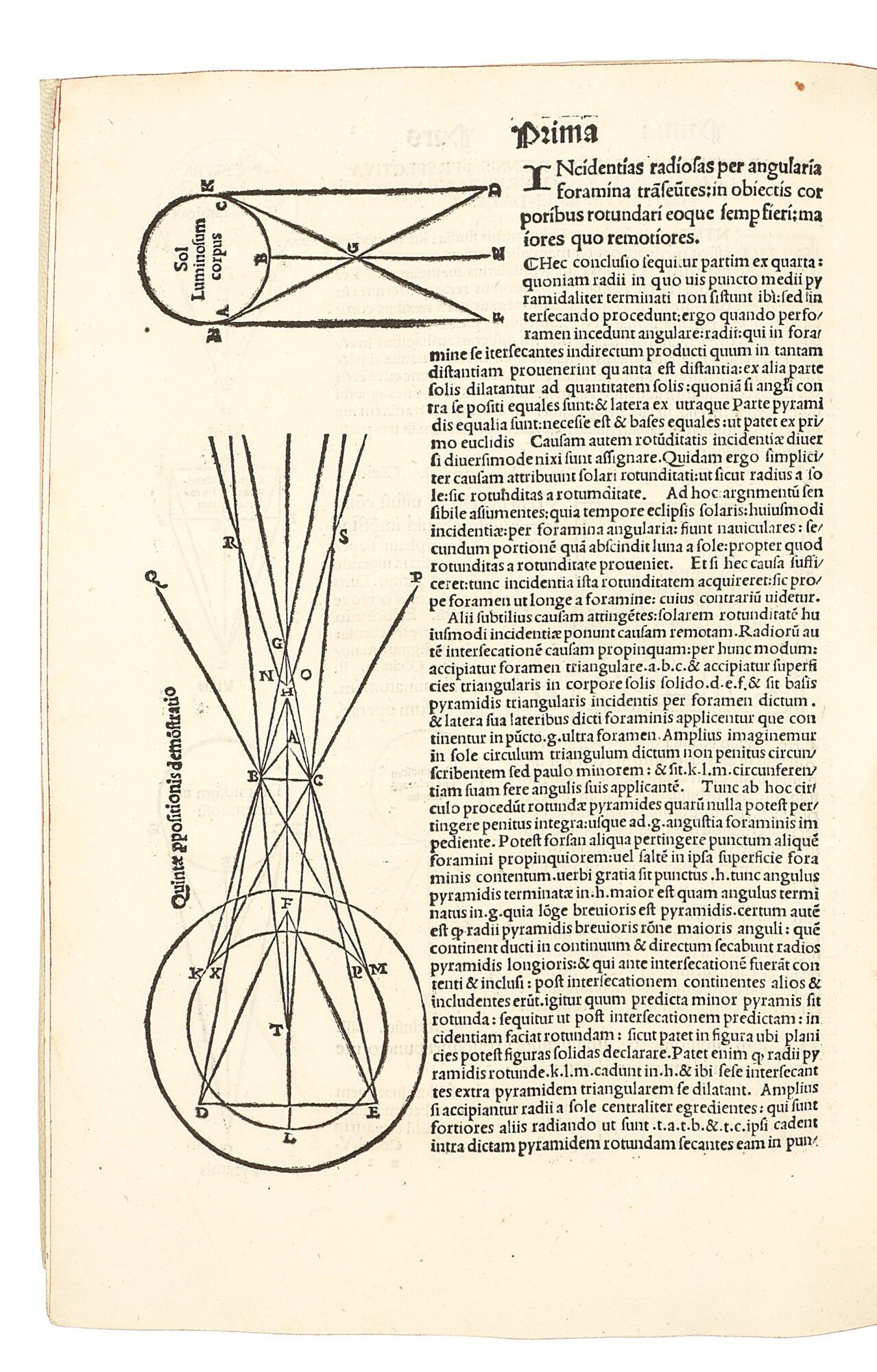
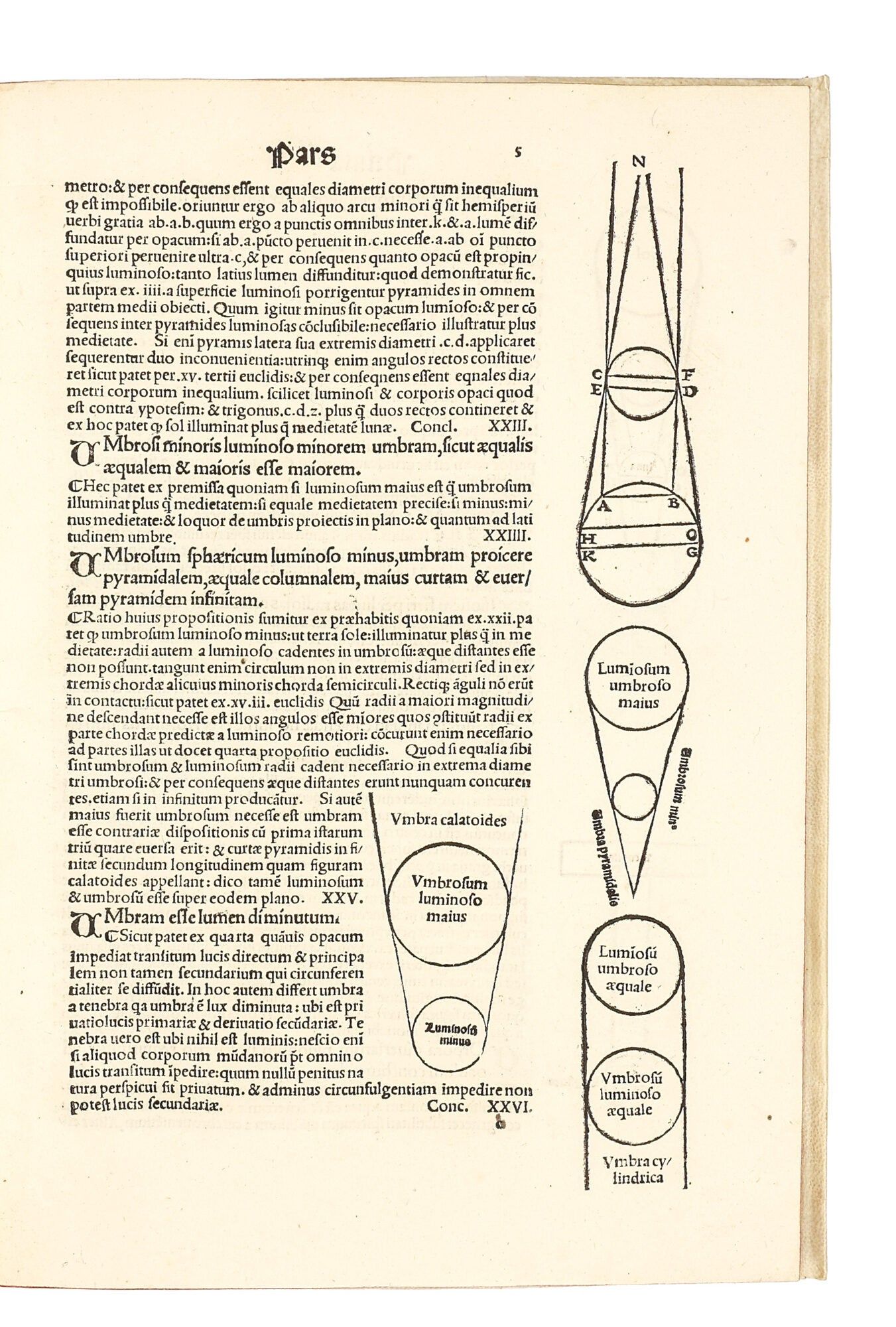
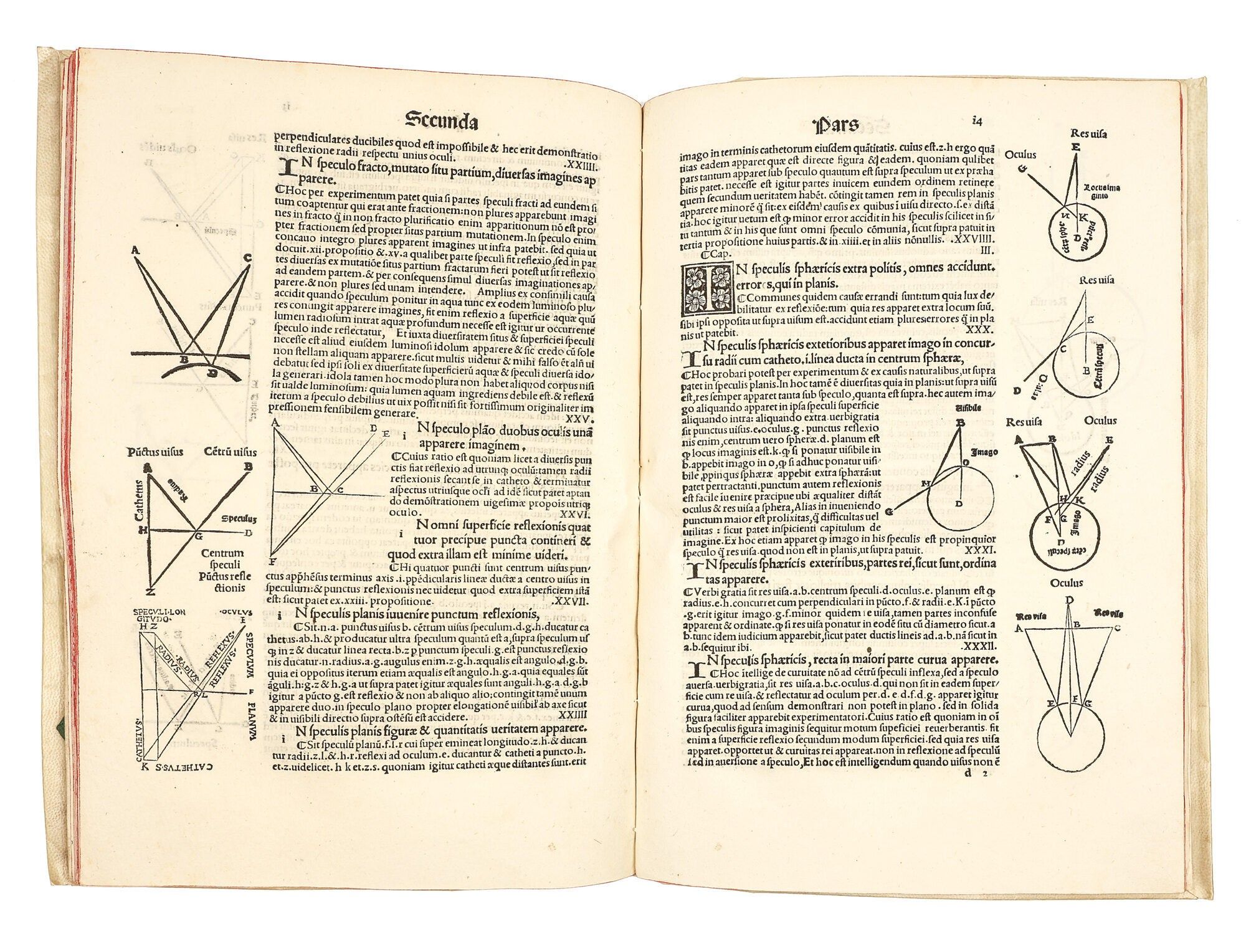
Venice: Giovanni Battista Sessa, June, 1504. THIRD OR FOURTH EDITION (of the two editions of 1504, priority has not been determined). THE FIRST TO BE EDITED BY LUCA GAURICO. Hardcover. Fine. Bound in modern vellum. Title with large woodcut showing the author in his study, surrounded by books, lecturing his students, one of whom takes notes. Sessa's cat-and-mouse printer's device appears on the same leaf.,The text is illustrated with 77 woodcut diagrams. A very fine copy, crisp and bright. There is a very light stain on the title page, a bit of soiling in the gutter of leaf A3, and a discreet paper repair to the fore-edge of the final leaf. "The 'Perspectiva communis' was the most widely used of all optical texts from the early fourteenth until the close of the sixteenth century, and it remains today the best index of what was known to the scientific community in general on the subject" (DSB).
It was first printed in Milan around 1482, then, in 1503, it was included in a collection by Thomas Bradwardine, "Praeclarissimum mathematicarum opus"(Valencia). This 1504 edition, the first edited by Luca Gaurico, can be considered the third, although another edition of the pre-Gaurico version was also published in 1504, at Leipzig. A mathematician from Naples and teacher of Scaliger, Gaurico, who also edited the works of Archimedes and Ptolemy, completely revised the text.
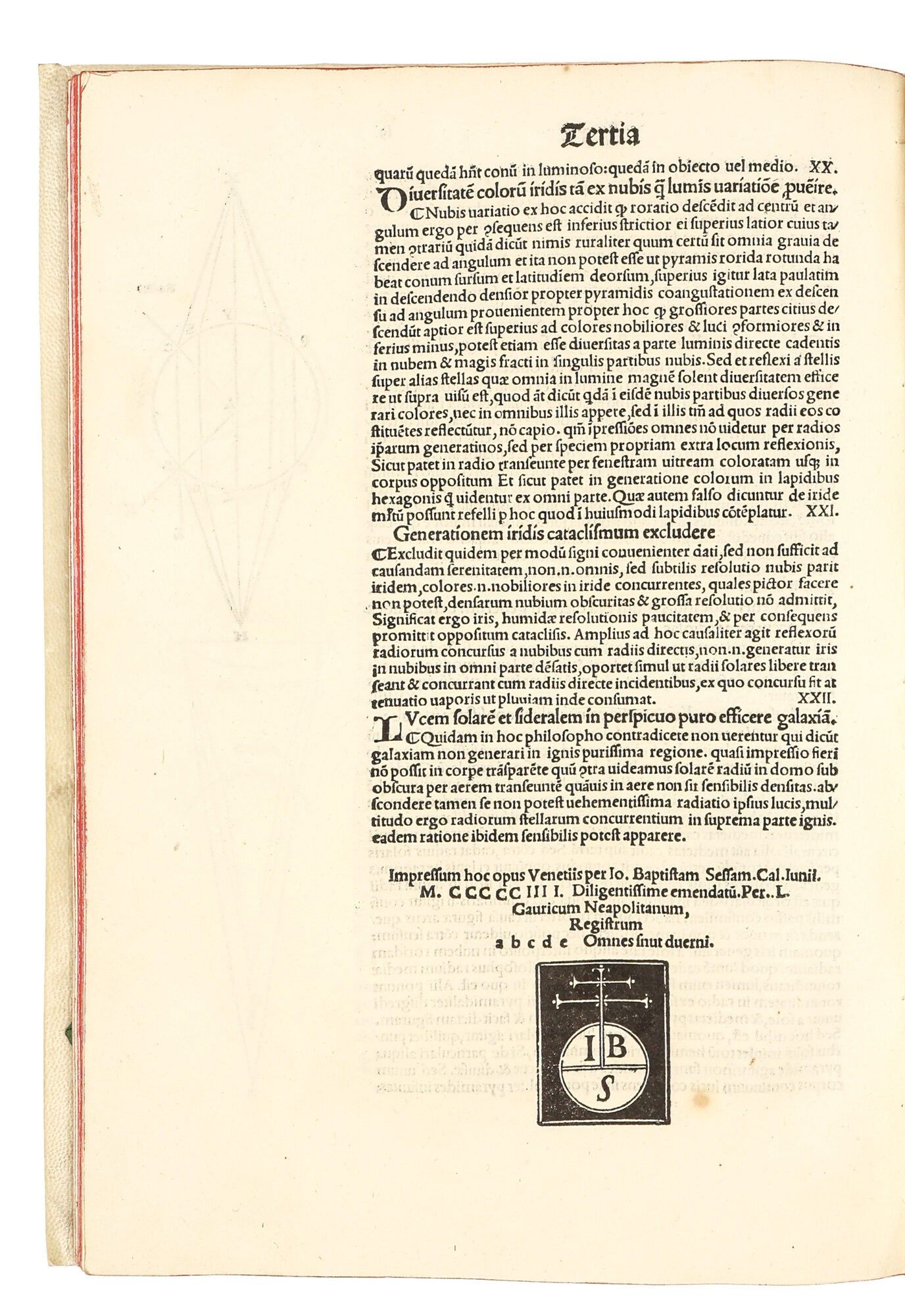
"The work on which Pecham's fame has chiefly rested is the Perspectiva communis, probably written between 1277 and 1279 during Pecham's professorship at the papal curia. In the first book Pecham discussed the propagation of light and color, the anatomy and, physiology of the eye, the act of visual perception, physical requirements for vision, the psychology of vision, and the errors of direct vision. In book II he discussed vision by reflected rays and presented a careful and sophisticated analysis of image formation by reflection. Book III was devoted to the phenomena of refraction, the rainbow, and the Milky Way.
"The central feature of Pecham's optical system and the dominant theme of book I of the 'Perspectiva communis' is the theory of direct vision. Here, as elsewhere, Pecham endeavored to reconcile all the available authorities-Aristotle, Euclid, Augustine, al-Kindi, Ibn al-Haytham, Ibn Rushd, Grosseteste, and Bacon. Following Ibn al-Haytham, Pecham argued that the emission of visual rays from the observer's eye is neither necessary nor sufficient as an explanation of sight; the primary agent of sight is therefore the ray coming to the eye from a point on the visible object. But in an attempt to follow Aristotle, al-Kindi, and Grosseteste as well, Pecham argued that visual rays do nevertheless exist and perform the important, but not always necessary, function of moderating the luminous rays from the visible object and making them, "commensurate with the visual power." Thus Pecham, like Bacon, resolved the age-old debate between the emission and intromission theories of vision in favor of a twofold radiation, although, to be sure, priority was given to rays issuing from the visible object.
"The rays issuing from points on the visible object fall perpendicularly onto the cornea and penetrate without refraction to the sensitive ocular organ, the glacial humor (or crystalline lens); nonperpendicular rays are weakened by refraction and therefore can be largely ignored. Since only one perpendicular ray issues from each point of the visible object and the collection of such perpendicular rays maintains a fixed order between the object and the eye, a one-to-one correspondence is established between points on the object and points on the glacial humor, and unconfused perception of the visual field is thus achieved. Vision is not "completed," however, in the glacial humor. There is a further propagation of the rays (or species) through the vitreous humor and optic nerve to the common nerve, where species from the two eyes combine, and eventually to the anterior part of the brain and the "place of interior judgment."
"Pecham's optical system included significantly more than a theory of direct vision. He briefly discussed the doctrine of species; treated at length the propagation of rays; and developed a theory to explain how solar radiation, when passing through noncircular apertures, gives rise to circular images. He expressed the full law of reflection and applied it to image formation by plane, spherical, cylindrical, and conical mirrors; in this analysis he revealed an implicit understanding of the nature of the focal point of a concave mirror. Although he did not possess a mathematical law of refraction, he successfully applied the general qualitative principles of refraction to the images that result from refraction at plane and circular interfaces between transparent media of various densities. In his discussion of the rainbow Pecham again attempted to reconcile different theories. He argued that all three kinds of rays (rectilinear, reflected, and refracted) concur in the generation of the rainbow...
"Pecham's 'Perspectiva communis' is still extant in more than sixty manuscripts and went through twelve printed editions, including a translation into Italian, between 1482 and 1665. It was used and cited by many medieval and Renaissance natural philosophers, including Dominicus de Clavasio, Henry of Langenstein, Blasius of Parma, Lorenzo Ghiberti, Leonardo da Vinci, Albert Brudzewski, Francesco Maurolico, Giambattista della Porta, Girolamo Fabrici, Johannes Kepler, Willebroad Snellius, and G. B. Riccioli. It was lectured upon, in the late Middle Ages, at the universities of Vienna, Prague, Paris, Leipzig, Cracow, Würzburg, Alcala, and Salamanca."(DSB).
It was first printed in Milan around 1482, then, in 1503, it was included in a collection by Thomas Bradwardine, "Praeclarissimum mathematicarum opus"(Valencia). This 1504 edition, the first edited by Luca Gaurico, can be considered the third, although another edition of the pre-Gaurico version was also published in 1504, at Leipzig. A mathematician from Naples and teacher of Scaliger, Gaurico, who also edited the works of Archimedes and Ptolemy, completely revised the text.
"The work on which Pecham's fame has chiefly rested is the Perspectiva communis, probably written between 1277 and 1279 during Pecham's professorship at the papal curia. In the first book Pecham discussed the propagation of light and color, the anatomy and, physiology of the eye, the act of visual perception, physical requirements for vision, the psychology of vision, and the errors of direct vision. In book II he discussed vision by reflected rays and presented a careful and sophisticated analysis of image formation by reflection. Book III was devoted to the phenomena of refraction, the rainbow, and the Milky Way.
"The central feature of Pecham's optical system and the dominant theme of book I of the 'Perspectiva communis' is the theory of direct vision. Here, as elsewhere, Pecham endeavored to reconcile all the available authorities-Aristotle, Euclid, Augustine, al-Kindi, Ibn al-Haytham, Ibn Rushd, Grosseteste, and Bacon. Following Ibn al-Haytham, Pecham argued that the emission of visual rays from the observer's eye is neither necessary nor sufficient as an explanation of sight; the primary agent of sight is therefore the ray coming to the eye from a point on the visible object. But in an attempt to follow Aristotle, al-Kindi, and Grosseteste as well, Pecham argued that visual rays do nevertheless exist and perform the important, but not always necessary, function of moderating the luminous rays from the visible object and making them, "commensurate with the visual power." Thus Pecham, like Bacon, resolved the age-old debate between the emission and intromission theories of vision in favor of a twofold radiation, although, to be sure, priority was given to rays issuing from the visible object.
"The rays issuing from points on the visible object fall perpendicularly onto the cornea and penetrate without refraction to the sensitive ocular organ, the glacial humor (or crystalline lens); nonperpendicular rays are weakened by refraction and therefore can be largely ignored. Since only one perpendicular ray issues from each point of the visible object and the collection of such perpendicular rays maintains a fixed order between the object and the eye, a one-to-one correspondence is established between points on the object and points on the glacial humor, and unconfused perception of the visual field is thus achieved. Vision is not "completed," however, in the glacial humor. There is a further propagation of the rays (or species) through the vitreous humor and optic nerve to the common nerve, where species from the two eyes combine, and eventually to the anterior part of the brain and the "place of interior judgment."
"Pecham's optical system included significantly more than a theory of direct vision. He briefly discussed the doctrine of species; treated at length the propagation of rays; and developed a theory to explain how solar radiation, when passing through noncircular apertures, gives rise to circular images. He expressed the full law of reflection and applied it to image formation by plane, spherical, cylindrical, and conical mirrors; in this analysis he revealed an implicit understanding of the nature of the focal point of a concave mirror. Although he did not possess a mathematical law of refraction, he successfully applied the general qualitative principles of refraction to the images that result from refraction at plane and circular interfaces between transparent media of various densities. In his discussion of the rainbow Pecham again attempted to reconcile different theories. He argued that all three kinds of rays (rectilinear, reflected, and refracted) concur in the generation of the rainbow...
"Pecham's 'Perspectiva communis' is still extant in more than sixty manuscripts and went through twelve printed editions, including a translation into Italian, between 1482 and 1665. It was used and cited by many medieval and Renaissance natural philosophers, including Dominicus de Clavasio, Henry of Langenstein, Blasius of Parma, Lorenzo Ghiberti, Leonardo da Vinci, Albert Brudzewski, Francesco Maurolico, Giambattista della Porta, Girolamo Fabrici, Johannes Kepler, Willebroad Snellius, and G. B. Riccioli. It was lectured upon, in the late Middle Ages, at the universities of Vienna, Prague, Paris, Leipzig, Cracow, Würzburg, Alcala, and Salamanca."(DSB).
Details
Title
Perspectiva communis
Author
OPTICS. Peckham [also Pecham], John (c. 1230 - 8 December 1292); Gaurico, Luca (March 12, 1475 - March 6, 1558)
Binding
Hardcover
Condition
Fine
Publisher
Giovanni Battista Sessa, June: Venice
Date
1504
Edition
THIRD OR FOURTH EDITION (of the two editions of 1504, priority h