

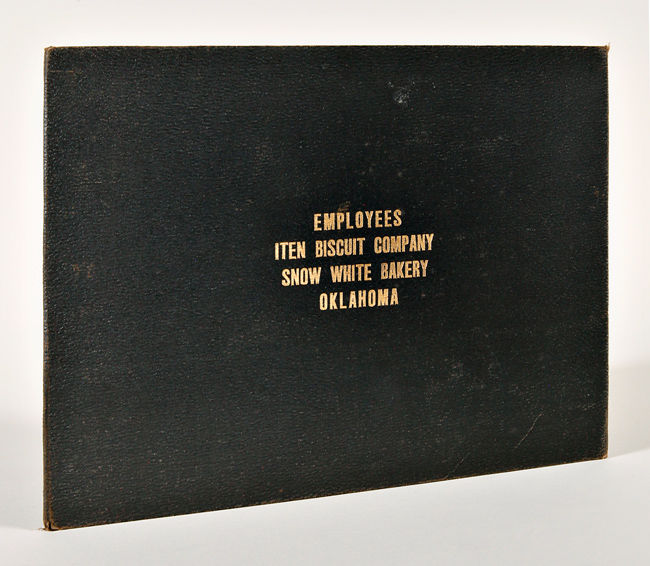
EMPLOYEES ITEN BISCUIT COMPANY SNOW WHITE BAKERY OKLAHOMA [cover title].
- [Oklahoma City: Fred L. Stone, , ca. 1913].
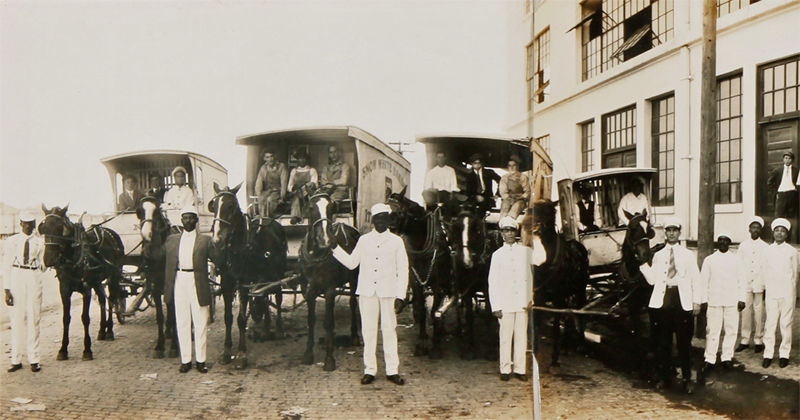
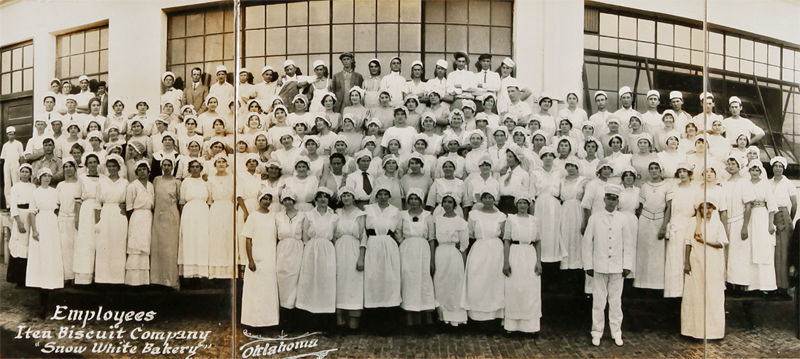
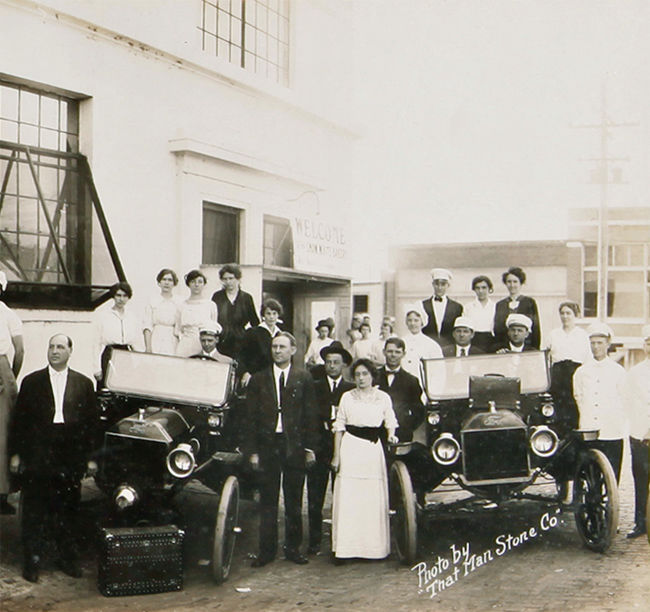
[Oklahoma City: Fred L. Stone,, ca. 1913].. Panoramic Photograph Laying Bare the Race, Class, and Gender Differences in an Oklahoma Factory A striking panoramic photograph of the employees of an early Oklahoma bakery, likely produced as a keepsake for the staff or management. The photograph shows some 200 employees of the Iten Biscuit Company of Oklahoma, a subsidiary of the main Iten company of Iowa. The arrangement of the employees in the photograph—the juxtaposition of race, gender, and class—is startling. At left, four horse-drawn carriages are controlled by African-American men in white uniforms and hats, with white men in overalls sitting in the carriages, holding the reins of the horses. The middle section is dominated by about 150 white women (and a handful of white men) in simple white dresses and bonnets. The right side of the image shows the executives of the company in dark suits and ties, and perhaps their wives and children, ranged around two Model-T Ford automobiles. The organization of the image divides the subjects into thirds, segregated by race, gender, and class. The photograph was likely taken about 1913. The Iten Biscuit Company's new Oklahoma City plant and distribution hub, in front of which the present panorama was taken, was completed in October 1912. Constructed at a cost of $250,000, the Iten Biscuit Company building in Oklahoma City consisted of five stories totaling about 126,000 square feet of space; it was also constructed with restrooms and a breakroom on each floor, quite unusual for a commercial building in 1912. The Iten Biscuit Company occupied the space for thirty years before being bought by Nabisco. The building still stands; it is now a large U-Haul Moving & Storage location at 100 SE 2nd Street in Oklahoma City. The photographer, Fred L. Stone, was an early and quite notable Oklahoma itinerant photographer. He captured images of the Sooner state both before and after the Land Rush of 1889, and promoted himself as the official photographer for the largest newspaper in Oklahoma City, The Oklahoman. He also claimed to be the first photographer in Oklahoma with a panoramic camera, with which he extensively documented Oklahoma City, Tulsa, and numerous other sites in Oklahoma and the surrounding states. Stone garnered so much attention for his early adoption of the panoramic camera that he became known as "That Man Stone," which he later used as an imprint in his photographs, as seen here. We could find no other examples of this panoramic photograph in OCLC, the market, or at auction. It is possibly unique. An informative visual representation of race, gender, and class differences at an early 20th-century Oklahoma commercial bakery. Four-panel panoramic silver gelatin photograph, each panel approximately 8 × 10 inches. With an additional 3½ × 6-inch silver gelatin photograph mounted on the inside front cover. Each of the four panels mounted on linen and folded into a black pebbled cloth binding, gilt title on front board. Mild edge wear to boards, one panel with a small chip in lower left corner. Very good.
Details
Title
EMPLOYEES ITEN BISCUIT COMPANY SNOW WHITE BAKERY OKLAHOMA [cover title].
Author
[Oklahoma Photographica]: [African Americana]:
Condition
Unknown
Publisher
[Oklahoma City: Fred L. Stone,
Date
ca. 1913].