

La Grande Danse macabre des hommes et des femmes ; Historiée et renouvellée de vieux Gaulois, en langage le plus poli de notre temps [...] Avec Le débat du Corps & de l'Ame, La Complainte de l'Ame d'amnée, l'Exhortation de bien vivre & de bien mourir, La Vie du mauvais Ante Christ, Les quinze signes du Jugement
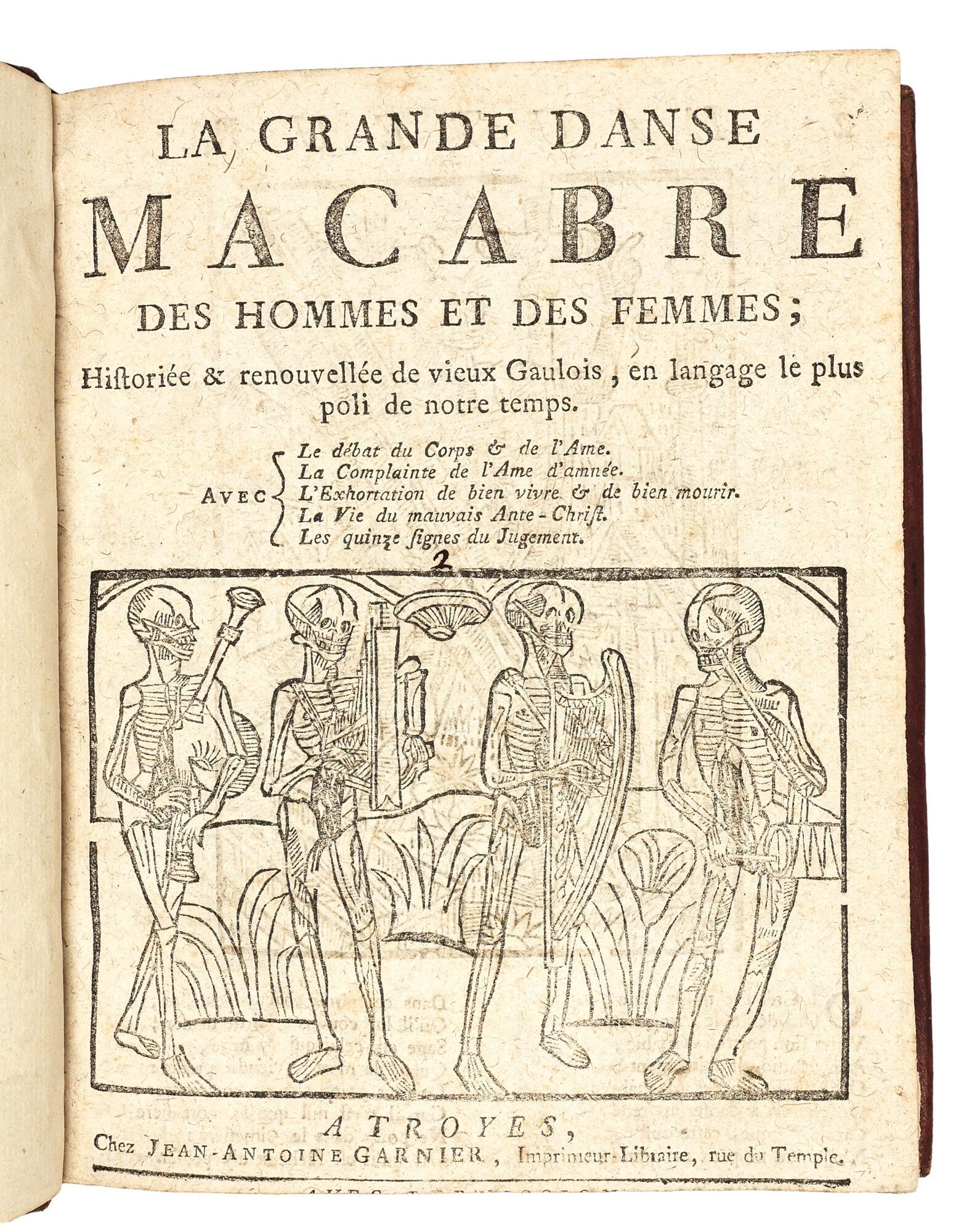




- Hardcover
- Troyes: chez Jean-Antoine Garnier, ca. 1766 to, 1773
Troyes: chez Jean-Antoine Garnier, ca. 1766 to, 1773. Hardcover. Fine. Bound with:
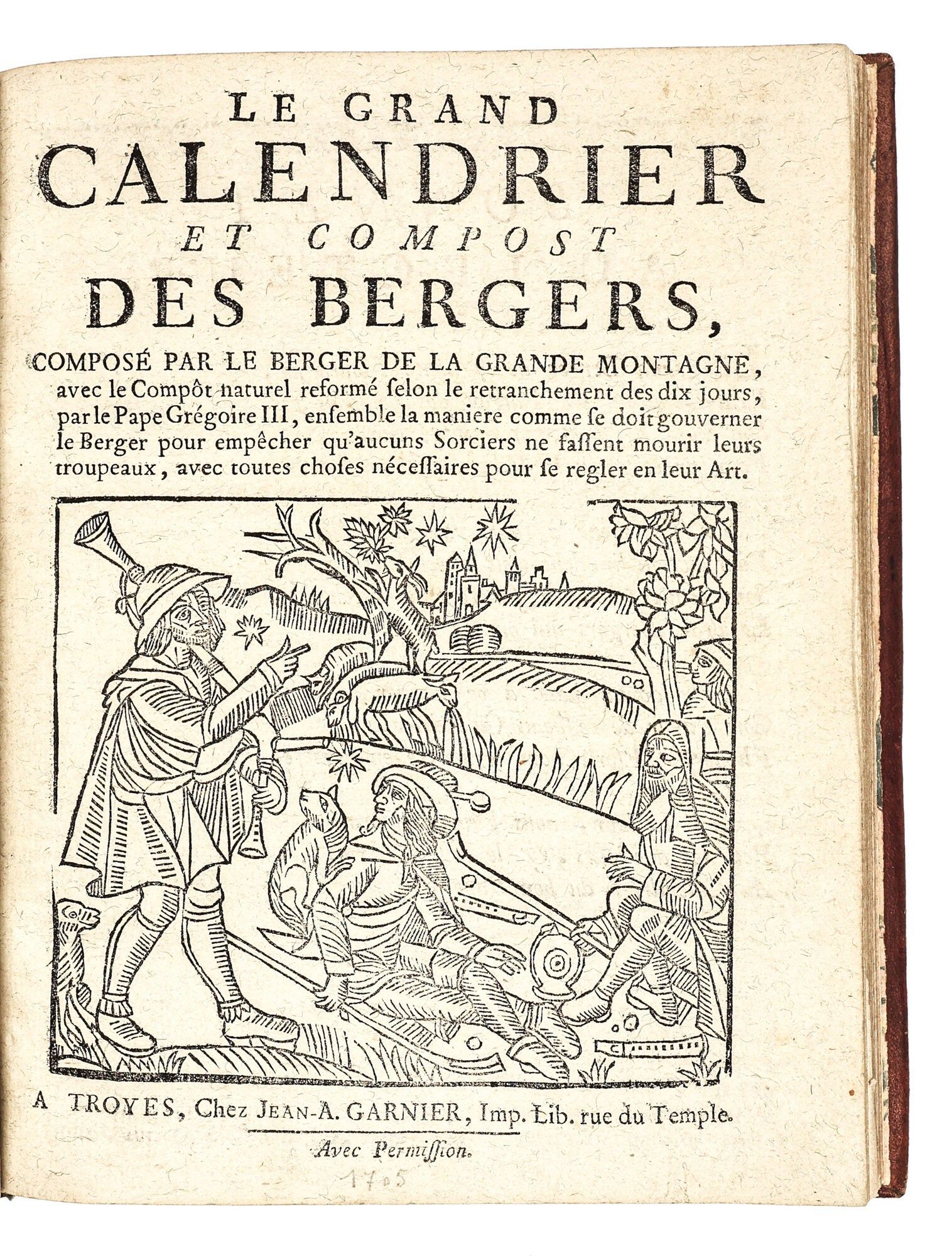
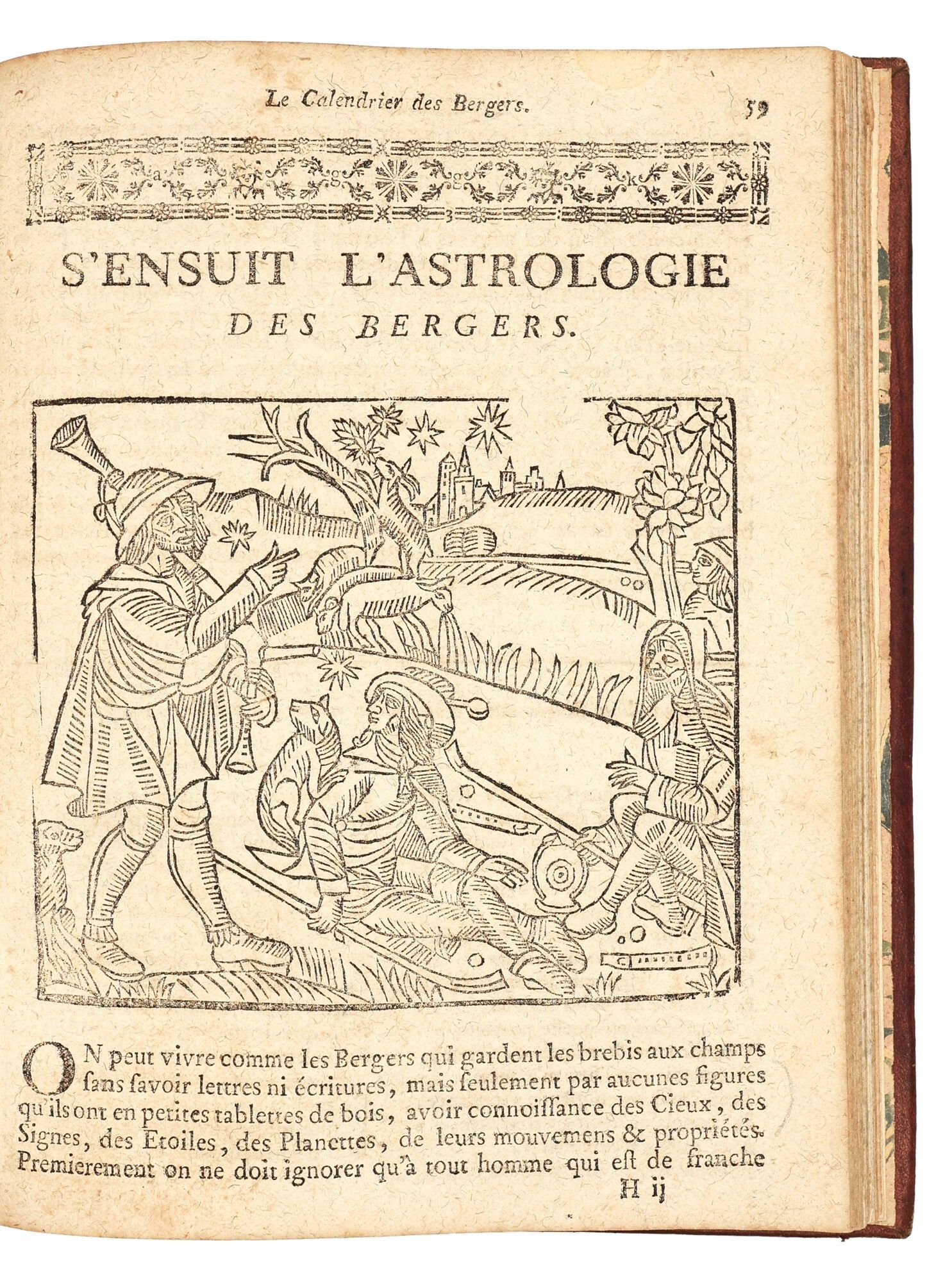
Le Grand Calendrier et Compost des bergers, composé par le berger de la Grande Montagne, Avec le Compôt naturel reformé selon le retranchement des dix jours, par le Pape Gregoire III. Ensemble la manière comme se doit gouverner le Berger pour empêcher qu'aucun Sorciers ne fassent mourir leurs troupeaux, avec toutes choses nécessaire pour se régler en leur art.
Troyes: Chez Jean-A. Garnier, Imp. Lib., No date [ca. 1776?]
Quarto: II. 144 pp. A-S4. TWO RARE EDITIONS. Bound in contemporary tanned sheep, the boards framed by a triple gold rule, the spine ruled in gold and with rampant lions tooled in the compartments. The Privilege at end is granted to Pierre Garnier, and dated 21 May 1728. It gives also a list of his other publications. Unusually fine copies, printed on delicate paper, of these works, which are rarely found in such nice condition, bound in a strictly contemporary binding. The bottom line of the first t.p. ("avec permission") has been shaved off. In the second work, leaf N1 has marginal stains; the last few leaves are lightly foxed.
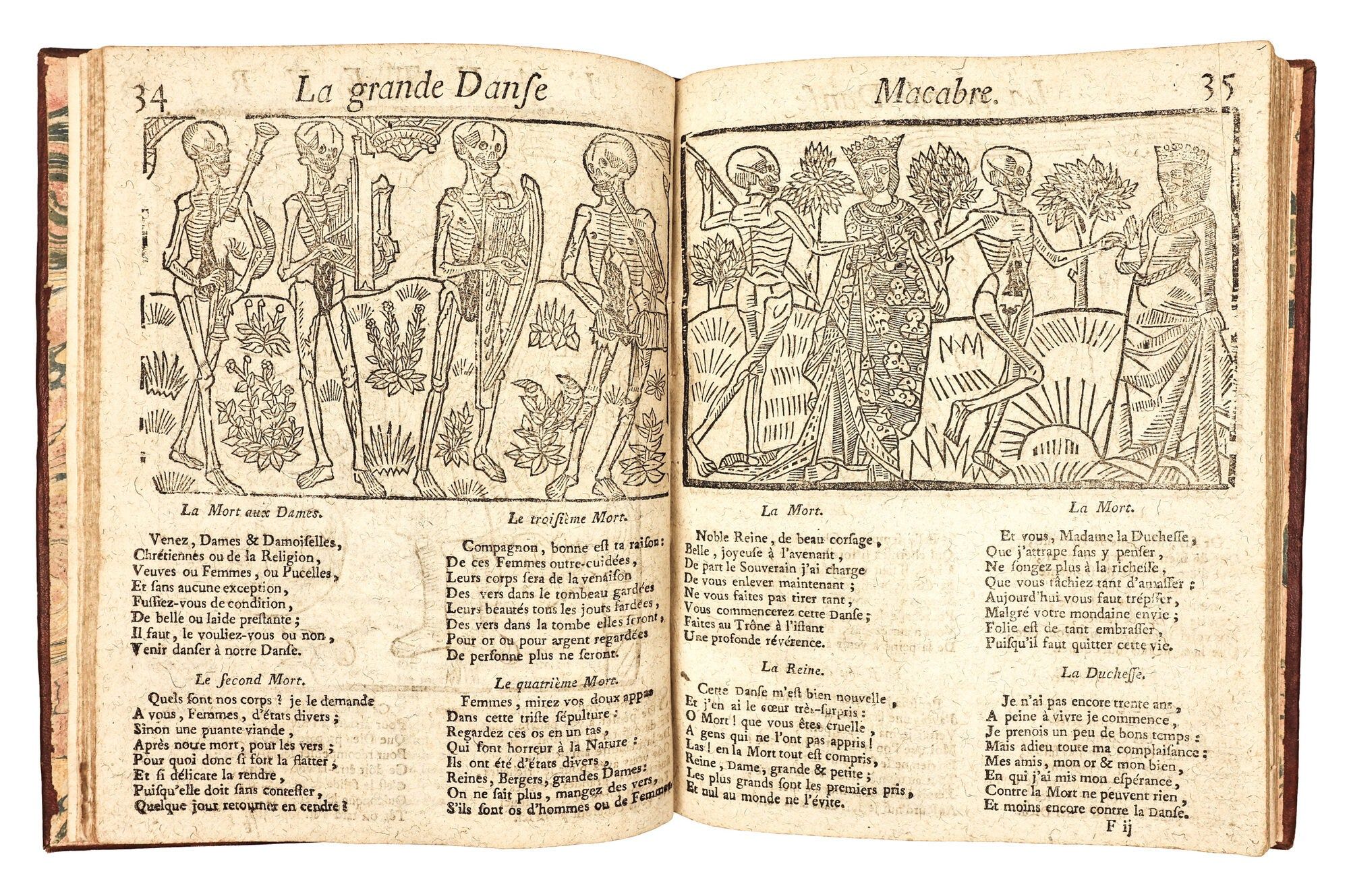
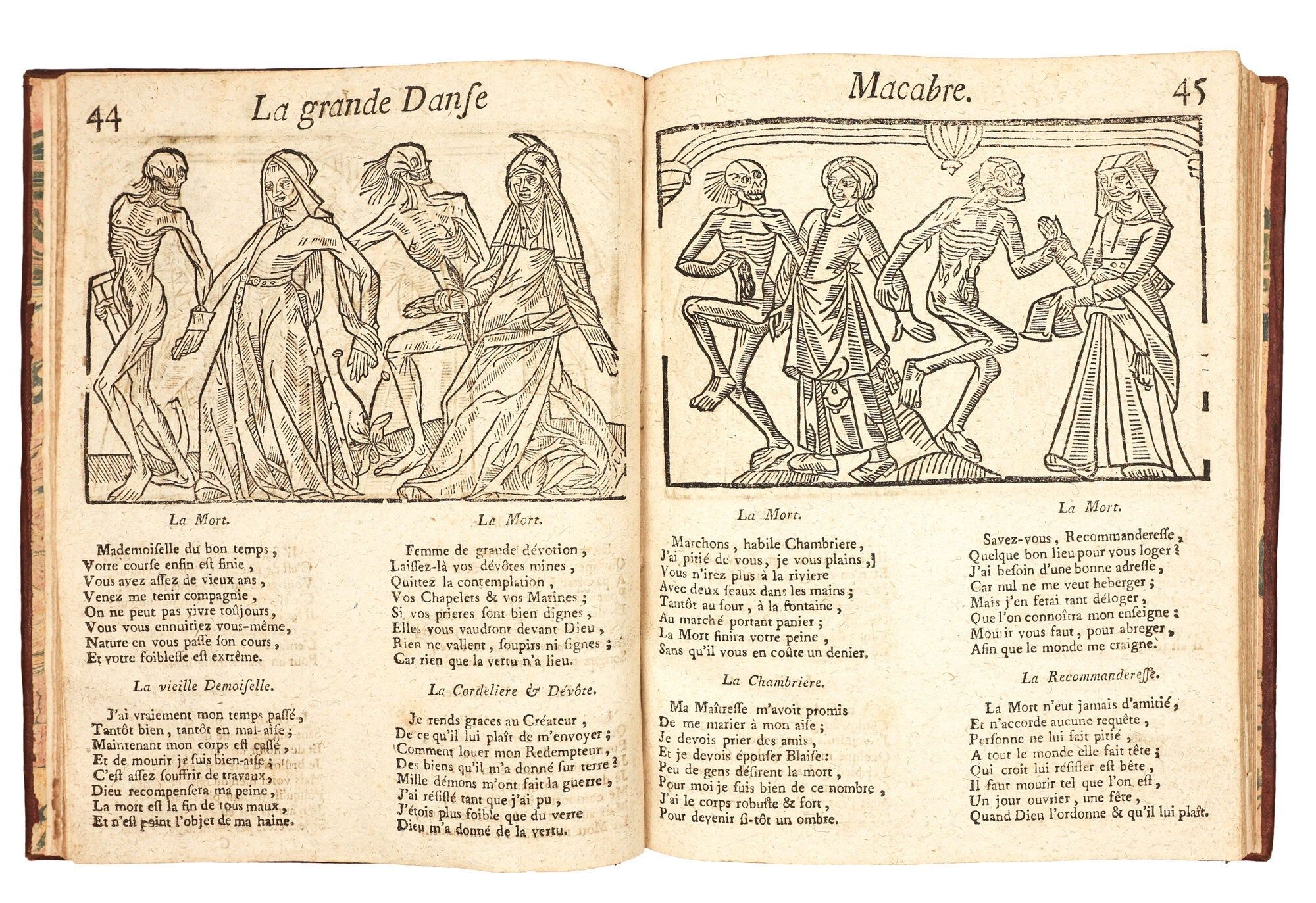
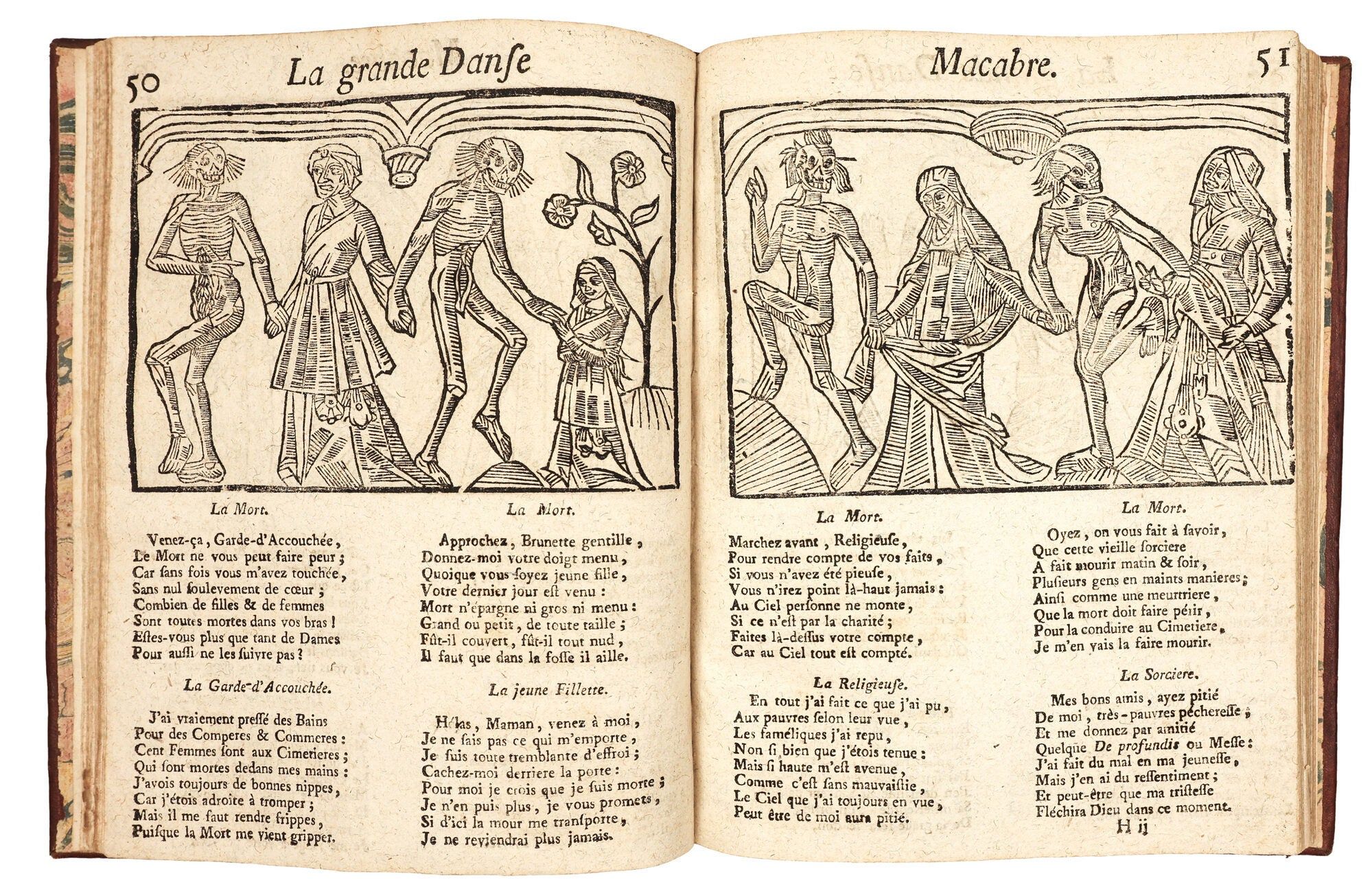
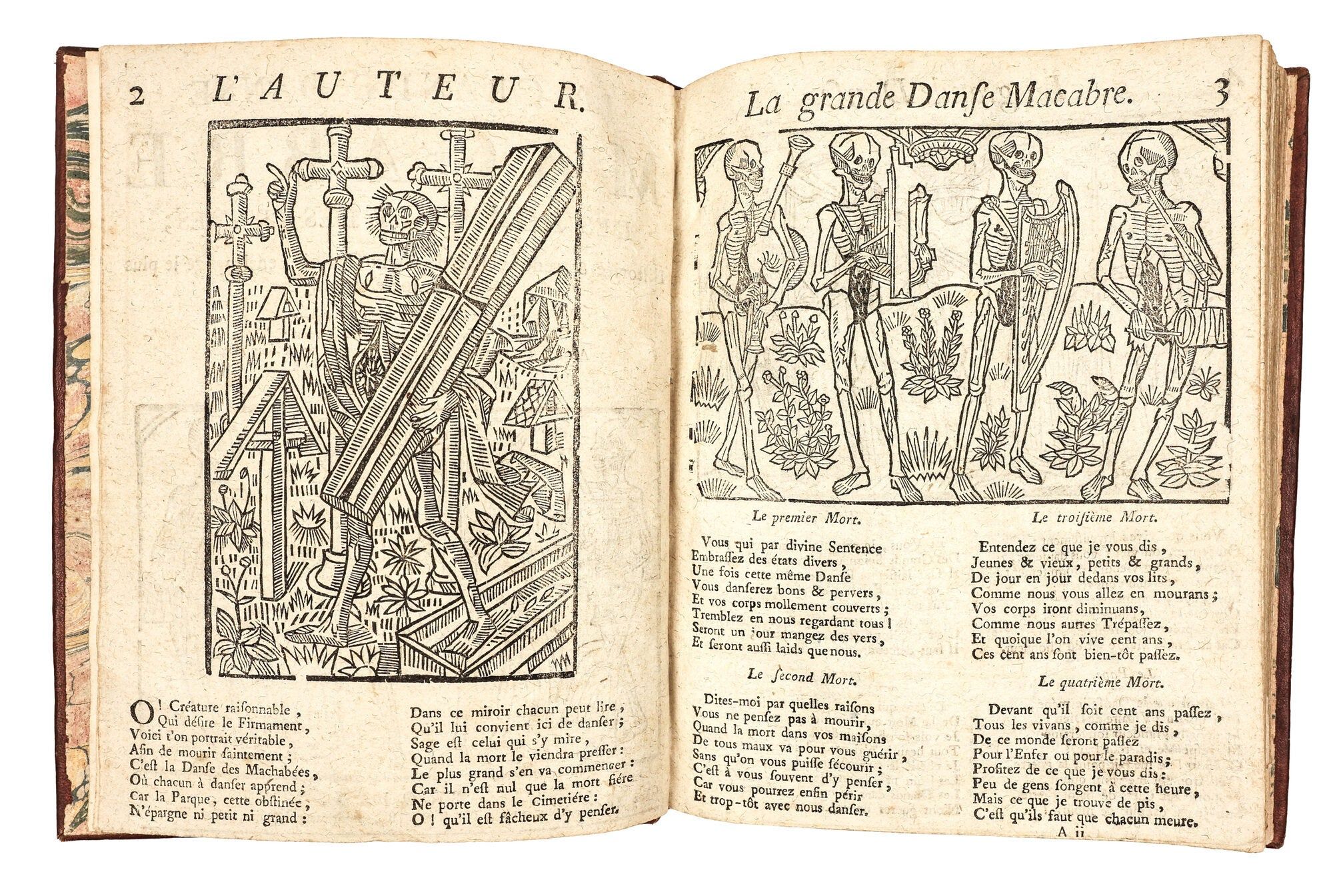
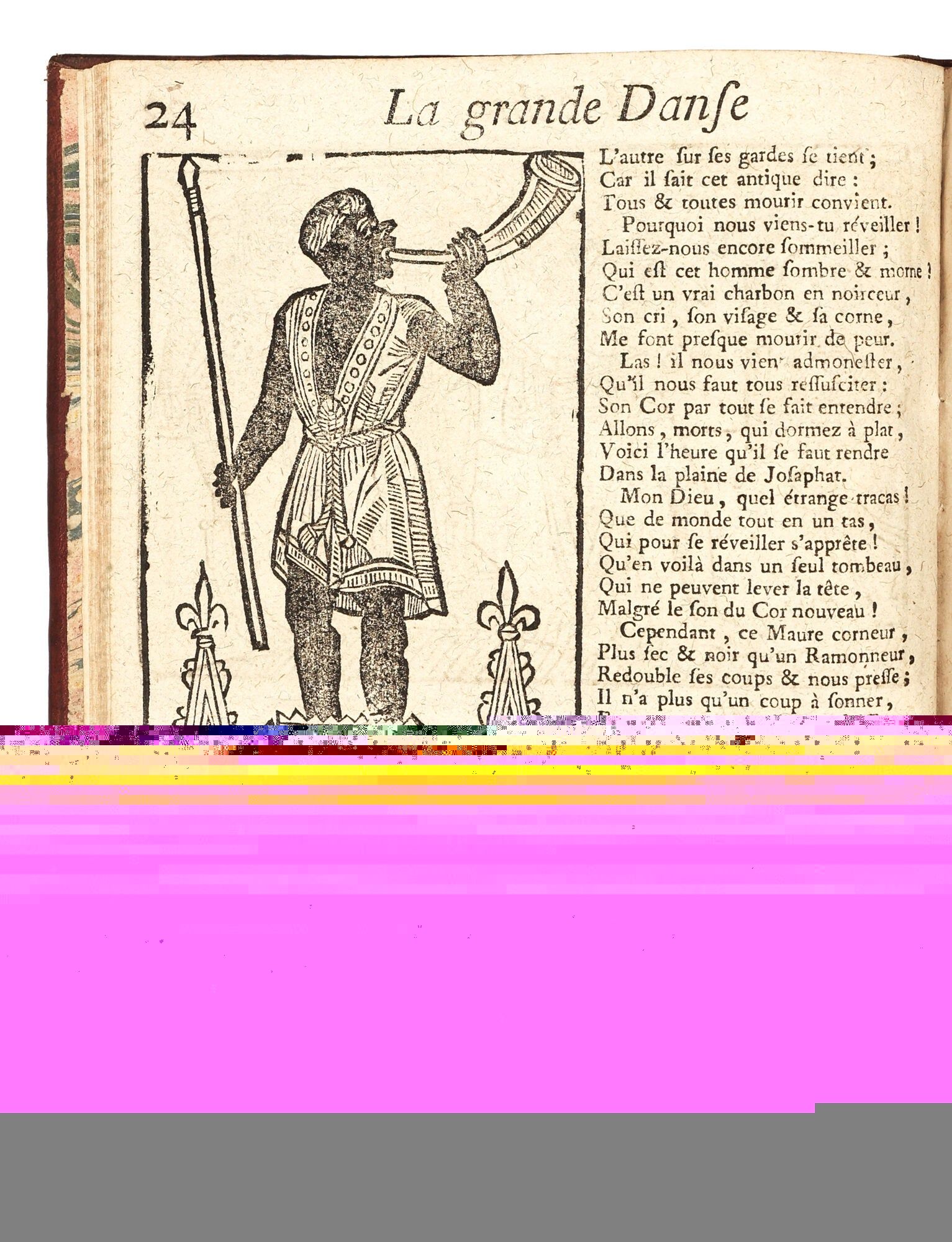
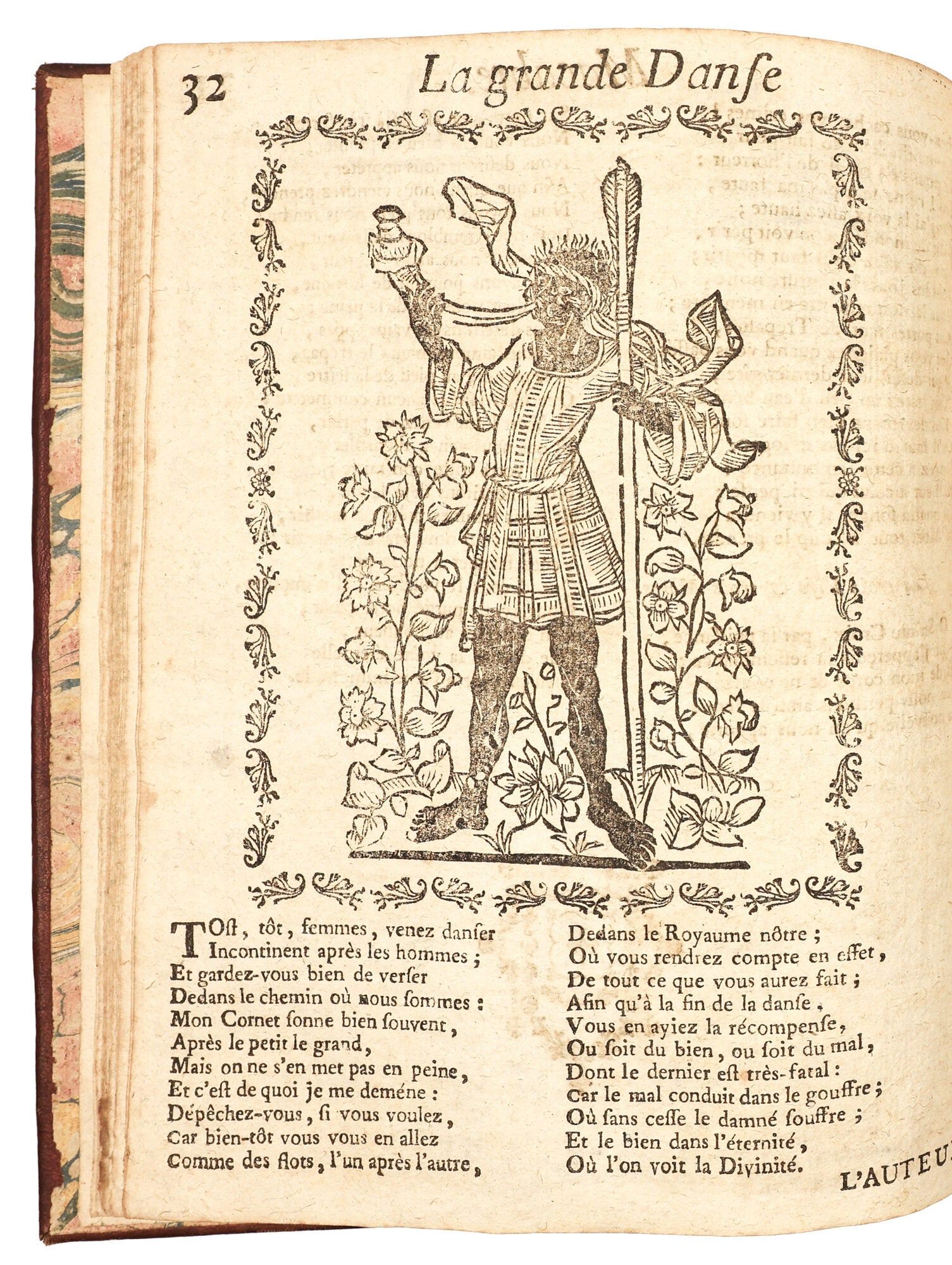
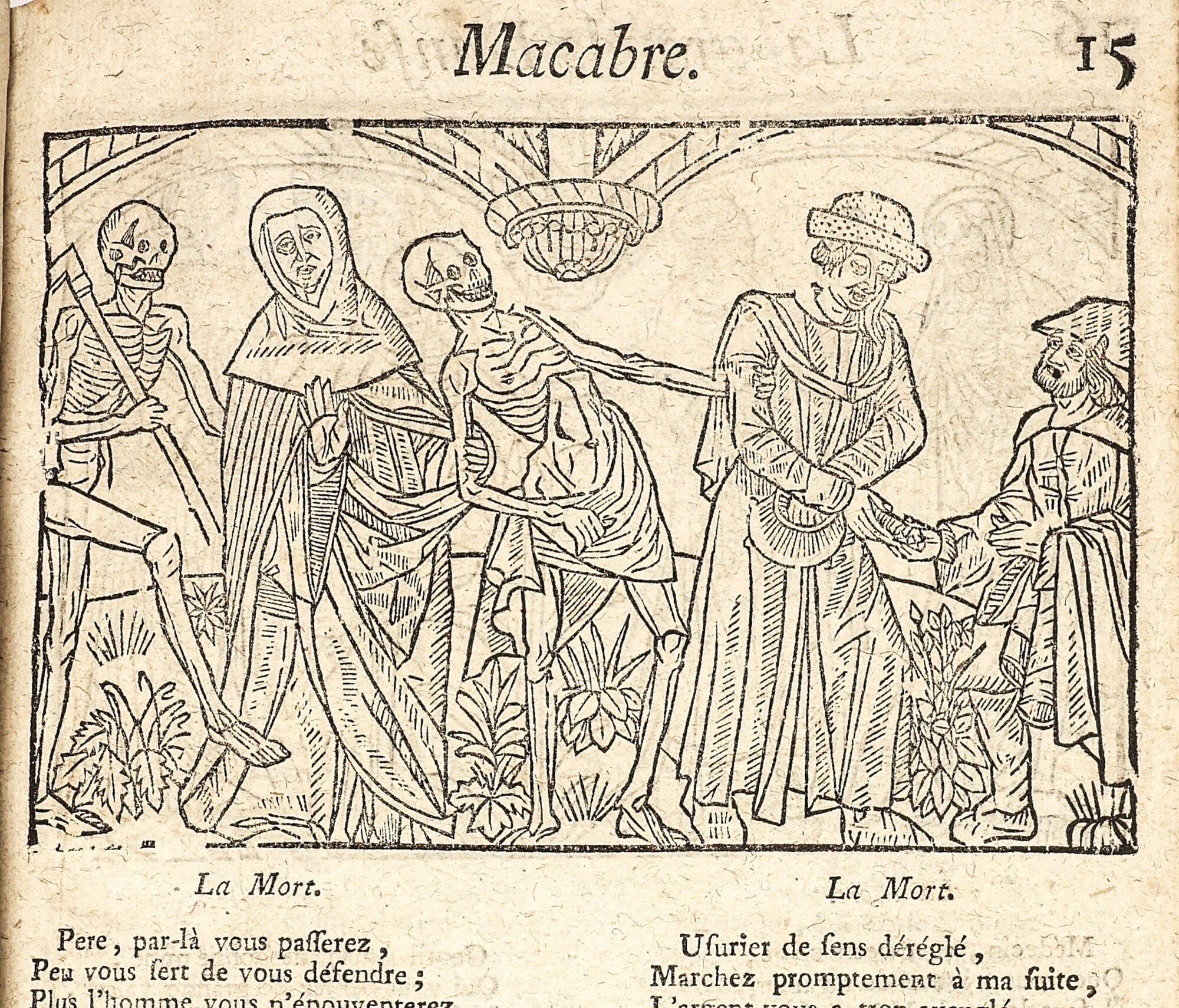
The Dance of Death, "Les trois vifs et les Trois Morts", and the other accompanying texts are illustrated with 60 woodcuts of the Dance of Death copied from the original designs which appeared in the edition of the Danse Macabre of G. Marchant, 1490. That of the Moor on p. 32 may be a very close copy of the same subject in the Compost. Another version of it appears on p. 27 and is a very close copy of that in the Bradwardine (No. 64). N. B. - the two blocks of this subject appearing respectively on pp. 24 & 27 of the present Danse Macabre are not identical.
Two works bound together, both examples of important literary genres dating to the late-Medieval and early-Renaissance periods. The "Danse macabre" is a pictorial cycle and poem first painted at a Paris cemetery about 1425. Woodcuts copied from the Paris fresco, along with the accompanying verses, were first printed by Guy Marchant at Paris in 1485. "Le Grand Calendrier", an illustrated almanac and calendar, was first printed in 1491 by Guy Marchant. The book, remarkable for both its text and its illustrations, was a kind of encyclopedia of meteorological, agricultural, hygienic, and moral knowledge.
I. The Dance of Death
One of the earliest examples of the pictorial cycle and poem known as the Danse Macabre was painted between August 1424 and Lent 1425 in the arcades of the Cimetière des Saints-Innocents (Cemetery of the Holy Innocents) in Paris. These arcades, constructed as charniers to house bones from earlier mass burials, were demolished in 1669, along with their frescoes. The images of the Danse in this book were directly inspired by the Paris Danse.
Woodcuts of the Danse copied from the Paris fresco, along with the 67 verses that accompanied the images, were first printed by Guy Marchant at Paris in 1485, with woodcuts designed by Pierre le Rouge. While there were no women in the original Danse, in 1486 Marchant published an all-female version, "La Danse Macabre des Femmes". Later, Marchant united these two texts in the two-volume "Miroer Salutaire". While Marchant followed the sequence from the Cimetière des Saints-Innocents, he introduced numerous changes, adding new pictorial elements and verses, including 20 additional dancers and the woodcut of the four skeleton musicians.
From the 16th through the 18th centuries, editions of the Danse appeared outside of Paris, printed -with various changes- by French provincial printers in Lyon, Rouen, and Troyes. Over the years, the woodblocks used to print the illustrations in the various Paris editions, worn or damaged from repeated use (and in some instances lost), were re-cut, with the images reproduced with varying degrees of fidelity to the originals.
The printing history of the Danse in Troyes began in 1493, when Pierre le Rouge's woodblocks were acquired by his nephew, Nicolas le Rouge, who printed editions of the text into the 1530s. It is in Troyes that the woodcuts were first copied, and further changes were introduced by successive printers.
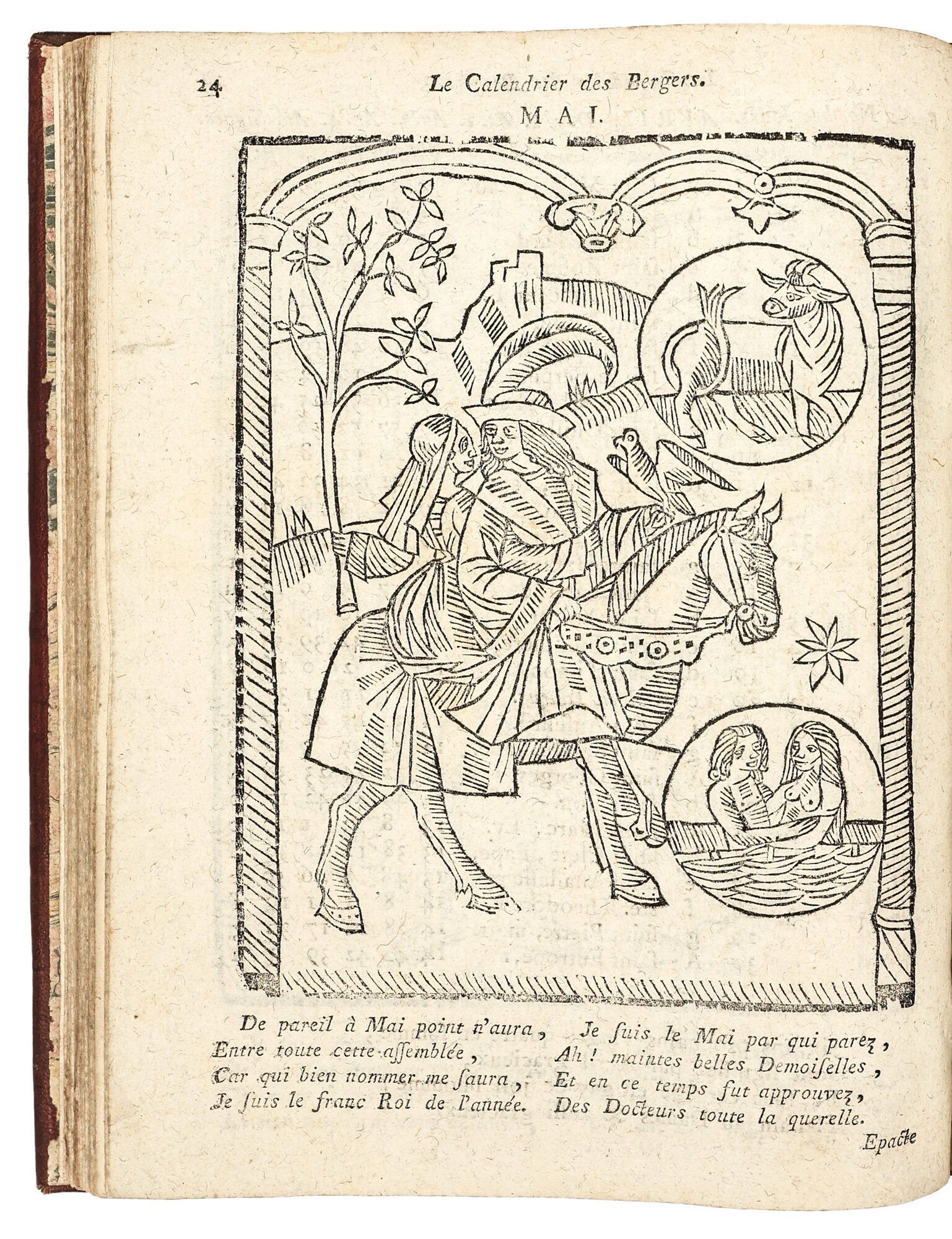
In 1610, the Troyes printer Noël Moreau began printing editions of the Danse, using copies of the woodcuts from the Parisian edition published by Marchant, 1490. Moreau added several new images at this point, including the Black man blowing a horn and carrying a spear. According to Mortimer, Moreau also used several original 15th c. blocks in this edition, e.g. (p. 26) the Punishment of the Sin of Luxury (also used in the "Compost et kalendrier des bergiers" of 1497...) and one of the Occupations of the Months (May) from the "Compost" of 1499.
In 1641, Nicolas Oudot's son (Nicolas Oudot II) printed a new edition, using Moreau's woodcuts. The last Oudot edition, with the text largely re-written, was printed by Nicolas II's son and widow in 1729, under the title "La Grande Danse Macabée (sic!)". It is this edition that would set the template for the next publishers, the Garniers.
The dating of this edition +/- 1773 is based on the dates during which the publisher is known to have been active. A number of early bibliographers, following the printed privilege on the last page, dated this edition to 1728, and numerous cataloguing records have this date. However, the publisher to whom the privilege was granted, Pierre Garnier, died in 1738. Further, Jean-Antoine Garnier, who is named as publisher on the title page, was active between 1766 and 1773. Alexis Socard ("Livres Populaires de Troyes", 1864, p. 126-127) tells us that the Garniers continued to print the book up until 1820 with the same imprint and privilege. See also: Corrard de Breban, "Recherches sur l'établissement et l'exercice de l'imprimerie à Troyes", Paris, 1873, 4th ed., p.73-74.
The additional texts:
Already in the late 15th c., editions of the Danse had begun to include supplemental texts. Those included in this edition are: "Le débat du corps et de l'ame", "La complainte de l'ame damnée", "L'exhortation de bien vivre et de bien mourir", "La vie du mauvais Antechrist", and "Les quinze signes du jugement." Of these, "La Vie du mauvais Antechrist" (pp. 70-72) is antisemitic. The Antichrist is born of incest by "Un paillard Juif abominable" who knows his own daughter carnally, is nursed by a whore before embarking on his career of destroying Christianity. He comes to Jerusalem where the Jews adore him (he himself is circumcised), but when he attempts a second Ascension from the Mount of Olives he is cast down into a sepulchre at the bottom of hell, and "dix millions ... De ces Juifs l'accompagneront". (Marquand Library)
Notes: Fairfax Murray 108; see a reproduction of one of J.A. Marchant's editions in Claudin's Hist. de l'Impr. I. 339 sq. A brief description of those edition(s), with some reproductions, is found in Nisard, Hist. des Livres populaires, 1854, II, 303 sq. A few of the images in these editions are new, e.g. (p. 26), the Punishment of the Sin of Luxury (which originated in the Compost of 1497, see No. 103 and reproduction in Claudin, I. 375) and one of the Occupations of the Months (May) from the Compost & Kal. Des Bergères, 1499 (see note to No. 103, and Claudin, I. 379 sq.) Langlois, Essai Historique, Philosophique et Pittoresque sur les Danses des Morts, I, p.340, 31; Douce, p.60, 26; Reichelt 96
II. The Shepherd's Calendar and Compost
Le Grand Calendrier et Compost des bergers
A Troyes chés P. Garnier, s.d. ca. 1776
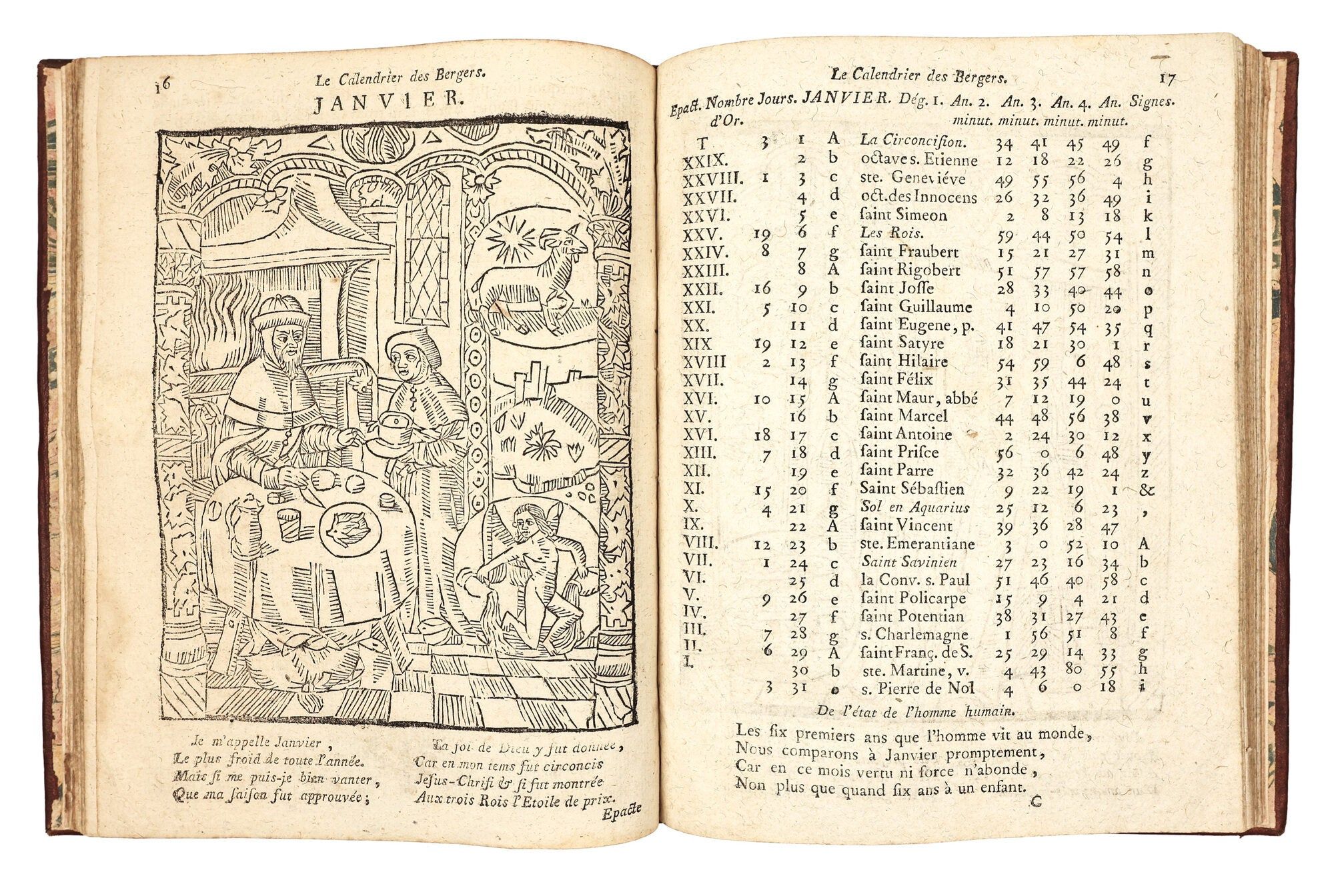
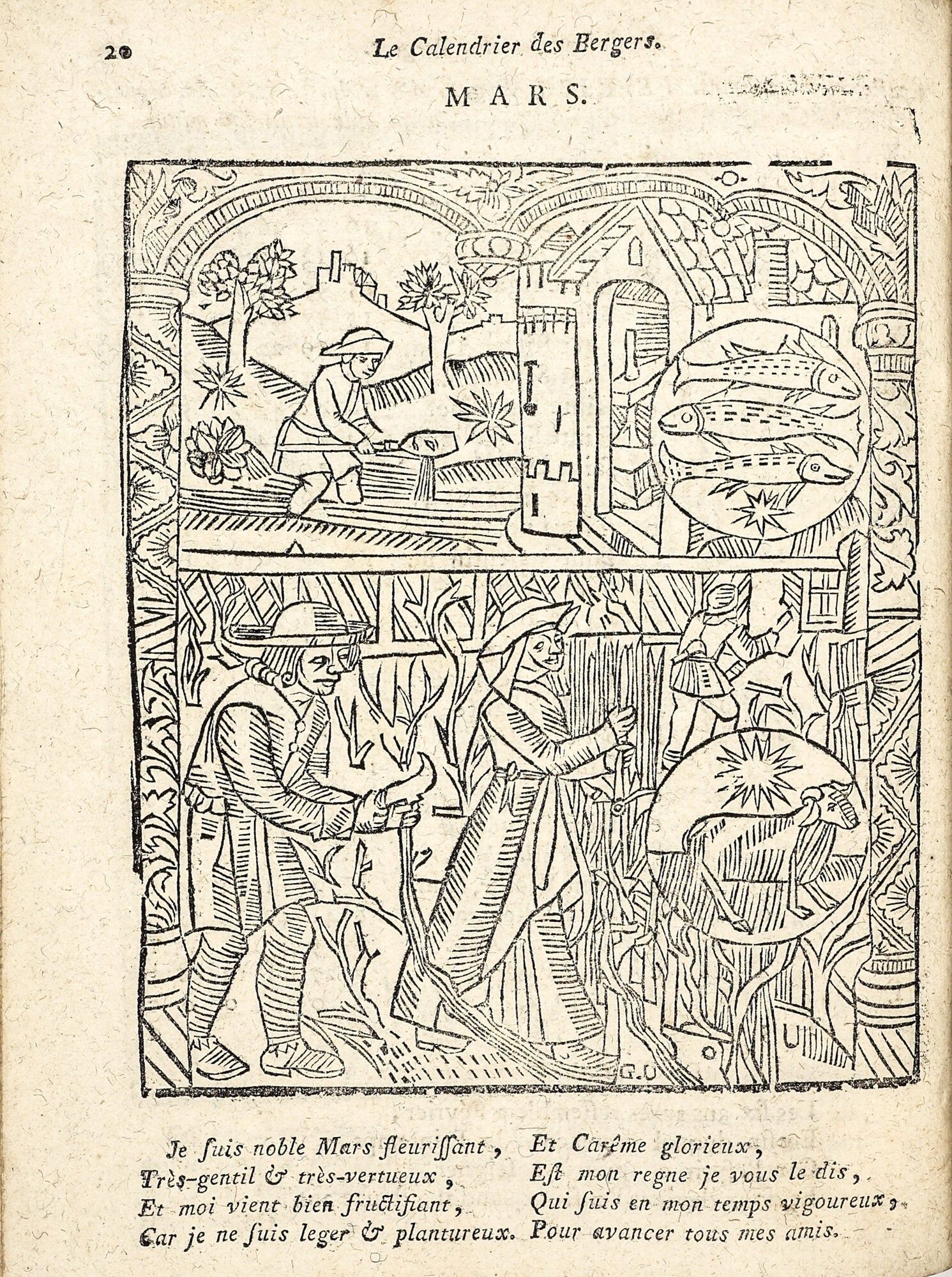
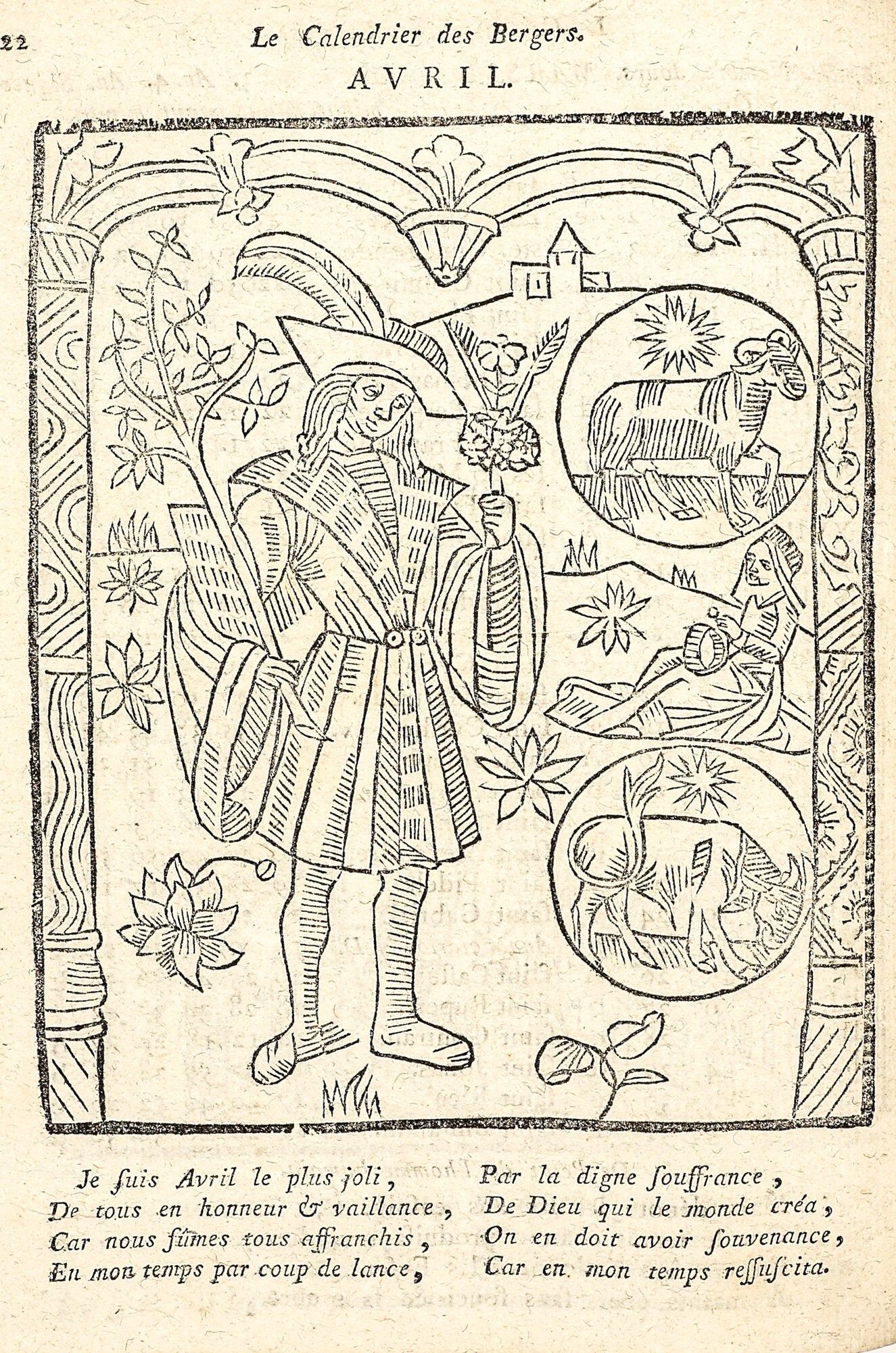
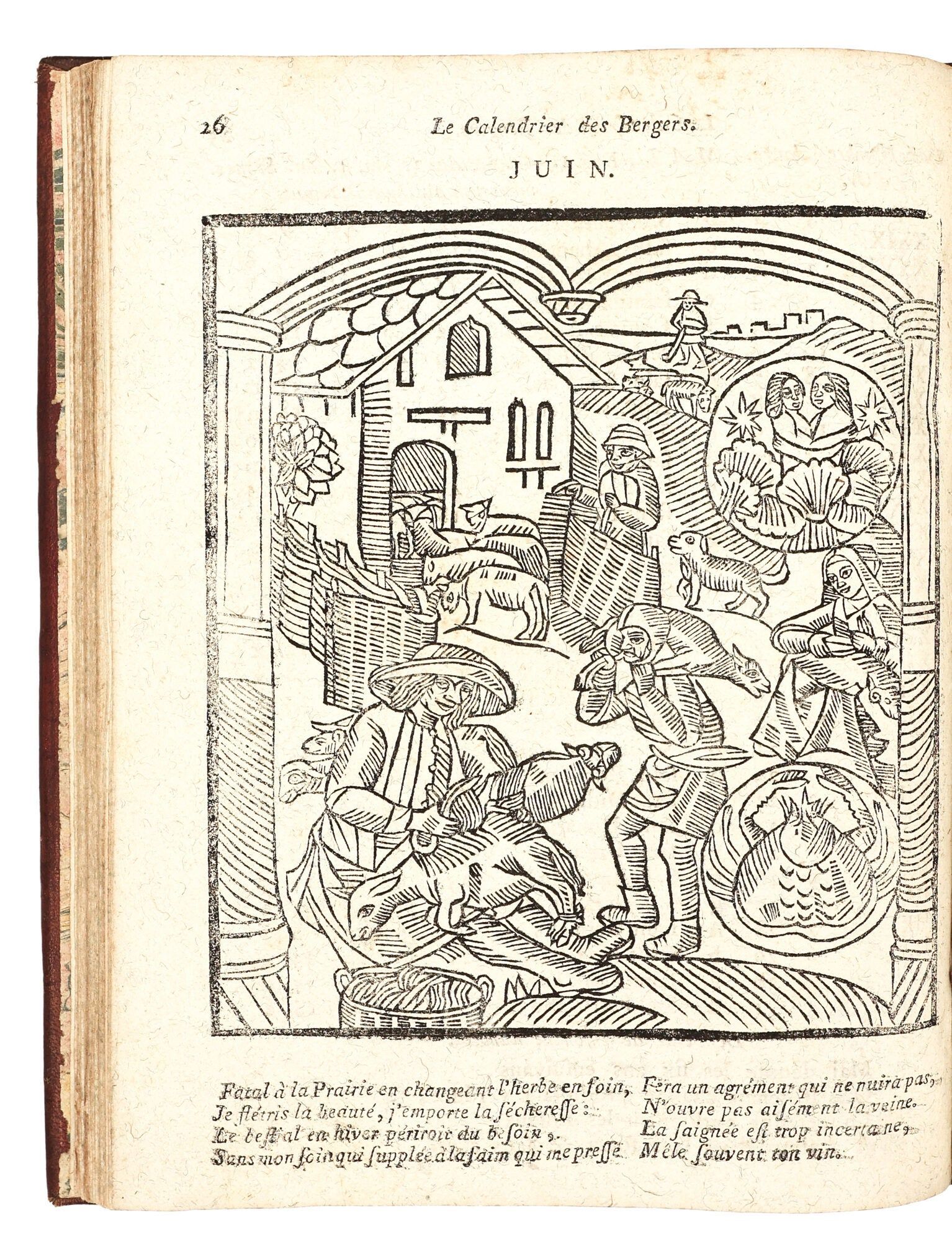
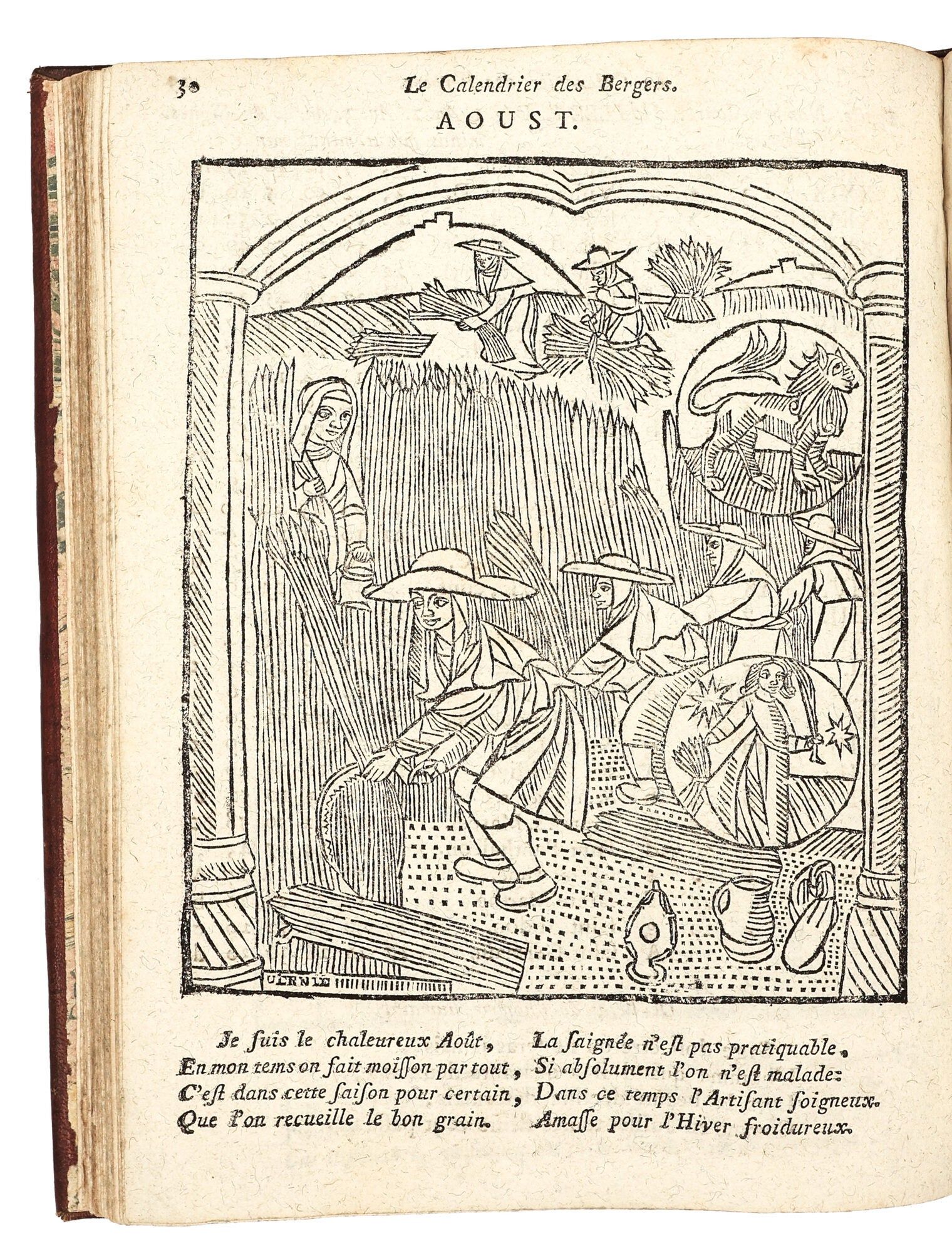
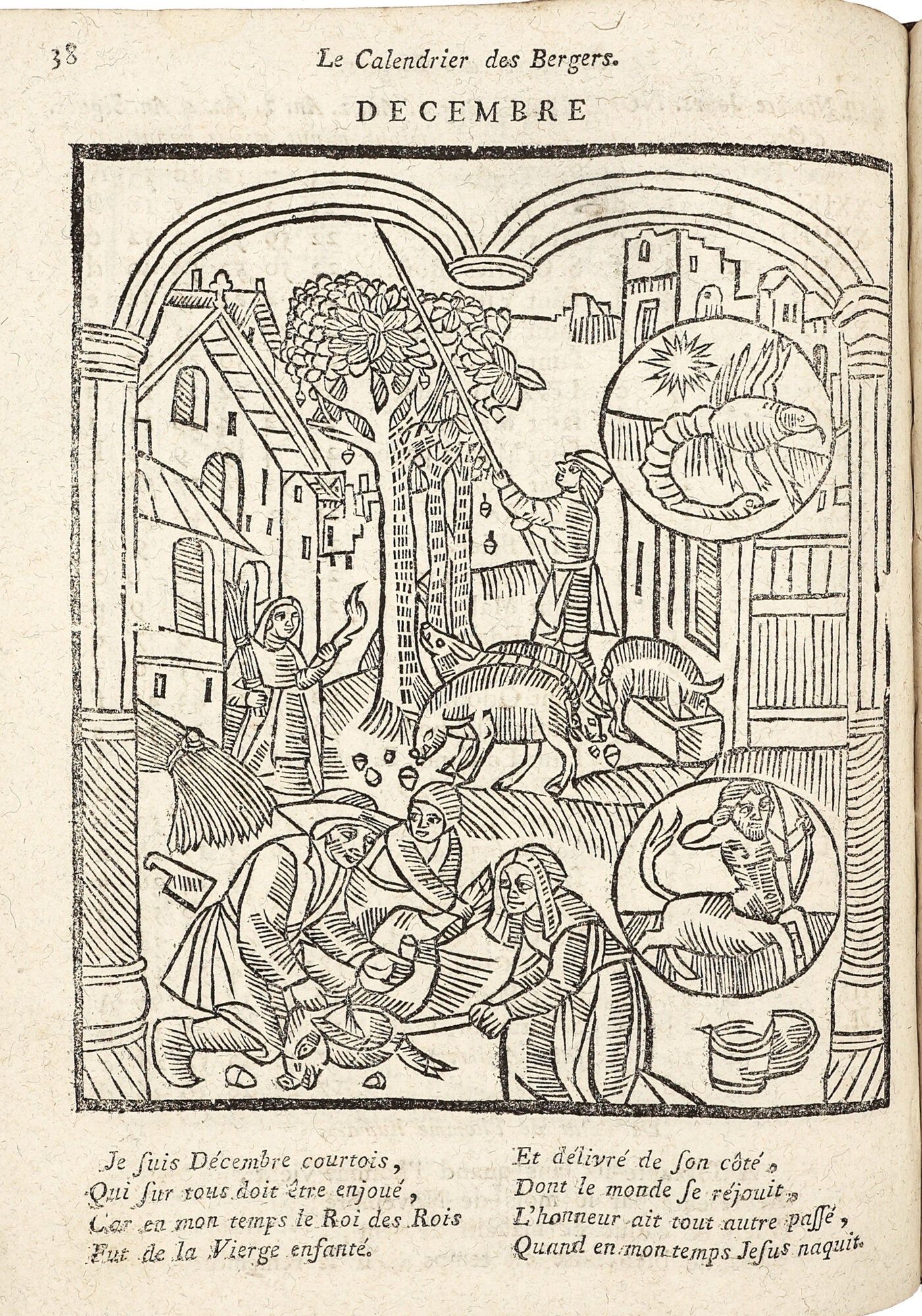
Illustrated with 49 woodcuts, including 12 full-page cuts, one for each month of the calendar. Like the Danse Macabre, many popular editions of this calendar were printed into the 18th c., particularly in Troyes and Paris.
The Kalendrier des Bergiers, an illustrated almanac and calendar, was first printed on 2 May 1491 by Guy Marchant. On 18 April 1493, he printed an entirely new edition under the title: "Compost et Kalendrier des Bergiers" and on 18 July, Marchant completed yet another edition, further expanded in both text and illustrations: "Here is the Compost et Kalendrier des Bergiers... to which many new items have been added, as those who look at it will be able to discover."
The book, remarkable for both its text and its illustrations, was a kind of encyclopedia of meteorological, agricultural, hygienic, and moral knowledge. "What we have here," says Monceaux, "is the first almanac ever printed in France, and one can readily understand the appeal of a work that addressed itself to the rural and popular masses and gave them advice of every kind on the health and hygiene of men and animals, on agriculture, on how to conduct oneself in this world with a view to arriving safely in the next - while at the same time giving those who could not read some basic knowledge of astronomy and the measurement of time via explanatory images."
The beautiful incunabula editions of the Shepherd's Calendar were transformed into popular booklets in the mid-17th century, notably by Nicolas Oudot. All the printers of the Bibliothèque bleue (Blue Library) published an edition of this Compost. "This undoubtedly means that the Compost was to be considered an introduction to popular literature, because it contained, presented-one might even say in their purest form the essential themes of the popular library." (G. Bollème, Les almanachs populaires, p. 41).
The book opens with a brief verse to the reader explaining the Gregorian calendar reform, followed by a prologue in which the shepherd-author presents his central argument: that the natural human lifespan is seventy-two years, demonstrable through a parallel between the twelve months of the year and twelve successive stages of human life, six years to each month. The heart of the book is the compost and the almanac proper. The compost material includes mnemonic verses and tables for calculating the moveable feasts of the church year - Easter, Pentecost, and the rest - along with the Golden Number (a nineteen-year cycle used to predict the date of the new moon), the Dominical Letter (a device for finding the day of the week on which any given feast falls), and Epact tables (the Epact being a number expressing the age of the moon on 1 January, used to calculate Easter under the Gregorian reform). The almanac proper gives each month its own full-page woodcut, a verse in the month's own voice describing its character and principal feasts, and a calendar table.
Part Two is devoted to the vices and the torments of Hell. It opens with the "Exhortation pour le Salut de l'Ame, faite par maniere de double ballade," a poem calling the reader to repentance. The moral center of this section is an extended account of the punishments awaiting sinners in Hell, introduced through the figure of Lazarus. It is illustrated with seven woodcuts depicting the punishments of the damned, one for each of the deadly sins - the proud hung from spinning wheels fitted with iron cramps; the envious plunged to the waist in a freezing river; the wrathful pierced by swords in a dark and blood-soaked hall; the slothful assailed by serpents; the avaricious submerged in cauldrons of boiling oil and molten metal; the gluttonous forced to eat toads and drink from a foetid river; the lustful tormented in pits of fire and sulphur.
Part Three - headed "La Troisième Partie du Compost des Bergers, qui est science salutaire, ou champ des vertus" - is devoted to religious and moral instruction. One notable section is the Field of Virtues ("Jardin ou Champ des Vertus"), which contains a poem of the soul adrift at sea guided by God to port, two shepherd songs, a verse catalogue of the pains of Hell, a long poem in the voice of a rotting corpse meditating on the vanity of earthly honor, a poem spoken by Death mounted on the pale horse of the Apocalypse, and the Tree of Virtues, with Humility as root and seven cardinal virtues - Charity, Faith, Hope, Prudence, Temperance, Justice, and Force - as its branches, each with named sub-branches.
Immediately following, and without a new Part heading, comes the Anatomical Man - a figure, illustrated with a woodcut, showing which of the twelve zodiac signs governs which part of the body, with the practical implication that one should not apply a surgical instrument to any part of the body while the moon is passing through its governing sign - followed by the four human complexions or temperaments (choleric, sanguine, phlegmatic, and melancholic), a month-by-month health regimen giving dietary and practical advice for each season, and a comprehensive phlebotomy guide treating every vein in the body from forehead to groin.
The book closes with the comic poem "Les débats des Gens d'Armes & d'une Femme contre un Limaçon," in which a woman armed with her distaff and two soldiers with their swords attempt to drive away a snail that has been eating her garden, while the snail defies them all by threatening them with its horns.
Le Grand Calendrier et Compost des bergers, composé par le berger de la Grande Montagne, Avec le Compôt naturel reformé selon le retranchement des dix jours, par le Pape Gregoire III. Ensemble la manière comme se doit gouverner le Berger pour empêcher qu'aucun Sorciers ne fassent mourir leurs troupeaux, avec toutes choses nécessaire pour se régler en leur art.
Troyes: Chez Jean-A. Garnier, Imp. Lib., No date [ca. 1776?]
Quarto: II. 144 pp. A-S4. TWO RARE EDITIONS. Bound in contemporary tanned sheep, the boards framed by a triple gold rule, the spine ruled in gold and with rampant lions tooled in the compartments. The Privilege at end is granted to Pierre Garnier, and dated 21 May 1728. It gives also a list of his other publications. Unusually fine copies, printed on delicate paper, of these works, which are rarely found in such nice condition, bound in a strictly contemporary binding. The bottom line of the first t.p. ("avec permission") has been shaved off. In the second work, leaf N1 has marginal stains; the last few leaves are lightly foxed.
The Dance of Death, "Les trois vifs et les Trois Morts", and the other accompanying texts are illustrated with 60 woodcuts of the Dance of Death copied from the original designs which appeared in the edition of the Danse Macabre of G. Marchant, 1490. That of the Moor on p. 32 may be a very close copy of the same subject in the Compost. Another version of it appears on p. 27 and is a very close copy of that in the Bradwardine (No. 64). N. B. - the two blocks of this subject appearing respectively on pp. 24 & 27 of the present Danse Macabre are not identical.
Two works bound together, both examples of important literary genres dating to the late-Medieval and early-Renaissance periods. The "Danse macabre" is a pictorial cycle and poem first painted at a Paris cemetery about 1425. Woodcuts copied from the Paris fresco, along with the accompanying verses, were first printed by Guy Marchant at Paris in 1485. "Le Grand Calendrier", an illustrated almanac and calendar, was first printed in 1491 by Guy Marchant. The book, remarkable for both its text and its illustrations, was a kind of encyclopedia of meteorological, agricultural, hygienic, and moral knowledge.
I. The Dance of Death
One of the earliest examples of the pictorial cycle and poem known as the Danse Macabre was painted between August 1424 and Lent 1425 in the arcades of the Cimetière des Saints-Innocents (Cemetery of the Holy Innocents) in Paris. These arcades, constructed as charniers to house bones from earlier mass burials, were demolished in 1669, along with their frescoes. The images of the Danse in this book were directly inspired by the Paris Danse.
Woodcuts of the Danse copied from the Paris fresco, along with the 67 verses that accompanied the images, were first printed by Guy Marchant at Paris in 1485, with woodcuts designed by Pierre le Rouge. While there were no women in the original Danse, in 1486 Marchant published an all-female version, "La Danse Macabre des Femmes". Later, Marchant united these two texts in the two-volume "Miroer Salutaire". While Marchant followed the sequence from the Cimetière des Saints-Innocents, he introduced numerous changes, adding new pictorial elements and verses, including 20 additional dancers and the woodcut of the four skeleton musicians.
From the 16th through the 18th centuries, editions of the Danse appeared outside of Paris, printed -with various changes- by French provincial printers in Lyon, Rouen, and Troyes. Over the years, the woodblocks used to print the illustrations in the various Paris editions, worn or damaged from repeated use (and in some instances lost), were re-cut, with the images reproduced with varying degrees of fidelity to the originals.
The printing history of the Danse in Troyes began in 1493, when Pierre le Rouge's woodblocks were acquired by his nephew, Nicolas le Rouge, who printed editions of the text into the 1530s. It is in Troyes that the woodcuts were first copied, and further changes were introduced by successive printers.
In 1610, the Troyes printer Noël Moreau began printing editions of the Danse, using copies of the woodcuts from the Parisian edition published by Marchant, 1490. Moreau added several new images at this point, including the Black man blowing a horn and carrying a spear. According to Mortimer, Moreau also used several original 15th c. blocks in this edition, e.g. (p. 26) the Punishment of the Sin of Luxury (also used in the "Compost et kalendrier des bergiers" of 1497...) and one of the Occupations of the Months (May) from the "Compost" of 1499.
In 1641, Nicolas Oudot's son (Nicolas Oudot II) printed a new edition, using Moreau's woodcuts. The last Oudot edition, with the text largely re-written, was printed by Nicolas II's son and widow in 1729, under the title "La Grande Danse Macabée (sic!)". It is this edition that would set the template for the next publishers, the Garniers.
The dating of this edition +/- 1773 is based on the dates during which the publisher is known to have been active. A number of early bibliographers, following the printed privilege on the last page, dated this edition to 1728, and numerous cataloguing records have this date. However, the publisher to whom the privilege was granted, Pierre Garnier, died in 1738. Further, Jean-Antoine Garnier, who is named as publisher on the title page, was active between 1766 and 1773. Alexis Socard ("Livres Populaires de Troyes", 1864, p. 126-127) tells us that the Garniers continued to print the book up until 1820 with the same imprint and privilege. See also: Corrard de Breban, "Recherches sur l'établissement et l'exercice de l'imprimerie à Troyes", Paris, 1873, 4th ed., p.73-74.
The additional texts:
Already in the late 15th c., editions of the Danse had begun to include supplemental texts. Those included in this edition are: "Le débat du corps et de l'ame", "La complainte de l'ame damnée", "L'exhortation de bien vivre et de bien mourir", "La vie du mauvais Antechrist", and "Les quinze signes du jugement." Of these, "La Vie du mauvais Antechrist" (pp. 70-72) is antisemitic. The Antichrist is born of incest by "Un paillard Juif abominable" who knows his own daughter carnally, is nursed by a whore before embarking on his career of destroying Christianity. He comes to Jerusalem where the Jews adore him (he himself is circumcised), but when he attempts a second Ascension from the Mount of Olives he is cast down into a sepulchre at the bottom of hell, and "dix millions ... De ces Juifs l'accompagneront". (Marquand Library)
Notes: Fairfax Murray 108; see a reproduction of one of J.A. Marchant's editions in Claudin's Hist. de l'Impr. I. 339 sq. A brief description of those edition(s), with some reproductions, is found in Nisard, Hist. des Livres populaires, 1854, II, 303 sq. A few of the images in these editions are new, e.g. (p. 26), the Punishment of the Sin of Luxury (which originated in the Compost of 1497, see No. 103 and reproduction in Claudin, I. 375) and one of the Occupations of the Months (May) from the Compost & Kal. Des Bergères, 1499 (see note to No. 103, and Claudin, I. 379 sq.) Langlois, Essai Historique, Philosophique et Pittoresque sur les Danses des Morts, I, p.340, 31; Douce, p.60, 26; Reichelt 96
II. The Shepherd's Calendar and Compost
Le Grand Calendrier et Compost des bergers
A Troyes chés P. Garnier, s.d. ca. 1776
Illustrated with 49 woodcuts, including 12 full-page cuts, one for each month of the calendar. Like the Danse Macabre, many popular editions of this calendar were printed into the 18th c., particularly in Troyes and Paris.
The Kalendrier des Bergiers, an illustrated almanac and calendar, was first printed on 2 May 1491 by Guy Marchant. On 18 April 1493, he printed an entirely new edition under the title: "Compost et Kalendrier des Bergiers" and on 18 July, Marchant completed yet another edition, further expanded in both text and illustrations: "Here is the Compost et Kalendrier des Bergiers... to which many new items have been added, as those who look at it will be able to discover."
The book, remarkable for both its text and its illustrations, was a kind of encyclopedia of meteorological, agricultural, hygienic, and moral knowledge. "What we have here," says Monceaux, "is the first almanac ever printed in France, and one can readily understand the appeal of a work that addressed itself to the rural and popular masses and gave them advice of every kind on the health and hygiene of men and animals, on agriculture, on how to conduct oneself in this world with a view to arriving safely in the next - while at the same time giving those who could not read some basic knowledge of astronomy and the measurement of time via explanatory images."
The beautiful incunabula editions of the Shepherd's Calendar were transformed into popular booklets in the mid-17th century, notably by Nicolas Oudot. All the printers of the Bibliothèque bleue (Blue Library) published an edition of this Compost. "This undoubtedly means that the Compost was to be considered an introduction to popular literature, because it contained, presented-one might even say in their purest form the essential themes of the popular library." (G. Bollème, Les almanachs populaires, p. 41).
The book opens with a brief verse to the reader explaining the Gregorian calendar reform, followed by a prologue in which the shepherd-author presents his central argument: that the natural human lifespan is seventy-two years, demonstrable through a parallel between the twelve months of the year and twelve successive stages of human life, six years to each month. The heart of the book is the compost and the almanac proper. The compost material includes mnemonic verses and tables for calculating the moveable feasts of the church year - Easter, Pentecost, and the rest - along with the Golden Number (a nineteen-year cycle used to predict the date of the new moon), the Dominical Letter (a device for finding the day of the week on which any given feast falls), and Epact tables (the Epact being a number expressing the age of the moon on 1 January, used to calculate Easter under the Gregorian reform). The almanac proper gives each month its own full-page woodcut, a verse in the month's own voice describing its character and principal feasts, and a calendar table.
Part Two is devoted to the vices and the torments of Hell. It opens with the "Exhortation pour le Salut de l'Ame, faite par maniere de double ballade," a poem calling the reader to repentance. The moral center of this section is an extended account of the punishments awaiting sinners in Hell, introduced through the figure of Lazarus. It is illustrated with seven woodcuts depicting the punishments of the damned, one for each of the deadly sins - the proud hung from spinning wheels fitted with iron cramps; the envious plunged to the waist in a freezing river; the wrathful pierced by swords in a dark and blood-soaked hall; the slothful assailed by serpents; the avaricious submerged in cauldrons of boiling oil and molten metal; the gluttonous forced to eat toads and drink from a foetid river; the lustful tormented in pits of fire and sulphur.
Part Three - headed "La Troisième Partie du Compost des Bergers, qui est science salutaire, ou champ des vertus" - is devoted to religious and moral instruction. One notable section is the Field of Virtues ("Jardin ou Champ des Vertus"), which contains a poem of the soul adrift at sea guided by God to port, two shepherd songs, a verse catalogue of the pains of Hell, a long poem in the voice of a rotting corpse meditating on the vanity of earthly honor, a poem spoken by Death mounted on the pale horse of the Apocalypse, and the Tree of Virtues, with Humility as root and seven cardinal virtues - Charity, Faith, Hope, Prudence, Temperance, Justice, and Force - as its branches, each with named sub-branches.
Immediately following, and without a new Part heading, comes the Anatomical Man - a figure, illustrated with a woodcut, showing which of the twelve zodiac signs governs which part of the body, with the practical implication that one should not apply a surgical instrument to any part of the body while the moon is passing through its governing sign - followed by the four human complexions or temperaments (choleric, sanguine, phlegmatic, and melancholic), a month-by-month health regimen giving dietary and practical advice for each season, and a comprehensive phlebotomy guide treating every vein in the body from forehead to groin.
The book closes with the comic poem "Les débats des Gens d'Armes & d'une Femme contre un Limaçon," in which a woman armed with her distaff and two soldiers with their swords attempt to drive away a snail that has been eating her garden, while the snail defies them all by threatening them with its horns.
Details
Title
La Grande Danse macabre des hommes et des femmes ; Historiée et renouvellée de vieux Gaulois, en langage le plus poli de notre temps [...] Avec Le débat du Corps & de l'Ame, La Complainte de l'Ame d'amnée, l'Exhortation de bien vivre & de bien mourir, La Vie du mauvais Ante Christ, Les quinze signes du Jugement
Author
[DANCE OF DEATH; SHEPHERD'S CALENDAR]
Binding
Hardcover
Condition
Fine
Publisher
chez Jean-Antoine Garnier, ca. 1766 to: Troyes
Date
1773