

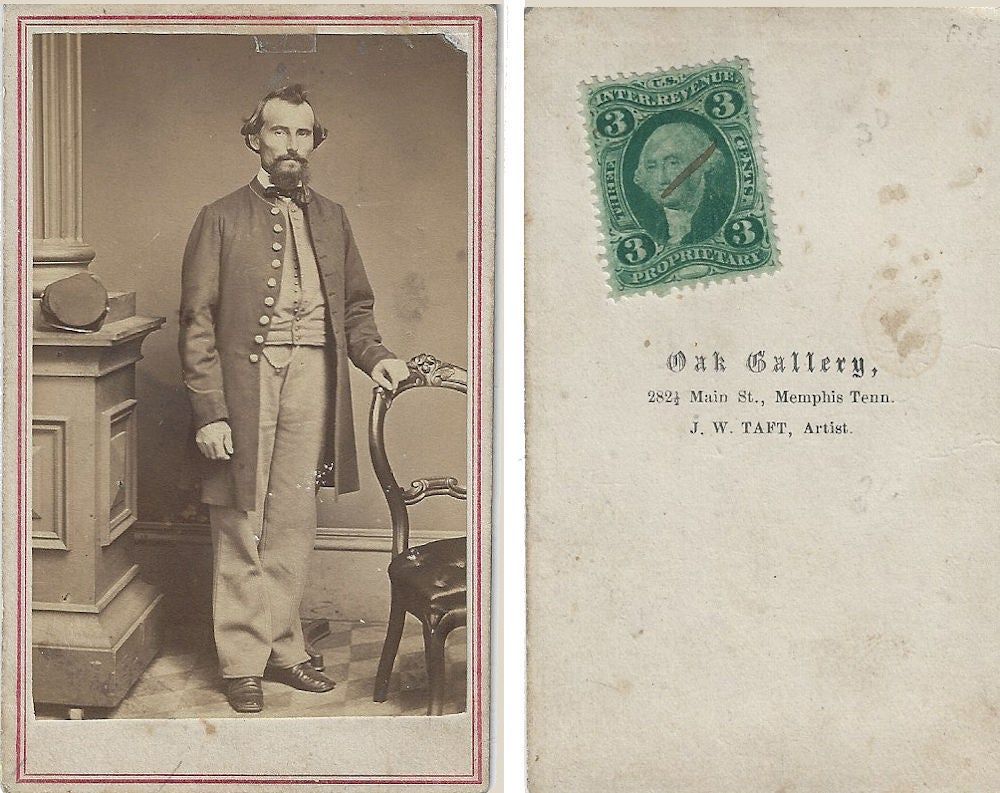
1864-1866 - CDV Photograph of a Union Soldier taken at the Oak Gallery taken at the Oak Galler in Memphis, Tennessee
- Cord-bound
- Memphis, Tennessee , 1866
The image shows an enlisted soldier wearing a 9-button, single-breasted, uniform frock coat. His kepi rests on a nearby column. Unidentified soldier.
The price of the revenue stamp indicates that his cdv would have sold for between 25 and 50 cents when new.
. Cartes-de-visite were first created to be used as calling cards by the French photographer, André-Adolphe-Eugène Disdéri, who patented the process in 1854. They became a world-wide fad that didn't wear off until around 1870 and were especially popular with American Civil War soldiers who wanted a memento of their service.The Oak Gallery, run by photographer J. W. Taft, was located at 282½ Main Street in Memphis. Taft was a popular Civil War photographer in the city who specialized in military photographs, especially soldiers stationed at Fort Pickering. Since there's no general information on this photographer, it is assumed that he came to Memphis near the end of the war specifically to make money photographing the occupying Union troops.
Beginning on 1 August 1864, the Internal Revenue Act charges a tax on all photographs in order to raise funds to support the cost of the Civil War. This became known as the Sun-Picture Tax because it was imposed on all images created by the use of daylight, specifically photographs, daguerreotypes, and ambrotypes. Rates were applied based on the retail price of the image. When a customer had paid the tax, a photographer was to affix a revenue stamp to the reverse of the image and cancel it with his signature and date. Most often, photographers simply drew a line across the stamp to preclude its reuse. The act was repealed on 1 August 1866.
(For more information, see "Cabinet Card Photos and the Historic Memphis Photographers" at the Historic Memphis website.)
.Details
Title
1864-1866 - CDV Photograph of a Union Soldier taken at the Oak Gallery taken at the Oak Galler in Memphis, Tennessee
Binding
Cord-bound
Condition
Very Good
Publisher
Memphis, Tennessee
Date
1866