

Photograph of Frank Lloyd Wright
- SIGNED
- New York: np, 1931
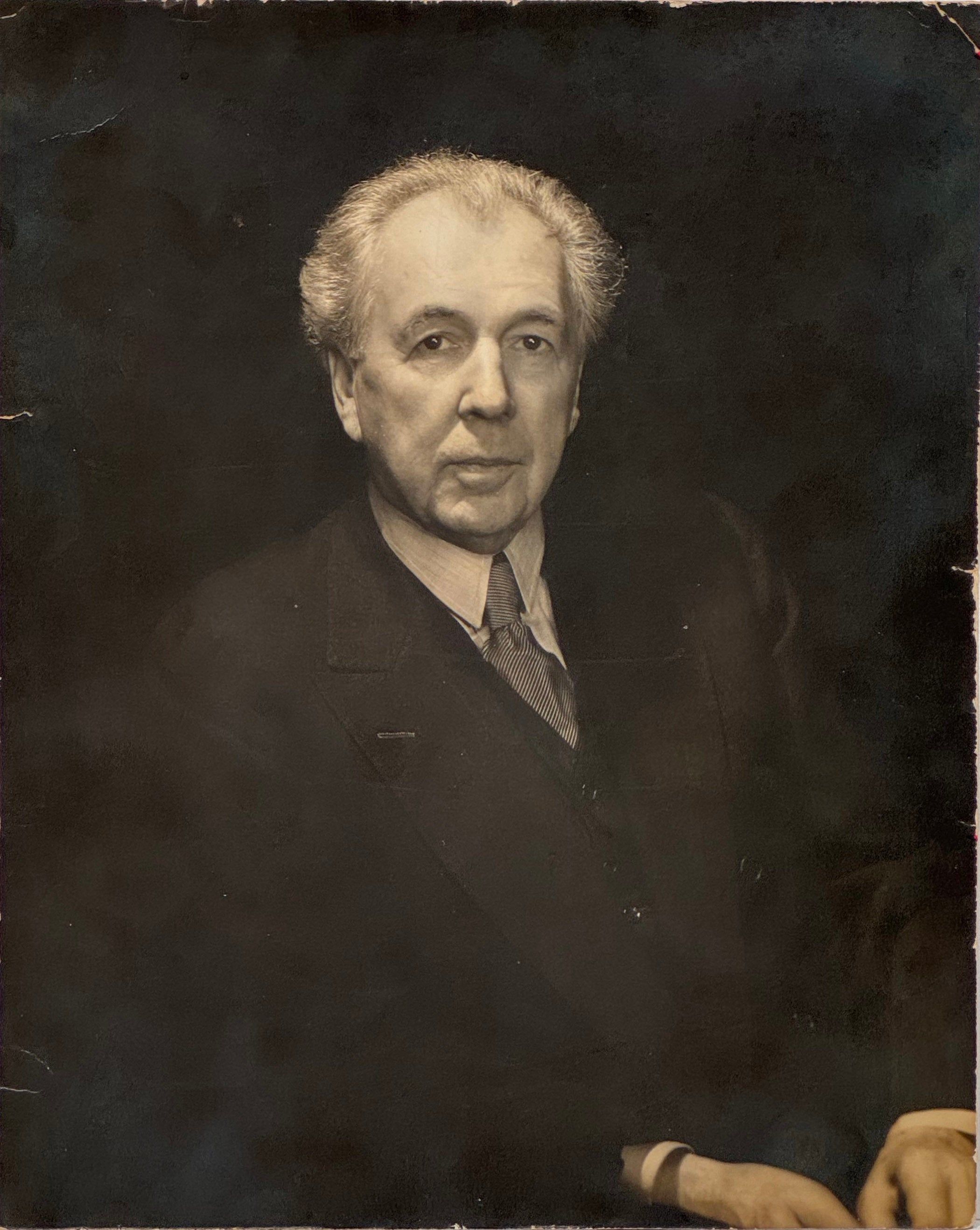
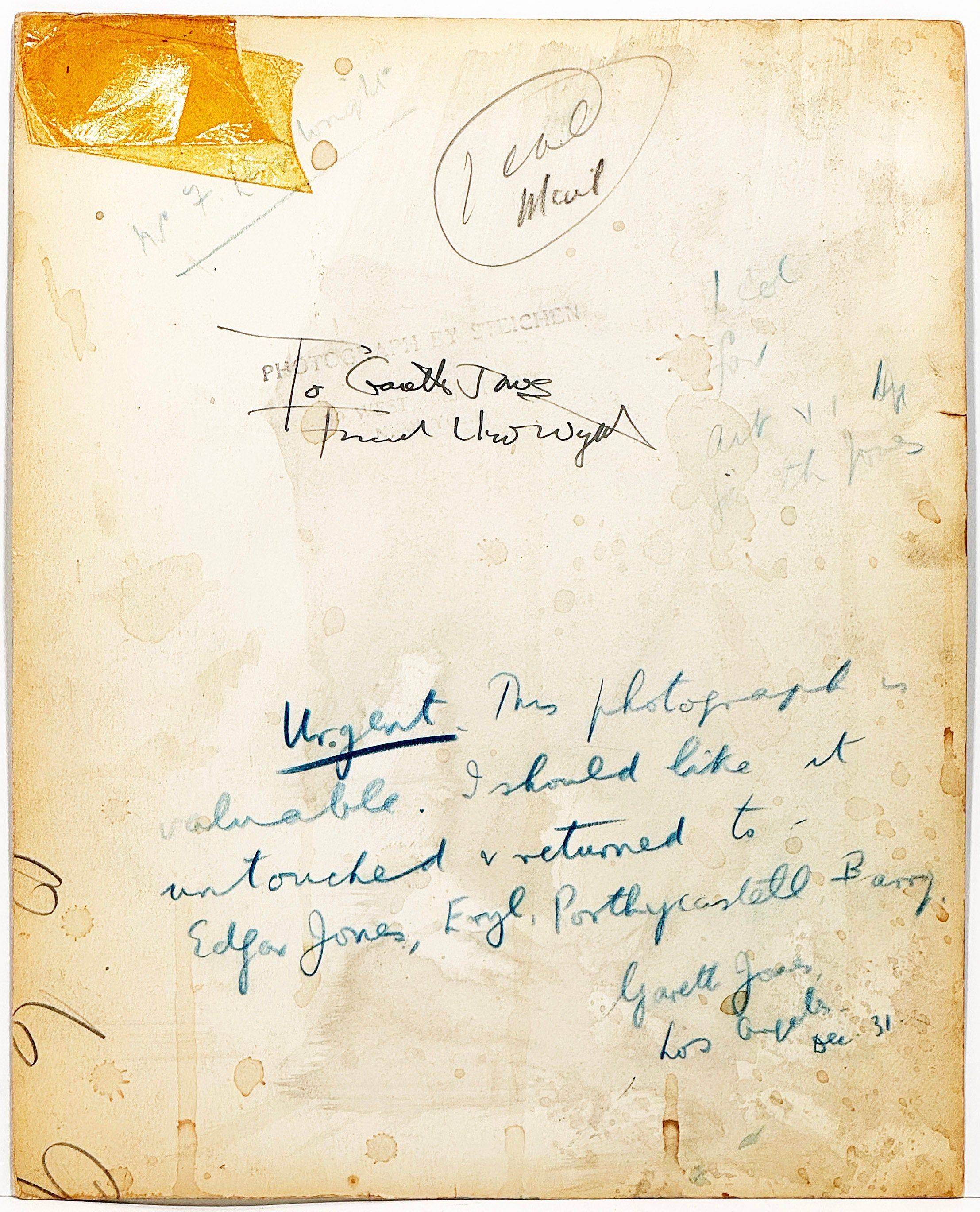
New York: np, 1931. first edition. Very Good. Edward Steichen. EXCEEDINGLY RARE AND IMPORTANT PHOTOGRAPH OF FRANK LLOYD WRIGHT BY EDWARD STEICHEN; INSCRIBED BY WRIGHT TO WELSH JOURNALIST GARETH JONES. INSCRIBED BY WRIGHT ON VERSO: "To Gareth Jones / Frank Lloyd Wright". Also with Steichen's New York Studio stamp (80 W. 40th Street) and a signed autograph note by Gareth Jones: "Urgent. This photograph is valuable. I should like it untouched and returned to Edgar Jones, Eryl, Porthycastell Barry. Gareth Jones Los Angeles Dec. 31". With additional editorial markings.
A remarkable vintage Steichen portrait of Frank Lloyd Wright preserving, within a single photograph, two distinct historical encounters separated by several years: first, Wright's carefully managed media rehabilitation campaign of 1931-32 conducted through Edward Steichen's studio portraiture; and second, the celebrated late-1934 Taliesin meeting between Wright and the Welsh journalist Gareth Jones, whose subsequent writings transformed the architect into a near-mythic figure for British readers.
The photograph is from Steichen's important early-1930s sitting with Wright, undertaken during a period in which the architect was consciously attempting to rehabilitate and reshape his public image. Contemporary accounts make clear that Wright regarded press photography and publication strategy as central to his professional "comeback" efforts of the early 1930s. Steichen - then perhaps the most influential portrait photographer in America - became an ideal collaborator in that effort, producing the now-iconic sequence of Wright portraits that helped define Wright as a man of great stature and historical importance.
No vintage prints from this Steichen sitting appear to have entered the market. Surviving examples seem to reside almost entirely within institutional or archival collections. The canonical frontal pose from the session is preserved in the collections of the Smithsonian National Portrait Gallery and the Harvard Art Museums, both descending from Steichen's own estate. The present photograph represents a variant pose from the same sitting: Wright appears in identical attire but rendered in dramatically sculptural lighting, emerging from darkness with an intensity absent from the more formal institutional images.
Unlike the Harvard and Smithsonian prints, which remained within Steichen's archive, the present print must have been one of very few to have been given by Steichen to Wright, who then presented it to Gareth Jones.
Jones - the brilliant Welsh journalist later murdered after exposing Stalin's Ukrainian famine - became deeply fascinated by Wright. In late 1934, Jones visited him at Wright's Wisconsin estate, Taliesin, interviewing him for an intended article for the Welsh newspaper The Western Mail where Jones worked. Jones viewed Wright not merely as an architect but as a transformative cultural force and fellow Welshman of global significance. His article, appearing in The Western Mail on February 8, 1935, described Wright in glowing terms, perhaps even with a touch of awe. Wright was, according to Jones, a "revolutionary and poetic architect," "one of the very greatest figures of this time," who is "a dreamer and a builder who thinks in terms of centuries."
It must have been during Jones's Taliesin visit that Wright presented him with the present Steichen print, personally signing and inscribing it to him on the back. The chronology is unusually precise: Jones's manuscript notation on the verso is dated "Dec 31" (we assume 1934), only weeks before publication of his February 8 article. The editorial markings on the back of the photo indicate that this photo was almost certainly the one used for the published portrait of Wright accompanying the article.
The verso of the photograph is rich with information and gives evidence for the sequence of events: Wright's inscription to Jones overlays Steichen's studio stamp; Jones then adds urgent manuscript instructions requesting that the photograph be returned "untouched" to his family home in Barry, South Wales, noting explicitly, "This photograph is valuable"; editorial and production markings indicate handling within the offices of The Western Mail in preparation for publication.
In the 1980s, the photograph was acquired by the distinguished Welsh architect and educator Dewi Prys-Thomas, one of the central figures in the development of modern Welsh architecture. The photograph remained, then, within a lineage of Welsh intellectual and architectural modernism extending from Wright himself through Gareth Jones and into the architectural culture of postwar Wales.
----------
Vintage gelatin silver print, c.1931-32, inscribed by Wright to Gareth Jones in late 1934. 23 x 18 cm. Steichen's studio stamp on verso. Signed and inscribed by Frank Lloyd Wright to Gareth Jones; additionally bearing extensive contemporary manuscript and editorial annotations relating to handling and publication. Image with some spots of soiling and imperfections almost exclusively seen in raking light; light wear at edges. Verso with old tape at upper left corner, and soiling and markings indicating signs of use.
A BEAUTIFUL PHOTOGRAPH WITH AN IMPORTANT PROVENANCE, MARKING A CRITICAL MOMENT IN WRIGHT'S CAREER.
A remarkable vintage Steichen portrait of Frank Lloyd Wright preserving, within a single photograph, two distinct historical encounters separated by several years: first, Wright's carefully managed media rehabilitation campaign of 1931-32 conducted through Edward Steichen's studio portraiture; and second, the celebrated late-1934 Taliesin meeting between Wright and the Welsh journalist Gareth Jones, whose subsequent writings transformed the architect into a near-mythic figure for British readers.
The photograph is from Steichen's important early-1930s sitting with Wright, undertaken during a period in which the architect was consciously attempting to rehabilitate and reshape his public image. Contemporary accounts make clear that Wright regarded press photography and publication strategy as central to his professional "comeback" efforts of the early 1930s. Steichen - then perhaps the most influential portrait photographer in America - became an ideal collaborator in that effort, producing the now-iconic sequence of Wright portraits that helped define Wright as a man of great stature and historical importance.
No vintage prints from this Steichen sitting appear to have entered the market. Surviving examples seem to reside almost entirely within institutional or archival collections. The canonical frontal pose from the session is preserved in the collections of the Smithsonian National Portrait Gallery and the Harvard Art Museums, both descending from Steichen's own estate. The present photograph represents a variant pose from the same sitting: Wright appears in identical attire but rendered in dramatically sculptural lighting, emerging from darkness with an intensity absent from the more formal institutional images.
Unlike the Harvard and Smithsonian prints, which remained within Steichen's archive, the present print must have been one of very few to have been given by Steichen to Wright, who then presented it to Gareth Jones.
Jones - the brilliant Welsh journalist later murdered after exposing Stalin's Ukrainian famine - became deeply fascinated by Wright. In late 1934, Jones visited him at Wright's Wisconsin estate, Taliesin, interviewing him for an intended article for the Welsh newspaper The Western Mail where Jones worked. Jones viewed Wright not merely as an architect but as a transformative cultural force and fellow Welshman of global significance. His article, appearing in The Western Mail on February 8, 1935, described Wright in glowing terms, perhaps even with a touch of awe. Wright was, according to Jones, a "revolutionary and poetic architect," "one of the very greatest figures of this time," who is "a dreamer and a builder who thinks in terms of centuries."
It must have been during Jones's Taliesin visit that Wright presented him with the present Steichen print, personally signing and inscribing it to him on the back. The chronology is unusually precise: Jones's manuscript notation on the verso is dated "Dec 31" (we assume 1934), only weeks before publication of his February 8 article. The editorial markings on the back of the photo indicate that this photo was almost certainly the one used for the published portrait of Wright accompanying the article.
The verso of the photograph is rich with information and gives evidence for the sequence of events: Wright's inscription to Jones overlays Steichen's studio stamp; Jones then adds urgent manuscript instructions requesting that the photograph be returned "untouched" to his family home in Barry, South Wales, noting explicitly, "This photograph is valuable"; editorial and production markings indicate handling within the offices of The Western Mail in preparation for publication.
In the 1980s, the photograph was acquired by the distinguished Welsh architect and educator Dewi Prys-Thomas, one of the central figures in the development of modern Welsh architecture. The photograph remained, then, within a lineage of Welsh intellectual and architectural modernism extending from Wright himself through Gareth Jones and into the architectural culture of postwar Wales.
----------
Vintage gelatin silver print, c.1931-32, inscribed by Wright to Gareth Jones in late 1934. 23 x 18 cm. Steichen's studio stamp on verso. Signed and inscribed by Frank Lloyd Wright to Gareth Jones; additionally bearing extensive contemporary manuscript and editorial annotations relating to handling and publication. Image with some spots of soiling and imperfections almost exclusively seen in raking light; light wear at edges. Verso with old tape at upper left corner, and soiling and markings indicating signs of use.
A BEAUTIFUL PHOTOGRAPH WITH AN IMPORTANT PROVENANCE, MARKING A CRITICAL MOMENT IN WRIGHT'S CAREER.
Details
Title
Photograph of Frank Lloyd Wright
Author
WRIGHT, FRANK LLOYD; STEICHEN, EDWARD; JONES, GARETH
Condition
Very Good
Publisher
np: New York
Date
1931
Edition
first edition