

WINE, WOMEN, AND SONG: MEDIEVAL LATIN STUDENTS' SONGS
- London: Chatto and Windus, 1884
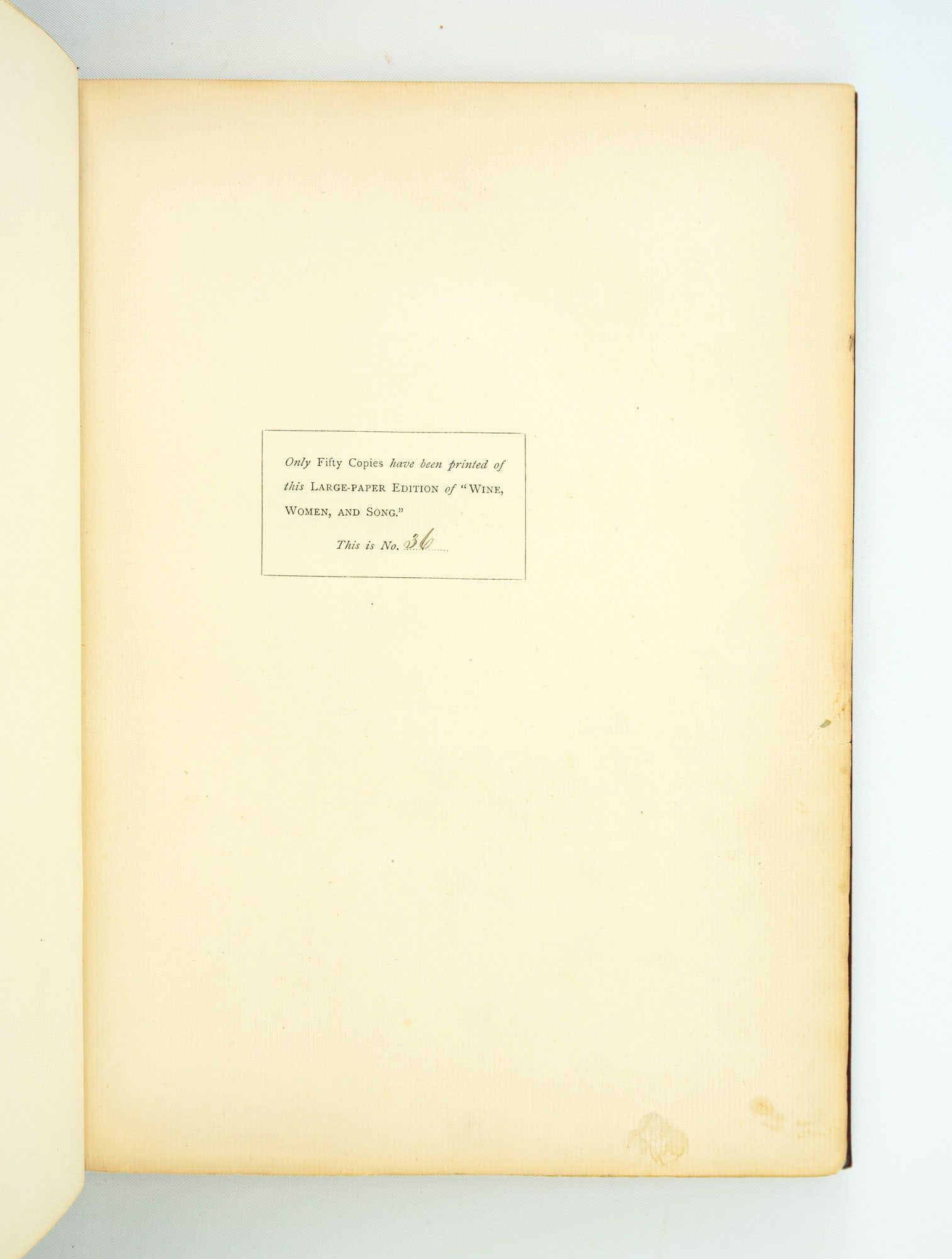
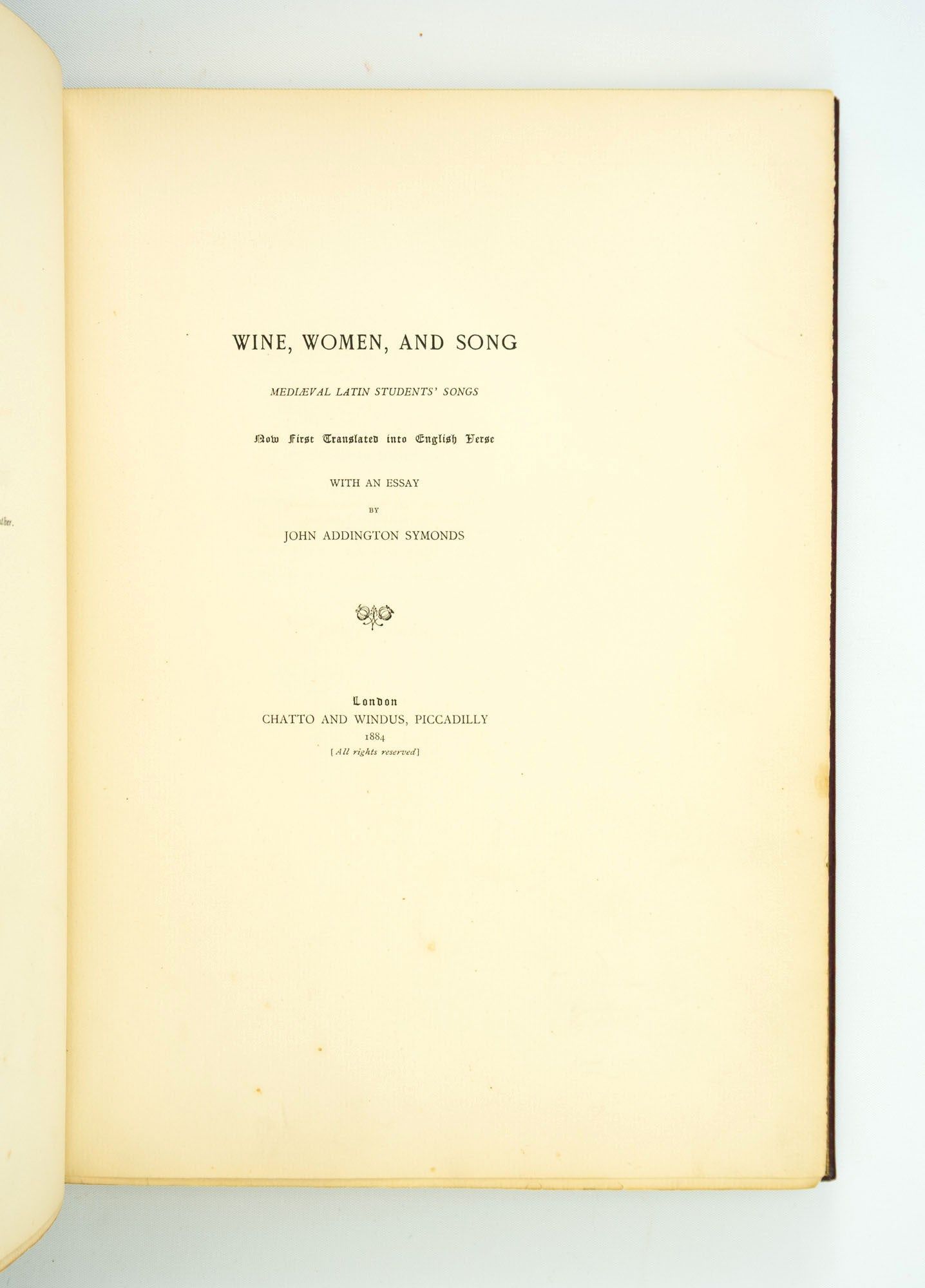
London: Chatto and Windus, 1884. No. 36 OF 50 LARGE PAPER COPIES. 283 x 207 mm. (11 1/4 x 8 1/4"). 4 p.l., 183, [1] pp.With a preface and explanatory notes by John Addington Symonds.
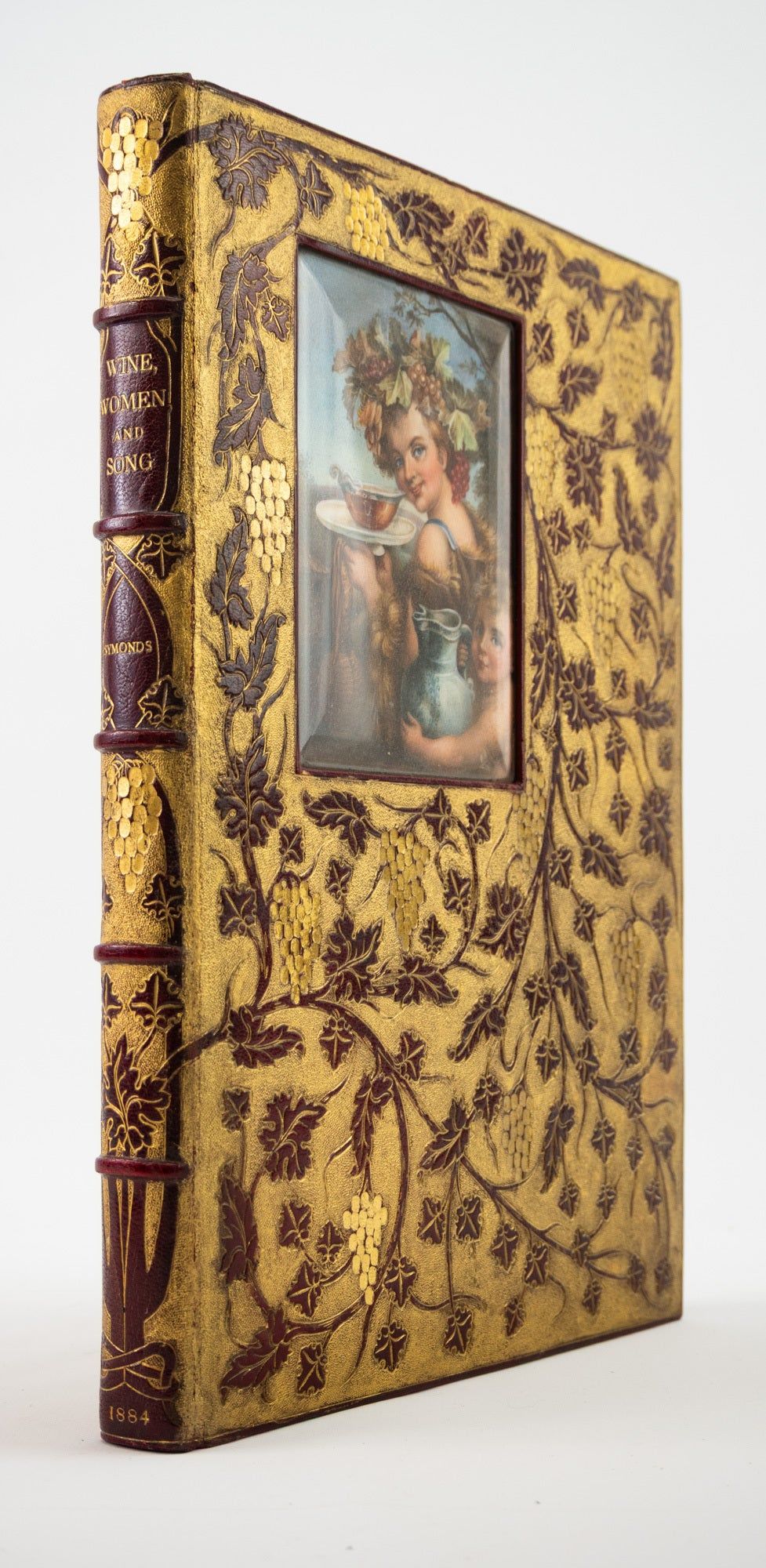
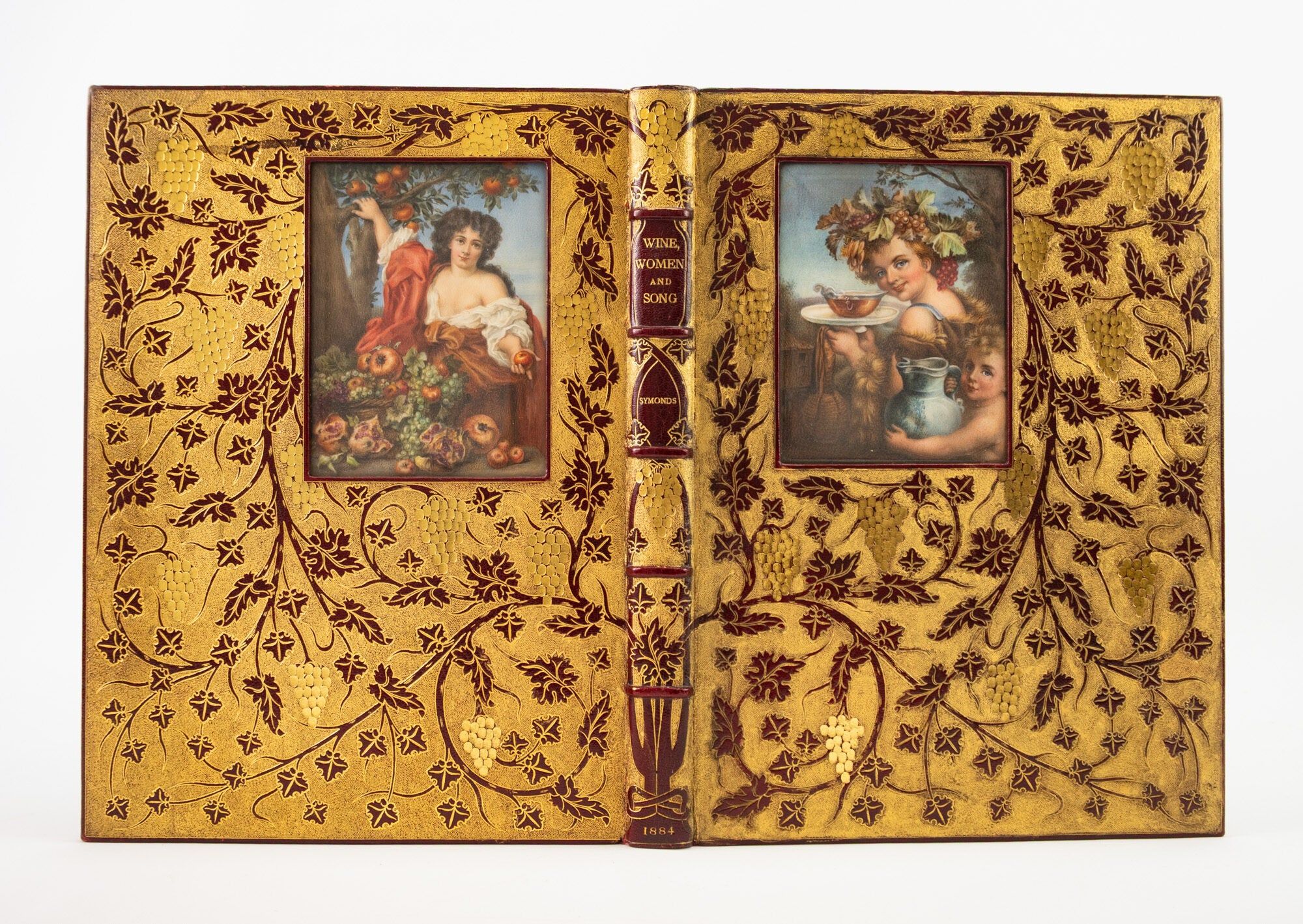
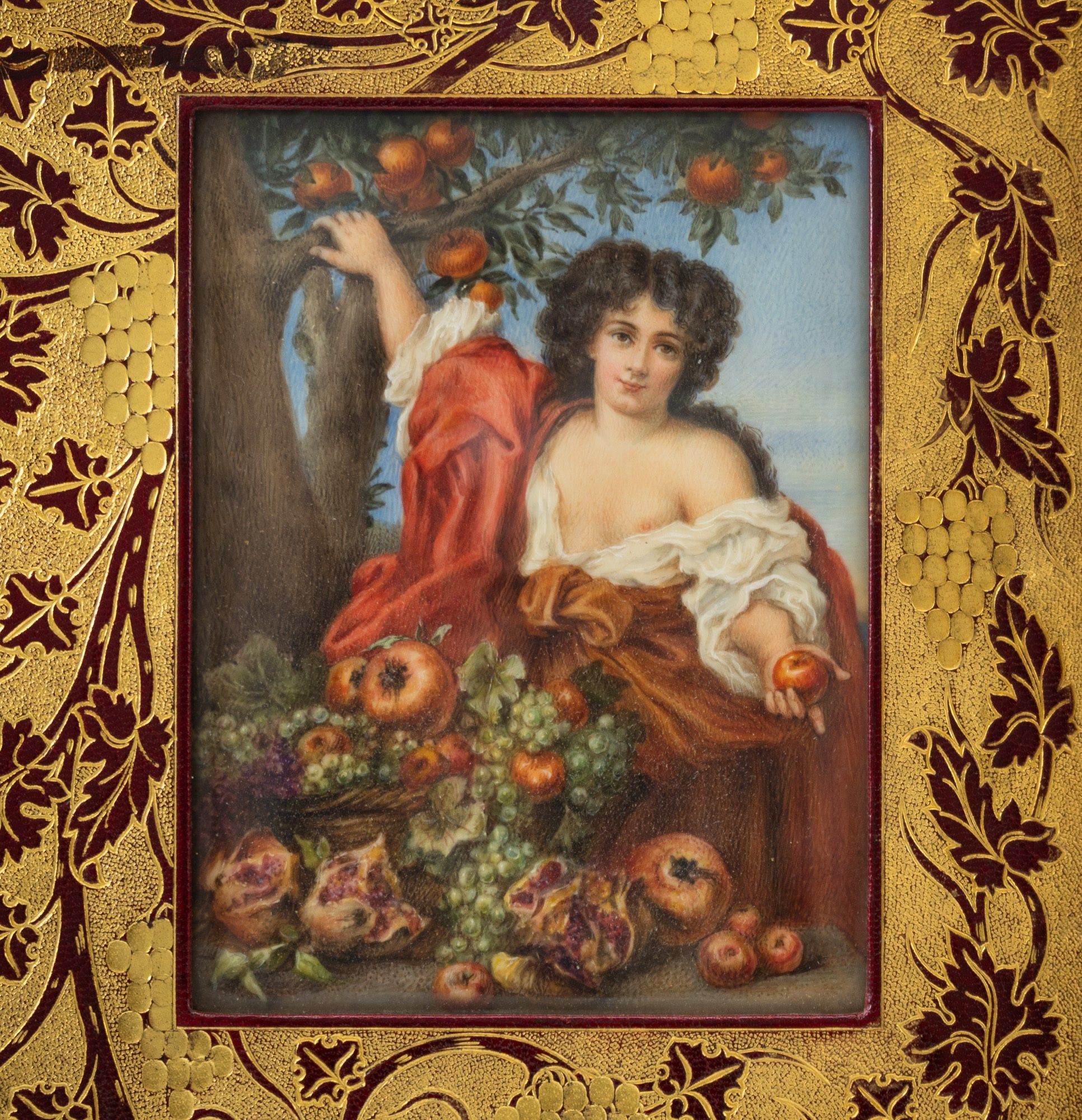
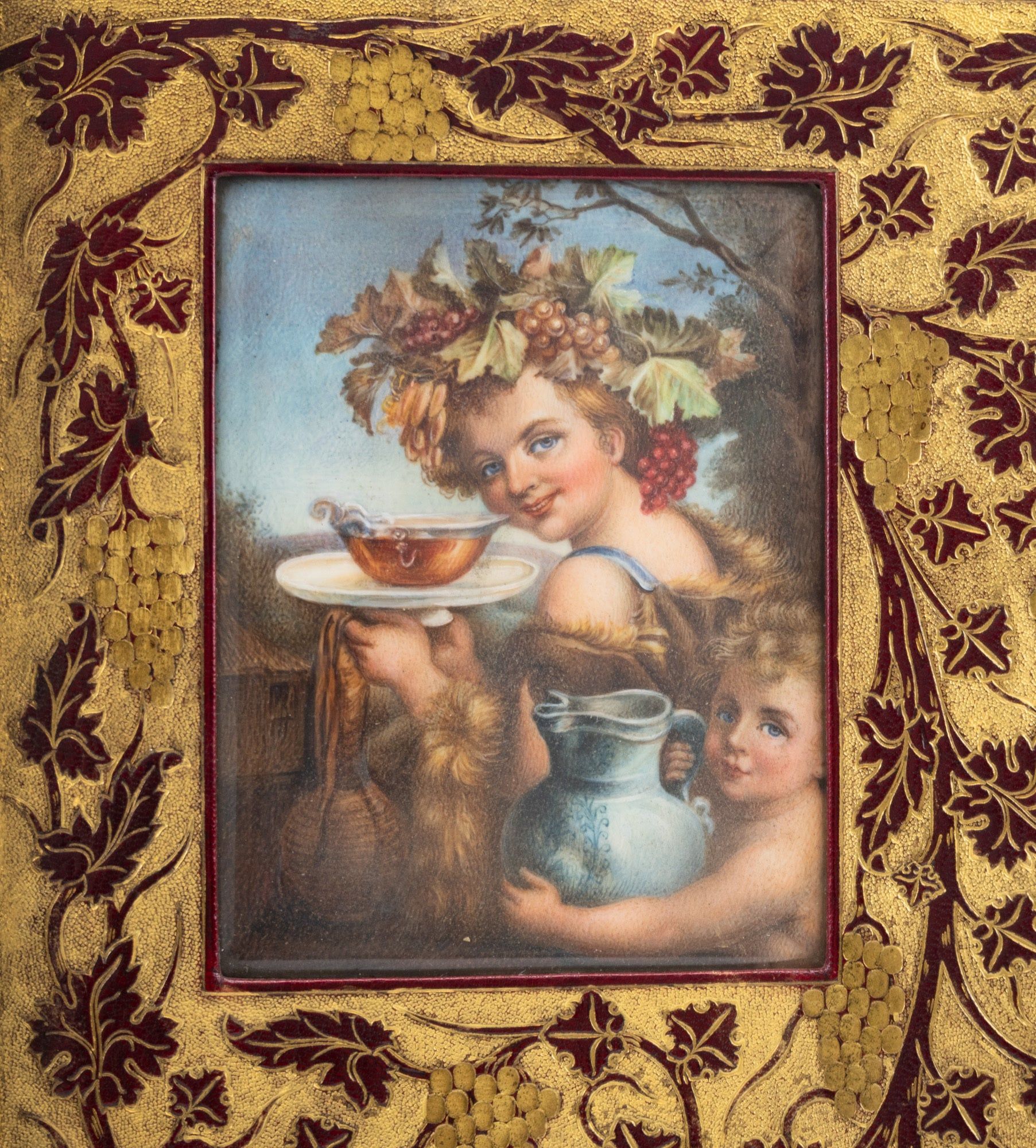
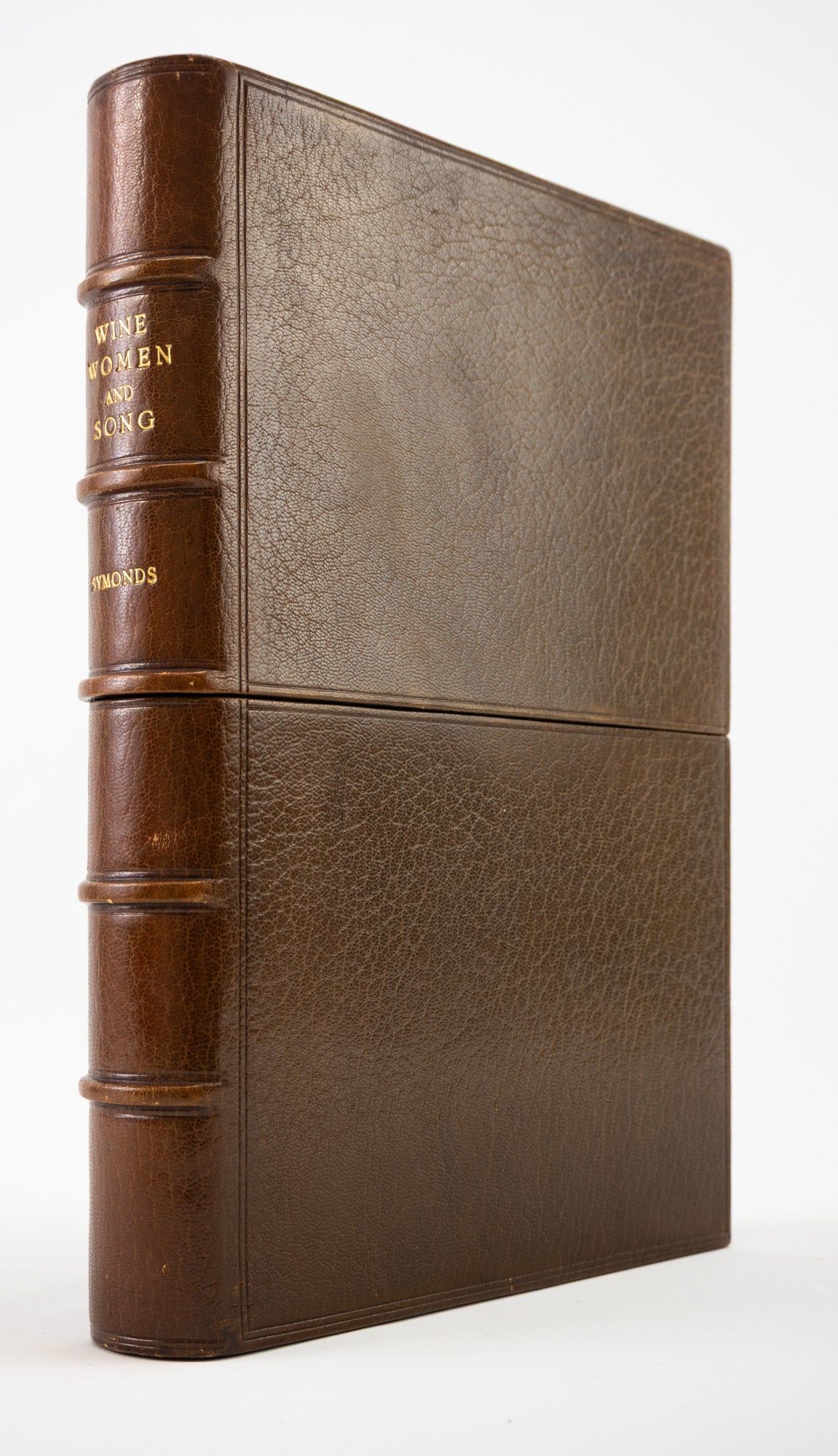
SPLENDID CRIMSON MOROCCO COSWAY BINDING BY RIVIERE & SON from desgins by J. H. STONEHOUSE (stamp-signed on front turn-in), the morocco very densely stippled with gold, as a background from an allover design of grapevines, springing from a base at the foot of the spine and swirling up the spine and across both covers, the branches laden with clusters of golden fruit, the upper left quadrant of each cover with a large (112 x 86 mm.) HAND-PAINTED MINIATURE UNDER GLASS BY MISS C. B. CURRIE (stamp-signed on rear turn-in), the miniature on the front cover a replica of Guido Reni's painting Bacchus, that on rear cover reproducing Maratta's The Fruit Picker, raised bands, two spine panels with gilt lettering framed by grapevines, turn-ins framed by gilt fillets and wide band of stippling, olive green watered silk endleaves, top edge gilt, other edges untrimmed (gold lightly retouched along front joint). Housed in the original chamois-lined honey-brown morocco pull-off case by Riviere & Son. A Large Paper Copy. Henry Sotheran Illustrated Catalogue No. 41 of Beautiful Cosway Bindings with Miss Currie's World-Famous Miniatures (1913), reproduced in Ratcliffe's Cosway Bindings, volume I. A tiny bit of wear just showing at the top of rear joint, beginning of text with isolated trivial finger smudges, but A VERY FINE COPY inside and out, the text with gigantic margins, the binding brilliant with gold, and the miniatures in perfect condition.
Containing a selection of 12th and 13th century songs mocking the sanctimonious and praising riotous living, this Ultra-Large Paper edition of "Wine, Women, and Song" is offered here in a splendid example of a so-called Cosway binding, one that appropriately embodies opulence and celebration, and one that features the work of the most famous painter to collaborate on Cosway bindings. The satirical verses here were composed in Latin by a wandering group of students and young clerics known as the Goliards. Primarily made up of younger sons from wealthy families forced into careers in the church by the laws of primogeniture, these rebellious youths had little interest in an ascetic religious life, and so took to the roads of England, France, and Germany as bands of singers and entertainers. Their songs mock Church hypocrisies and celebrate the sensual pleasures of a worldly existence. The Cosway style of binding, with painted miniatures inlaid in handsome morocco, apparently originated with the London bookselling firm of Henry Sotheran about 1909, the year G. C. Williamson's book entitled "Richard Cosway" was remaindered by Sotheran and presumably given this special decorative treatment. The name "Cosway" then was used to describe any book so treated, whatever its subject. Our copy was splendidly produced by the widely-recognized triumvirant of Cosway binding partners: Riviere, Stonehouse, and Currie. Specifically, finely painted miniatures on Cosway bindings were executed by Caroline Billin Currie (1849-1940) from 1910 until her death, creating such paintings for the bookseller Sotheran's, usually (as here) from designs by J. H. Stonehouse for bindings executed (again, as here) by the long-established binders Riviere. In their 1913 catalogue, Sotheran's described the present binding as a "beautiful example" (and offered it for sale at the considerable sum of £78). The portraits gracing Cosway-style bindings vary greatly in their level of achievement; Miss Currie's paintings are universally acknowledged as the very best. And whereas the majority of Cosway paintings (whether by Currie or an inferior artist) appear in relatively small ovals, the two paintings on the covers here are striking because of their considerably larger size. In addition, while most Cosway bindings show head-and-shoulder portraits, Miss Currie has here reinterpreted two charming paintings with oenophilic subjects: "The Boy Bacchus" by Italian Baroque painter Guido Reni (1575-1642), and "The Fruit Picker" by Late Baroque artist Carlo Maratta (1625-1713). Reni and Maratta were the leading Italian painters of, respectively, the first and second half of the 17th century, and were the preferred painters of the popes of the period. Both specialized in religious and mythological subjects--definitely not featured here! "The Fruit Picker" shows a voluptuous dark-haired woman, one hand on an apple tree, the other proffering a piece of the fruit, with a basket overflowing with grapes and pomegranates in the foreground. Currie produced a very faithful copy, down to the risqué glimpse of a breast, but softened the facial expression slightly with wider eyes and a gentle smile, in contrast to the more knowing and seductive original. She took more liberties with the other original, transforming Reni's dark, mischievious young god of wine into a darling blue-eyed blond English boy with rosy cheeks, much more in line with Victorian sensibilities. Her execution of both paintings is in every way a triumph..
SPLENDID CRIMSON MOROCCO COSWAY BINDING BY RIVIERE & SON from desgins by J. H. STONEHOUSE (stamp-signed on front turn-in), the morocco very densely stippled with gold, as a background from an allover design of grapevines, springing from a base at the foot of the spine and swirling up the spine and across both covers, the branches laden with clusters of golden fruit, the upper left quadrant of each cover with a large (112 x 86 mm.) HAND-PAINTED MINIATURE UNDER GLASS BY MISS C. B. CURRIE (stamp-signed on rear turn-in), the miniature on the front cover a replica of Guido Reni's painting Bacchus, that on rear cover reproducing Maratta's The Fruit Picker, raised bands, two spine panels with gilt lettering framed by grapevines, turn-ins framed by gilt fillets and wide band of stippling, olive green watered silk endleaves, top edge gilt, other edges untrimmed (gold lightly retouched along front joint). Housed in the original chamois-lined honey-brown morocco pull-off case by Riviere & Son. A Large Paper Copy. Henry Sotheran Illustrated Catalogue No. 41 of Beautiful Cosway Bindings with Miss Currie's World-Famous Miniatures (1913), reproduced in Ratcliffe's Cosway Bindings, volume I. A tiny bit of wear just showing at the top of rear joint, beginning of text with isolated trivial finger smudges, but A VERY FINE COPY inside and out, the text with gigantic margins, the binding brilliant with gold, and the miniatures in perfect condition.
Containing a selection of 12th and 13th century songs mocking the sanctimonious and praising riotous living, this Ultra-Large Paper edition of "Wine, Women, and Song" is offered here in a splendid example of a so-called Cosway binding, one that appropriately embodies opulence and celebration, and one that features the work of the most famous painter to collaborate on Cosway bindings. The satirical verses here were composed in Latin by a wandering group of students and young clerics known as the Goliards. Primarily made up of younger sons from wealthy families forced into careers in the church by the laws of primogeniture, these rebellious youths had little interest in an ascetic religious life, and so took to the roads of England, France, and Germany as bands of singers and entertainers. Their songs mock Church hypocrisies and celebrate the sensual pleasures of a worldly existence. The Cosway style of binding, with painted miniatures inlaid in handsome morocco, apparently originated with the London bookselling firm of Henry Sotheran about 1909, the year G. C. Williamson's book entitled "Richard Cosway" was remaindered by Sotheran and presumably given this special decorative treatment. The name "Cosway" then was used to describe any book so treated, whatever its subject. Our copy was splendidly produced by the widely-recognized triumvirant of Cosway binding partners: Riviere, Stonehouse, and Currie. Specifically, finely painted miniatures on Cosway bindings were executed by Caroline Billin Currie (1849-1940) from 1910 until her death, creating such paintings for the bookseller Sotheran's, usually (as here) from designs by J. H. Stonehouse for bindings executed (again, as here) by the long-established binders Riviere. In their 1913 catalogue, Sotheran's described the present binding as a "beautiful example" (and offered it for sale at the considerable sum of £78). The portraits gracing Cosway-style bindings vary greatly in their level of achievement; Miss Currie's paintings are universally acknowledged as the very best. And whereas the majority of Cosway paintings (whether by Currie or an inferior artist) appear in relatively small ovals, the two paintings on the covers here are striking because of their considerably larger size. In addition, while most Cosway bindings show head-and-shoulder portraits, Miss Currie has here reinterpreted two charming paintings with oenophilic subjects: "The Boy Bacchus" by Italian Baroque painter Guido Reni (1575-1642), and "The Fruit Picker" by Late Baroque artist Carlo Maratta (1625-1713). Reni and Maratta were the leading Italian painters of, respectively, the first and second half of the 17th century, and were the preferred painters of the popes of the period. Both specialized in religious and mythological subjects--definitely not featured here! "The Fruit Picker" shows a voluptuous dark-haired woman, one hand on an apple tree, the other proffering a piece of the fruit, with a basket overflowing with grapes and pomegranates in the foreground. Currie produced a very faithful copy, down to the risqué glimpse of a breast, but softened the facial expression slightly with wider eyes and a gentle smile, in contrast to the more knowing and seductive original. She took more liberties with the other original, transforming Reni's dark, mischievious young god of wine into a darling blue-eyed blond English boy with rosy cheeks, much more in line with Victorian sensibilities. Her execution of both paintings is in every way a triumph..
Details
Title
WINE, WOMEN, AND SONG: MEDIEVAL LATIN STUDENTS' SONGS
Author
(BINDINGS - COSWAY BINDING). SYMONDS, JOHN ADDINGTON
Condition
Unknown
Publisher
Chatto and Windus: London
Date
1884
Edition
No. 36 OF 50 LARGE PAPER COPIES