

PICTURESQUE SKETCHES IN SPAIN
- London: Hodgson & Graves, 1837
London: Hodgson & Graves, 1837. FIRST EDITION. 558 x 372 mm. (22 x 14 3/4"). Lithographed dedication leaf with list of plates on verso, followed by plates, final leaf advertising Lewis's The Alhambra.
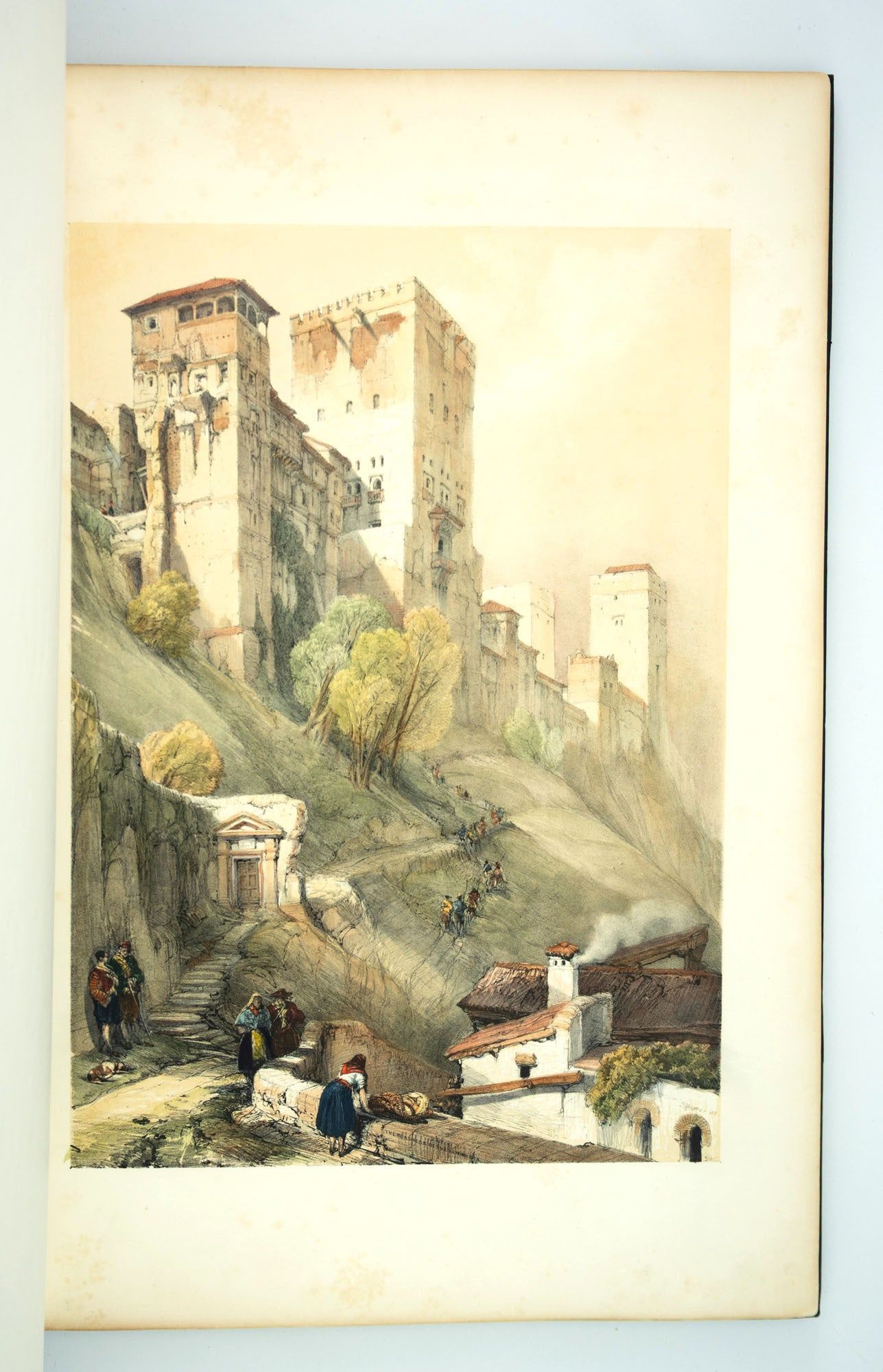
Very attractive sympathetic green half morocco over the original blue moiré fine-ribbed cloth boards, raised bands, cover and spine lettered in gilt. WITH 26 FINE LITHOGRAPHS (including title page with depiction of the entrance to the Chapel of Ferdinand and Isabella) DONE ON VERY THICK PAPER, AND ALL WITH VERY ACCOMPLISHED PERIOD HAND COLORING. Later tissue guards. Abbey, Travel 152. Two unobtrusive small rubbed spots on upper cover, a tiny bit of chafing to boards, but the binding lustrous and otherwise unworn. The third plate (showing the interior of the Cathedral of Seville) with a very expertly repaired five-inch tear (noticeable in the image only if you look very carefully for it), dedication leaf somewhat foxed, plates with insignificant pale spotting, occasional soiling to versos, but nevertheless extremely attractive internally, with excellent coloring, full margins, and few signs of use. A very pleasing copy.
Presented here with pleasing hand-coloring, this giant folio is one of the celebrated illustrated travel books of the period, is the work that brought landscape artist David Roberts to the attention of the public, and is the publication that prompted art critic John Ruskin to praise his "absolutely careful and faithful" depiction of "the greatness and richness of things." For Ruskin, it also allowed one to imagine "serenely and joyfully . . . the splendour of the aisles of Seville, or the strength of the towers of Granada, and [to forget] oneself, for a time." Roberts (1796-1864) had shown artistic ability at an early age, and was apprenticed at 10 to a house painter who did decorative interiors for clients including Sir Walter Scott. After completing his apprenticeship, Roberts supported himself and his family as a theatrical scene designer and painter in Edinburgh and London, all the while continuing to create oil paintings of landscapes, which he sold at exhibitions. DNB notes that "Roberts was quick to see the potential of reproducing his sketches as prints, to reach a wider audience," and he pursued this means of monetizing the sketches and paintings he made on his travels. After selling some individual prints and small collections of sketches, Roberts issued "Spain" as his first large format book. According to Abbey, he was paid £350 for the drawings and for supervising and touching up the lithography stones as needed. Roberts went above and beyond this request, doing some of the drawings on stone himself, and refining every one. His efforts paid off: according to DNB, "The prints (both authorized and pirated copies) brought him widespread fame and popularity, and are still sold as souvenirs." The scenes here give us a wide range of experiences: great Islamic or Gothic architecture and humble water mills, religious processions and bull fights, busy market squares and dizzying mountain paths. And in every view we see the inhabitants of the place, doing things ordinary or exciting. Tinted and colored versions of "Sketches" appear on the market with approximately equal frequency, but a colored copy seems to be an entirely different--and vividly better--book..
Very attractive sympathetic green half morocco over the original blue moiré fine-ribbed cloth boards, raised bands, cover and spine lettered in gilt. WITH 26 FINE LITHOGRAPHS (including title page with depiction of the entrance to the Chapel of Ferdinand and Isabella) DONE ON VERY THICK PAPER, AND ALL WITH VERY ACCOMPLISHED PERIOD HAND COLORING. Later tissue guards. Abbey, Travel 152. Two unobtrusive small rubbed spots on upper cover, a tiny bit of chafing to boards, but the binding lustrous and otherwise unworn. The third plate (showing the interior of the Cathedral of Seville) with a very expertly repaired five-inch tear (noticeable in the image only if you look very carefully for it), dedication leaf somewhat foxed, plates with insignificant pale spotting, occasional soiling to versos, but nevertheless extremely attractive internally, with excellent coloring, full margins, and few signs of use. A very pleasing copy.
Presented here with pleasing hand-coloring, this giant folio is one of the celebrated illustrated travel books of the period, is the work that brought landscape artist David Roberts to the attention of the public, and is the publication that prompted art critic John Ruskin to praise his "absolutely careful and faithful" depiction of "the greatness and richness of things." For Ruskin, it also allowed one to imagine "serenely and joyfully . . . the splendour of the aisles of Seville, or the strength of the towers of Granada, and [to forget] oneself, for a time." Roberts (1796-1864) had shown artistic ability at an early age, and was apprenticed at 10 to a house painter who did decorative interiors for clients including Sir Walter Scott. After completing his apprenticeship, Roberts supported himself and his family as a theatrical scene designer and painter in Edinburgh and London, all the while continuing to create oil paintings of landscapes, which he sold at exhibitions. DNB notes that "Roberts was quick to see the potential of reproducing his sketches as prints, to reach a wider audience," and he pursued this means of monetizing the sketches and paintings he made on his travels. After selling some individual prints and small collections of sketches, Roberts issued "Spain" as his first large format book. According to Abbey, he was paid £350 for the drawings and for supervising and touching up the lithography stones as needed. Roberts went above and beyond this request, doing some of the drawings on stone himself, and refining every one. His efforts paid off: according to DNB, "The prints (both authorized and pirated copies) brought him widespread fame and popularity, and are still sold as souvenirs." The scenes here give us a wide range of experiences: great Islamic or Gothic architecture and humble water mills, religious processions and bull fights, busy market squares and dizzying mountain paths. And in every view we see the inhabitants of the place, doing things ordinary or exciting. Tinted and colored versions of "Sketches" appear on the market with approximately equal frequency, but a colored copy seems to be an entirely different--and vividly better--book..
Details
Title
PICTURESQUE SKETCHES IN SPAIN
Author
ROBERTS, DAVID
Condition
Unknown
Publisher
Hodgson & Graves: London
Date
1837
Edition
FIRST EDITION