

EX PLAUTI COMOEDIIS XX QUARUM CARMINA MAGNA EX PARTE IN MENSUM SUUM RESTITUTA SUNT MDXXII
- Venetiis [Venice]: In aedibus Aldi et Andreae Asulani Soceri [Torresano], July 1522
Venetiis [Venice]: In aedibus Aldi et Andreae Asulani Soceri [Torresano], July 1522. First Aldine Edition. 210 x 140 mm. (8 1/4 x 5 1/2"). 14 p.l., 284 pp.
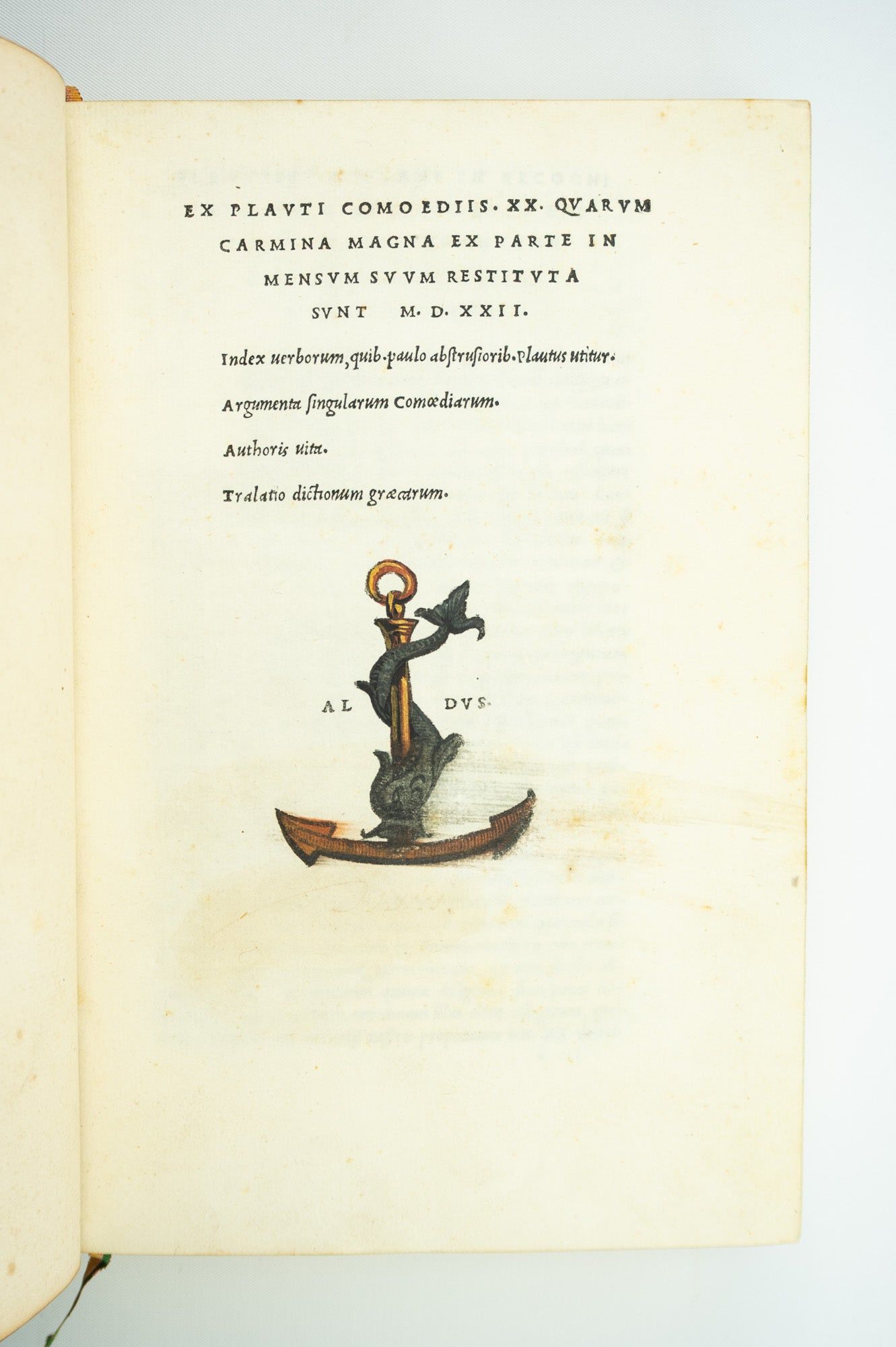
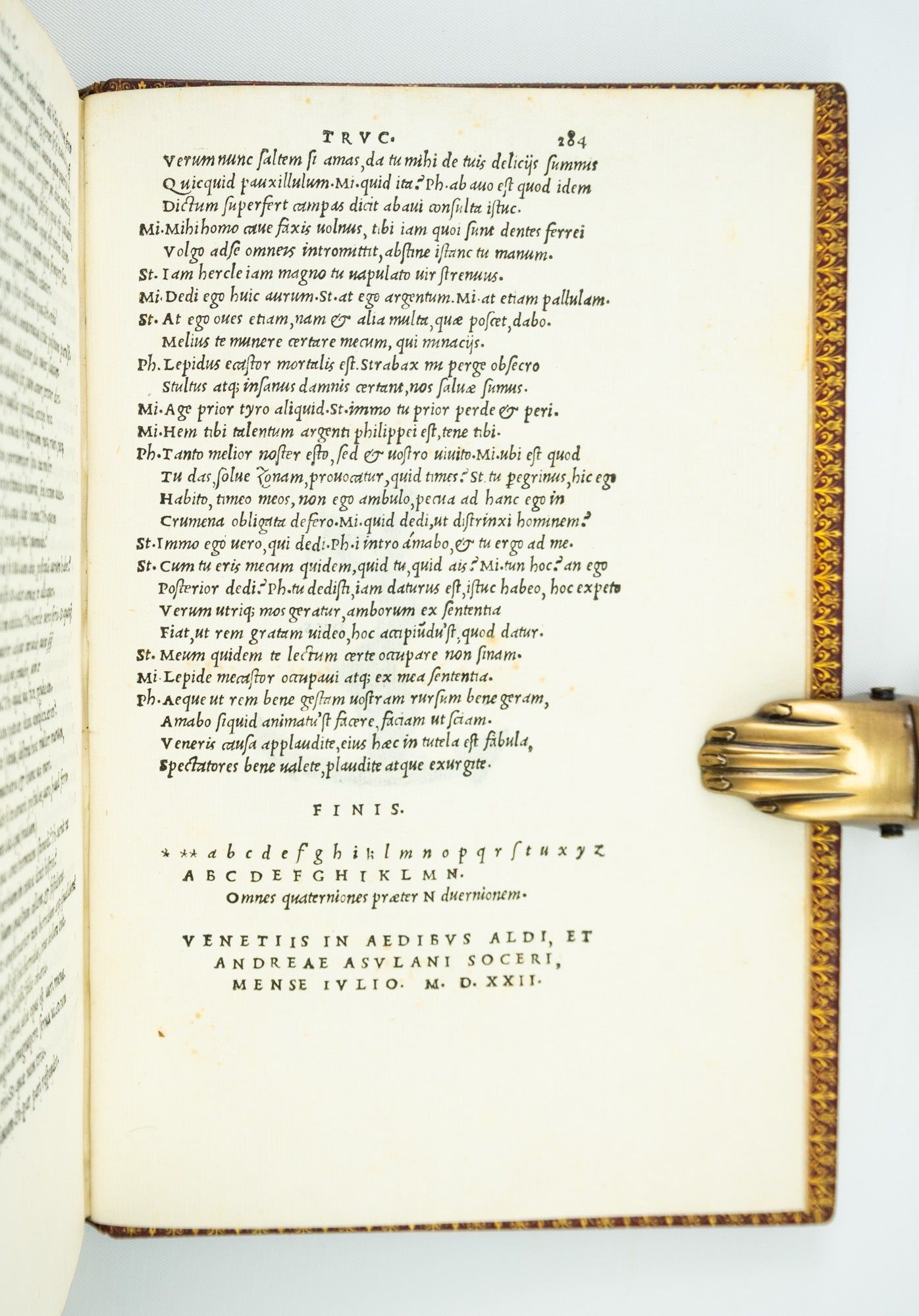
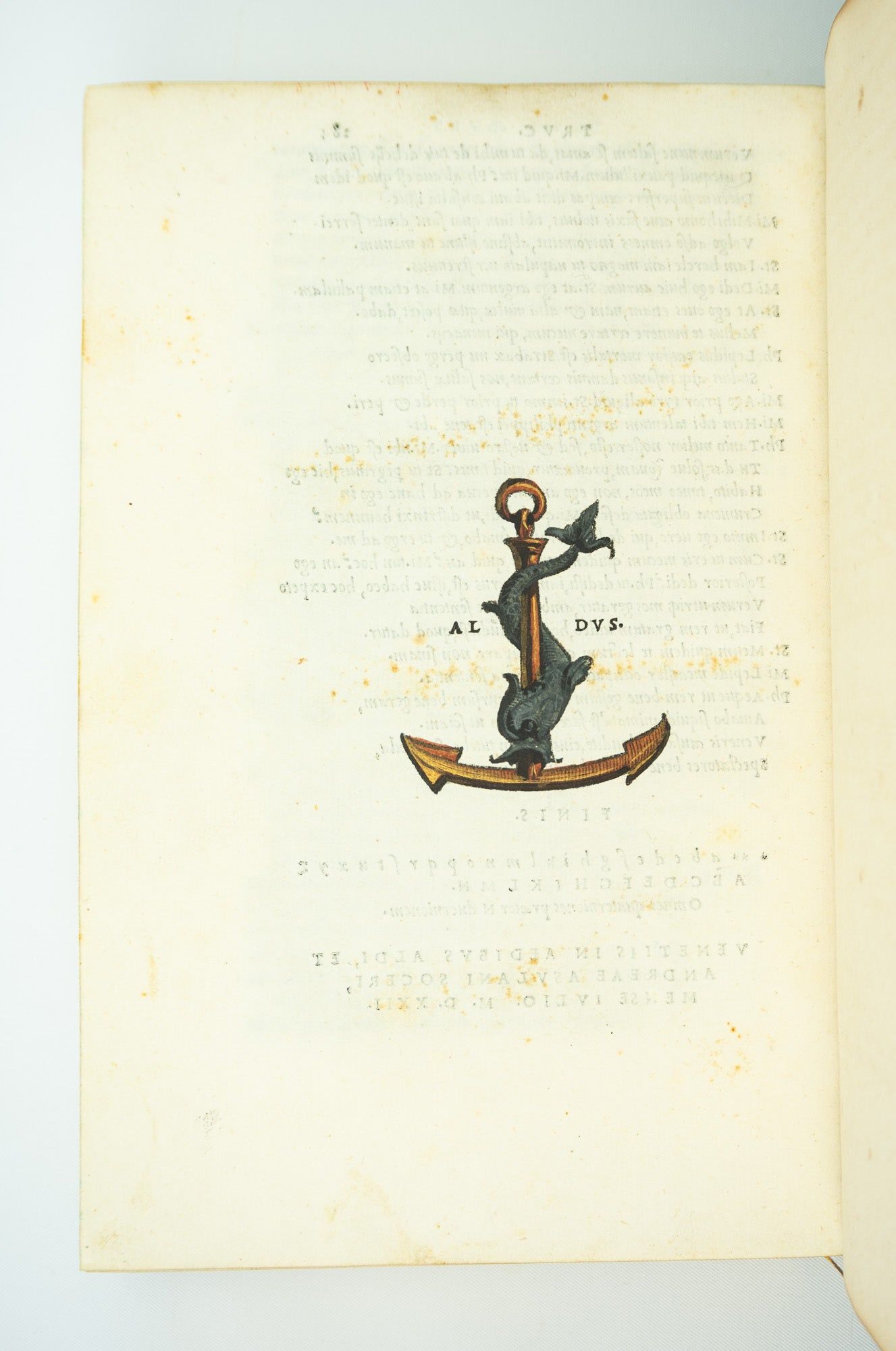
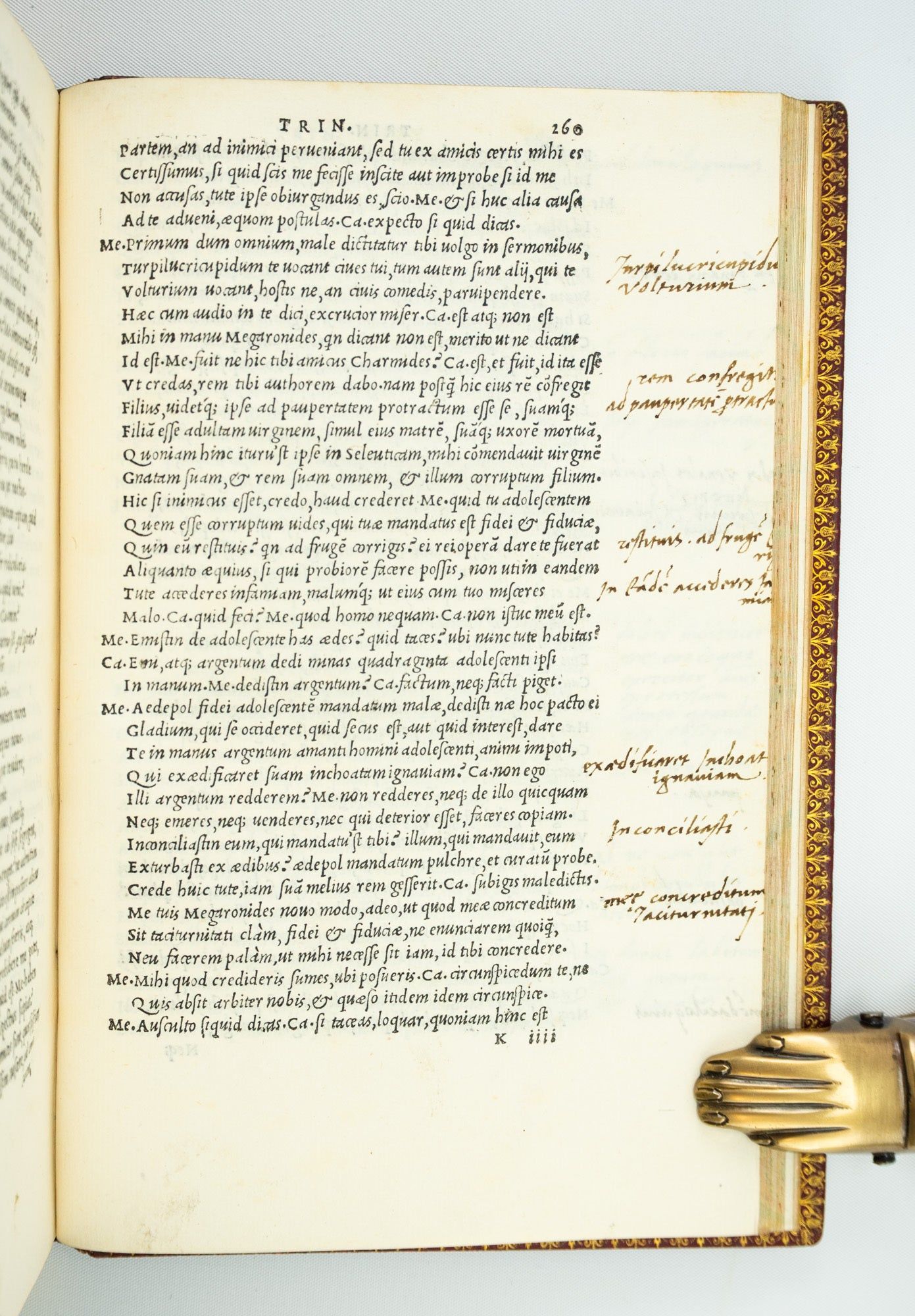
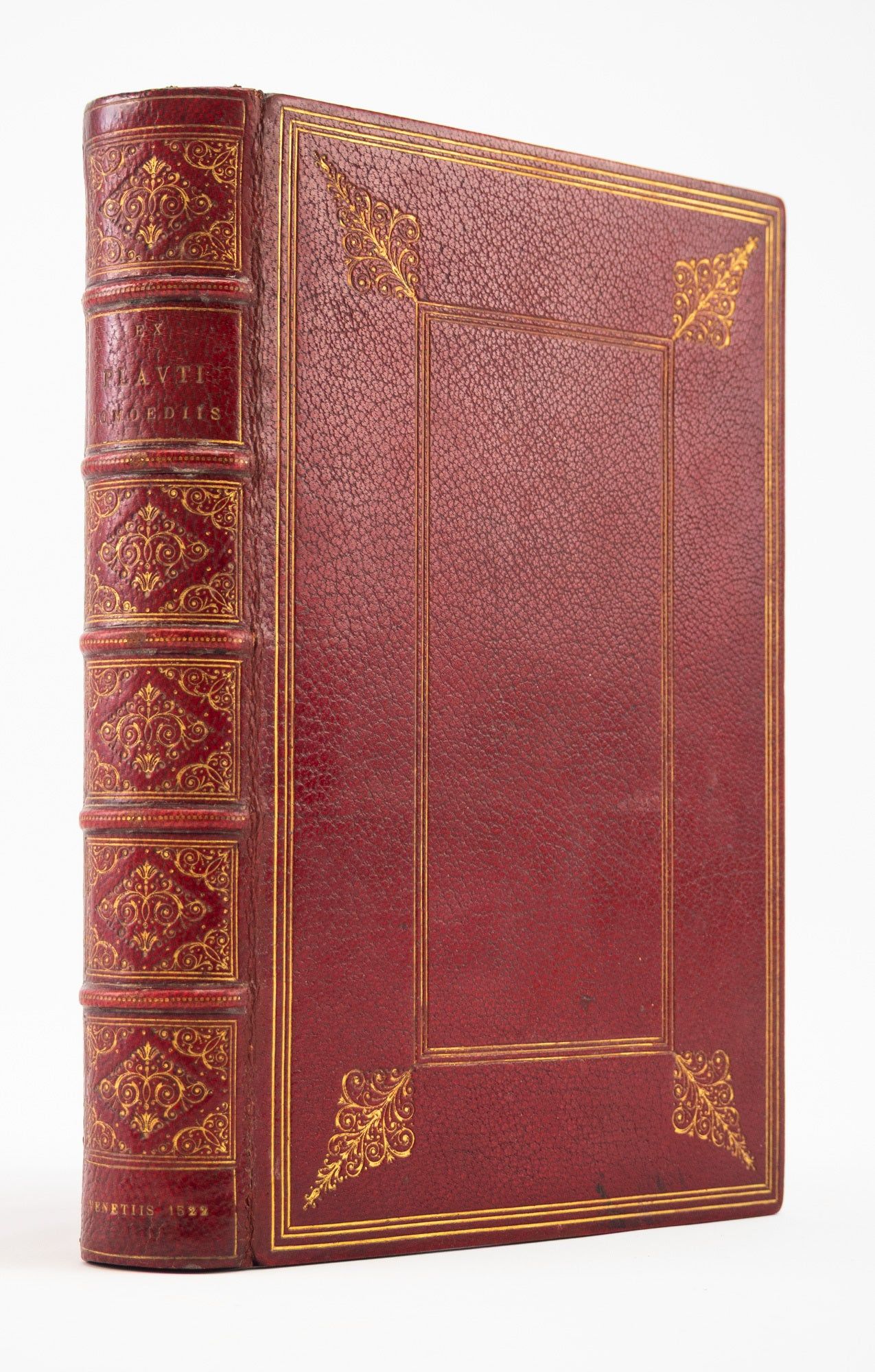
Pretty 19th century red morocco by J. Canape (stamp-signed on front turn-in), gilt, covers with French fillet frame, oblique fleurons at corners, raised bands, spine compartments with intricate central lozenge, lacy cornerpieces, gilt lettering, densely gilt turn-ins, marbled endpapers, all edges gilt over marbling. Printer's dolphin and anchor device on title and final pages, both with contemporary hand coloring. Occasional contemporary ink marginalia, more extensive on the play "Trinummus." Renouard 94:2; Ahmanson-Murphy 211; Adams P-1487; EDIT16 CNCE 37687; USTC 849863. Gilt slightly dulled, the text perhaps washed and resized (but the marginalia quite dark, so maybe not), isolated negligible stains, the colored anchor and dolphin device at front slightly smeared (apparently when someone tried to wash away a previous owner's name), otherwise QUITE A BEAUTIFUL COPY--especially smooth, crisp, and bright, in a solid, appealing binding.
Set in elegant Aldine italic type, this is an attractively bound and overall very pleasing copy of an important early edition of the comedies of the celebrated Roman poet Plautus (ca. 254-184 B.C.), the earliest major Roman author whose works survive in some quantity. Appearing originally during the Second Punic War in the late third century B.C., Plautian comedies featured zany and often ribald characters who give us a picture of Italian society before Greek influence had polished the rough edges, and Plautus' language is an important source of information for the understanding of the development of Latin. Aesthetically, our tall octavo volume containing the author's 20 extant comedies is one of the most pleasing products to be issued by an Aldine press. The margins are spacious, the graceful italic type is comfortably leaded to enhance the readability of the text, and the archaic use of initial spaces provides a pleasing periodic variation in the length of line. Our copy features an attractive binding by Jules Canape (fl. 1865-94), a former trade binder who had begun to produce fine bindings in 1874. The atelier he founded went on to become one of France's leading binderies under the leadership of his son, Georges (1864-1940); the quality and taste that made the workshop famous is evident here in this work of the father, with its attractive, lacy tooling..
Pretty 19th century red morocco by J. Canape (stamp-signed on front turn-in), gilt, covers with French fillet frame, oblique fleurons at corners, raised bands, spine compartments with intricate central lozenge, lacy cornerpieces, gilt lettering, densely gilt turn-ins, marbled endpapers, all edges gilt over marbling. Printer's dolphin and anchor device on title and final pages, both with contemporary hand coloring. Occasional contemporary ink marginalia, more extensive on the play "Trinummus." Renouard 94:2; Ahmanson-Murphy 211; Adams P-1487; EDIT16 CNCE 37687; USTC 849863. Gilt slightly dulled, the text perhaps washed and resized (but the marginalia quite dark, so maybe not), isolated negligible stains, the colored anchor and dolphin device at front slightly smeared (apparently when someone tried to wash away a previous owner's name), otherwise QUITE A BEAUTIFUL COPY--especially smooth, crisp, and bright, in a solid, appealing binding.
Set in elegant Aldine italic type, this is an attractively bound and overall very pleasing copy of an important early edition of the comedies of the celebrated Roman poet Plautus (ca. 254-184 B.C.), the earliest major Roman author whose works survive in some quantity. Appearing originally during the Second Punic War in the late third century B.C., Plautian comedies featured zany and often ribald characters who give us a picture of Italian society before Greek influence had polished the rough edges, and Plautus' language is an important source of information for the understanding of the development of Latin. Aesthetically, our tall octavo volume containing the author's 20 extant comedies is one of the most pleasing products to be issued by an Aldine press. The margins are spacious, the graceful italic type is comfortably leaded to enhance the readability of the text, and the archaic use of initial spaces provides a pleasing periodic variation in the length of line. Our copy features an attractive binding by Jules Canape (fl. 1865-94), a former trade binder who had begun to produce fine bindings in 1874. The atelier he founded went on to become one of France's leading binderies under the leadership of his son, Georges (1864-1940); the quality and taste that made the workshop famous is evident here in this work of the father, with its attractive, lacy tooling..
Details
Title
EX PLAUTI COMOEDIIS XX QUARUM CARMINA MAGNA EX PARTE IN MENSUM SUUM RESTITUTA SUNT MDXXII
Author
(ALDINE IMPRINT). PLAUTUS, TITUS MACCIUS
Condition
Unknown
Publisher
In aedibus Aldi et Andreae Asulani Soceri [Torresano]: Venetiis [Venice]
Date
July 1522
Edition
First Aldine Edition