

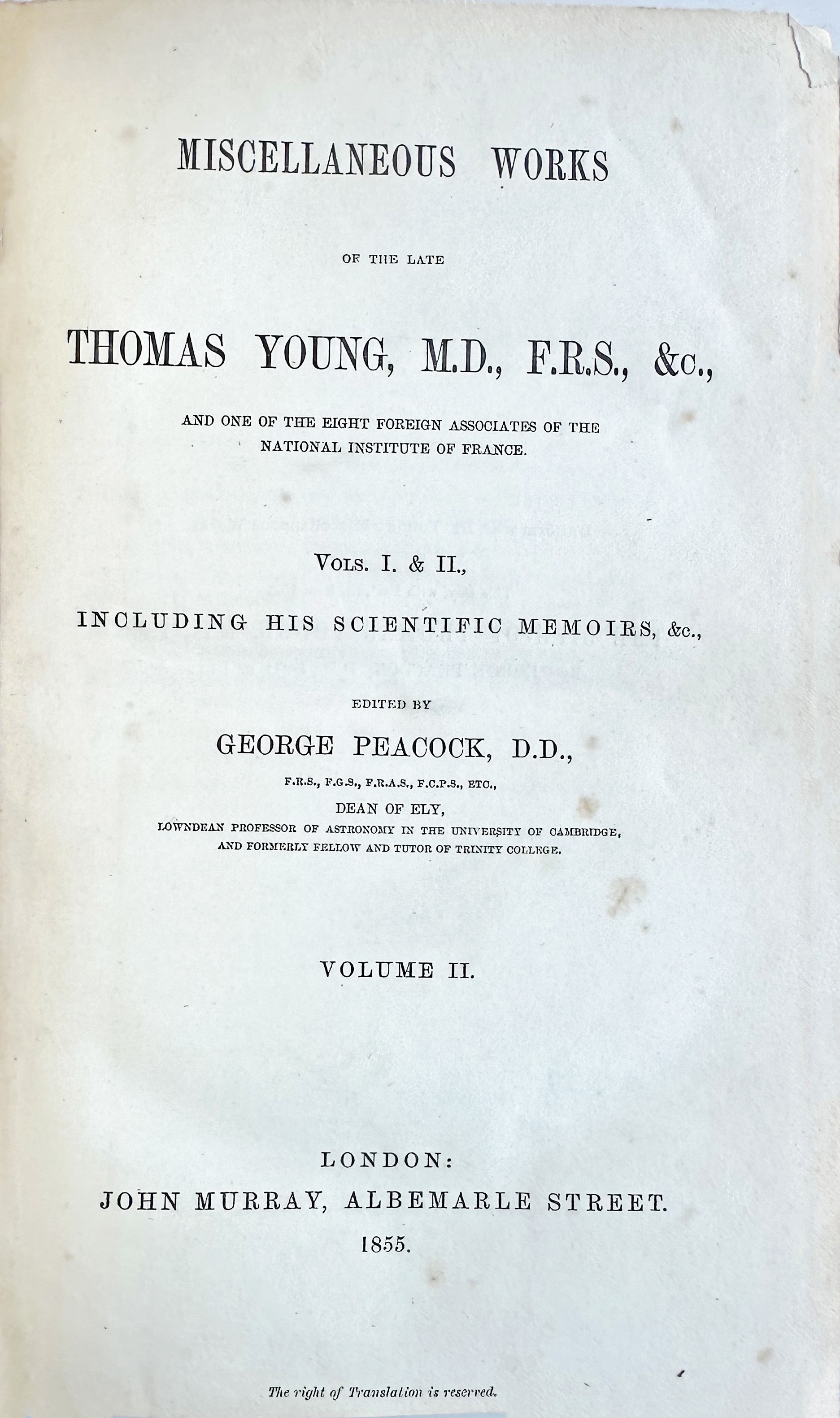
Miscellaneous Works of the Late Thomas Young, M.D., F.R.S., &c., and one of the eight foreign associates of the National Institute of France . . . Including his scientific memoirs, &c., Edited by George Peacock, D.D. [vol. III: edited by John Leitch].
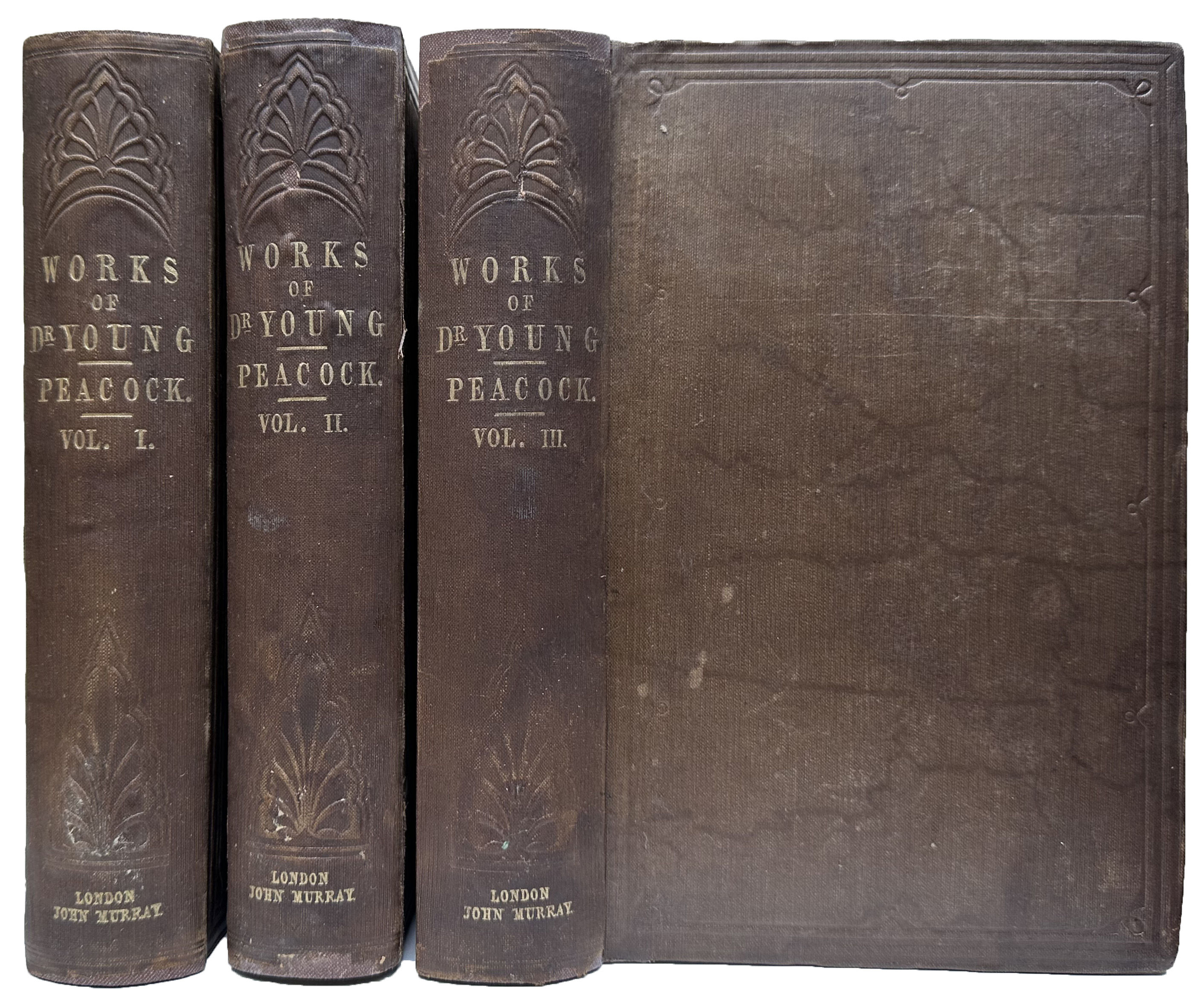
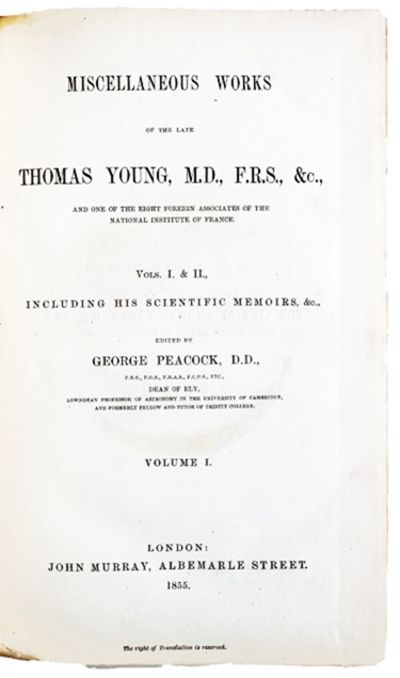
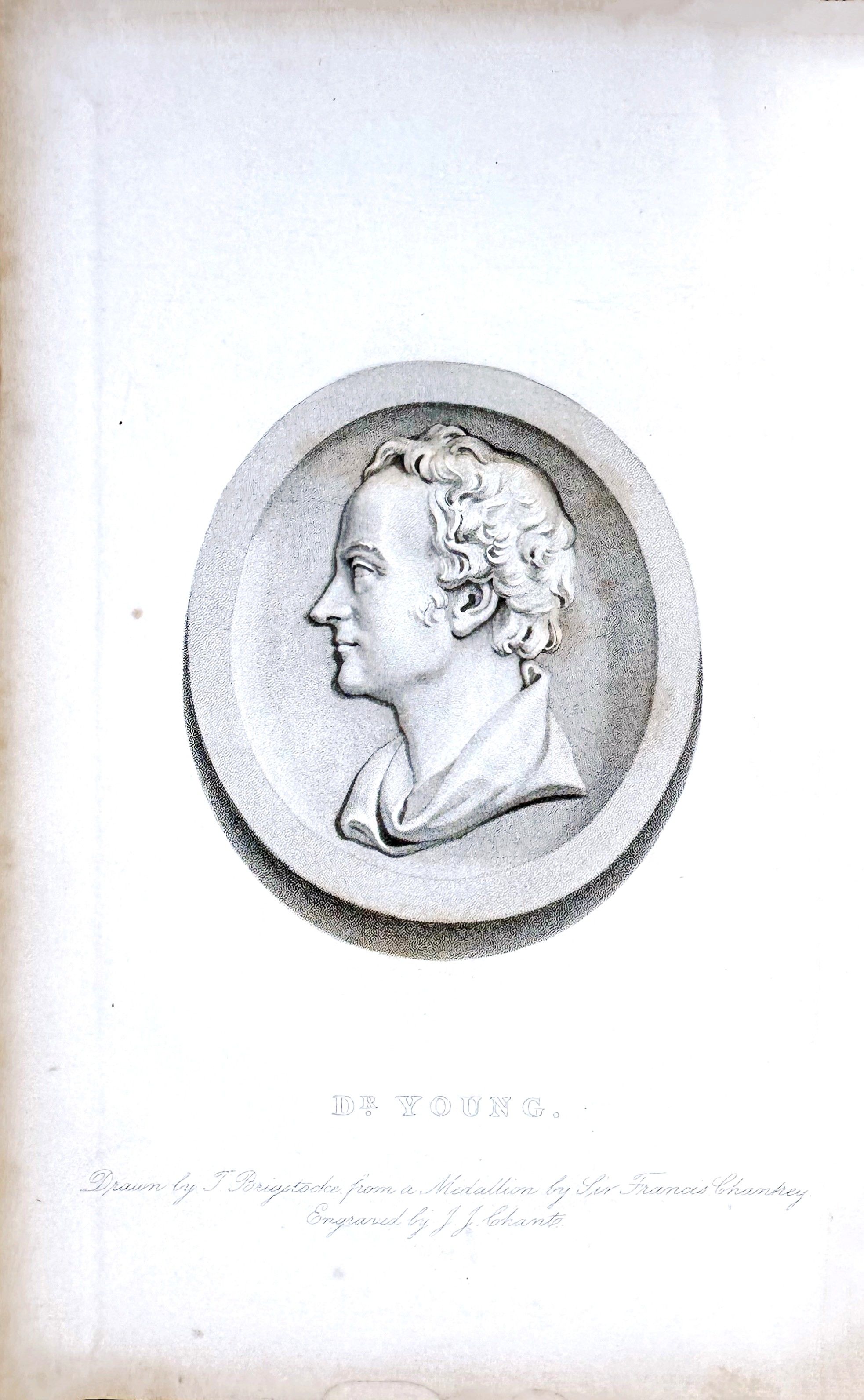
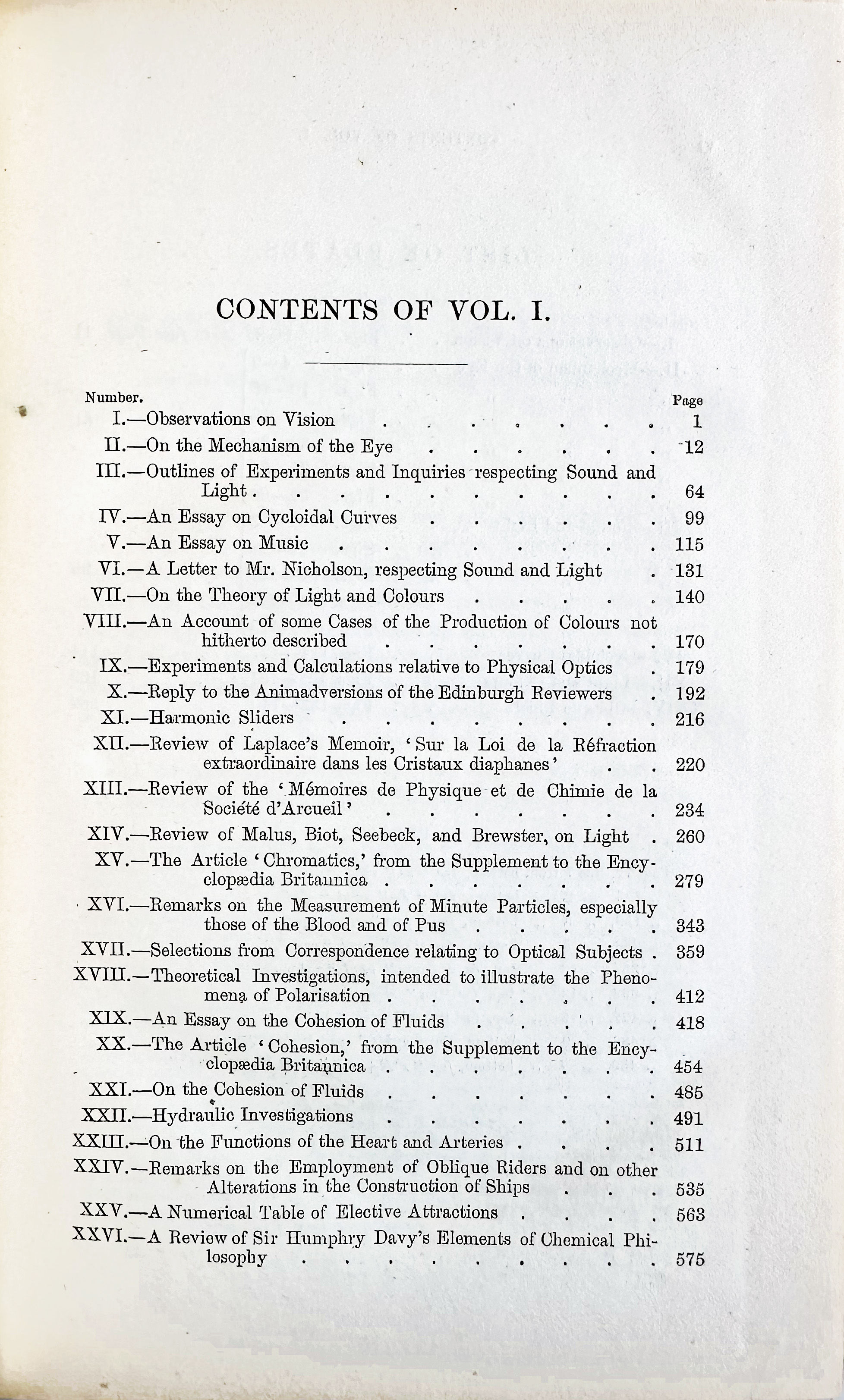
- London:: John Murray, 1855., 1855
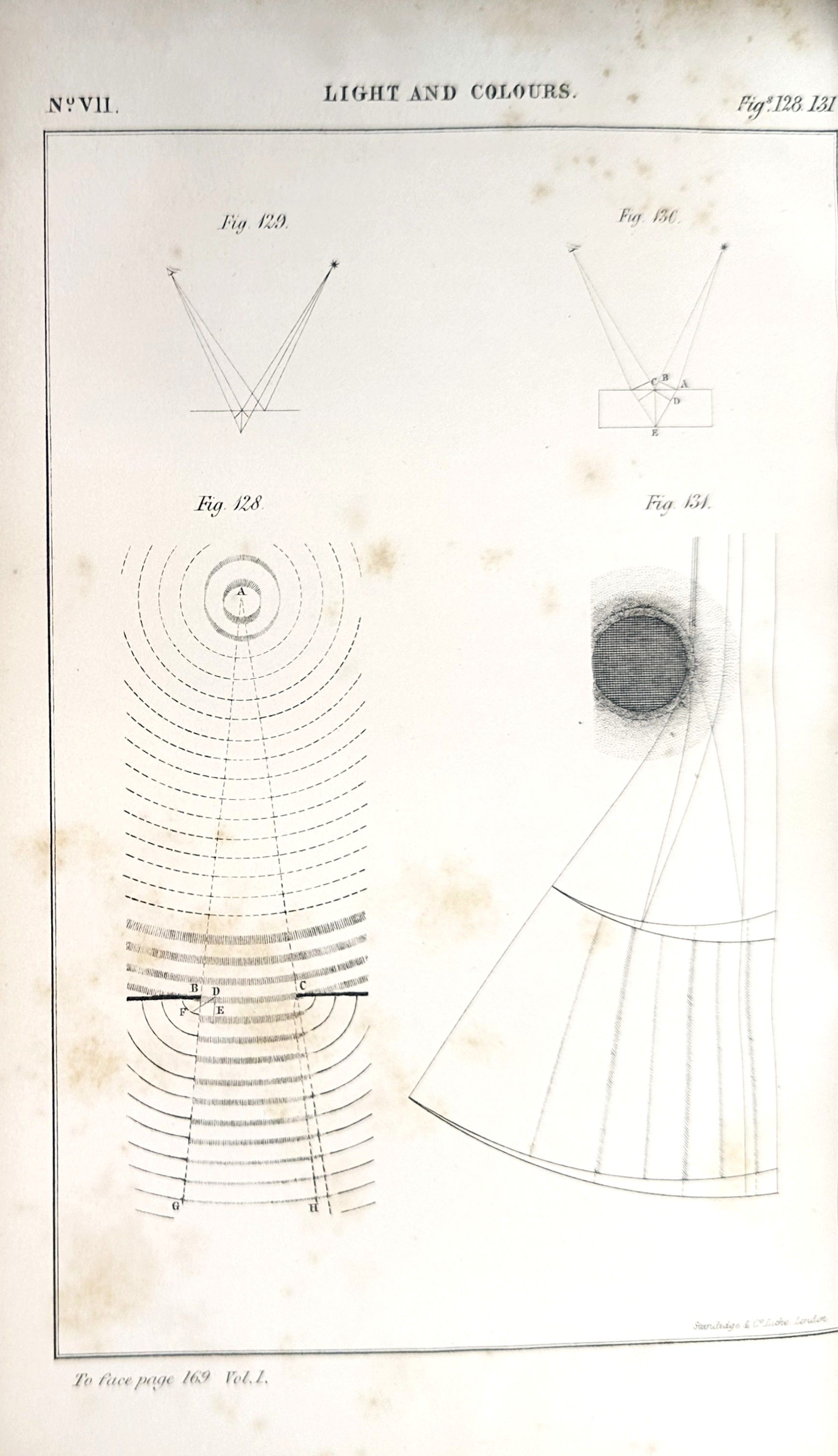
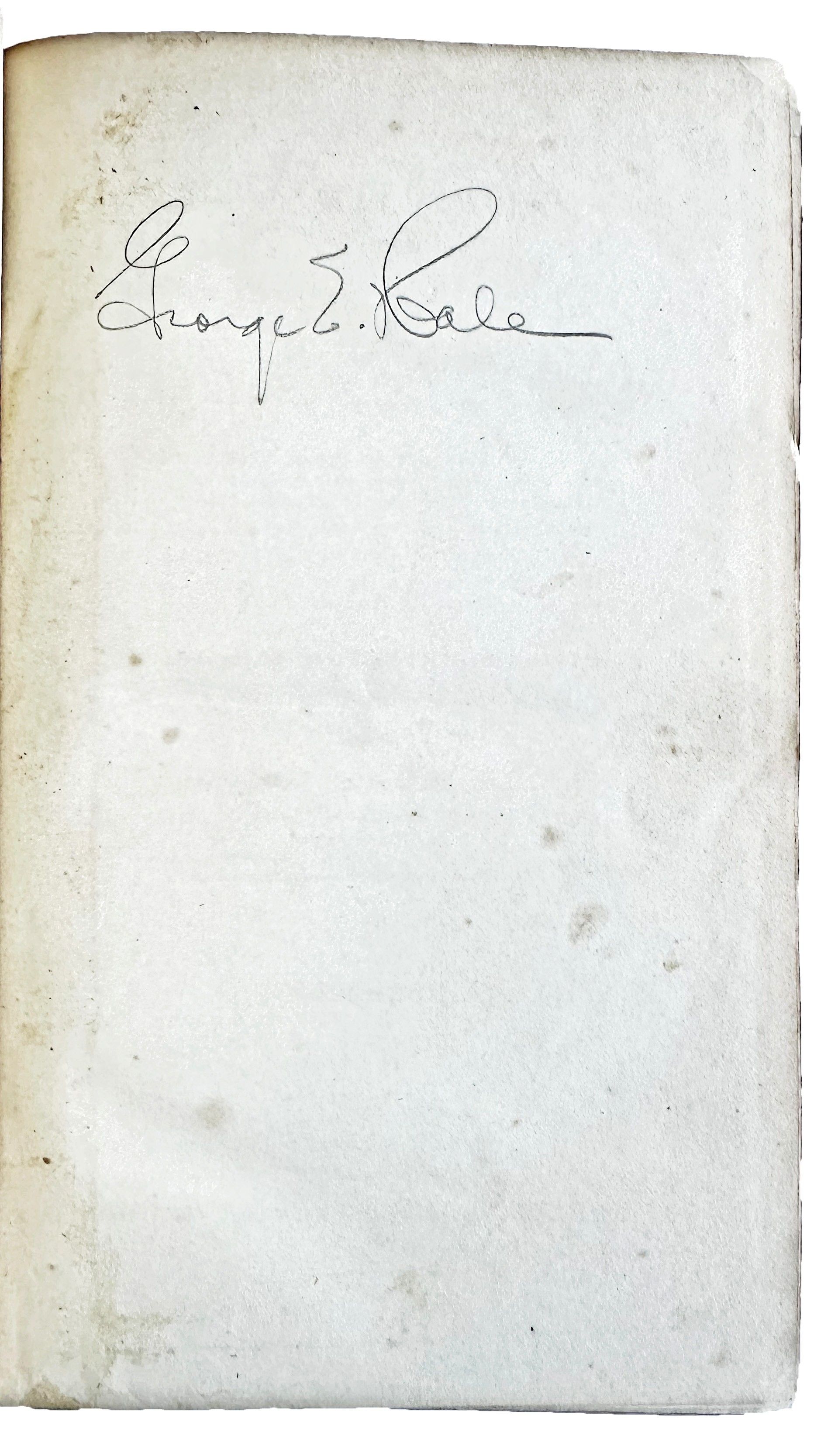
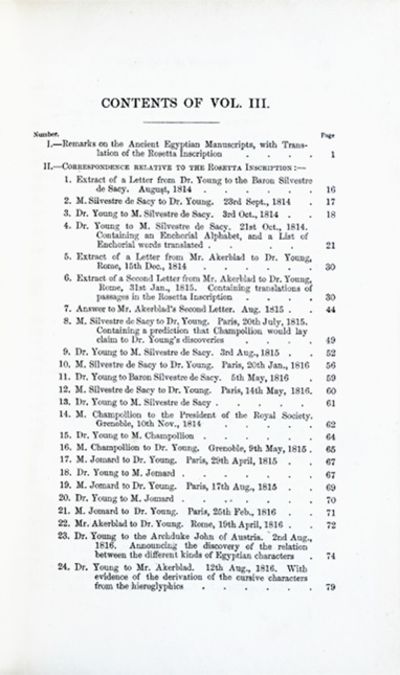
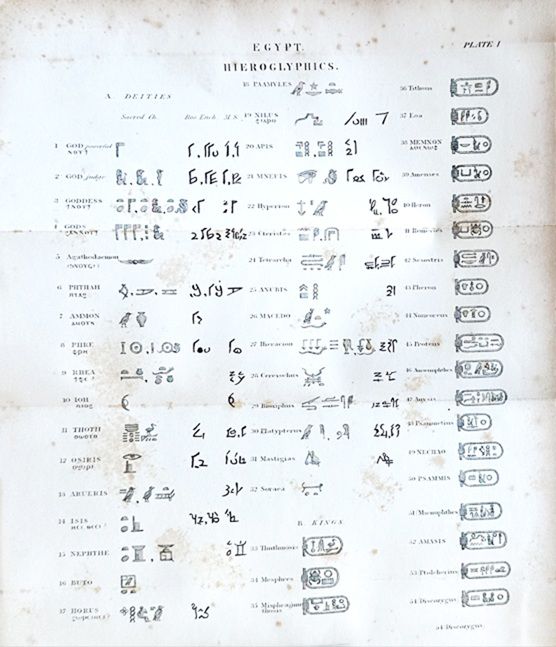
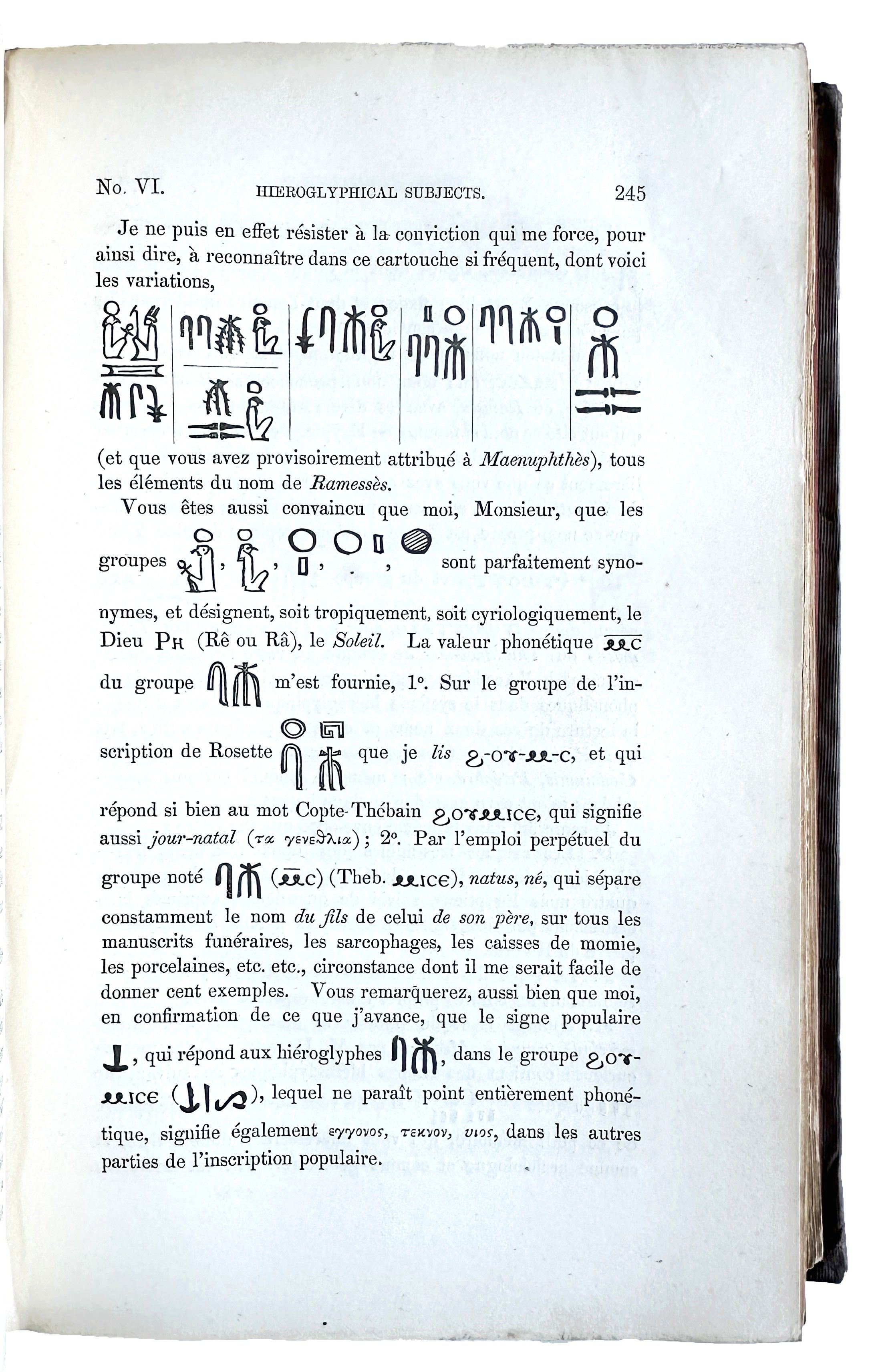
London:: John Murray, 1855., 1855. 3 volumes. Large 8vo. vi, 600; v, [1], 623, [1]; x, 625, [1] pp. 24 engraved plates [vol. I] plates numbered 52-66 [vol. II]; 5 folding plates of Egyptian hieroglyphs, [vol. III] + figures, errata; light foxing. Original full blind- and gilt-stamped cloth, with dark brown or burnt-orange endsheets; fully restored with recent rebacking in brown cloth, the original spines mounted; small paper spine labels (from Carnegie) removed. Embossed stamp of the Carnegie Institution of Washington, Mount Wilson Observatory. Signature of George E. Hale (vols. II & III). Very good+ set. INSCRIBED (TWICE) BY GEORGE ELLERY HALE. First edition of the author's collected works. One of the most remarkable persons of his time, he was a polyglot-polymath, engaged in many intellectual pursuits, achieving lasting recognition in the fields of ophthalmology, optics, chromatics, light & color, physics, linguistics and Egyptology. This collection of his writings also includes his papers relating to architecture, marine science (tides), astronomy, bridge construction, weights & measures, etc. / The most significant contribution here is clearly Young's studies of Egyptian hieroglyphs. See below for the record of Young's work at the very end of his life, working to understand the mysteries of hieroglyphs. His work was instrumental in deciphering the Rosetta Stone. Young and Jean-François Champollion were engaged in the effort, at first collaborating and soon distancing themselves. Champollion's translation was issued in 1822. "Subsequently, Young felt that Champollion was unwilling to share the credit for the decipherment. In the ensuing controversy, strongly motivated by the political tensions of that time, the British tended to champion Young, while the French mostly championed Champollion. Champollion did acknowledge some of Young's contribution, but rather sparingly." – Wikip. / "In 1801 he was appointed professor of Natural Philosophy at the Royal Institution, and as such delivered those remarkable lectures, which he published in two volumes quarto with the title "A Course of Lectures on Natural Philosophy and the Mechanical Arts." "They form altogether," says Dr. Peacock, "the most comprehensive system of natural philosophy, and of what the French call physics, that has ever been published in this country; equally remarkable for precision and accuracy in the enunciation of the vast multitude of propositions and facts which they contain, for the boldness with which they enter upon the discussion of the most abstruse and difficult subjects and for the addition or suggestion of new matter or new views in almost every department of philosophy." / "Dr. Young from the month of February, 1829, had suffered from what he considered repeated attacks of asthma, and was evidently uneasy at the state of his health. This gradually deteriorated. He had in the beginning of April great difficulty in breathing, with some discharge of blood habitually from the lungs, and was in a state of great weakness. He had completed all the works on which he was engaged, with the exception of the rudiments of an Egyptian Dictionary, which he had brought near to its completion, and which he was extremely anxious to be able to finish. It was then in the hands of the lithographers, and he not only continued to give directions concerning it, but laboured at it with a pencil when confined to bed, and unable to hold a pen." / "His last anxiety concerning the proceedings of one or two persons who had made him the object of reiterated attacks in consequence of being dissatisfied with the arrangements of the Nautical Almanac, was that nothing should go forth on his part to increase irritation, and when papers were sent him which went to enumerate and prove the errors into which these individuals had fallen, his desire was that they should be suppressed. His illness continued with some slight variations, but he was gradually sinking into greater and greater weakness until the morning of the 10th May, 1829, when he expired without a struggle, having hardly completed his fifty-sixth year. The disease proved to be ossification of the aorta. His remains were deposited in the vault of his wife's family at Farnborough in Kent." – Royal College of Physicians. REFERENCES: See: Frank Oldham, Thomas Young, M.D., F.R.S. (1773–1829), Physics Bulletin, Volume 5, Number 56, 1954. PROVENANCE: George E. Hale (1868-1938), noted California solar astronomer and astrophysicist – gave his personal (& family) library to the Carnegie Foundation, Mount Wilson Observatory, where he was its director.
Details
Title
Miscellaneous Works of the Late Thomas Young, M.D., F.R.S., &c., and one of the eight foreign associates of the National Institute of France . . . Including his scientific memoirs, &c., Edited by George Peacock, D.D. [vol. III: edited by John Leitch].
Author
YOUNG, Thomas (1773-1829).
Condition
Unknown
Publisher
John Murray, 1855.: London:
Date
1855