

Kung-Kwa at On-Na Lew Chew
- New York: G.P. Putnam & Company, 1856
New York: G.P. Putnam & Company, 1856. Tinted lithograph on proof paper, tipped onto a bristol board with glossy back as issued with additional hand colouring. A quietly revealing image from Heine's Graphic Scenes of the Japan Expedition: the American encounter with the Ryukyu Islands in Japan, where diplomacy, observation, and coastal movement preceded the better-known landings in Japan.
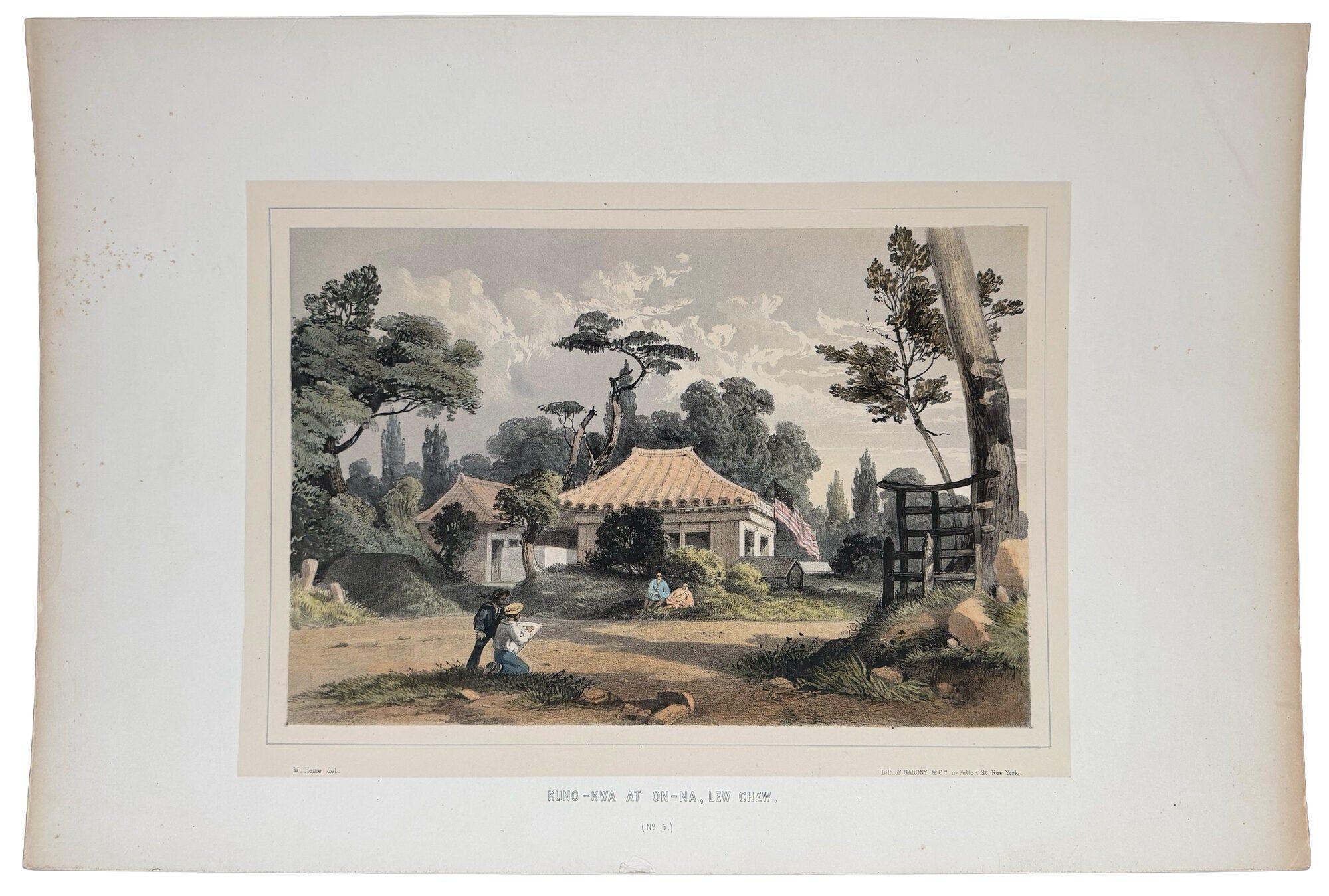
This plate is one of the more understated images in Graphic Scenes of the Japan Expedition, and that restraint is part of its appeal. Lew Chew was the period Western name for the Ryukyu Islands, and On-Na corresponds to Onna, on Okinawa. The scene shows a kung-kwa, or village rest house, set back behind a low wall and gate, its tiled roof partly screened by trees. Heine gives the building a strong sense of place: the whitewashed wall, shaded yard, garden growth, and open path all suggest a local administrative or stopping-place outside the more formal diplomatic centres of Naha and Shuri. In the foreground, one figure sits with a portfolio or sketchbook, while another stands nearby. Ryukyuan figures appear closer to the building, absorbed into the architecture and enclosure of the scene. The print therefore records more than a picturesque stop on the route to Japan, turning a coastal village structure into evidence of landscape, architecture, custom, and access. Within the Perry visual record, Kung-Kwa at On-Na is valuable precisely because it shifts attention from treaty ceremony to the quieter geography of the voyage. It places Okinawa within the wider American itinerary through the China Seas, the Ryukyus, and Japan, and preserves a carefully observed view of a Ryukyuan public building at the moment when the islands were being drawn into the diplomatic and commercial mapping of the Pacific. Wilhelm Heine was the official artist on Commodore Matthew C. Perry's expedition to Japan in 1853-54. On returning to the United States he produced several series of prints commemorating the trip. A group of six elephant-folio prints appeared in 1855, and the following year a second volume was issued, in a smaller format, with different images and with explanatory text. Both projects employed the New York lithographic firm of Sarony, among the best lithographers in the United States at that time.
Bennett, p.53; McGrath American Color Plate Books 123.
This plate is one of the more understated images in Graphic Scenes of the Japan Expedition, and that restraint is part of its appeal. Lew Chew was the period Western name for the Ryukyu Islands, and On-Na corresponds to Onna, on Okinawa. The scene shows a kung-kwa, or village rest house, set back behind a low wall and gate, its tiled roof partly screened by trees. Heine gives the building a strong sense of place: the whitewashed wall, shaded yard, garden growth, and open path all suggest a local administrative or stopping-place outside the more formal diplomatic centres of Naha and Shuri. In the foreground, one figure sits with a portfolio or sketchbook, while another stands nearby. Ryukyuan figures appear closer to the building, absorbed into the architecture and enclosure of the scene. The print therefore records more than a picturesque stop on the route to Japan, turning a coastal village structure into evidence of landscape, architecture, custom, and access. Within the Perry visual record, Kung-Kwa at On-Na is valuable precisely because it shifts attention from treaty ceremony to the quieter geography of the voyage. It places Okinawa within the wider American itinerary through the China Seas, the Ryukyus, and Japan, and preserves a carefully observed view of a Ryukyuan public building at the moment when the islands were being drawn into the diplomatic and commercial mapping of the Pacific. Wilhelm Heine was the official artist on Commodore Matthew C. Perry's expedition to Japan in 1853-54. On returning to the United States he produced several series of prints commemorating the trip. A group of six elephant-folio prints appeared in 1855, and the following year a second volume was issued, in a smaller format, with different images and with explanatory text. Both projects employed the New York lithographic firm of Sarony, among the best lithographers in the United States at that time.
Bennett, p.53; McGrath American Color Plate Books 123.
Details
Title
Kung-Kwa at On-Na Lew Chew
Author
HEINE, Wilhelm (1827-1885)
Condition
Unknown
Publisher
G.P. Putnam & Company: New York
Date
1856