

Tracing Consumer Demand in the USSR: Official Soviet Ministry of Trade Order No. 68, the Bureaucratic Substitutes for Price Tracking in the Post-Stalin Planned Economy, 1955
- SIGNED
- 1955
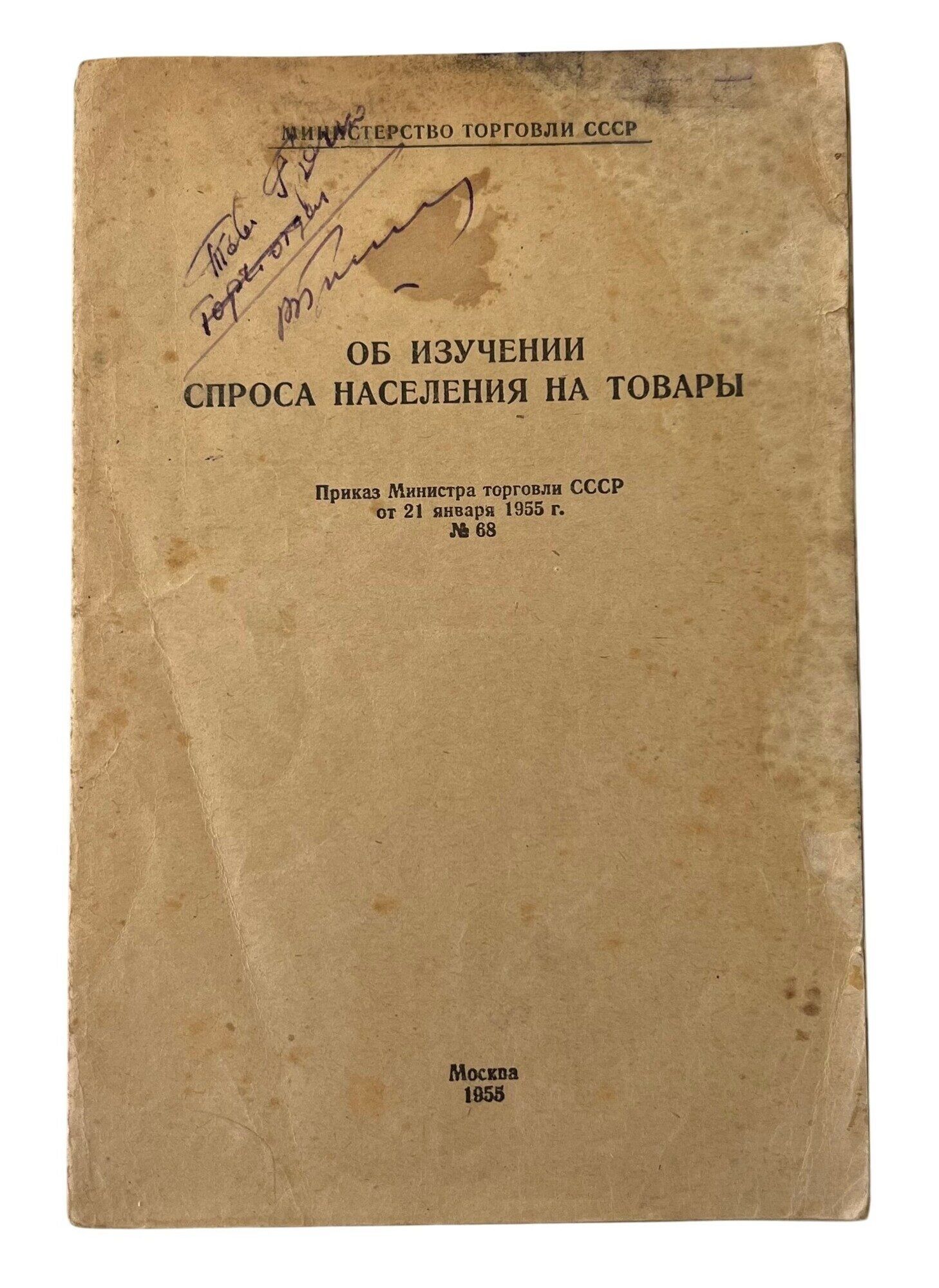
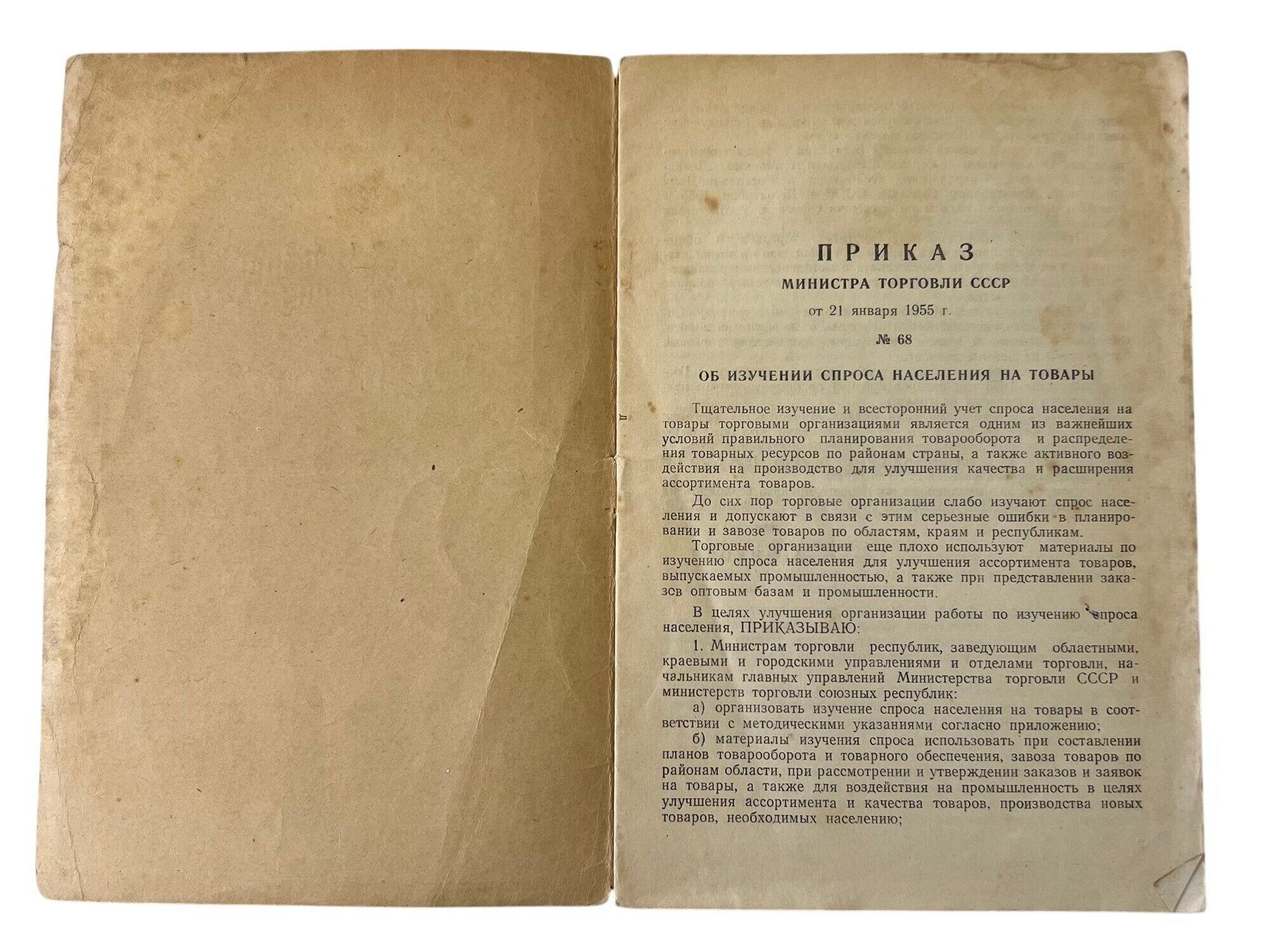
1955. USSR Ministry of Trade pamphlet containing Order No. 68, "On the Study of Population Demand for Goods," issued 21 January 1955 under Minister of Trade A. Mikoyan. The order is less a neutral study guide than an enforcement rulebook for measuring consumer demand inside a dictatorial planned economy that lacked market prices as a reliable signal for supply. It required trade authorities to collect and report evidence of "careful study and comprehensive accounting of population demand" for use in commodity turnover plans, regional distribution, industrial orders, and pressure on manufacturers to improve assortment and quality.
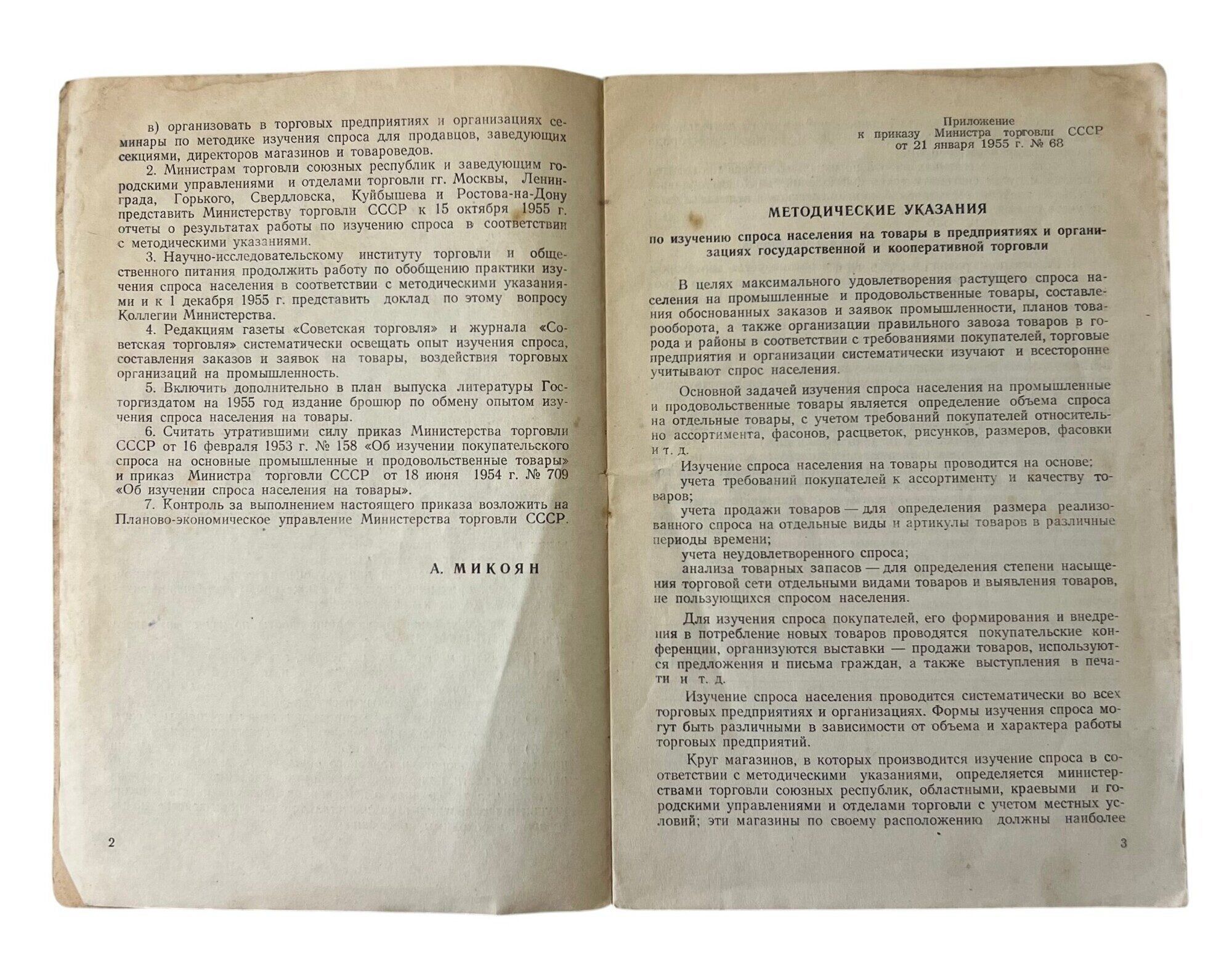
Ministerstvo torgovli SSSR. Ob izuchenii sprosa naseleniia na tovary: Prikaz Ministra torgovli SSSR ot 21 ianvaria 1955 g. No. 68. Moscow: Tipografiia MT SSSR, 1955. 5.5 x 8.5 inches. 15 pp. Printed self-wrappers, stapled. Russian-language Ministry of Trade order with methodological appendix and printed forms. The order was addressed to republican ministries, regional trade departments, the trade authorities of Moscow, Leningrad, Gorky, Sverdlovsk, Kuibyshev, and Rostov-on-Don, the Scientific Research Institute of Trade and Public Catering, and the newspaper and journal Sovetskaia torgovlia. The final page carries the typeset name of A. Mikoyan; the appendix is signed in type by V. Tyukov, head of the Ministry's Planning-Economic Administration, and V. Lopatkin, director of the Scientific Research Institute of Trade and Public Catering.
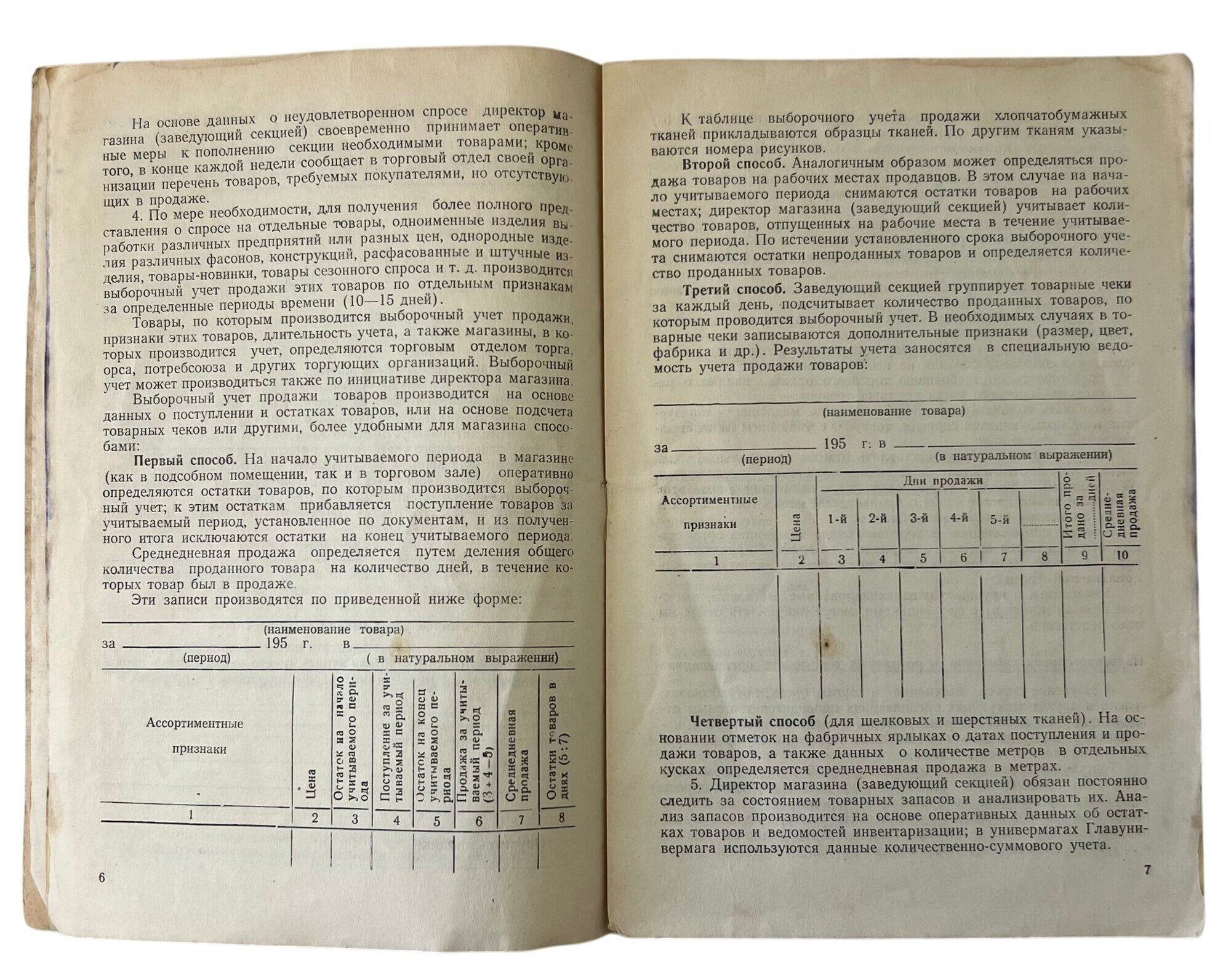
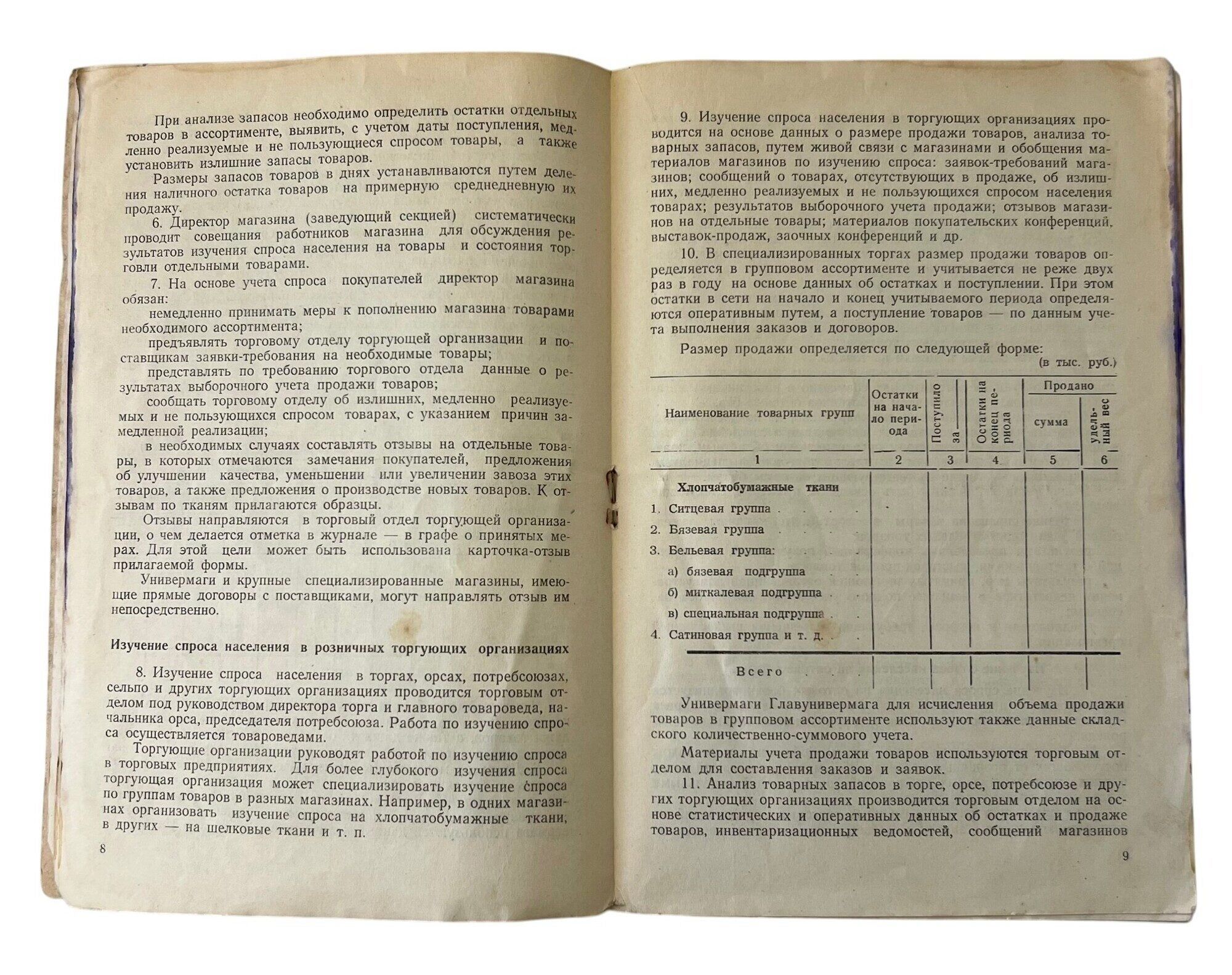
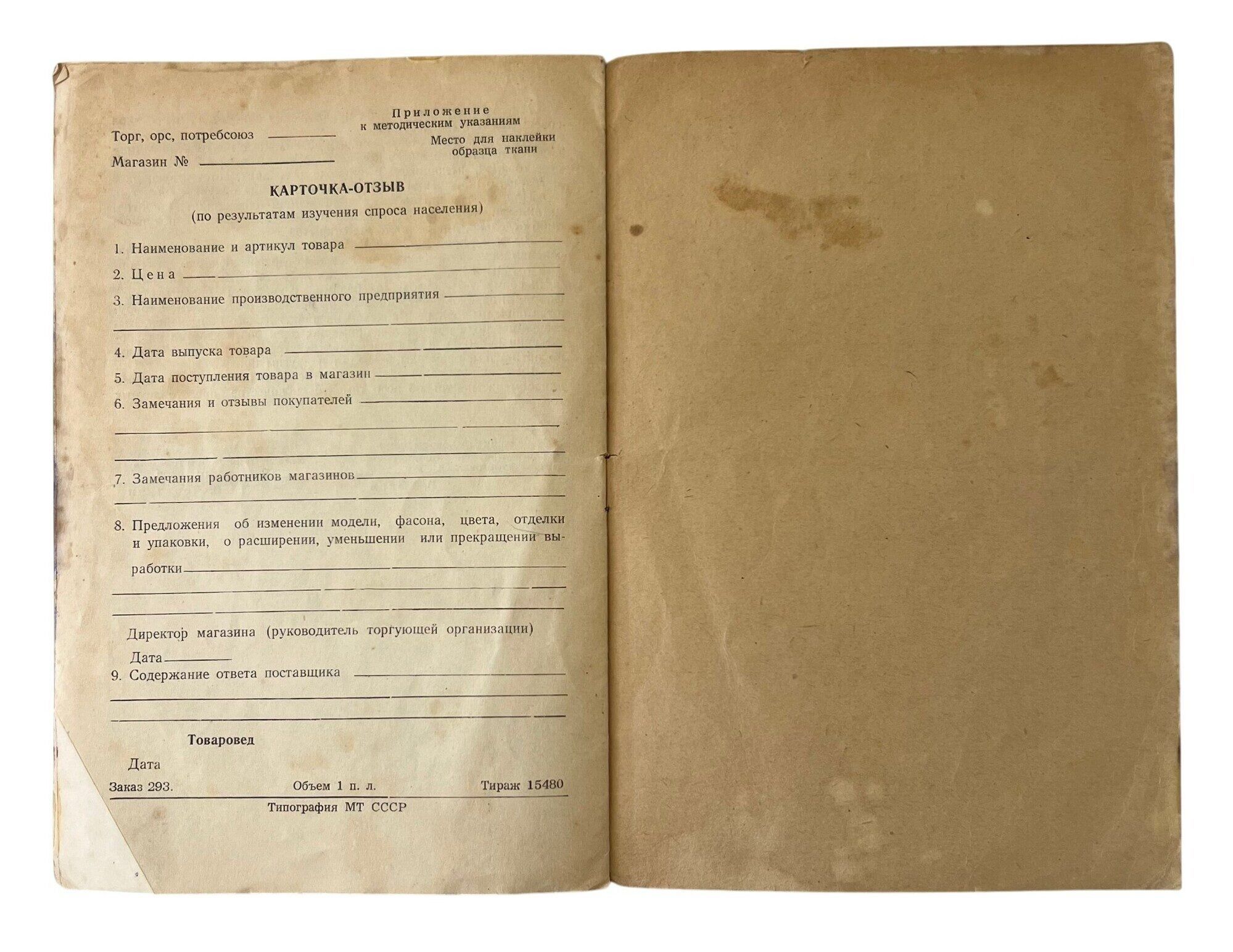
The appendix sets out practical procedures for converting shortages, unsold stock, buyer complaints, sales counts, buyer conferences, sales-exhibitions, letters, postcards, newspaper notices, and written store reports into usable information for ministries and manufacturers. Printed tables record commodity name, price, daily sales, stock at the beginning and end of a period, receipts, and unsold goods; cloth examples divide merchandise into cotton, linen, satin, baize, and other groups. A tear-out "kartochka-otzyv" asks for product name, price, manufacturer, production date, store receipt date, buyer remarks, store-worker comments, proposed changes in model, cut, color, finish, packaging, expansion, reduction, or discontinuation of production, supplier response, and a space for affixing a fabric sample.
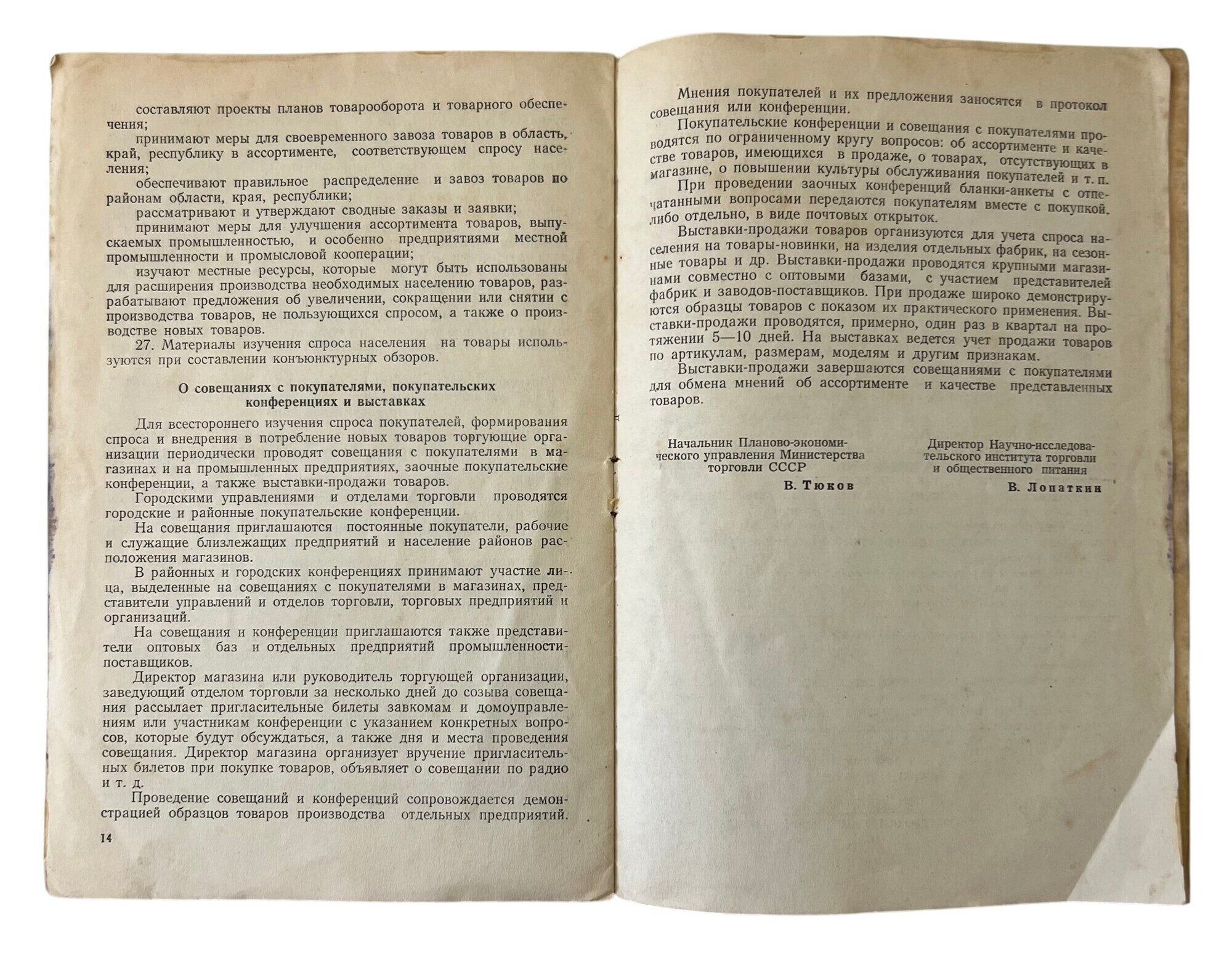
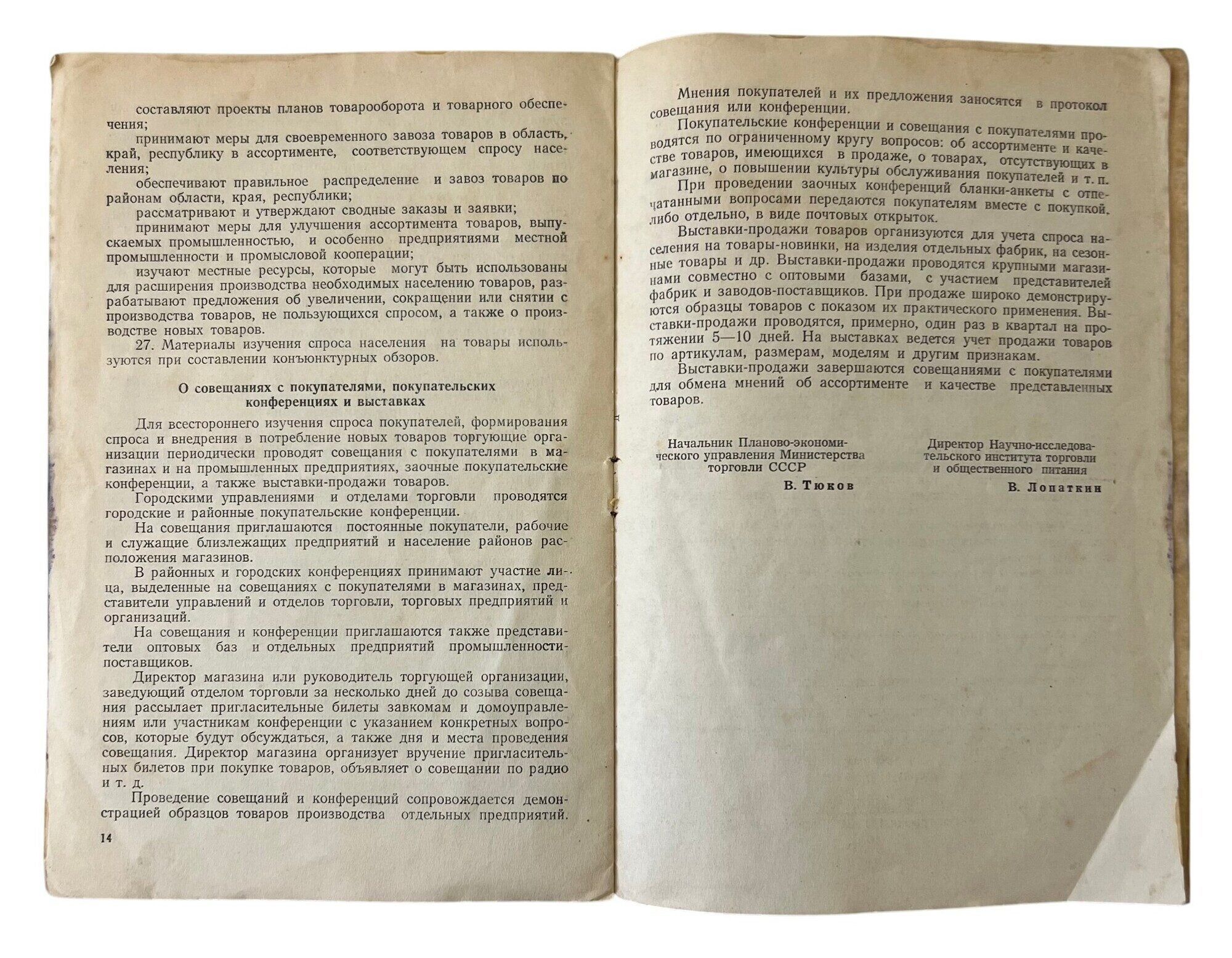
Order No. 68 repealed Ministry of Trade Order No. 158 of 16 February 1953 and Order No. 709 of 18 June 1954, placing the booklet inside a rapid sequence of post-Stalin revisions to Soviet demand-study policy. Responsibility is assigned across store directors, section heads, commodity specialists, trade departments, regional authorities, research institutes, newspapers, and industrial suppliers. Buyer conferences were to include workers, nearby residents, store employees, trade officials, wholesalers, and industrial representatives; sales-exhibitions were to run five to ten days, display broad assortments, include factory representatives, record sales by article, size, model, and other traits, and end with meetings on assortment and quality.
The booklet has toning, staining, edge wear, creasing, corner loss to the lower outer corner of the final leaf, and a contemporary routing inscription on the front wrapper; the staples remain intact and the feedback form is present, overall good condition. A compact Ministry of Trade manual for the bureaucratic substitutes Soviet retail used to approximate consumer demand during a period known for chronic shortages, long food lines, and the suppression of private trade.
Ministerstvo torgovli SSSR. Ob izuchenii sprosa naseleniia na tovary: Prikaz Ministra torgovli SSSR ot 21 ianvaria 1955 g. No. 68. Moscow: Tipografiia MT SSSR, 1955. 5.5 x 8.5 inches. 15 pp. Printed self-wrappers, stapled. Russian-language Ministry of Trade order with methodological appendix and printed forms. The order was addressed to republican ministries, regional trade departments, the trade authorities of Moscow, Leningrad, Gorky, Sverdlovsk, Kuibyshev, and Rostov-on-Don, the Scientific Research Institute of Trade and Public Catering, and the newspaper and journal Sovetskaia torgovlia. The final page carries the typeset name of A. Mikoyan; the appendix is signed in type by V. Tyukov, head of the Ministry's Planning-Economic Administration, and V. Lopatkin, director of the Scientific Research Institute of Trade and Public Catering.
The appendix sets out practical procedures for converting shortages, unsold stock, buyer complaints, sales counts, buyer conferences, sales-exhibitions, letters, postcards, newspaper notices, and written store reports into usable information for ministries and manufacturers. Printed tables record commodity name, price, daily sales, stock at the beginning and end of a period, receipts, and unsold goods; cloth examples divide merchandise into cotton, linen, satin, baize, and other groups. A tear-out "kartochka-otzyv" asks for product name, price, manufacturer, production date, store receipt date, buyer remarks, store-worker comments, proposed changes in model, cut, color, finish, packaging, expansion, reduction, or discontinuation of production, supplier response, and a space for affixing a fabric sample.
Order No. 68 repealed Ministry of Trade Order No. 158 of 16 February 1953 and Order No. 709 of 18 June 1954, placing the booklet inside a rapid sequence of post-Stalin revisions to Soviet demand-study policy. Responsibility is assigned across store directors, section heads, commodity specialists, trade departments, regional authorities, research institutes, newspapers, and industrial suppliers. Buyer conferences were to include workers, nearby residents, store employees, trade officials, wholesalers, and industrial representatives; sales-exhibitions were to run five to ten days, display broad assortments, include factory representatives, record sales by article, size, model, and other traits, and end with meetings on assortment and quality.
The booklet has toning, staining, edge wear, creasing, corner loss to the lower outer corner of the final leaf, and a contemporary routing inscription on the front wrapper; the staples remain intact and the feedback form is present, overall good condition. A compact Ministry of Trade manual for the bureaucratic substitutes Soviet retail used to approximate consumer demand during a period known for chronic shortages, long food lines, and the suppression of private trade.
Details
Title
Tracing Consumer Demand in the USSR: Official Soviet Ministry of Trade Order No. 68, the Bureaucratic Substitutes for Price Tracking in the Post-Stalin Planned Economy, 1955
Author
Soviet Union Economy
Condition
Unknown
Date
1955