

Turn of the Century Meatpacking Before Mechanization: Butchers, Hanging Rooms, and Refrigerated Food Distribution, Photo Archive 1910s to 1940s
- 1900
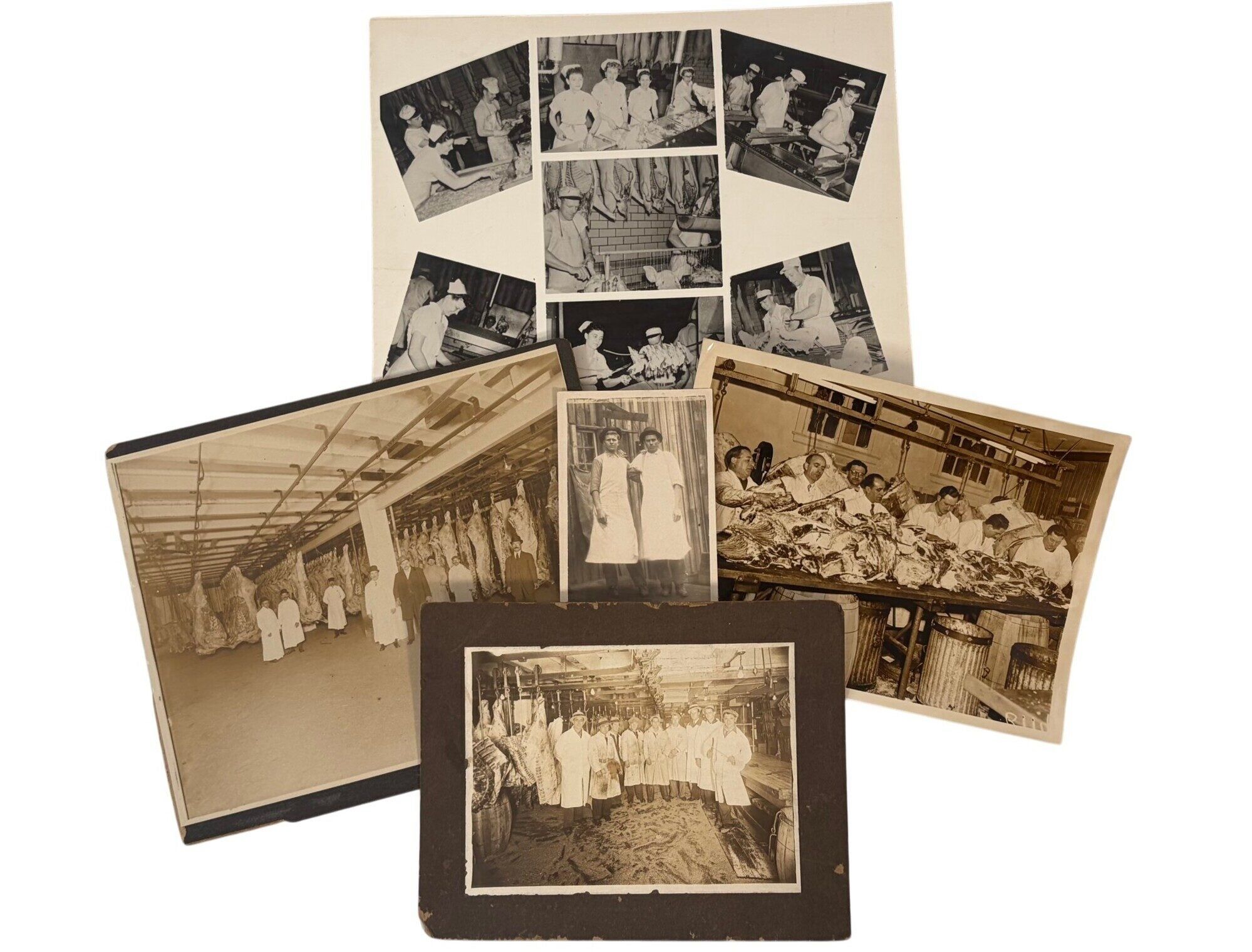
1900. Industrial butcher shop and slaughterhouse photo archive depicting meatpacking labor during the rapid expansion of refrigerated food distribution in the early twentieth century, when urban slaughterhouses and cold storage facilities transformed American food consumption. After the introduction of refrigerated rail transport in the late nineteenth century, cities such as Philadelphia, Chicago, and New York became major processing and distribution centers supplying dressed beef to rapidly growing urban populations. Federal regulation of meatpacking intensified after Upton Sinclair's The Jungle and the passage of the 1906 Meat Inspection Act, placing new attention on sanitation, labor conditions, and industrial processing methods inside American packinghouses. The group preserves the physical labor behind that system: carcass handling, butchering tables crowded with dressed meat, and workers posed inside refrigerated hanging rooms built for large-scale commercial throughput.
Photo archive of 11 silver gelatin photographs, Various sizes ranging Aprox 3 x 5 to 8 x 10 inches, with 7 photographs are attached to a 12 x10 mat. Philadelphia, Pennsylvania and New York, circa 1910s-1920s. White-aproned butchers stand shoulder-to-shoulder at long wooden cutting tables piled with heavy cuts of beef beneath suspended overhead rail systems used to move carcasses through processing rooms. Two large interior views show rows of hanging beef sides extending deep into refrigerated storage areas, with workers and supervisors posed among steel hooks, concrete floors, and industrial support columns. A meatpacking interior photo of with rows of hanging beef and workers in blood stained white apron and hats. A smaller portrait-format image shows two young butchers outdoors in aprons and brimmed work hats beside rough wooden siding, their direct posture emphasizing the physical identity and occupational pride associated with skilled meat labor before widespread mechanization displaced many hand-processing practices. Verso markings include a stamped credit for "Dickerson Photographers, 149 North 9th St., Phila." and an "International News Photos" reproduction stamp with a New York address .Also includes 7 photos on one mat of 1940s Female and male butchers with knives at work.
By the 1910s, meatpacking ranked among the most dangerous industrial occupations in the United States, with workers exposed daily to cold storage environments, repetitive knife work, and heavy carcass transport inside crowded urban facilities. Labor unrest and union organizing intensified across the meat industry during these decades, particularly after World War I inflation and the 1921 nationwide packinghouse strike involving tens of thousands of workers. Edge wear, light creasing, minor toning, and scattered surface abrasions; overall in very good condition.
Photo archive of 11 silver gelatin photographs, Various sizes ranging Aprox 3 x 5 to 8 x 10 inches, with 7 photographs are attached to a 12 x10 mat. Philadelphia, Pennsylvania and New York, circa 1910s-1920s. White-aproned butchers stand shoulder-to-shoulder at long wooden cutting tables piled with heavy cuts of beef beneath suspended overhead rail systems used to move carcasses through processing rooms. Two large interior views show rows of hanging beef sides extending deep into refrigerated storage areas, with workers and supervisors posed among steel hooks, concrete floors, and industrial support columns. A meatpacking interior photo of with rows of hanging beef and workers in blood stained white apron and hats. A smaller portrait-format image shows two young butchers outdoors in aprons and brimmed work hats beside rough wooden siding, their direct posture emphasizing the physical identity and occupational pride associated with skilled meat labor before widespread mechanization displaced many hand-processing practices. Verso markings include a stamped credit for "Dickerson Photographers, 149 North 9th St., Phila." and an "International News Photos" reproduction stamp with a New York address .Also includes 7 photos on one mat of 1940s Female and male butchers with knives at work.
By the 1910s, meatpacking ranked among the most dangerous industrial occupations in the United States, with workers exposed daily to cold storage environments, repetitive knife work, and heavy carcass transport inside crowded urban facilities. Labor unrest and union organizing intensified across the meat industry during these decades, particularly after World War I inflation and the 1921 nationwide packinghouse strike involving tens of thousands of workers. Edge wear, light creasing, minor toning, and scattered surface abrasions; overall in very good condition.
Details
Title
Turn of the Century Meatpacking Before Mechanization: Butchers, Hanging Rooms, and Refrigerated Food Distribution, Photo Archive 1910s to 1940s
Author
Butchers; Meatpacking
Condition
Unknown
Date
1900