

Rerum in ecclesia gestarum, quae postremis et perculosis his temporibus evenerunt maximarumque per Europam persecutionem ac sanctorum Dei martyrum caeterarumq[ue] rerum si quae insignioris exempli sint, digesti per regna & nationes commentarii : pars prima in qua primùm de rebus per Angliam & Scotiam gestis ... narratio continetur
- Hardcover
- Basel: Per Nicolaum Brylingerum, et Ioannem Oporinum, 1559
Basel: Per Nicolaum Brylingerum, et Ioannem Oporinum, 1559. Hardcover. Fine. [bound with]
Pantaleon, Heinrich (1522-1595)
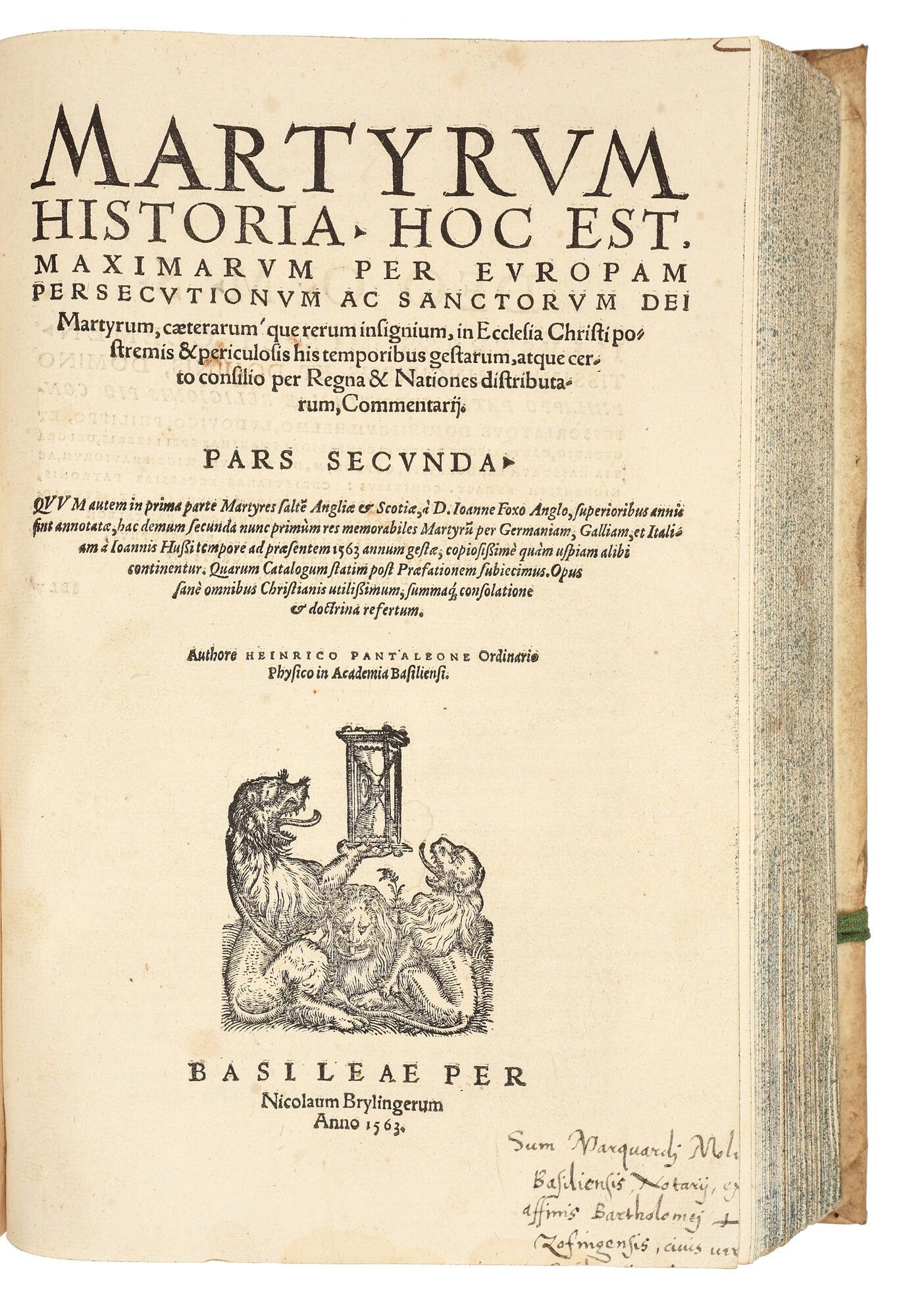
Martyrum historia hoc est maximarum per Europam persecutionum ac sanctorum dei Martyrum, caeterarumque rerum insignium, in Ecclesia Christi postremis et periculosis his temporibus gestarum, atque certo consilio per Regna et Nationes distributarum, Commentarii. Pars Secunda Qvvm autem in prima parte Martyres salte[m] Angliae & Scotiae, a D. Ioanne Foxo Anglo superioribus annis sint annotatae, hac demum secunda nunc primum res memorabiles Martyru[m] per Germaniam, Galliam, et Italiam a Ioannis Hussi tempore ad praesentem 1563 annum gestae continentur.
Basel: Per Nicolaum Brylingerum, et Ioannem Oporinum, 1559 [and] Per Nicolaum Brylingerum, 1563
Folio: 27 x 18 cm. Two books in one volume: I. [14], 732 [i.e. 736] pp. Collation: A4, a-z4, A-Z4, aa-qq4, rr8, ss-zz4, Aa-Ff4, Gg6, Hh-Ii4, Kk6, Ll-Yy4 (-Yy4 blank) II. [12], 160 [i.e. 361], [9] pp. Collation: π6, A-Z6, Aa-Hh6 (-Hh6 blank)
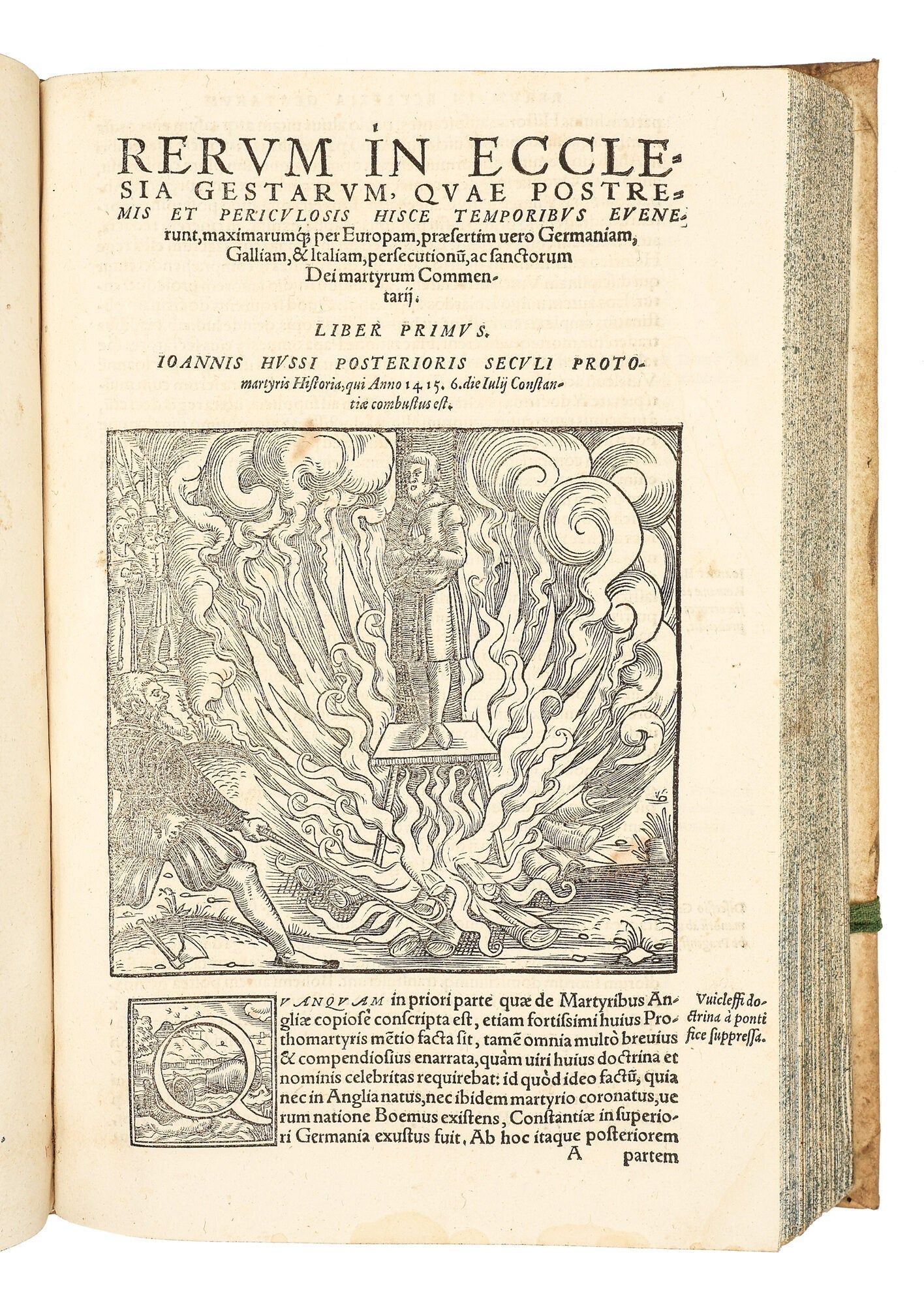
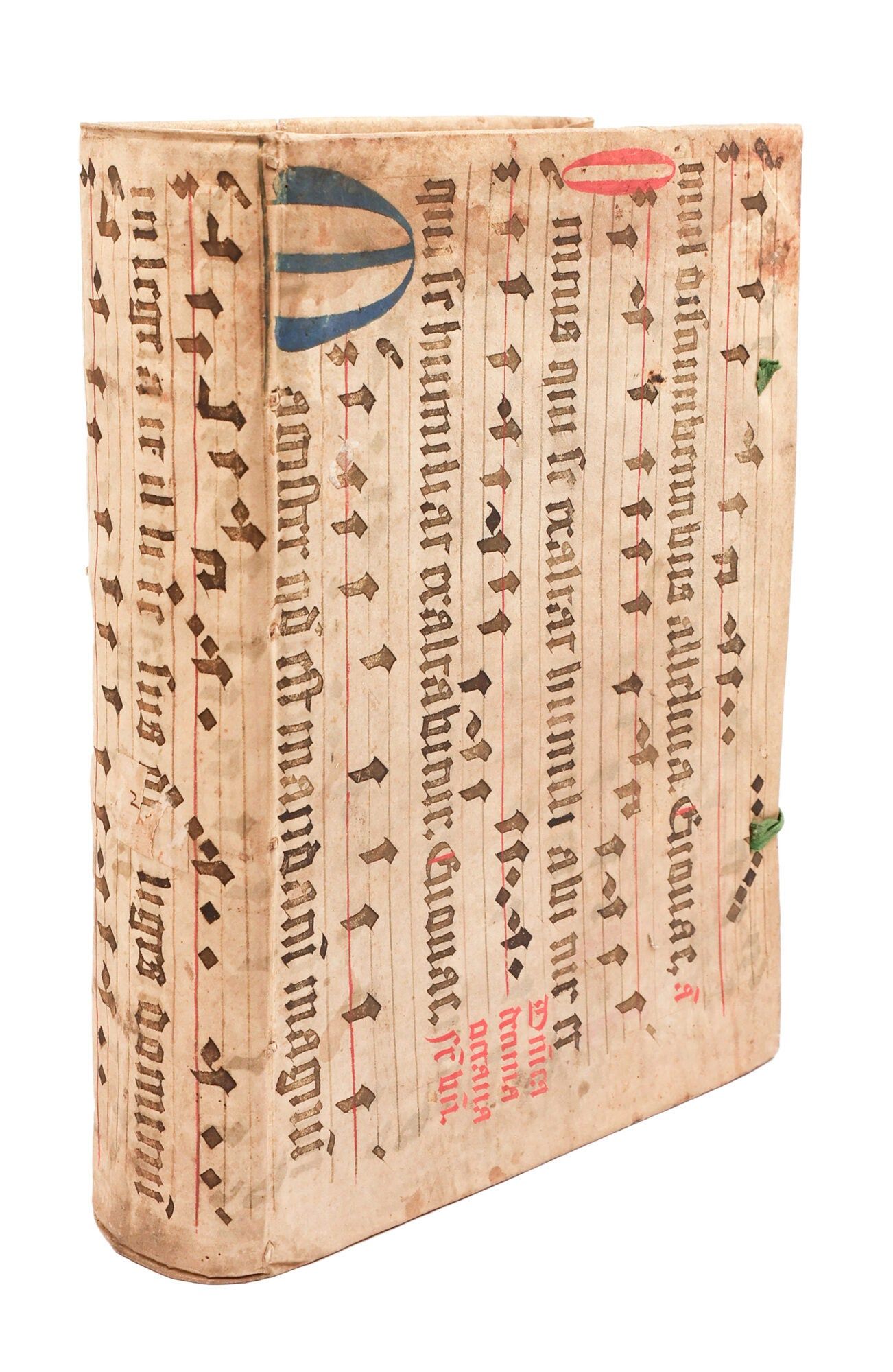
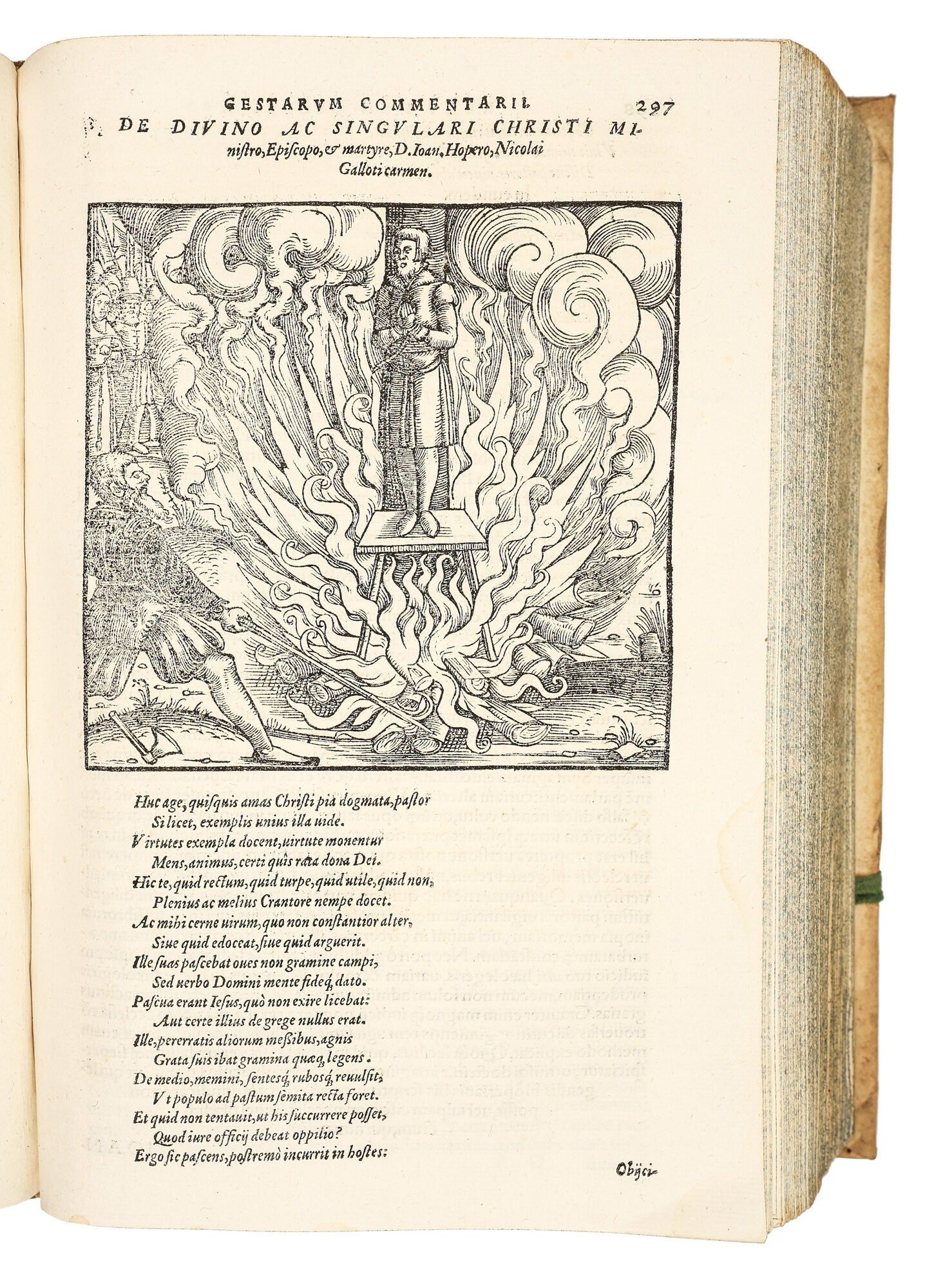
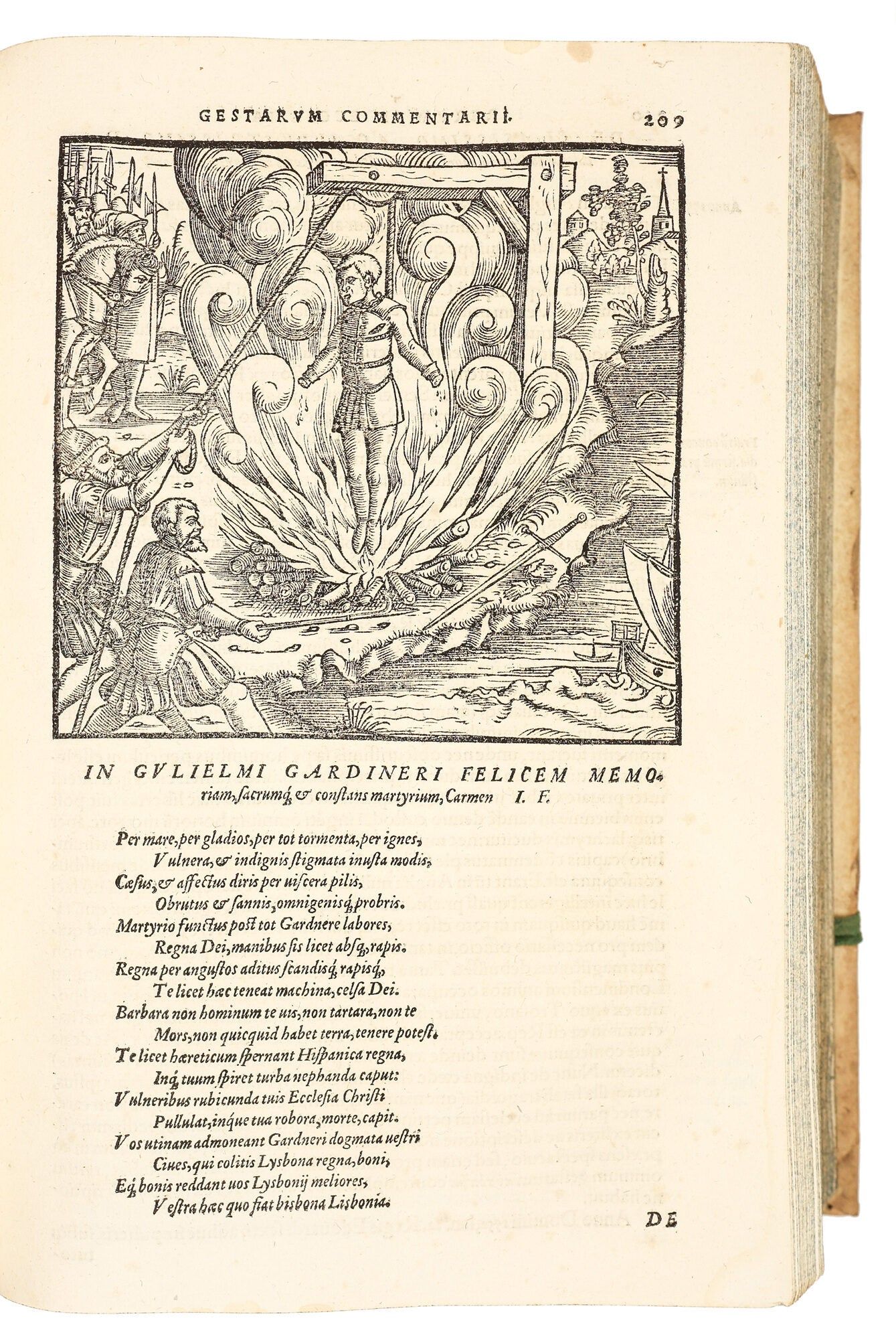
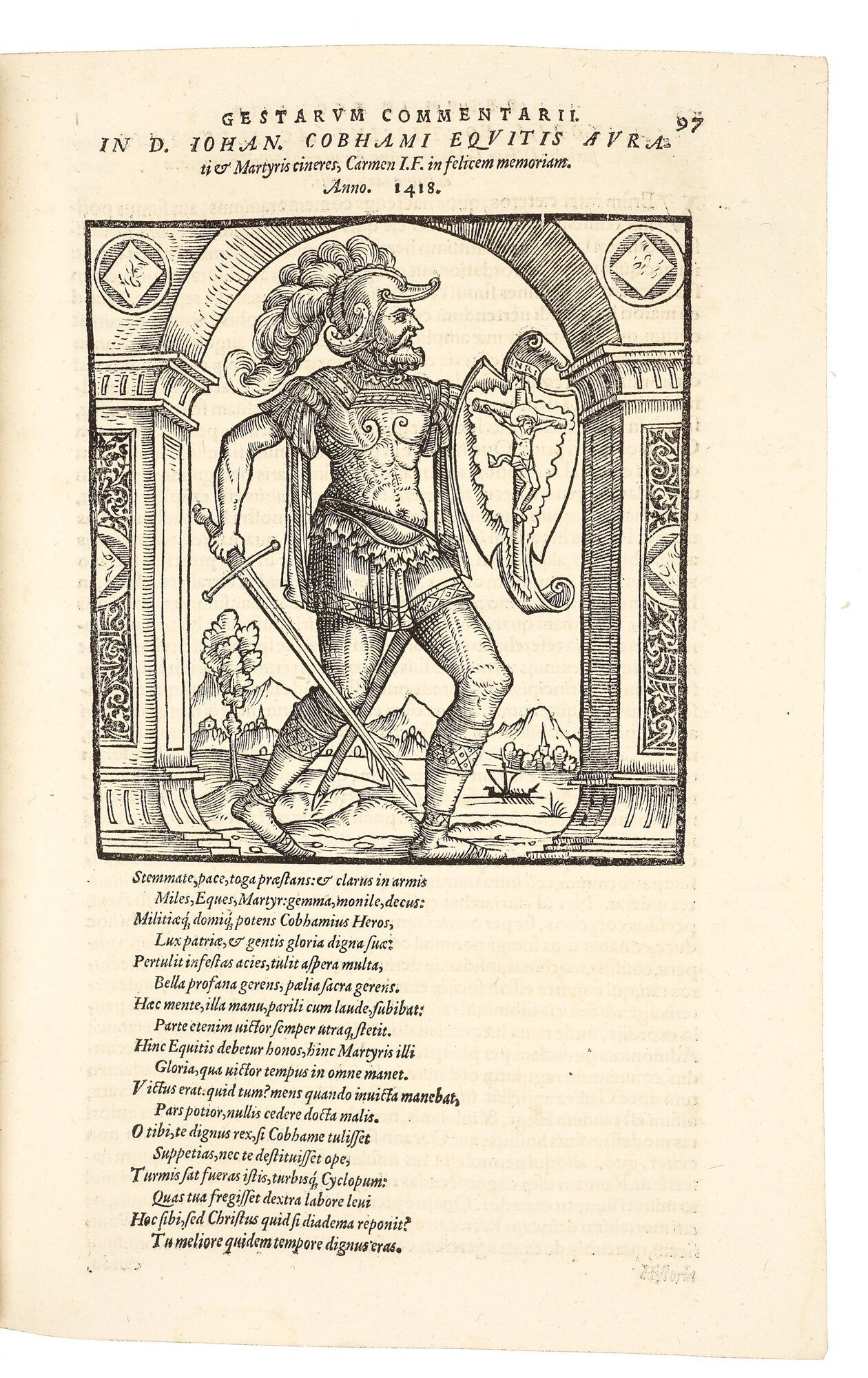
FIRST EDITION OF BOTH BOOKS. Bound in a later binding covered with an antiphonal leaf. Blank inner margin of first title restored (not affecting the text), the leaf lightly washed; short worm-trail in the text in the first three gatherings. Some light damp-staining in the lower blank margin, small hole in the text on three leaves (Xx2, Xx3, Yy1); last leaf with a few light stains. Illustrated with four large woodcuts (three of them of martyrs being burned at the stake) on leaves A1, D4, P4, Xx4 of the first work. With a partially trimmed contemporary ownership inscription on the second title page: "Sum Marquardi Moli[ ] Basiliensis Notarii, ex [ ] affinis Bartholomei + Zofingiensis civis ver[ ]..."
The rare first and sole edition of John Foxe's Latin martyrology of English and Scottish reformers, written while the author was in exile in Europe during the reign of Mary Tudor. The book would later serve as the basis for Foxe's "Book of Martyrs" (Acts and Monuments). The book, which begins with the life of John Wyclif and culminates in the Marian persecutions of his own day, was completed in the first year of Elizabeth's reign and shortly before Foxe's return to England. This copy is bound with Heinrich Pantaleon's 1563 martyrology of European reformers (Foxe had advertised such a book on the title page of the 1559 volume but it never materialized.) Pantaleon's book became an important resource for Foxe when he wrote the "Acts and Monuments" (see below).
The full title of the work reads: "A commentary on the events in the Church that have occurred both in the past and in these recent perilous times, including the greatest persecutions throughout Europe, and the martyrs of the saints of God, and other particularly notable events, organized by kingdoms and nations. The first part, in which is first contained a narrative of the events that took place in England and Scotland." The 750-page folio, referred to as Foxe's "second martyrology", was preceded by a shorter Latin martyrology, an octavo of 404 pages, with a similar name, "Commentarii rerum in ecclesia gestarum"(1554), in which Foxe covered only the earliest English reformers, such as Wyclif, and notable early European reformers like Jan Hus and Girolamo Savonarola.
"Foxe's second martyrology was originally designed as part of an even more ambitious undertaking [than his first]. The idea was formed, probably by Edmund Grindal [the Marian exile], who seems to have informally headed the project, for two parallel editions of a 'martyrum historia', one in English, the other in Latin. The Latin edition was entrusted to Foxe, while a team of exiles gathered data and prepared the English language edition. From the outset, however, despite Grindal's insistence that the two martyrologies be as similar as possible, Foxe seems to have envisioned a work different from the one Grindal had in mind, covering not only the Marian persecution, but also (and here John Bale's influence can be discerned) Lollards and pre-Marian reformers.
"Grindal had hoped to have both editions ready for publication soon after the summer of 1556, but this proved a wildly over-optimistic estimate. Foxe, who devoted himself increasingly to the Latin martyrology... nevertheless did not finish it until the late summer of 1559 and then only by abridging drastically its intended scope. The English-language martyrology was never completed at all. The work of Grindal's team was not, however, fruitless. They amassed a considerable collection of documents which were passed on to Foxe and were printed in his second martyrology...
"On 17 November, Queen Mary died. When the news reached the continent Grindal wrote to Foxe to recommend that he delay publishing his martyrology until 'we are able to obtain more accurate and more detailed information from England' (BL, Harley MS 417, fol. 102r-v). Foxe, however, ignored Grindal's advice and pressed on with his project...
"For the second martyrology, Foxe restricted his work (with the important exceptions of Jan Hus and Jerome Prague) to English men and women who died for the gospel. Nevertheless, as the full title of the book, 'Rerum in ecclesia gestarum ... commentarii', makes clear, with its reference to a Europe-wide persecution ('per Europam persecutionem'), Foxe planned a further volume or volumes on the sufferings of the godly on the continent, and never ceased to see the English Reformation in its larger European context.
"'Rerum in ecclesia gestarum... commentarii' [hereafter "Rerum'], printed in Basel in August 1559, was divided into six books. The first book was largely a reprint of Foxe's 1554 martyrology with some additions. The second book covered the reigns of Henry VIII and Edward VI, from the death of Richard Hunne in 1515 to the execution of the duke of Somerset in 1552. Foxe's two basic sources for this book were first Bale's 'Catalogus' [the first bio-bibliography of English authors] and then Edward Hall's 'Chronicle'. He supplemented these sources with Alexander Alesius's 'Of the Auctoritie of the Word of God', John Bale's edition of [the English martyr] John Lambert's 'Treatise on the Sacrament', and Bale's 'Examinations of Anne Askew', all reprinted (in Latin) in 'Rerum'. Foxe also relied on accounts sent to him by eyewitnesses; among these were the vivid description of the Duke of Somerset's execution in 1552 and, in a triumph of precisely directed enquiry, the extraordinarily accurate account of William Gardiner's martyrdom. With Edward VI's reign Foxe came into his own, but for events before the reign he was almost totally dependent on Bale's research, writings, and contacts.
"The final four books of 'Rerum' were devoted to the Marian persecution. Book 3, which covered the first eighteen months of Mary's reign and ended with the martyrdoms of John Rogers and John Hooper, was almost entirely a collage of print or manuscript treatises, including the letters of Jane Grey, Stephen Gardiner's examination of Sir James Hales, and two works by Hooper never subsequently reprinted: an appeal to the English nobility and a treatise on the eucharist. Where he had previously built on Bale's foundations, Foxe now relied on material gathered by Grindal and Heinrich Bullinger.
"The final three books, covering the period up to Cranmer's death in March 1556, are also based on the research of Grindal and his team, and probably represent what Grindal's planned martyrology would have looked like had it been written. They consist almost entirely of the writings of the martyrs themselves, generally their letters and their accounts of their examinations. Martyrs for whom such materials did not exist were simply listed unless informants supplied accounts of their sufferings. The final four pages of 'Rerum' merely list the martyrs of the final two and a half years of Mary's reign, along with the dates and locales of their executions; by now Oporinus [he work's printer] wanted the work finished in time for the Frankfurt book fair, while Foxe wanted to return home. 'Rerum' appeared, with a warm dedication to the duke of Norfolk, in September 1559.
"Although it was rushed and truncated, 'Rerum' was also Foxe's first great literary success. Jean Crespin expressed interest in printing a French translation of 'Rerum'; ultimately he simply paid Foxe the compliment of plagiarizing it liberally (Foxe responded in kind). Oporinus bestowed an equally backhanded compliment on his former employee by pestering him for the second part of the martyrology, which was eventually provided by Heinrich Pantaleon [bound with this copy], while the great Bullinger wrote congratulating Foxe on the work.
"Foxe had left England in 1554 penniless and relatively unknown. He returned home in October 1559 not much richer, but with a substantial reputation. He also returned with a goal: the completion, on his own terms, of the martyrology that he had started. Like Aaron's serpent, this project swallowed all the other concerns in Foxe's life, in a task that preoccupied him for the next decade."(ODNB)
II. Pantaleon's European Martyrology: A Source book for Foxe's "Acts & Monuments".
On the title page of the 1559 "Rervm", Foxe had promised a second part devoted to the European martyrs. When Foxe abandoned it to focus on the "Acts and Monuments", the printer of the first part recruited Heinrich Pantaleon, a friend of John Bale, to write it. The resulting "Martyrvm historia" was framed as the "second part" of Foxe's work. Pantaleon's book and the first edition of Foxe's "Acts and Monuments" have a publication date of 20 March 1563-a coordination that D. S. Gehring and T. S. Freeman argue was engineered by the publisher to link the works and boost sales. Unlike Foxe, Pantaleon had the ability to read numerous vernacular languages (German, French, and Dutch), and was therefore able to compile his account from existing major Protestant martyrologies. Through Pantaleon's Latin's text, Foxe was then able to access information that had previously been inaccessible to him.
In their study "Martyrologists without Boundaries: the Collaboration of John Foxe and Heinrich Pantaleon," Gehring and Freeman trace Foxe's use of Pantaleon's "Martyrvm historia" (Basel, 1563) in compiling the European sections of his "Acts and Monuments". They argue that Pantaleon's work enabled Foxe to realize his vision of a universal rather than merely national Protestant Church. Without the "Martyrvm historia", the "Acts and Monuments" would have been a largely insular record of England, Scotland, and France.
Pantaleon's influence is most apparent in the 1570 edition of the "Acts and Monuments", where Foxe added seventy folios on European martyrs. For the German martyrs, Foxe's reliance on Pantaleon was heavy-Gehring and Freeman estimate Foxe took as much as ninety percent of one key table from Pantaleon - and the Italian martyrs came almost entirely from Pantaleon, including material he had gathered firsthand through Italian Protestants in Basel.
Pantaleon, Heinrich (1522-1595)
Martyrum historia hoc est maximarum per Europam persecutionum ac sanctorum dei Martyrum, caeterarumque rerum insignium, in Ecclesia Christi postremis et periculosis his temporibus gestarum, atque certo consilio per Regna et Nationes distributarum, Commentarii. Pars Secunda Qvvm autem in prima parte Martyres salte[m] Angliae & Scotiae, a D. Ioanne Foxo Anglo superioribus annis sint annotatae, hac demum secunda nunc primum res memorabiles Martyru[m] per Germaniam, Galliam, et Italiam a Ioannis Hussi tempore ad praesentem 1563 annum gestae continentur.
Basel: Per Nicolaum Brylingerum, et Ioannem Oporinum, 1559 [and] Per Nicolaum Brylingerum, 1563
Folio: 27 x 18 cm. Two books in one volume: I. [14], 732 [i.e. 736] pp. Collation: A4, a-z4, A-Z4, aa-qq4, rr8, ss-zz4, Aa-Ff4, Gg6, Hh-Ii4, Kk6, Ll-Yy4 (-Yy4 blank) II. [12], 160 [i.e. 361], [9] pp. Collation: π6, A-Z6, Aa-Hh6 (-Hh6 blank)
FIRST EDITION OF BOTH BOOKS. Bound in a later binding covered with an antiphonal leaf. Blank inner margin of first title restored (not affecting the text), the leaf lightly washed; short worm-trail in the text in the first three gatherings. Some light damp-staining in the lower blank margin, small hole in the text on three leaves (Xx2, Xx3, Yy1); last leaf with a few light stains. Illustrated with four large woodcuts (three of them of martyrs being burned at the stake) on leaves A1, D4, P4, Xx4 of the first work. With a partially trimmed contemporary ownership inscription on the second title page: "Sum Marquardi Moli[ ] Basiliensis Notarii, ex [ ] affinis Bartholomei + Zofingiensis civis ver[ ]..."
The rare first and sole edition of John Foxe's Latin martyrology of English and Scottish reformers, written while the author was in exile in Europe during the reign of Mary Tudor. The book would later serve as the basis for Foxe's "Book of Martyrs" (Acts and Monuments). The book, which begins with the life of John Wyclif and culminates in the Marian persecutions of his own day, was completed in the first year of Elizabeth's reign and shortly before Foxe's return to England. This copy is bound with Heinrich Pantaleon's 1563 martyrology of European reformers (Foxe had advertised such a book on the title page of the 1559 volume but it never materialized.) Pantaleon's book became an important resource for Foxe when he wrote the "Acts and Monuments" (see below).
The full title of the work reads: "A commentary on the events in the Church that have occurred both in the past and in these recent perilous times, including the greatest persecutions throughout Europe, and the martyrs of the saints of God, and other particularly notable events, organized by kingdoms and nations. The first part, in which is first contained a narrative of the events that took place in England and Scotland." The 750-page folio, referred to as Foxe's "second martyrology", was preceded by a shorter Latin martyrology, an octavo of 404 pages, with a similar name, "Commentarii rerum in ecclesia gestarum"(1554), in which Foxe covered only the earliest English reformers, such as Wyclif, and notable early European reformers like Jan Hus and Girolamo Savonarola.
"Foxe's second martyrology was originally designed as part of an even more ambitious undertaking [than his first]. The idea was formed, probably by Edmund Grindal [the Marian exile], who seems to have informally headed the project, for two parallel editions of a 'martyrum historia', one in English, the other in Latin. The Latin edition was entrusted to Foxe, while a team of exiles gathered data and prepared the English language edition. From the outset, however, despite Grindal's insistence that the two martyrologies be as similar as possible, Foxe seems to have envisioned a work different from the one Grindal had in mind, covering not only the Marian persecution, but also (and here John Bale's influence can be discerned) Lollards and pre-Marian reformers.
"Grindal had hoped to have both editions ready for publication soon after the summer of 1556, but this proved a wildly over-optimistic estimate. Foxe, who devoted himself increasingly to the Latin martyrology... nevertheless did not finish it until the late summer of 1559 and then only by abridging drastically its intended scope. The English-language martyrology was never completed at all. The work of Grindal's team was not, however, fruitless. They amassed a considerable collection of documents which were passed on to Foxe and were printed in his second martyrology...
"On 17 November, Queen Mary died. When the news reached the continent Grindal wrote to Foxe to recommend that he delay publishing his martyrology until 'we are able to obtain more accurate and more detailed information from England' (BL, Harley MS 417, fol. 102r-v). Foxe, however, ignored Grindal's advice and pressed on with his project...
"For the second martyrology, Foxe restricted his work (with the important exceptions of Jan Hus and Jerome Prague) to English men and women who died for the gospel. Nevertheless, as the full title of the book, 'Rerum in ecclesia gestarum ... commentarii', makes clear, with its reference to a Europe-wide persecution ('per Europam persecutionem'), Foxe planned a further volume or volumes on the sufferings of the godly on the continent, and never ceased to see the English Reformation in its larger European context.
"'Rerum in ecclesia gestarum... commentarii' [hereafter "Rerum'], printed in Basel in August 1559, was divided into six books. The first book was largely a reprint of Foxe's 1554 martyrology with some additions. The second book covered the reigns of Henry VIII and Edward VI, from the death of Richard Hunne in 1515 to the execution of the duke of Somerset in 1552. Foxe's two basic sources for this book were first Bale's 'Catalogus' [the first bio-bibliography of English authors] and then Edward Hall's 'Chronicle'. He supplemented these sources with Alexander Alesius's 'Of the Auctoritie of the Word of God', John Bale's edition of [the English martyr] John Lambert's 'Treatise on the Sacrament', and Bale's 'Examinations of Anne Askew', all reprinted (in Latin) in 'Rerum'. Foxe also relied on accounts sent to him by eyewitnesses; among these were the vivid description of the Duke of Somerset's execution in 1552 and, in a triumph of precisely directed enquiry, the extraordinarily accurate account of William Gardiner's martyrdom. With Edward VI's reign Foxe came into his own, but for events before the reign he was almost totally dependent on Bale's research, writings, and contacts.
"The final four books of 'Rerum' were devoted to the Marian persecution. Book 3, which covered the first eighteen months of Mary's reign and ended with the martyrdoms of John Rogers and John Hooper, was almost entirely a collage of print or manuscript treatises, including the letters of Jane Grey, Stephen Gardiner's examination of Sir James Hales, and two works by Hooper never subsequently reprinted: an appeal to the English nobility and a treatise on the eucharist. Where he had previously built on Bale's foundations, Foxe now relied on material gathered by Grindal and Heinrich Bullinger.
"The final three books, covering the period up to Cranmer's death in March 1556, are also based on the research of Grindal and his team, and probably represent what Grindal's planned martyrology would have looked like had it been written. They consist almost entirely of the writings of the martyrs themselves, generally their letters and their accounts of their examinations. Martyrs for whom such materials did not exist were simply listed unless informants supplied accounts of their sufferings. The final four pages of 'Rerum' merely list the martyrs of the final two and a half years of Mary's reign, along with the dates and locales of their executions; by now Oporinus [he work's printer] wanted the work finished in time for the Frankfurt book fair, while Foxe wanted to return home. 'Rerum' appeared, with a warm dedication to the duke of Norfolk, in September 1559.
"Although it was rushed and truncated, 'Rerum' was also Foxe's first great literary success. Jean Crespin expressed interest in printing a French translation of 'Rerum'; ultimately he simply paid Foxe the compliment of plagiarizing it liberally (Foxe responded in kind). Oporinus bestowed an equally backhanded compliment on his former employee by pestering him for the second part of the martyrology, which was eventually provided by Heinrich Pantaleon [bound with this copy], while the great Bullinger wrote congratulating Foxe on the work.
"Foxe had left England in 1554 penniless and relatively unknown. He returned home in October 1559 not much richer, but with a substantial reputation. He also returned with a goal: the completion, on his own terms, of the martyrology that he had started. Like Aaron's serpent, this project swallowed all the other concerns in Foxe's life, in a task that preoccupied him for the next decade."(ODNB)
II. Pantaleon's European Martyrology: A Source book for Foxe's "Acts & Monuments".
On the title page of the 1559 "Rervm", Foxe had promised a second part devoted to the European martyrs. When Foxe abandoned it to focus on the "Acts and Monuments", the printer of the first part recruited Heinrich Pantaleon, a friend of John Bale, to write it. The resulting "Martyrvm historia" was framed as the "second part" of Foxe's work. Pantaleon's book and the first edition of Foxe's "Acts and Monuments" have a publication date of 20 March 1563-a coordination that D. S. Gehring and T. S. Freeman argue was engineered by the publisher to link the works and boost sales. Unlike Foxe, Pantaleon had the ability to read numerous vernacular languages (German, French, and Dutch), and was therefore able to compile his account from existing major Protestant martyrologies. Through Pantaleon's Latin's text, Foxe was then able to access information that had previously been inaccessible to him.
In their study "Martyrologists without Boundaries: the Collaboration of John Foxe and Heinrich Pantaleon," Gehring and Freeman trace Foxe's use of Pantaleon's "Martyrvm historia" (Basel, 1563) in compiling the European sections of his "Acts and Monuments". They argue that Pantaleon's work enabled Foxe to realize his vision of a universal rather than merely national Protestant Church. Without the "Martyrvm historia", the "Acts and Monuments" would have been a largely insular record of England, Scotland, and France.
Pantaleon's influence is most apparent in the 1570 edition of the "Acts and Monuments", where Foxe added seventy folios on European martyrs. For the German martyrs, Foxe's reliance on Pantaleon was heavy-Gehring and Freeman estimate Foxe took as much as ninety percent of one key table from Pantaleon - and the Italian martyrs came almost entirely from Pantaleon, including material he had gathered firsthand through Italian Protestants in Basel.
Details
Title
Rerum in ecclesia gestarum, quae postremis et perculosis his temporibus evenerunt maximarumque per Europam persecutionem ac sanctorum Dei martyrum caeterarumq[ue] rerum si quae insignioris exempli sint, digesti per regna & nationes commentarii : pars prima in qua primùm de rebus per Angliam & Scotiam gestis ... narratio continetur
Author
Foxe, John (1516/17-1587)
Binding
Hardcover
Condition
Fine
Publisher
Per Nicolaum Brylingerum, et Ioannem Oporinum: Basel
Date
1559