

Clementi's Introduction to the Art of playing on the Piano Forte: Containing, the Elements of Music; Preliminary notions on Fingering with Examples; and Fifty fingered Lessons, In the major and minor keys mostly in use by Composers of the first rank, Ancient and Modern: To which are prefixed short Preludes by the Author ... Price 10s. 6d. [Op. 42]
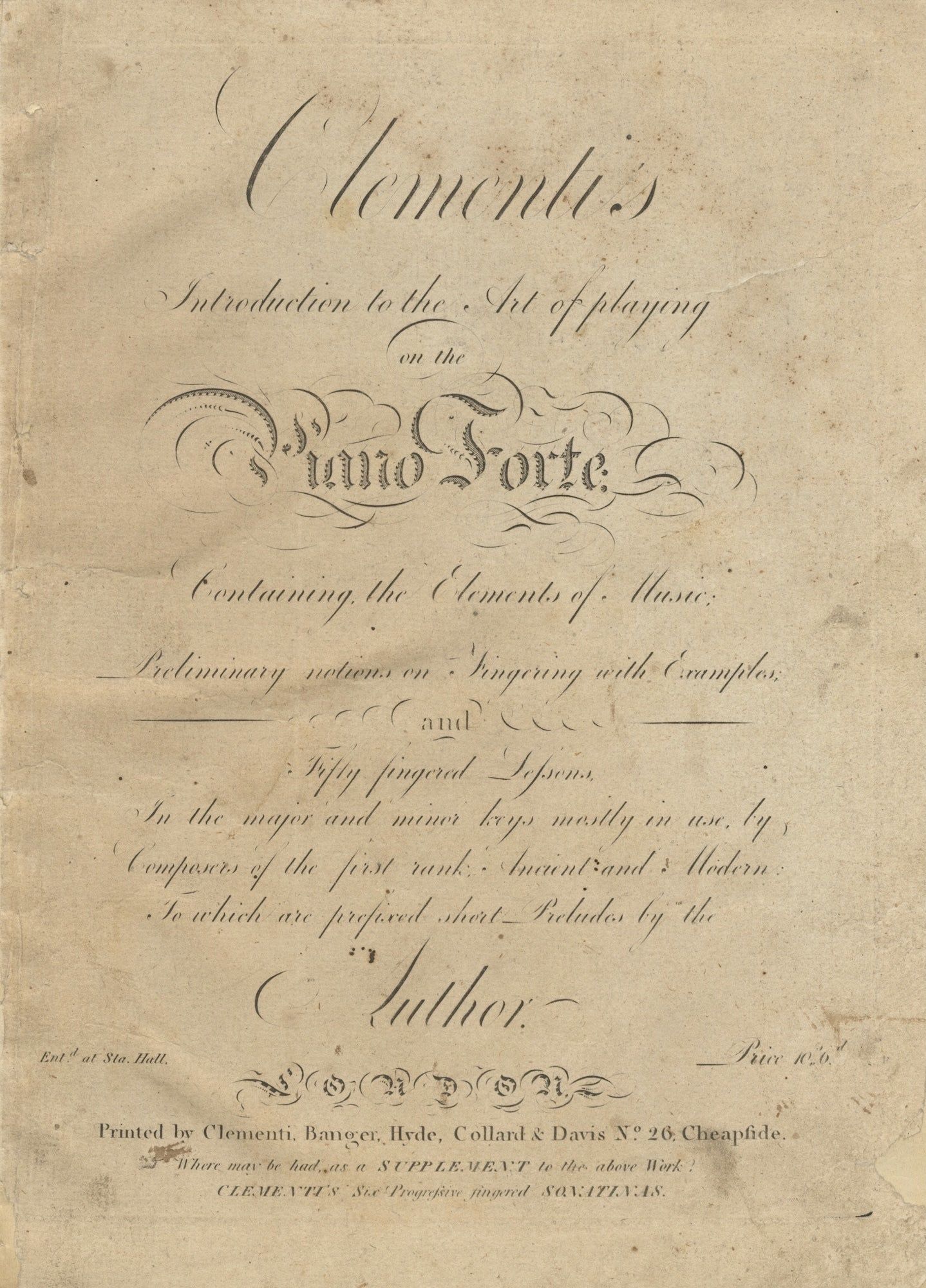
- London: Clementi, Banger, Hyde, Collard & Davis No. 26, Cheapside. where may be had, as a Supplement to the above Work, Clementi's Six P, 1806
London: Clementi, Banger, Hyde, Collard & Davis No. 26, Cheapside. where may be had, as a Supplement to the above Work, Clementi's Six Progressive fingered Sonatinas, 1806. Folio. Disbound. 1f. (recto title, verso blank), 63, [i] (blank) pp. Watermark 1806.
Occasional markings in pen, some dashes, and the final notes of the 23rd lesson cancelled, p. 35.
Slightly worn; minor soiling to blank lower margins; occasional small tears to lower edges; occasional repairs, including to lower outer corner of title, with outer margin of blank verso reinforced; lower portion of blank outer margin of first page reinforced. First Edition, later issue of this highly influential work. Tyson p. 84. RISM C3080 (two copies only).
The "preliminaries" include observations on "Clefs; The Scale, or Gamut; Exercise for treble notes; Exercise for bass notes; Intervals; Example of the Natural or Diatonic scale; Example of Intervals; Tenor, Counter-tenor, and Soprano clefs explained; Figure, Length, and relative Value of Notes; Time and its divisions; Sharps, and Flats, &c.; Various other marks; Abbreviations; Style, Graces, and marks of Expression, &c.; Appogiaturas, and other Graces in small notes explained; Turns, Shakes, and Beats, explained; Major, and Minor Modes or Keys; Explanation of Various Terms; Fingering; Extensions and Contractions &c. ...
Intended for the complete beginner, it starts off with a compact explanation of musical notation and elementary theory, including time-signatures, tonalities, and ornamentation, and then proceeds to specifically pianistic matters such as hand position... and fingering. A series of exercises follows: scales, arpeggios, and, surprisingly early on, passages in thirds and sixths. The bulk of Clementi's Introduction is a remarkable series of fifty 'lessons' - short pieces of various kinds and various grades of difficulty by diverse composers. They are arranged by keys (eighteen of the twenty-four are represented), and each group is prefaced with a prelude by Clementi.
These 'lessons' provide further evidence of the scale and range of Clementi's activities as a collector of music during this period. Compositions of Cavalli, Bach [J.S. and C.P.E], Handel, D. Scarlatti, Couperin, and Rameau are placed alongside pieces by Haydn and Pleyel, and by Clementi's younger contemporaries, Cramer, Dussek, and Beethoven... J.S. Bach is represented by the Polonaise and Minuet from the Sixth French Suite in E major [Lesson XLVIII, pp. 62-63, BWV817]. This is one of several first printings of Bach for which Clementi was responsible during this period, none of which, so far as I can ascertain, has been recognized as such. .. The Introduction also features one of Beethoven's earliest appearances in print in England [Lesson XXXIX, p. 52]... his slight 'Ländlerischer Tanz' - Clementi calls it a waltz - in D major, WO 11 ...
The ageing Beethoven thought highly of it; Schindler tells us this, and several of the composer's letters from 1825 and 1826 record his efforts to secure more copies of the work ...
The fullest testimony we have as to Beethoven's regard for Clementi's music is that of the composer's assistant Anton Felix Schindler: He had nothing by Haydn or Cherubini; of Mozart's music he had a part of the score of Don Giovanni and many sonatas. Almost all of Clementi's sonatas were at hand. He had the greatest admiration for these sonatas, considering them the most beautiful, the most pianistic of works, both for their lovely, pleasing, original melodies and for the consistent, easily followed form of each movement... The musical education of his beloved nephew was confined for many years almost exclusively to the playing of Clementi sonatas." Plantinga: Clementi, pp. 164-167, 310.
"This tutor was designed primarily as a succinct introduction to the basic knowledge required by the rapidly-growing class of amateur music-makers. Nevertheless, the brief remarks and exercises were sufficient to reveal to the observant reader and skillful teacher of the time the germ of the new technical skills and interpretative knowledge needed for performance of the emerging piano literature. Thus, this volume, which was more up-to-date than many others written between 1800 and 1820, discloses significant details concerning the transitional state of keyboard performance at the turn of the century, some twenty years after the pianoforte achieved primacy among the keyboard instruments." Sandra P. Rosenblum in her introduction to a facsimile of the second issue of the work published in New York by Da Capo in 1974.
Occasional markings in pen, some dashes, and the final notes of the 23rd lesson cancelled, p. 35.
Slightly worn; minor soiling to blank lower margins; occasional small tears to lower edges; occasional repairs, including to lower outer corner of title, with outer margin of blank verso reinforced; lower portion of blank outer margin of first page reinforced. First Edition, later issue of this highly influential work. Tyson p. 84. RISM C3080 (two copies only).
The "preliminaries" include observations on "Clefs; The Scale, or Gamut; Exercise for treble notes; Exercise for bass notes; Intervals; Example of the Natural or Diatonic scale; Example of Intervals; Tenor, Counter-tenor, and Soprano clefs explained; Figure, Length, and relative Value of Notes; Time and its divisions; Sharps, and Flats, &c.; Various other marks; Abbreviations; Style, Graces, and marks of Expression, &c.; Appogiaturas, and other Graces in small notes explained; Turns, Shakes, and Beats, explained; Major, and Minor Modes or Keys; Explanation of Various Terms; Fingering; Extensions and Contractions &c. ...
Intended for the complete beginner, it starts off with a compact explanation of musical notation and elementary theory, including time-signatures, tonalities, and ornamentation, and then proceeds to specifically pianistic matters such as hand position... and fingering. A series of exercises follows: scales, arpeggios, and, surprisingly early on, passages in thirds and sixths. The bulk of Clementi's Introduction is a remarkable series of fifty 'lessons' - short pieces of various kinds and various grades of difficulty by diverse composers. They are arranged by keys (eighteen of the twenty-four are represented), and each group is prefaced with a prelude by Clementi.
These 'lessons' provide further evidence of the scale and range of Clementi's activities as a collector of music during this period. Compositions of Cavalli, Bach [J.S. and C.P.E], Handel, D. Scarlatti, Couperin, and Rameau are placed alongside pieces by Haydn and Pleyel, and by Clementi's younger contemporaries, Cramer, Dussek, and Beethoven... J.S. Bach is represented by the Polonaise and Minuet from the Sixth French Suite in E major [Lesson XLVIII, pp. 62-63, BWV817]. This is one of several first printings of Bach for which Clementi was responsible during this period, none of which, so far as I can ascertain, has been recognized as such. .. The Introduction also features one of Beethoven's earliest appearances in print in England [Lesson XXXIX, p. 52]... his slight 'Ländlerischer Tanz' - Clementi calls it a waltz - in D major, WO 11 ...
The ageing Beethoven thought highly of it; Schindler tells us this, and several of the composer's letters from 1825 and 1826 record his efforts to secure more copies of the work ...
The fullest testimony we have as to Beethoven's regard for Clementi's music is that of the composer's assistant Anton Felix Schindler: He had nothing by Haydn or Cherubini; of Mozart's music he had a part of the score of Don Giovanni and many sonatas. Almost all of Clementi's sonatas were at hand. He had the greatest admiration for these sonatas, considering them the most beautiful, the most pianistic of works, both for their lovely, pleasing, original melodies and for the consistent, easily followed form of each movement... The musical education of his beloved nephew was confined for many years almost exclusively to the playing of Clementi sonatas." Plantinga: Clementi, pp. 164-167, 310.
"This tutor was designed primarily as a succinct introduction to the basic knowledge required by the rapidly-growing class of amateur music-makers. Nevertheless, the brief remarks and exercises were sufficient to reveal to the observant reader and skillful teacher of the time the germ of the new technical skills and interpretative knowledge needed for performance of the emerging piano literature. Thus, this volume, which was more up-to-date than many others written between 1800 and 1820, discloses significant details concerning the transitional state of keyboard performance at the turn of the century, some twenty years after the pianoforte achieved primacy among the keyboard instruments." Sandra P. Rosenblum in her introduction to a facsimile of the second issue of the work published in New York by Da Capo in 1974.
Details
Title
Clementi's Introduction to the Art of playing on the Piano Forte: Containing, the Elements of Music; Preliminary notions on Fingering with Examples; and Fifty fingered Lessons, In the major and minor keys mostly in use by Composers of the first rank, Ancient and Modern: To which are prefixed short Preludes by the Author ... Price 10s. 6d. [Op. 42]
Author
CLEMENTI, Muzio 1752-1832
Condition
Unknown
Publisher
Clementi, Banger, Hyde, Collard & Davis No. 26, Cheapside. where may be had, as a Supplement to the above Work, Clementi's Six P: London
Date
1806