

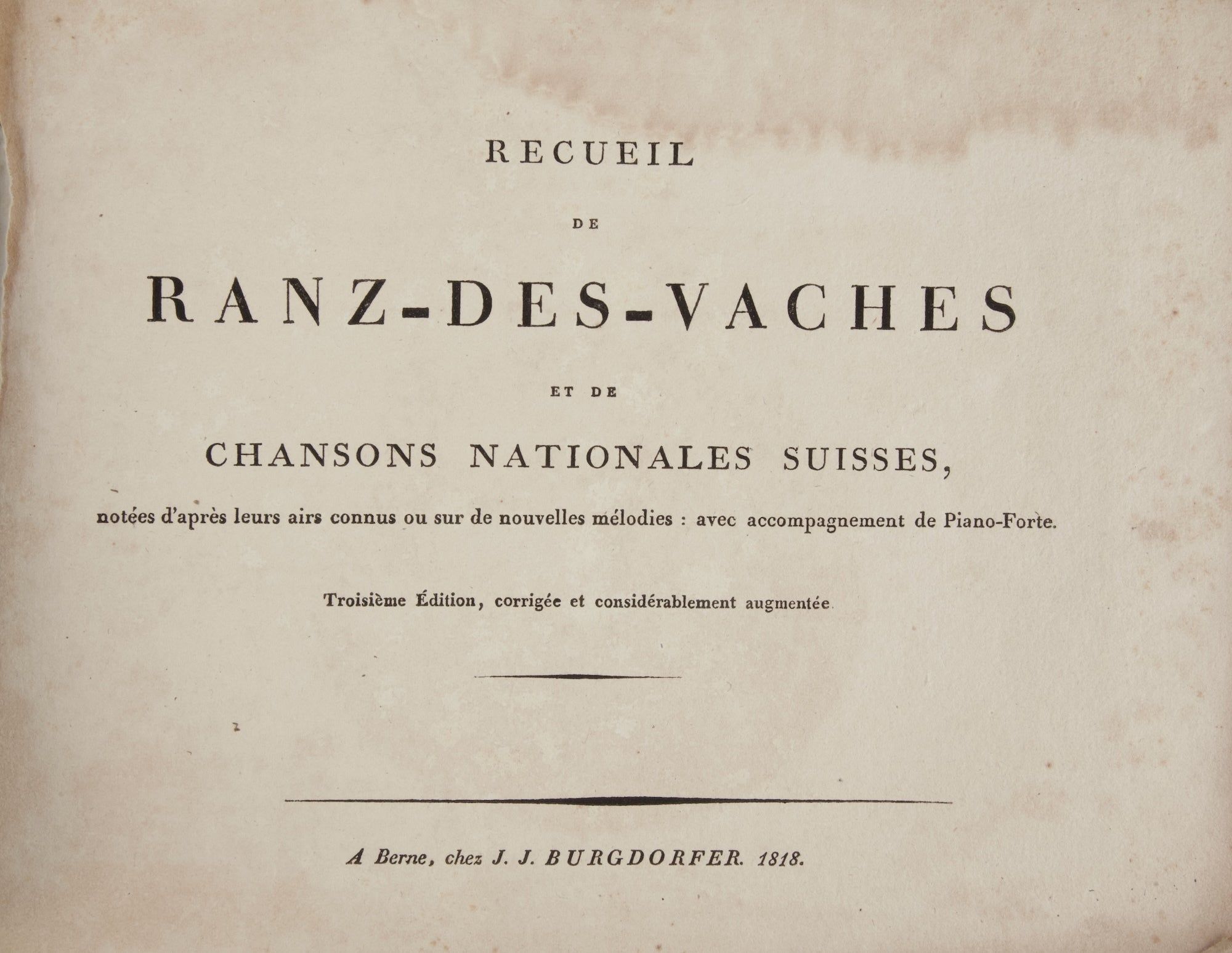
Recueil de ranz-des-vaches et chansons nationales Suisses, notées d'après leurs airs connus ou sur de nouvelles mélodies: avec accompagnement de Piano-Forte. Troisième Édition, corrigée et considérablement augmentée
- Berne: J. J. Burgdorfer, 1818
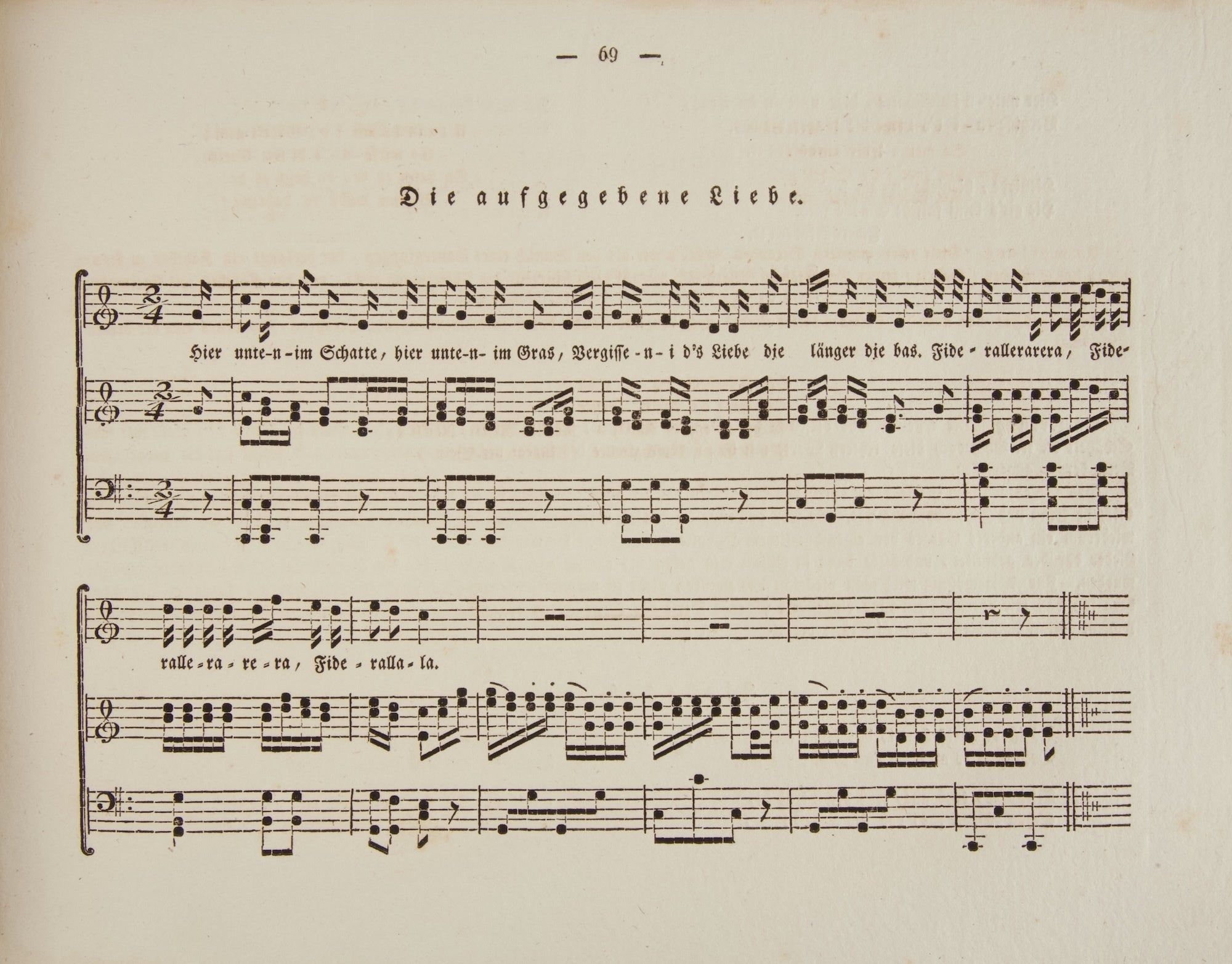
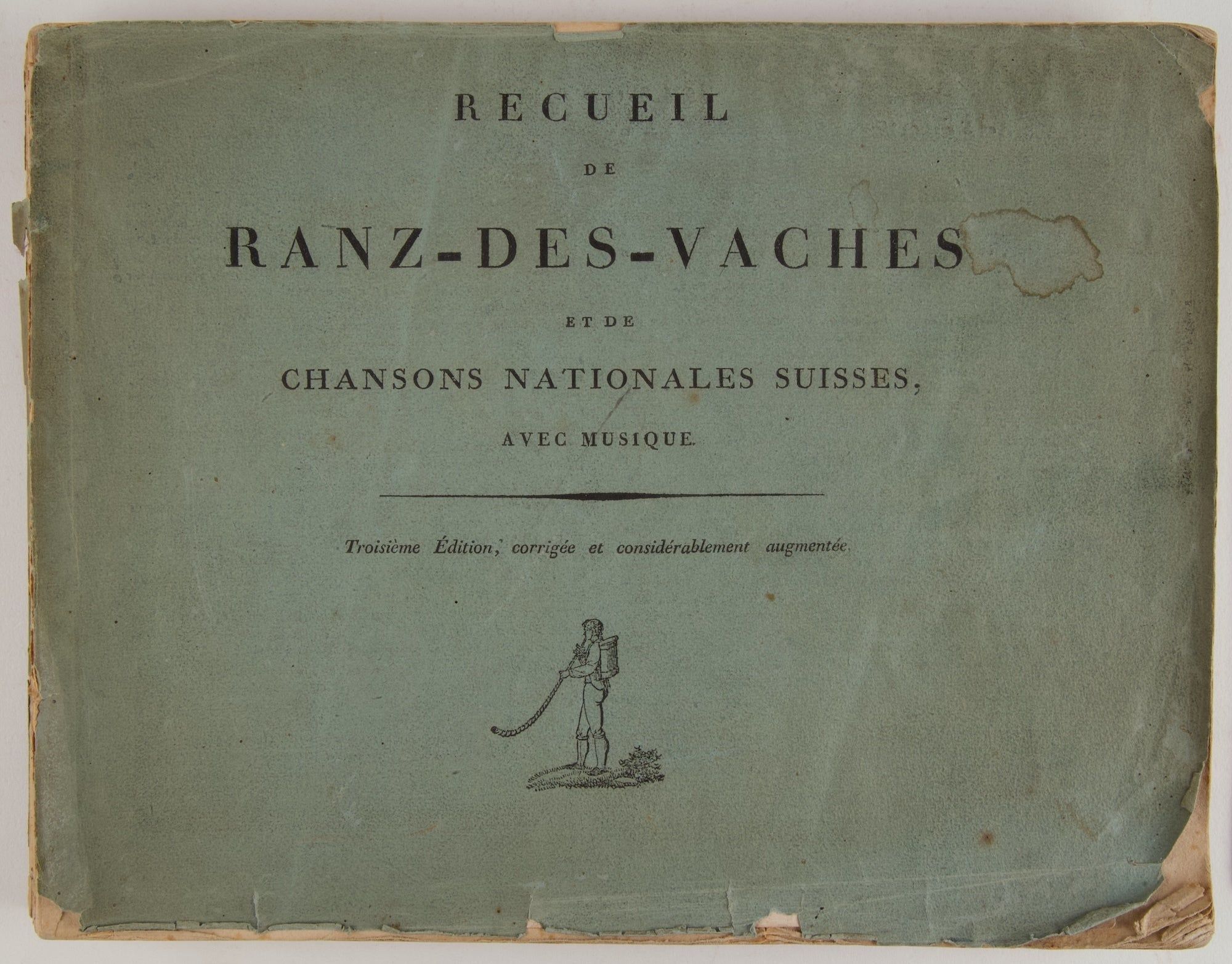
Berne: J. J. Burgdorfer, 1818. Oblong quarto. Original publisher's mid-green printed wrappers. 1f. (recto title, verso blank), 1f. ("Inhalt"), [v-x] ("Préface de la seconde édition"), xi-xxiv ("Avant-propos de la troisième édition"), 126 (music), 127-131 ("Worterklärungen"), 132-133 ("Traduction Interlinèaire du Ranz des Vaches d'Appenzell, p. 24"), 134-135 ("Verbesserungen in der Musik."), 136 ("Verbesserungen.") pp.
55 songs in German/Swiss dialects, with the exception of those to pp. 107-122 in French. Preface by Johann Rudolf Wyss, noted Swiss editor, writer, and scholar. Typeset throughout. With illustration of Alphorn player to upper and Swiss female figure to lower wrapper.
"Articles de Fonds en livres et objects d'arts, concernant la Suisse, qu'on trouve aussi chez les principaux libraires de la Suisse" to verso of upper and recto of lower wrapper.
Scored mainly for voice and piano, with instrumental selections for piano and unspecified treble instrument.
Wrappers worn, with several small stains and tears to edges; upper nearly detached, with lower margin of verso repaired with ivory tape. Light uniform browning; occasional minor foxing and small stains; signatures loose. Third edition. OCLC 20912723.
A compilation of traditional Swiss folk songs and occasional instrumental selections, including music for the Alphorn and solo piano compositions, many arranged by Ferdinand Fürchtegott Huber.
The alphorn was a "wooden trumpet of pastoral communities in the Alps. ... The commonest length of the alphorn is about 185 cm, in which case its range extends to the 5th or 6th harmonic (as quoted by Beethoven at the end of the Pastoral Symphony). ... Alphorns were known best as herdsmen's calling instruments, serving also in some areas to summon to church and formerly to war. They may also be numinous: among the Mari of Russia the long wooden trumpet is made for the spring festival and afterwards sacrificially burnt or hidden in a sacred place. Overall likeness in making and using alphorns, and their distribution, suggest that they possibly may have originated among post-Celtic peoples of the Migration Era. There is no firm evidence of prior existence; 'cornu alpinus' in Tacitus is less than proof of a wooden trumpet, of which the earliest specimen, from the 9th-century Oseberg ship (Oslo, Vikingskiphuset), supports iconographic suggestions that wooden trumpets of moderate size were used as summoning and military instruments in early medieval northern Europe in addition to their pastoral functions." Anthony C. Baines, revised by Max Peter Baumann in Grove Music Online. Rossini evoked the Alphorn in his iconic 1829 William Tell Overture.
Of great importance to the preservation of the oral heritage of Swiss alpine herders.
55 songs in German/Swiss dialects, with the exception of those to pp. 107-122 in French. Preface by Johann Rudolf Wyss, noted Swiss editor, writer, and scholar. Typeset throughout. With illustration of Alphorn player to upper and Swiss female figure to lower wrapper.
"Articles de Fonds en livres et objects d'arts, concernant la Suisse, qu'on trouve aussi chez les principaux libraires de la Suisse" to verso of upper and recto of lower wrapper.
Scored mainly for voice and piano, with instrumental selections for piano and unspecified treble instrument.
Wrappers worn, with several small stains and tears to edges; upper nearly detached, with lower margin of verso repaired with ivory tape. Light uniform browning; occasional minor foxing and small stains; signatures loose. Third edition. OCLC 20912723.
A compilation of traditional Swiss folk songs and occasional instrumental selections, including music for the Alphorn and solo piano compositions, many arranged by Ferdinand Fürchtegott Huber.
The alphorn was a "wooden trumpet of pastoral communities in the Alps. ... The commonest length of the alphorn is about 185 cm, in which case its range extends to the 5th or 6th harmonic (as quoted by Beethoven at the end of the Pastoral Symphony). ... Alphorns were known best as herdsmen's calling instruments, serving also in some areas to summon to church and formerly to war. They may also be numinous: among the Mari of Russia the long wooden trumpet is made for the spring festival and afterwards sacrificially burnt or hidden in a sacred place. Overall likeness in making and using alphorns, and their distribution, suggest that they possibly may have originated among post-Celtic peoples of the Migration Era. There is no firm evidence of prior existence; 'cornu alpinus' in Tacitus is less than proof of a wooden trumpet, of which the earliest specimen, from the 9th-century Oseberg ship (Oslo, Vikingskiphuset), supports iconographic suggestions that wooden trumpets of moderate size were used as summoning and military instruments in early medieval northern Europe in addition to their pastoral functions." Anthony C. Baines, revised by Max Peter Baumann in Grove Music Online. Rossini evoked the Alphorn in his iconic 1829 William Tell Overture.
Of great importance to the preservation of the oral heritage of Swiss alpine herders.
Details
Title
Recueil de ranz-des-vaches et chansons nationales Suisses, notées d'après leurs airs connus ou sur de nouvelles mélodies: avec accompagnement de Piano-Forte. Troisième Édition, corrigée et considérablement augmentée
Author
[SWISS SONGS - Early 19th Century]. Wyss, Johann Rudolf, ed. 1782-1830
Condition
Unknown
Publisher
J. J. Burgdorfer: Berne
Date
1818