

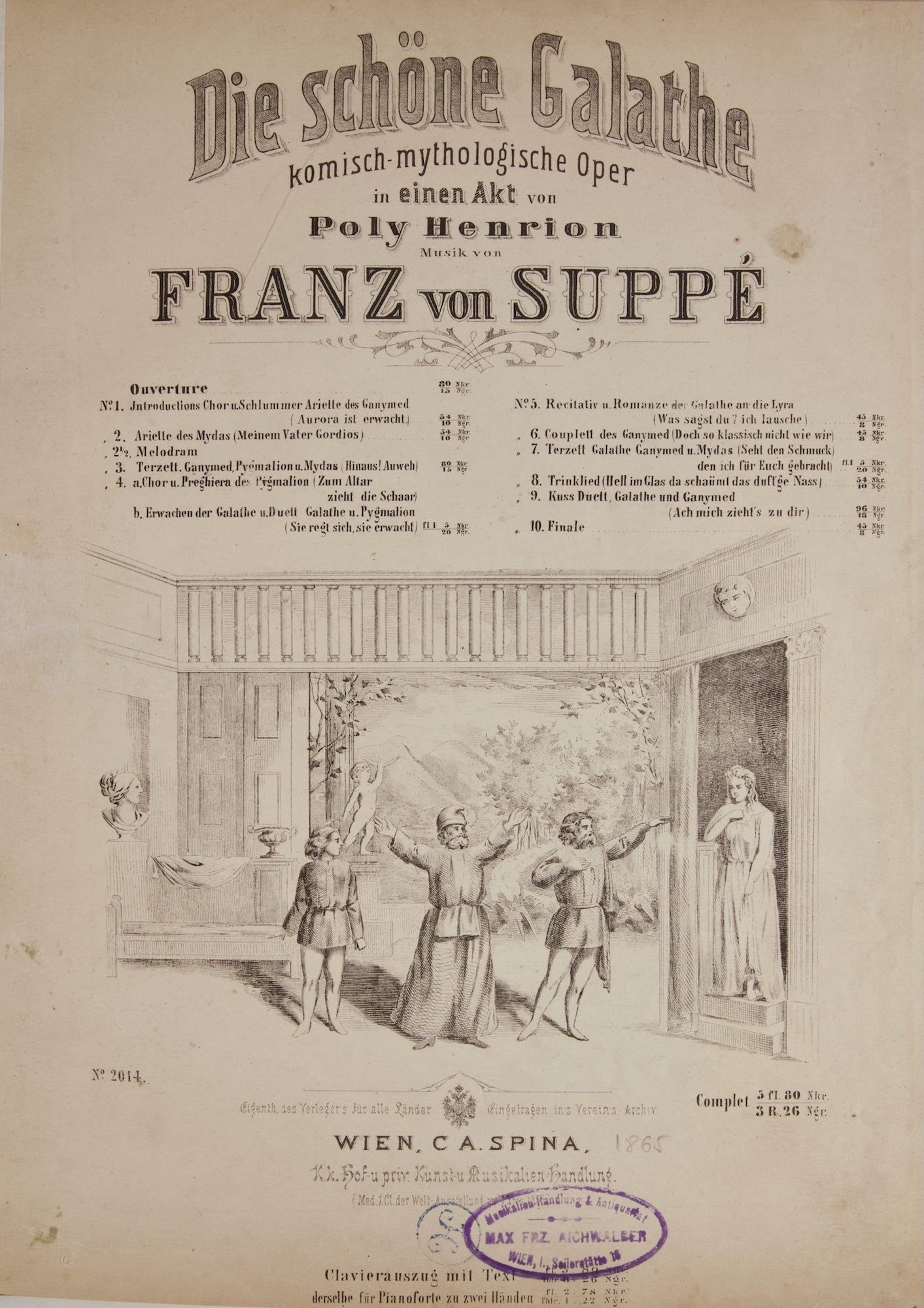
Die schöne Galathe komisch-mythologische Oper in einen Akt von Poly Henrion ... No. 2014 ... Complet 3fl. 30 Nkr. 3 R. 26 Ngr. [Piano-vocal score]
- Wien: C .A. Spina [PNs F.G. 2014; 2014 No.1-2014 No. 8; F.G. 2014.9], 1865
Wien: C .A. Spina [PNs F.G. 2014; 2014 No.1-2014 No. 8; F.G. 2014.9], 1865. Folio. Half dark brown textured cloth with marbled boards, manuscript title label to upper. 1f. (recto title, verso blank), 3-80 pp. Title lithographed, music engraved.
With fine illustrated title of a scene from the opera with singers and Greco-Roman set incorporating columns, sculptural bust, and mascaron.
Occasional small stains and minor soiling, mainly to lower blank margins; narrow strip of white paper to blank inner margin of title with small tape repair. First Edition. OCLC 30370740.
Die schöne Galathean, an operetta in one act to a libretto by "Poly Henrion" (L. Kohn von Kohlenegg), was first performed in Berlin at Meysel's on 30 June 1865.
"Suppé is the earliest Viennese composer of musical farces whose works still survive as viable stage scores (and popular overtures), and later in his career he became the first master of the classical Viennese operetta in the train of the acclimatized scores of Offenbach. His light, fluent style includes the ability to vary a phrase length or melodic and rhythmic figure in a personal and immediately effective way. Though now remembered mainly as the composer of overtures such as Poet and Peasant, Light Cavalry and Morning, Noon and Night in Vienna, his ambitions extended to the composition of large-scale sacred works and operas. He is at his best and most characteristic in the series of famous operettas from Die schöne Galathee (1865) to Boccaccio (1879). Numbers like 'Hab ich nur deine Liebe', 'Mia bella Fiorentina' and 'Holde Schöne' from Boccaccio have an irresistible elegance and élan, and his scoring is worthy of the finest orchestras rather than the bands that so often seize upon the overtures in particular. The song 'O du [Das ist] mein Österreich' of 1849 has become virtually Austria's second national song." Peter Branscombe and Dorothea Link in Grove Music Online
The sculptor Pygmalion (tenor) has produced a statue of a beautiful woman, Galathea, which the wealthy art collector Mydas (buffo baritone) wishes to buy; but Pygmalion will not part with it. He wishes that the beautiful creature could be alive and prays to Venus to this end. Galathea does come to life (soprano), but causes havoc with her flirtations with Pygmalion's servant Ganymede (mezzo-soprano), her extraction of jewels from Mydas, her taste for wine and her tantrums. Pygmalion's prayer that Galathea be returned to stone is answered, but Mydas's jewels are turned to stone too. Pygmalion is now only too happy to let Mydas buy the statue." Andrew Lamb in Grove Music Online
A Viennese response to Offenbach, Suppé's richly melodic score includes Mydas's 'Meinem Vater Gordios', Galathea's awakening ('Sie regt sich, sie erwacht'), her drinking song 'Hell im Glas', Ganymede's 'Wir Griechen', the treasure trio 'Seht den Schmuck' and Ganymede's kissing duet with Galathea 'Ach, mich zieht's zu dir'. At the first production Anna Grobecker of the Carltheater, Vienna, made a guest appearance as Ganymede." ibid.
With fine illustrated title of a scene from the opera with singers and Greco-Roman set incorporating columns, sculptural bust, and mascaron.
Occasional small stains and minor soiling, mainly to lower blank margins; narrow strip of white paper to blank inner margin of title with small tape repair. First Edition. OCLC 30370740.
Die schöne Galathean, an operetta in one act to a libretto by "Poly Henrion" (L. Kohn von Kohlenegg), was first performed in Berlin at Meysel's on 30 June 1865.
"Suppé is the earliest Viennese composer of musical farces whose works still survive as viable stage scores (and popular overtures), and later in his career he became the first master of the classical Viennese operetta in the train of the acclimatized scores of Offenbach. His light, fluent style includes the ability to vary a phrase length or melodic and rhythmic figure in a personal and immediately effective way. Though now remembered mainly as the composer of overtures such as Poet and Peasant, Light Cavalry and Morning, Noon and Night in Vienna, his ambitions extended to the composition of large-scale sacred works and operas. He is at his best and most characteristic in the series of famous operettas from Die schöne Galathee (1865) to Boccaccio (1879). Numbers like 'Hab ich nur deine Liebe', 'Mia bella Fiorentina' and 'Holde Schöne' from Boccaccio have an irresistible elegance and élan, and his scoring is worthy of the finest orchestras rather than the bands that so often seize upon the overtures in particular. The song 'O du [Das ist] mein Österreich' of 1849 has become virtually Austria's second national song." Peter Branscombe and Dorothea Link in Grove Music Online
The sculptor Pygmalion (tenor) has produced a statue of a beautiful woman, Galathea, which the wealthy art collector Mydas (buffo baritone) wishes to buy; but Pygmalion will not part with it. He wishes that the beautiful creature could be alive and prays to Venus to this end. Galathea does come to life (soprano), but causes havoc with her flirtations with Pygmalion's servant Ganymede (mezzo-soprano), her extraction of jewels from Mydas, her taste for wine and her tantrums. Pygmalion's prayer that Galathea be returned to stone is answered, but Mydas's jewels are turned to stone too. Pygmalion is now only too happy to let Mydas buy the statue." Andrew Lamb in Grove Music Online
A Viennese response to Offenbach, Suppé's richly melodic score includes Mydas's 'Meinem Vater Gordios', Galathea's awakening ('Sie regt sich, sie erwacht'), her drinking song 'Hell im Glas', Ganymede's 'Wir Griechen', the treasure trio 'Seht den Schmuck' and Ganymede's kissing duet with Galathea 'Ach, mich zieht's zu dir'. At the first production Anna Grobecker of the Carltheater, Vienna, made a guest appearance as Ganymede." ibid.
Details
Title
Die schöne Galathe komisch-mythologische Oper in einen Akt von Poly Henrion ... No. 2014 ... Complet 3fl. 30 Nkr. 3 R. 26 Ngr. [Piano-vocal score]
Author
SUPPÉ, Franz von 1819-1895
Condition
Unknown
Publisher
C .A. Spina [PNs F.G. 2014; 2014 No.1-2014 No. 8; F.G. 2014.9]: Wien
Date
1865