

Six Sonatas for the Piano Forte or Harpsichord With a Violin Accompaniment ... Opera II. Price 10s „6d. [Piano part only]
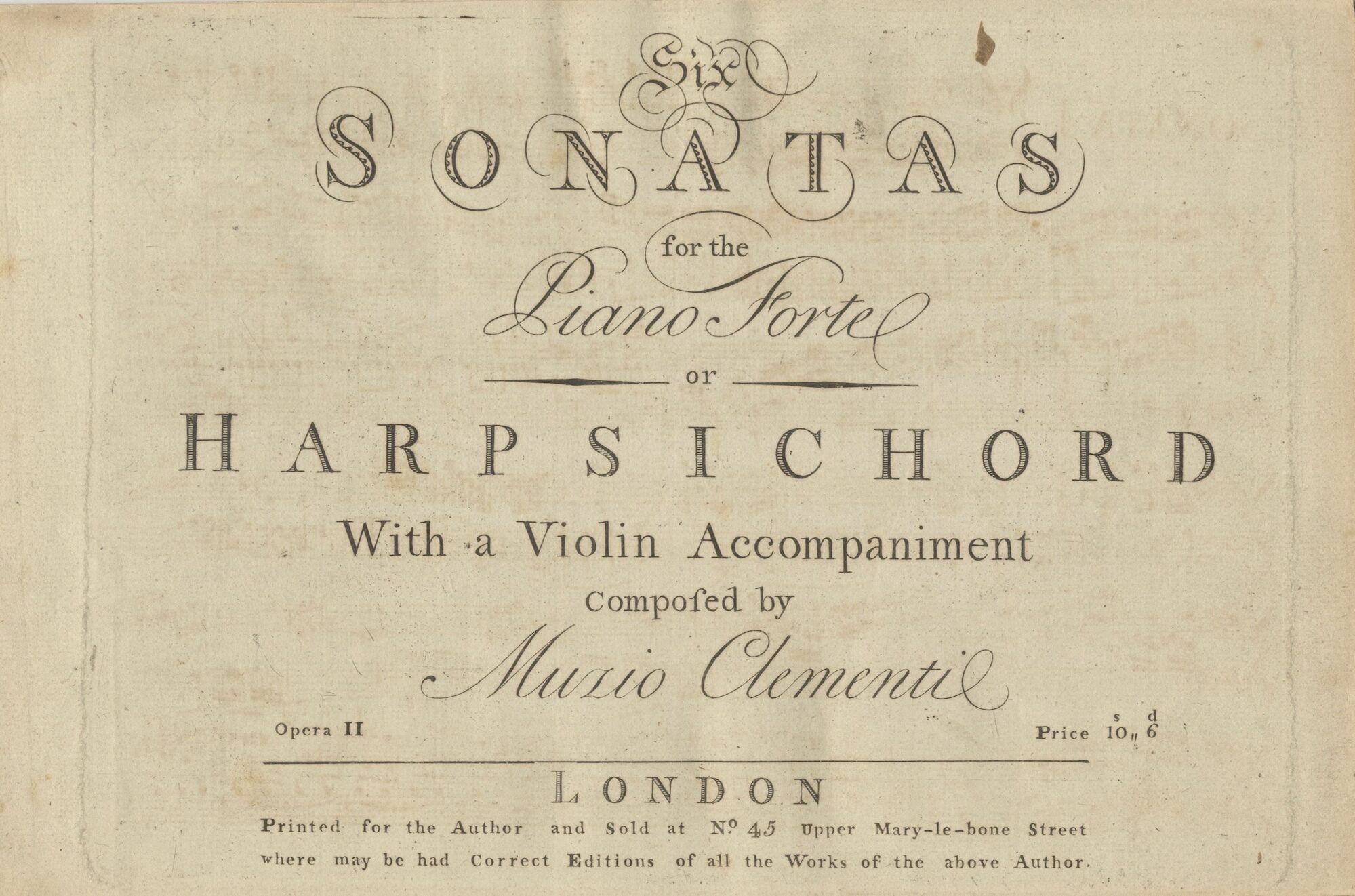
- London: Printed for the Author and Sold at No. 45 Upper Mary-le-bone Street where may be had Correct Editions of all the Works of the ab, 1792
London: Printed for the Author and Sold at No. 45 Upper Mary-le-bone Street where may be had Correct Editions of all the Works of the above Author, 1792. Oblong folio. Disbound. [i] (title), 2-33, [i] (blank) pp. Engraved throughout.
Some leaves closely trimmed at lower margin; title partially detached. Revised version. Tyson (b), p. 37. BUC p. 198. RISM C2727 (piano part only) and CC2727 (with violin part).
"Although Op. 2 is described on its original title-page as 'six sonatas for the piano forte or harpsichord with an accompanyment for a German flute or violin,' the 2nd, 4th and 6th are in fact for keyboard instrument alone, and it is these which gave the opus its astonishing reputation: no. 2 in C (the 'celebrated octave lesson'), no. 4 in A and no. 6 in B flat. Several revised versions of these sonatas were published by Clementi. In later editions Clementi's "Op. 2" was often represented only by the three unaccompanied sonatas - a fact that has led to some confusion in their numbering. It is a sign of the reputation which these sonatas enjoyed on the continent as well as in England that they were selected by J. G. Nägeli in 1803 to form the "première suite" of his Répertoire des Clavecinistes, intended as a library of forceful piano-writing." Tyson: Muzio Clementi Thematic Catalogue, p. 14.
Clementi was an English composer, keyboard player and virtuoso, teacher, music publisher, entrepreneur, and piano manufacturer of Italian birth. "[His] influence on following generations of pianists and piano composers is hard to overestimate. Beethoven's earlier keyboard writing seems unmistakably indebted to his music of the 1780s and 1790s. Clementi was the principal teacher of several leading pianists of the 1820s and 1830s, and he had more informal contacts with many others during their formative years, for example Herz, Meyerbeer, Dussek, and perhaps Hummel. His didactic works, especially the Introduction to the Art of Playing on the Piano Forte, the op.36 sonatinas, and the Gradus ad Parnassum, became staples in the education of pianists at all levels. Thus in several ways he impressed his stamp on piano playing and writing from about 1790 until far into the 19th century. And increasing numbers of modern editions and recordings of his works made 20th-century musicians and audiences aware once more of his virtues as a composer." Leon Plantinga, revised by Luca Lévi Sala in Grove Music Online.
Some leaves closely trimmed at lower margin; title partially detached. Revised version. Tyson (b), p. 37. BUC p. 198. RISM C2727 (piano part only) and CC2727 (with violin part).
"Although Op. 2 is described on its original title-page as 'six sonatas for the piano forte or harpsichord with an accompanyment for a German flute or violin,' the 2nd, 4th and 6th are in fact for keyboard instrument alone, and it is these which gave the opus its astonishing reputation: no. 2 in C (the 'celebrated octave lesson'), no. 4 in A and no. 6 in B flat. Several revised versions of these sonatas were published by Clementi. In later editions Clementi's "Op. 2" was often represented only by the three unaccompanied sonatas - a fact that has led to some confusion in their numbering. It is a sign of the reputation which these sonatas enjoyed on the continent as well as in England that they were selected by J. G. Nägeli in 1803 to form the "première suite" of his Répertoire des Clavecinistes, intended as a library of forceful piano-writing." Tyson: Muzio Clementi Thematic Catalogue, p. 14.
Clementi was an English composer, keyboard player and virtuoso, teacher, music publisher, entrepreneur, and piano manufacturer of Italian birth. "[His] influence on following generations of pianists and piano composers is hard to overestimate. Beethoven's earlier keyboard writing seems unmistakably indebted to his music of the 1780s and 1790s. Clementi was the principal teacher of several leading pianists of the 1820s and 1830s, and he had more informal contacts with many others during their formative years, for example Herz, Meyerbeer, Dussek, and perhaps Hummel. His didactic works, especially the Introduction to the Art of Playing on the Piano Forte, the op.36 sonatinas, and the Gradus ad Parnassum, became staples in the education of pianists at all levels. Thus in several ways he impressed his stamp on piano playing and writing from about 1790 until far into the 19th century. And increasing numbers of modern editions and recordings of his works made 20th-century musicians and audiences aware once more of his virtues as a composer." Leon Plantinga, revised by Luca Lévi Sala in Grove Music Online.
Details
Title
Six Sonatas for the Piano Forte or Harpsichord With a Violin Accompaniment ... Opera II. Price 10s „6d. [Piano part only]
Author
CLEMENTI, Muzio 1752-1832
Condition
Unknown
Publisher
Printed for the Author and Sold at No. 45 Upper Mary-le-bone Street where may be had Correct Editions of all the Works of the ab: London
Date
1792