

A favorite Duett for two Performers on One Piano Forte or Harpsichord ... op 6. Price 2s. 6d. [Piano-four hands]
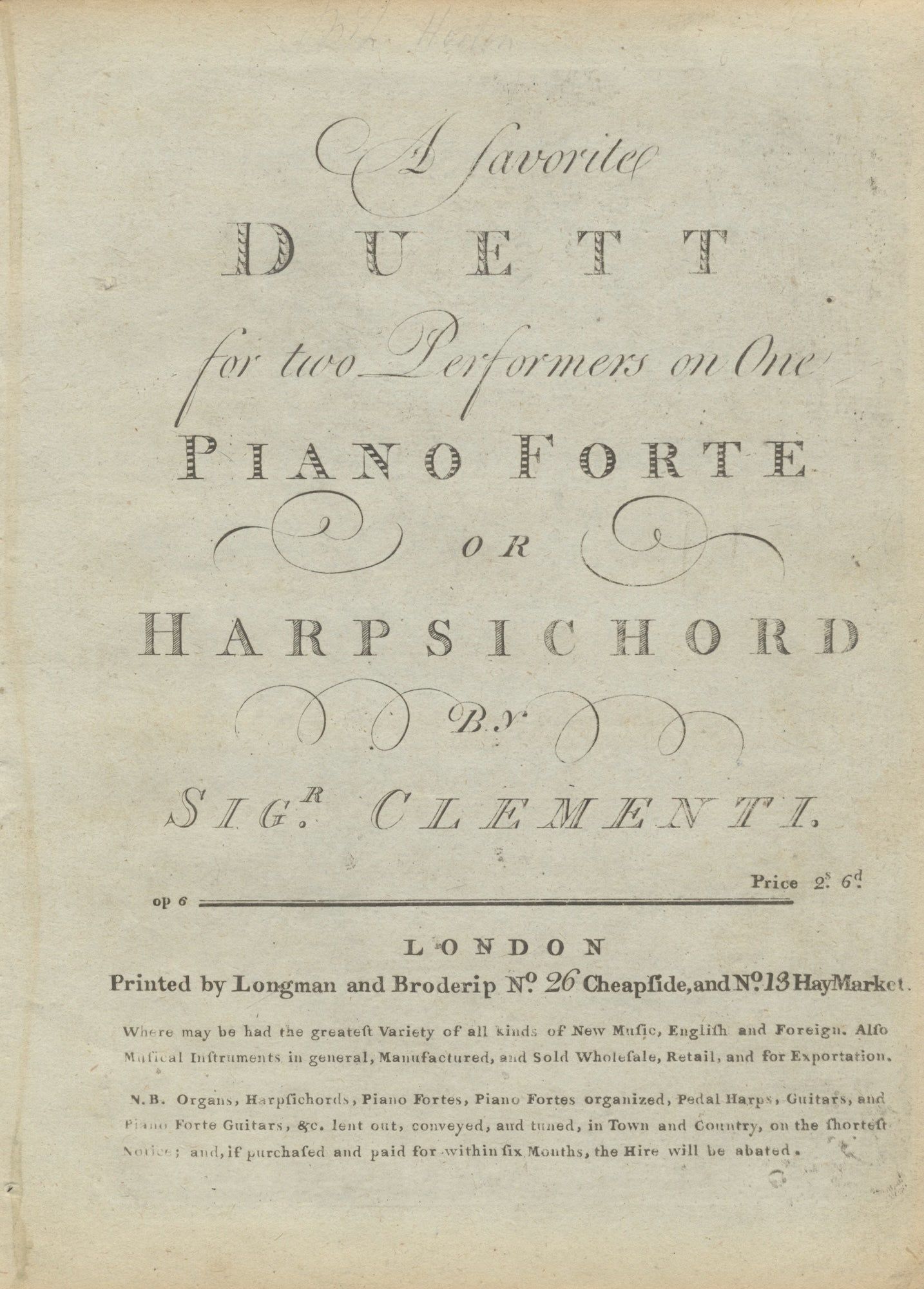
- London: Longman and Broderip No. 26 Cheapside, and No. 13 HayMarket, 1795
London: Longman and Broderip No. 26 Cheapside, and No. 13 HayMarket, 1795. Folio. Disbound. 1f. (recto title, verso blank), 13, [i] (blank) pp. Engraved throughout.
Slightly worn; small hole to blank inner margin of title; partially detached. Not in Tyson. BUC p. 198. RISM C2768 (two copies only in the U.S., at the Boston Public Library and the Library of Congress).
Here published singly, the piano four-hand duet originally served as the opening piece of the first edition of Op. 6 (Bailleux, ca. 1780-1781), followed by two keyboard-violin sonatas, and three keyboard fugues (Tyson p. 41).
Clementi was an English composer, keyboard player and virtuoso, teacher, music publisher, entrepreneur, and piano manufacturer of Italian birth. ["His] influence on following generations of pianists and piano composers is hard to overestimate. Beethoven's earlier keyboard writing seems unmistakably indebted to his music of the 1780s and 1790s. Clementi was the principal teacher of several leading pianists of the 1820s and 1830s, and he had more informal contacts with many others during their formative years, for example Herz, Meyerbeer, Dussek, and perhaps Hummel. His didactic works, especially the Introduction to the Art of Playing on the Piano Forte, the op.36 sonatinas, and the Gradus ad Parnassum, became staples in the education of pianists at all levels. Thus in several ways he impressed his stamp on piano playing and writing from about 1790 until far into the 19th century. And increasing numbers of modern editions and recordings of his works made 20th-century musicians and audiences aware once more of his virtues as a composer." Leon Plantinga, revised by Luca Lévi Sala in Grove Music Online.
Slightly worn; small hole to blank inner margin of title; partially detached. Not in Tyson. BUC p. 198. RISM C2768 (two copies only in the U.S., at the Boston Public Library and the Library of Congress).
Here published singly, the piano four-hand duet originally served as the opening piece of the first edition of Op. 6 (Bailleux, ca. 1780-1781), followed by two keyboard-violin sonatas, and three keyboard fugues (Tyson p. 41).
Clementi was an English composer, keyboard player and virtuoso, teacher, music publisher, entrepreneur, and piano manufacturer of Italian birth. ["His] influence on following generations of pianists and piano composers is hard to overestimate. Beethoven's earlier keyboard writing seems unmistakably indebted to his music of the 1780s and 1790s. Clementi was the principal teacher of several leading pianists of the 1820s and 1830s, and he had more informal contacts with many others during their formative years, for example Herz, Meyerbeer, Dussek, and perhaps Hummel. His didactic works, especially the Introduction to the Art of Playing on the Piano Forte, the op.36 sonatinas, and the Gradus ad Parnassum, became staples in the education of pianists at all levels. Thus in several ways he impressed his stamp on piano playing and writing from about 1790 until far into the 19th century. And increasing numbers of modern editions and recordings of his works made 20th-century musicians and audiences aware once more of his virtues as a composer." Leon Plantinga, revised by Luca Lévi Sala in Grove Music Online.
Details
Title
A favorite Duett for two Performers on One Piano Forte or Harpsichord ... op 6. Price 2s. 6d. [Piano-four hands]
Author
CLEMENTI, Muzio 1752-1832
Condition
Unknown
Publisher
Longman and Broderip No. 26 Cheapside, and No. 13 HayMarket: London
Date
1795