

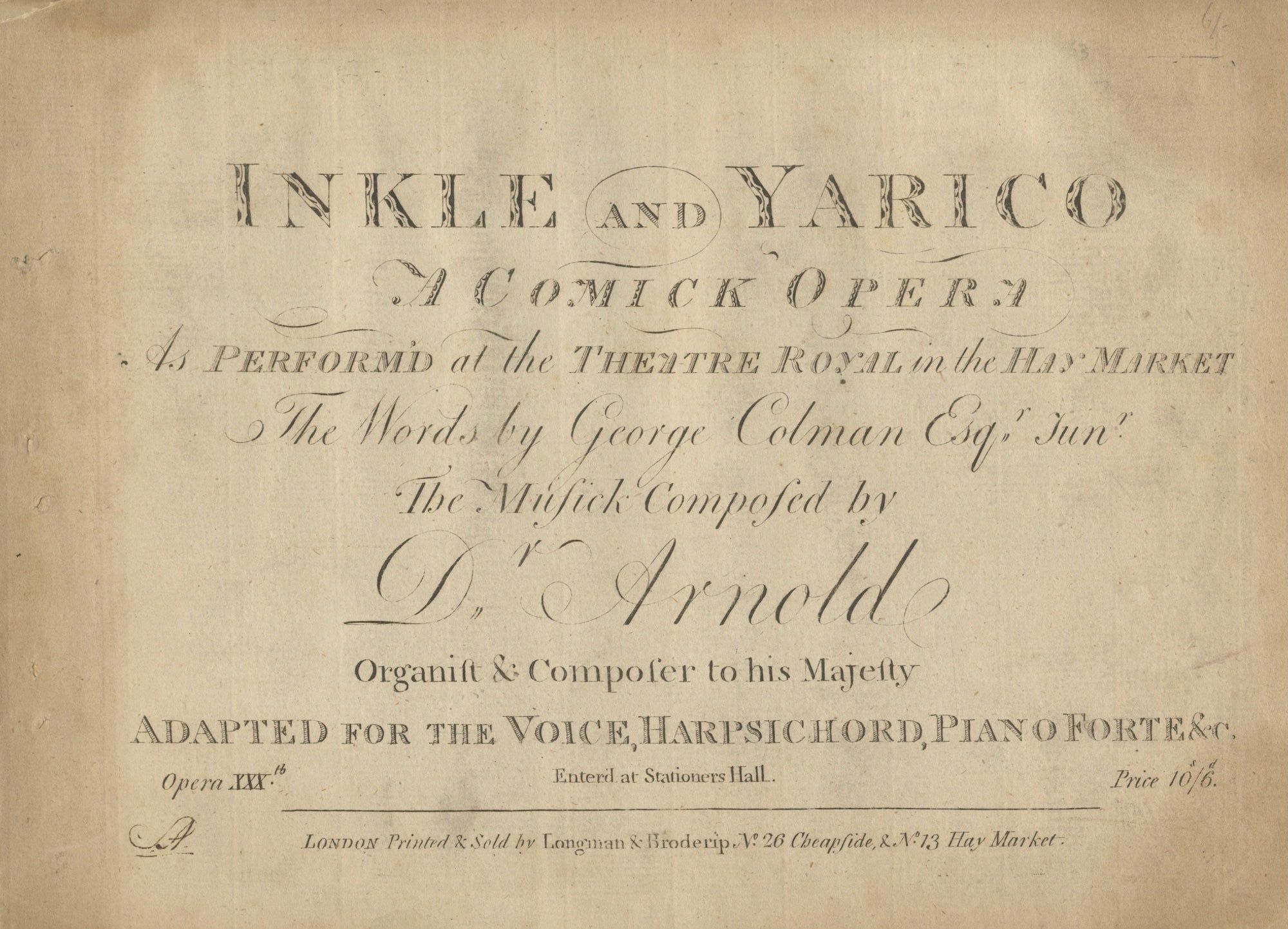
Inkle and Yarico. A Comick Opera As Perform'd at the Theatre Royal in the Hay Market The Words by George Colman Esqr. Junr. ... Adapted for the Voice, Harpsichord, Piano Forte &c. Opera XXXth. ... Price 10s/6d. [Piano-vocal score]
- SIGNED
- London: Printed & Sold Longman & Broderip No. 26 Cheapside, & No. 13 Hay Market, 1787
London: Printed & Sold Longman & Broderip No. 26 Cheapside, & No. 13 Hay Market, 1787. Oblong folio. Disbound. 1f. (recto title, verso blank), [i] (index), 2-45, [i] (blank) pp. Engraved throughout.
Overture arranged for keyboard. Scored primarily for voice and figured bass with occasionally fleshed-out keyboard
textures and a violin part or parts notated on one staff above the voice.
With Arnold's autograph initials to lower inner corner of title.
Provenance
Noted American harpsichordist Louis Bagger (1926-2024).
Occasional soiling, foxing, and small stains; small binder's holes to blank inner margins; blank lower edge of title slightly chipped. First Edition. BUC p. 52. RISM A2261.
Inkle and Yarico was first performed in London at Covent Garden on 4 August 1787. One of Arnold's most successful operas, its plot centers on the story of the kindness shown to a white man by a black woman and his subsequent decision to sell her into slavery. The opera was particularly topical as the issue of slavery was under discussion in the British Parliament at the time.
"In Ligon's True Exact History of the Island of Barbadoes (1673) there is a story, presumably true and exact, of a beautiful naked Indian girl called Yarico who is got with child and has her baby by the side of a pond. Three hours later, carrying the baby in her arms, she meets a young English merchant running away from some Indian warriors. She hides him in a cave, feeds him, and falls in love with him. When it is safe, he takes her back to his ship and, instead of rewarding her, sells her into slavery. Steele repeated this shocking story in The Spectator (No. 11; 13.3.11), invented the name of Thomas Inkle for the young trader, and made him the baby's father. He only discovers she is with child when he is about to sell her. 'He made use of that Information, to rise in his Demands upon the Purchaser.' Steele rather oddly thought the story 'a Counterpart to the Ephesian Matron' of Petronius, and was moved to tears by the gross ingratitude shown in both stories. We have found several plays and operas that pointed the moral superiority of the savage over the educated European, most notably Polly, but Inkle and Yarico was much the most successful, partly because it was better written, and partly because slavery had suddenly become a national problem. It was well known that during the previous winter two go-ahead young politicians, William Pitt and William Wilberforce, had been having frequent discussions as to how the Slave Trade might be abolished, and those who found it financially rewarding began to prepare their defence. Wilberforce was to have introduced the necessary Bill, but in the spring of 1787 he became seriously ill, and as a stop-gap device Pitt successfully carried a resolution on 9 May that the House should commit itself to a full discussion of slavery early in the next session. The ethics of slavery thus began to be widely debated, and as a result Colman wrote Inkle and Yarico. It was one of our first problem plays." Fiske: English Theatre Music in the Eighteenth Century Second Edition, p. 477.
Arnold, an English composer, conductor, organist, and editor, was "the son of Thomas Arnold, a commoner, and, according to some sources, the Princess Amelia (she was certainly his patron). Arnold received his education as a Child of the Chapel Royal (December 1, 1748 to August 31, 1758), where he was occasionally noticed by Handel (something he 'remember'd with delight & spoke of with a starting tear'), and on leaving became known as an organist, conductor, and teacher, and composed prolifically. In autumn 1764 he was engaged by John Beard as harpsichordist and composer to Covent Garden; there he compiled several pastiche operas, including the popular The Maid of the Mill (1765), which is among the supreme examples of the form. ... Statistics show that Arnold's more successful operas, such as The Agreeable Surprise (1781) and Inkle and Yarico (1787), an early anti-slavery opera, were among the most frequently performed of all operas of the time." Robert Hoskins in Grove Music Online.
Overture arranged for keyboard. Scored primarily for voice and figured bass with occasionally fleshed-out keyboard
textures and a violin part or parts notated on one staff above the voice.
With Arnold's autograph initials to lower inner corner of title.
Provenance
Noted American harpsichordist Louis Bagger (1926-2024).
Occasional soiling, foxing, and small stains; small binder's holes to blank inner margins; blank lower edge of title slightly chipped. First Edition. BUC p. 52. RISM A2261.
Inkle and Yarico was first performed in London at Covent Garden on 4 August 1787. One of Arnold's most successful operas, its plot centers on the story of the kindness shown to a white man by a black woman and his subsequent decision to sell her into slavery. The opera was particularly topical as the issue of slavery was under discussion in the British Parliament at the time.
"In Ligon's True Exact History of the Island of Barbadoes (1673) there is a story, presumably true and exact, of a beautiful naked Indian girl called Yarico who is got with child and has her baby by the side of a pond. Three hours later, carrying the baby in her arms, she meets a young English merchant running away from some Indian warriors. She hides him in a cave, feeds him, and falls in love with him. When it is safe, he takes her back to his ship and, instead of rewarding her, sells her into slavery. Steele repeated this shocking story in The Spectator (No. 11; 13.3.11), invented the name of Thomas Inkle for the young trader, and made him the baby's father. He only discovers she is with child when he is about to sell her. 'He made use of that Information, to rise in his Demands upon the Purchaser.' Steele rather oddly thought the story 'a Counterpart to the Ephesian Matron' of Petronius, and was moved to tears by the gross ingratitude shown in both stories. We have found several plays and operas that pointed the moral superiority of the savage over the educated European, most notably Polly, but Inkle and Yarico was much the most successful, partly because it was better written, and partly because slavery had suddenly become a national problem. It was well known that during the previous winter two go-ahead young politicians, William Pitt and William Wilberforce, had been having frequent discussions as to how the Slave Trade might be abolished, and those who found it financially rewarding began to prepare their defence. Wilberforce was to have introduced the necessary Bill, but in the spring of 1787 he became seriously ill, and as a stop-gap device Pitt successfully carried a resolution on 9 May that the House should commit itself to a full discussion of slavery early in the next session. The ethics of slavery thus began to be widely debated, and as a result Colman wrote Inkle and Yarico. It was one of our first problem plays." Fiske: English Theatre Music in the Eighteenth Century Second Edition, p. 477.
Arnold, an English composer, conductor, organist, and editor, was "the son of Thomas Arnold, a commoner, and, according to some sources, the Princess Amelia (she was certainly his patron). Arnold received his education as a Child of the Chapel Royal (December 1, 1748 to August 31, 1758), where he was occasionally noticed by Handel (something he 'remember'd with delight & spoke of with a starting tear'), and on leaving became known as an organist, conductor, and teacher, and composed prolifically. In autumn 1764 he was engaged by John Beard as harpsichordist and composer to Covent Garden; there he compiled several pastiche operas, including the popular The Maid of the Mill (1765), which is among the supreme examples of the form. ... Statistics show that Arnold's more successful operas, such as The Agreeable Surprise (1781) and Inkle and Yarico (1787), an early anti-slavery opera, were among the most frequently performed of all operas of the time." Robert Hoskins in Grove Music Online.
Details
Title
Inkle and Yarico. A Comick Opera As Perform'd at the Theatre Royal in the Hay Market The Words by George Colman Esqr. Junr. ... Adapted for the Voice, Harpsichord, Piano Forte &c. Opera XXXth. ... Price 10s/6d. [Piano-vocal score]
Author
ARNOLD, Samuel 1740-1802
Condition
Unknown
Publisher
Printed & Sold Longman & Broderip No. 26 Cheapside, & No. 13 Hay Market: London
Date
1787